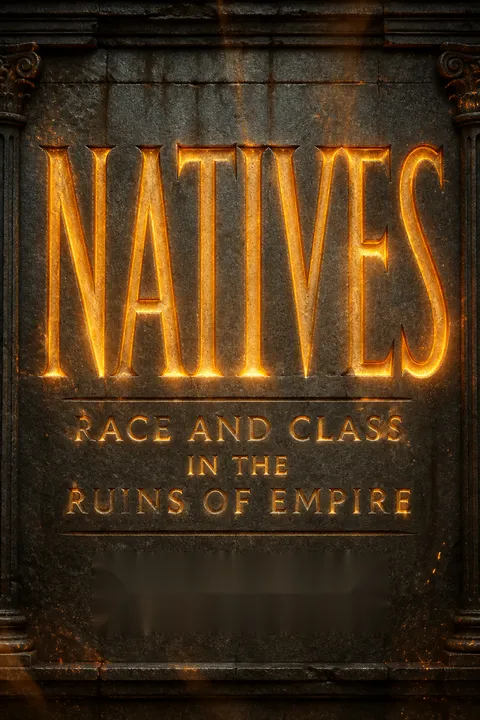

Key Takeaways
1. Race and Class: A Personal Awakening in 1980s Britain
I was born poor and racialised as black – despite my ‘white’ mother – in perhaps the most tumultuous decade of Britain’s domestic racial history.
A crucible of identity. Born in the 1980s to a British-Caribbean father and a Scottish/English mother, my upbringing was a stark lesson in race and class. Growing up in a single-parent, working-class family in Camden, London—a "petri dish" of 130 languages and vast wealth disparities—I witnessed my first stabbing at twelve and was first searched by police the same year. This environment, typical for peers who met early deaths or prison, forced me to confront the irrational manifestations of prejudice.
Imperial echoes. My parents' meeting itself was a confluence of imperial histories: my father, a British-born child of Windrush migrants, and my mother, an army child born in Germany, disowned by her father for being with a 'nig nog'. This personal narrative is interwoven with macroeconomic shifts, slave revolts, and decolonisation. The 1980s, a decade of Thatcherite-Reaganite ascendancy, saw the rollback of the welfare state and a surge in racial tensions.
A decade of unrest. For black Britain, the 1980s began with the New Cross fire/massacre, a suspected racist arson attack that killed thirteen black youths, largely ignored by the prime minister. This tragedy, coupled with the racialised British Nationality Act, ignited widespread uprisings across the country, from Brixton to Handsworth. These "disturbances" were direct reactions to state violence, racism, poverty, and class conflict, shaping a generation's understanding of their place in Britain.
2. The Denial of Racism: A Very British Brand
in a racially structured polity, the only people who can find it psychologically possible to deny the centrality of race are those who are racially privileged, for whom race is invisible precisely because the world is structured around them, whiteness as the ground against which the figures of other races – those who, unlike us, are raced – appear.
Polite denial. Discussions about race in the UK are often characterized by a "Very British Brand of Racism": polite denial, quiet amusement, or outright outrage at the suggestion that Britain isn't a total meritocracy. This phenomenon of "self-induced stupidity" is particularly pronounced when confronting Britain's racist history and present reality.
Common deflections. Typical counter-arguments used to silence discussions on race include:
- "If we just stop talking about it, it will go away."
- "Stop playing the race card."
- "Why can't you just get over it? It's all in the past."
- "You have a chip on your shoulder."
- "Why don't you just go back to where you came from?"
- "I don't see colour."
- "It's not about race."
Maintaining privilege. These non-arguments serve to avoid uncomfortable conversations and maintain the existing power structures. They imply that racism is a personal failing rather than a systemic issue, and that those who experience it are either oversensitive or ungrateful. This denial allows the racially privileged to remain oblivious to the structures that benefit them, making race invisible precisely because the world is structured around their whiteness.
3. The Education System's Hidden Biases: The "Special Needs" Trap
It was now clear to us all that whatever abuses I had had to deal with from this woman were entirely a result of her discomfort at having to teach little brown children, particularly those with a little too much brains and a little too much to say for themselves.
Early suppression. From my first year in primary school, I encountered bullying not from peers, but from teachers who were irritated by my self-confidence and intelligence. One teacher created a "magic button" to silence me, while another sarcastically wished I was "still in Jamaica." This culminated in my placement in a "special needs" group, despite being English-born and reading above my age level, without my parents' knowledge.
Systemic discrimination. My mother's discovery of this led to a confrontation where the teacher, flustered, blurted out that she "admitted to tapping him, but it’s not because he is brown." This revealed a deeper discomfort with teaching "little brown children." Decades of studies confirm this systemic bias:
- Black Caribbean pupils are three times more likely to be excluded than white pupils, even when controlling for factors like free school meals or special educational needs.
- Teachers consistently underestimate black pupils' academic ability, assessing them significantly lower than their blind test results.
- Black students are less likely to be entered for higher-tier exams, limiting their potential for top GCSE grades.
Beyond the classroom. This institutional racism, documented by reports like Bernard Coard's "How the West Indian Child is Made Educationally Subnormal," creates an environment where black children are constantly battling against low expectations. While my family's politicized support and pan-African Saturday school helped me navigate these challenges, many black children are unfairly marked down, their talents overlooked, and their dreams derailed by a system that often fails to see their potential.
4. The Dehumanization of Black Excellence: "Linford's Lunchbox"
The question is, would Linford’s penis ever have become a story if he had not won?
Racialized achievement. In 1992, Linford Christie's Olympic gold medal in the 100-meter sprint was a moment of pride for black Britain, yet the tabloid press quickly shifted focus from his athletic achievement to "Linford's Lunchbox"—a euphemism for his penis. This objectification, occurring at the peak of his career, highlighted how black excellence in sport is often racialized, echoing old stereotypes of "brawn over brains."
Contradictory narratives. The media's obsession with Linford's physique, and the subsequent public debate, revealed a deep-seated discomfort with black men dominating "masculine" sporting tests. This contrasts sharply with the unconditional love shown to Frank Bruno, who, despite his achievements, was often seen by black communities as an "Uncle Tom" for his deference to white expectations and his refusal to boycott apartheid South Africa. Bruno's post-fight breakdown, repeatedly asserting "I'm not an Uncle Tom," went largely uncommented on by a mainstream media lacking the vocabulary to address such racial complexities.
Explaining black success. Even in 2012, the BBC aired a film before the Olympic 200-meter final, linking black athletic performance to slavery, asking if white athletes were "institutionally programmed" to think they couldn't compete. This "slave-sprint" theory, despite its obvious logical flaws and lack of scientific basis, exemplifies the need to "explain" black excellence in ways that reinforce racial stereotypes rather than acknowledging hard work, cultural factors, and superior training. It's an insult that ignores the real institutional legacies of slavery while giving prime-time coverage to nebulous links.
5. Empire's Distorted Memory: Abolition Myths and Hidden Crimes
By what force of magic could an educated adult be compelled to believe that one man, all by himself, could put an end to a few centuries of tri-continental multi-million-pound business enterprise – and genocide – by the sheer force of his moral convictions?
The Wilberforce myth. My primary school teacher, like generations of Brits, taught me that William Wilberforce single-handedly "stopped slavery." This fairy tale ignores the complex reality:
- Britain was not the first to abolish slavery; Denmark and France preceded it.
- Britain actively fought to re-enslave people in French Caribbean islands and tried to crush the Haitian Revolution.
- The British government compensated slave owners, not the enslaved, upon abolition.
- Major slave rebellions in the British Caribbean (e.g., Jamaica's Baptist War) were crucial in forcing abolition.
Hidden histories. The British Empire's legacy is marred by selective amnesia. "Operation Legacy" involved the systematic destruction or hiding of documents detailing colonial crimes, making an accurate history impossible. This propaganda, from education to media, fosters a national pride in empire while ignoring atrocities like:
- The deliberate starvation of millions in India.
- The imprisonment and mass torture of British-Kenyans in concentration camps.
- The forced removal of the population of Diego Garcia for a US army base.
A convenient narrative. The "Africans sold their own people" cliché, often used to deflect British culpability, oversimplifies complex pre-colonial African societies and ignores the extensive resistance to enslavement. This selective memory allows Britain to avoid critical self-reflection, maintaining a narrative of moral superiority while ignoring the brutal realities of its imperial past and its continued impact on global relations.
6. Policing Black Bodies: A Legacy of Criminalization
In the inner cities of the UK, teenage boys racialised as black are instead introduced to the fact that the protection of the law does not apply to our bodies.
Early criminalization. My first police search at twelve, without an adult or rights read, was a stark introduction to the reality that the law's protection did not apply to my black body. Frequent stop-and-searches, even when on my way to elite maths classes, reinforced the perception of black youth as inherently criminal. This experience is common for working-class black males in London, where the state's violence is an inescapable part of adolescence.
Systemic bias. Police interactions often reveal deep-seated racial assumptions:
- Officers expressing disbelief that a black man driving a nice car could be a doctor.
- The "black-on-black violence" narrative, despite class being a far greater factor in crime and the historical prevalence of white youth gangs in the UK.
- The violent arrest of black men for selling books in Brixton, framed as a matter of "space" and "belonging" in a gentrifying area.
A tool of social control. Racialized stop-and-search is not primarily about fighting crime, but about social engineering—conditioning black boys and men to understand their subordinate place in British society. This legacy stems from more brutal policing tactics of the past, like the notorious Special Patrol Group. Despite official admissions of past racism, current policing strategies, like calls for "tougher sentences" for "teenage thugs" (often racialized as black), echo old patterns, ignoring evidence that such approaches are ineffective and exacerbate problems.
7. Mandela, Castro, and the Hypocrisy of Western Morality
The hypocritical worship of black freedom fighters once they are no longer seen to pose a danger or are safely dead – Martin Luther King might be the best example of this – is one of the keys ways of maintaining a liberal veneer over what in reality is brutal intent.
Selective admiration. Nelson Mandela, once labeled a "terrorist" by Margaret Thatcher, became a global saint after his release, praised by Western leaders who had previously supported apartheid. This belated admiration contrasts sharply with the demonization of Fidel Castro, whom Mandela called "my brother" and "my president." This dichotomy exposes a Western morality that embraces black freedom fighters only when they no longer challenge established class hierarchies.
Cuba's decisive role. Cuba, the only non-African nation to send troops to fight the apartheid regime, provided crucial military and medical aid to the ANC. Mandela himself acknowledged Cuba's "unparalleled" contribution to African liberation. Yet, Western media largely ignores this, preferring to label Castro a "dictator" while overlooking Cuba's impressive human rights record:
- Murder rate four times lower than Latin American average.
- Universal access to healthcare and education.
- Extensive medical internationalism, sending healthcare workers to dozens of countries, often in crisis zones.
Ideological blindness. The stark difference in how Mandela and Castro are remembered reveals an ideological bias. Western governments and media often prioritize anti-communist narratives over genuine human rights concerns, supporting brutal regimes when it serves their interests. This selective memory allows them to avoid critical analysis of their own historical complicity in injustice and the true outcomes of political processes.
8. The Global Shift: Decline of Whiteness, End of Capitalism?
The twenty-first century could well turn out to be a shit century in which to be a bigot clinging to old assumptions of gender, race and the eternal supremacy of a particular culture or geographic region, or alternatively old hierarchies might well continue to reassert themselves.
A changing world order. The 21st century marks a significant shift from unipolar Western dominance, with the rise of Asian powers like China and India. China's rapid industrialization, poverty reduction, and technological advancements, achieved without invading half the planet, challenge the notion of inherent Western superiority. This "pivot to Asia" by the US signals a reordering of global power, which will inevitably reshape questions of race and class.
Crisis of whiteness. Whiteness, historically a metaphor for power, is facing a crisis as its default status erodes. This is reflected in phenomena like Trump's election and Brexit, which, despite claims of economic anxiety, were largely driven by racial anxieties and a fear of "white decline." The idea of "white genocide," a laughable notion given the historical context, highlights the warped worldview of white nationalists clinging to a supremacist identity.
The future of identity. The "mixing of the races" and changing demographics, particularly in cities like London, consistently undermine interpersonal racism, despite the fears of bigots. However, the reassertion of old hierarchies through new forms of bigotry (e.g., anti-Muslim sentiment) remains a threat. The future will be determined by whether societies choose to confront difficult issues, embrace diversity, and work towards a more just order, or succumb to the "pangs" of a declining, imagined past.
Review Summary
Natives by Akala receives overwhelmingly positive reviews, praised for its powerful exploration of racism, class, and British imperialism through personal memoir and historical analysis. Readers commend Akala's intelligence, research depth, and accessible writing style that challenges comfortable assumptions about British history. The book examines systemic racism in education, policing, and institutions while debunking myths about slavery abolition and empire. Some critics find it repetitive or politically biased, questioning his terminology and left-wing viewpoints. Most reviewers recommend it as essential reading for understanding modern Britain's racial dynamics and post-colonial legacy.
People Also Read
Download PDF
Download EPUB
.epub digital book format is ideal for reading ebooks on phones, tablets, and e-readers.








































