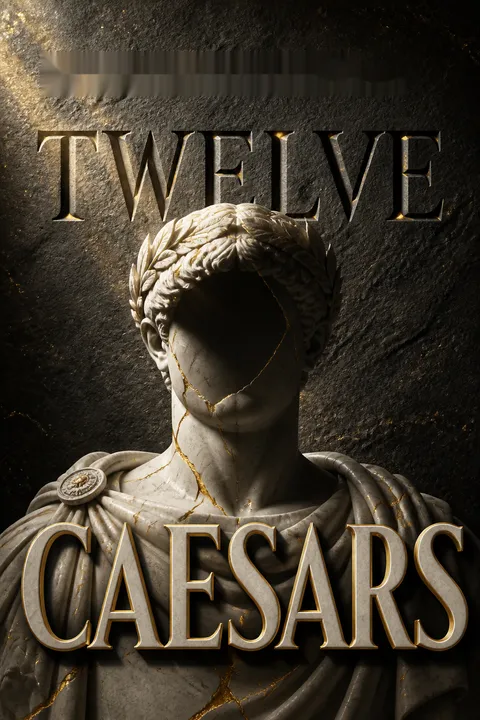

Key Takeaways
1. Roman Emperors: An Enduring Global Presence
We are still surrounded by Roman emperors.
Ubiquitous imagery. Roman emperors, particularly figures like Julius Caesar and Nero, continue to permeate Western culture, appearing in diverse forms from museum artifacts to modern media. Their faces are instantly recognizable, often requiring only a few symbolic elements like a laurel wreath or toga to evoke their identity. This enduring presence highlights their deep integration into our collective consciousness, far beyond academic circles.
Cultural shorthand. These imperial figures serve as powerful cultural shorthand, allowing satirists to transform modern politicians into "Nero fiddling while Rome burns" with immediate understanding. Their influence extends across centuries and continents, resonating in ways that other historical rulers often do not. This widespread recognition underscores their lasting impact on art, politics, and popular imagination.
Diverse manifestations. The sheer variety of their representations, from ancient pastry moulds to contemporary chocolate coins, demonstrates their pervasive cultural footprint.
- Ancient forms: Marble busts, colossal bronzes, exquisite cameos, wall paintings, and miniature coin heads.
- Modern forms: Tapestries, silver and ceramic pieces, waxworks, pub signs, beer labels, and even boxer shorts.
This constant re-creation, often with knowing self-irony, ensures their continued relevance and visibility in daily life.
2. Imperial Images: A History of Misidentification and Fluidity
The mistaken identity at the heart of the story of the sarcophagus of ‘Alexander’ is historically significant in its own right (without it, after all, there is no story).
Persistent misidentification. The identification of Roman imperial portraits has always been fraught with uncertainty, leading to a rich history of mistaken identities that are often as significant as the correct ones. From ancient times to the present, sculptures have been re-carved, re-identified, or simply mislabeled, creating a complex web of attribution. This fluidity means that many influential "emperors" in art history are, in fact, "emperors" in quotation marks.
Blurred lines of authenticity. The boundary between ancient and modern is particularly porous in Roman portraiture, making it challenging to definitively date many pieces. Sculptural techniques and materials remained largely consistent for centuries, allowing for seamless integration of later additions or outright forgeries. This ambiguity means that some pieces oscillate between being classified as ancient, modern pastiches, or even fakes, defying conclusive categorization.
The "Getty Commodus" case. A striking example is the bust of Emperor Commodus in the Getty Museum, which has been variously dated to the second, sixteenth, or eighteenth century.
- Initial classification: Sixteenth-century Italian imitation.
- Later reclassifications: Eighteenth-century piece, or radically, an original second-century CE portrait.
- Current consensus: Leans towards ancient Roman, based on microscopic evidence like mineral deposits.
This ongoing debate highlights the subjective nature of art historical identification and the enduring puzzles surrounding imperial images.
3. Suetonius: The Architect of the "Twelve Caesars" Canon
It was, in fact, the popularity of this series of imperial biographies that gave the Twelve Caesars their canonical place in later history and launched the fashion for their re-creation in those canonical line-ups of modern busts and paintings.
Canonical framework. Gaius Suetonius Tranquillus, a second-century CE biographer, inadvertently shaped the modern perception of Roman emperors by compiling his "Lives of the Twelve Caesars." This collection, spanning from Julius Caesar to Domitian, became a foundational text for understanding early imperial rule and established the definitive roster of these iconic figures. His work provided the literary blueprint for countless artistic interpretations.
Renaissance rediscovery. Suetonius's biographies experienced immense popularity during the Renaissance, with numerous manuscript copies and printed editions circulating across Europe. This widespread readership fueled a demand for visual representations of "his" emperors, leading to the creation of the first chronological "runs" of imperial portraits in art. Artists and patrons sought to visualize the vivid characters and anecdotes described in his text.
Source of inspiration. Beyond defining the canonical twelve, Suetonius's detailed physical descriptions and lurid anecdotes provided rich material for artists.
- Physical traits: Caesar's baldness, Tiberius's antics, Nero's lust for his mother.
- Key events: Claudius cowering behind a curtain, Nero fiddling while Rome burns, Domitian torturing flies.
These stories, whether historical fact or palace gossip, became inextricably linked to the emperors' visual identities, inspiring centuries of artistic re-creation and shaping our enduring view of Roman power.
4. Coins: The Renaissance's Window to Imperial Faces
For hundreds of years, coins and their heads played a bigger role in how emperors were imagined than any of those precise, or dodgy, comparisons of neck wrinkles and Adam’s apples might suggest.
Ubiquitous and authentic. Roman imperial coins were, for centuries, the most accessible and authentic visual records of emperors, especially outside southern Europe. Unlike scarce marble sculptures, coins were found in abundance wherever Romans had been, making them a primary source for artists and scholars seeking to reconstruct imperial likenesses. Their small scale and widespread availability made them invaluable.
Historical veracity. Renaissance humanists and antiquarians regarded coins as more reliable historical evidence than written texts, believing they offered a direct, unmediated glimpse into the past. As one scholar noted, coins provided "a history that keeps silent and displays the truth whereas words… say whatever they please." This trust in numismatic evidence elevated coins to a central role in historical and artistic reconstruction.
Artistic template. Coins served as a crucial artistic template for depicting emperors in various media, influencing the development of modern portraiture.
- Manuscript illustrations: Early Suetonius manuscripts featured coin-like profiles.
- Prints and engravings: Marcantonio Raimondi's luxury series of Caesars mimicked coin designs.
- Architectural decoration: Mantegna's ceiling in Mantua and the facade of La Certosa in Pavia incorporated coin-like roundels.
This "numismatic idiom" lent authority and authenticity to portraits of both ancient rulers and contemporary figures, establishing a visual language that persisted for centuries.
5. The "Twelve Caesars": A Flexible and Contested Category
What we call ‘the Twelve Caesars’ are often not quite that at all.
Beyond the canonical list. Despite the enduring influence of Suetonius, the "Twelve Caesars" was never a rigidly fixed category in artistic representation. From its earliest modern iterations, artists and patrons frequently adapted, expanded, or truncated the list, demonstrating a dynamic engagement with the concept rather than strict adherence to the literary canon. This flexibility allowed for diverse interpretations and political messaging.
Substitutions and omissions. Early sets of imperial portraits often included figures outside Suetonius's list or omitted some of his canonical twelve.
- Fifteenth-century sculptures: Included Agrippa, Hadrian, and Antoninus Pius alongside traditional Caesars, replacing others like Caligula or Vitellius.
- Raimondi's prints: Substituted Trajan for Caligula, reflecting a moral agenda to include "good" emperors.
These variations highlight a desire to shape the imperial narrative, sometimes to present more virtuous role models or to reflect contemporary political ideals.
"Works in progress." Collections of Caesars were rarely acquired as complete, immutable sets; rather, they evolved over time through piecemeal acquisition, accidental loss, and deliberate rearrangement. The Aldobrandini Tazze, for instance, despite their systematic design, suffered from figures being screwed onto the wrong bowls, creating a "mongrel" collection. This fluidity underscores that the "Twelve Caesars" was often a living, changing entity, reflecting the vagaries of collecting and the passage of time.
6. Imperial Portraits: Tools of Power, Propaganda, and Satire
Throughout their history, images of ancient emperors—like some of those of more recent soldiers and politicians—have raised more awkward and more loaded questions.
Legitimizing modern power. From the Renaissance onwards, modern rulers and aristocrats frequently adopted the guise of Roman emperors in their portraits, using classical imagery to legitimize their own authority and connect themselves to a prestigious past. This "all'antica" style, whether in toga-clad statues or breastplated paintings, served as a powerful visual rhetoric of power, even if it sometimes risked accusations of autocracy.
The "Andrew Jackson dilemma." The adoption of imperial imagery by modern leaders often sparked controversy, particularly in republican contexts. Andrew Jackson famously refused burial in a sarcophagus believed to be for an emperor, declaring, "my republican feelings and principles forbid it." This highlights the inherent tension between republican ideals and the autocratic connotations of Roman imperial symbols, forcing a reckoning with the political implications of such artistic choices.
Satire and subversion. Beyond overt legitimation, imperial images were also potent tools for satire and critique, exposing the vices and follies of both ancient and modern rulers.
- Verrio's "King's Staircase": Depicted emperors as laughable failures, based on Julian the Apostate's satire, in a royal palace.
- Rubens's caricatures: Showed a thuggish Vespasian and a fly-stabbing Domitian, revealing a humorous, irreverent side to imperial power.
These subversive interpretations demonstrate that Roman emperors were not always revered figures but could be used to question authority and reflect on the darker aspects of leadership.
7. The Interplay of Ancient and Modern Interpretations
For better or worse, most modern viewers have some template of the most famous imperial figures in their minds before ever casting an eye directly on any Roman sculpture, cameo or coin.
Mutual influence. The relationship between ancient imperial images and their modern re-creations is a complex, two-way street. Modern artists draw inspiration from ancient prototypes, but contemporary cultural templates, often formed through popular media like cartoons or films, also shape how we perceive and identify ancient Roman art. This feedback loop means our understanding of antiquity is constantly mediated by modern lenses.
Anachronic art. Many imperial images defy straightforward chronological classification, existing as "anachronic" works that blend elements from different eras. Sculptures might be ancient heads on modern busts, or modern creations deliberately mimicking ancient styles. This temporal fluidity challenges rigid historical categorization, inviting viewers to consider the continuous dialogue between past and present in art.
Lost meanings and new contexts. As imperial images traveled across centuries and continents, their original meanings often shifted or were lost, only to gain new interpretations in different contexts.
- Titian's Caesars: Originally part of a complex dynastic display in Mantua, they were later dispersed, becoming standalone portraits in royal collections and eventually mass-produced prints.
- Oxford's "emperors": Anonymous stone figures outside the Sheldonian Theatre, likely intended as "worthies," were re-identified by Max Beerbohm as "Roman emperors," acquiring a new literary and cultural significance.
These transformations highlight how art's meaning is not fixed but evolves with its audience and environment.
8. Women of the Imperial Court: Power, Stereotypes, and Representation
What this means is that the accusation of gross sexual immorality often thrown at the women of the imperial family may reflect what they got up to, but not necessarily (most people at the time had no more reliable information on Messalina’s sex life than we do).
Power of proximity. Women in the Roman imperial family, despite lacking formal political roles, were perceived as wielding significant influence due to their proximity to the emperor. This "power of proximity" made them convenient scapegoats for unexplained imperial decisions and fueled rumors of their ambition and treachery. Their perceived influence was often exaggerated in ancient literature, reflecting anxieties about hidden power dynamics within the palace.
Dynastic anxieties. The crucial role of imperial women in producing legitimate heirs led to sharply contrasting stereotypes in ancient literature: the virtuous, child-bearing matriarch versus the sexually immoral, poisoning villainess. These stereotypes reflected deep-seated anxieties about female sexuality and its potential to disrupt the orderly transmission of power, especially in an era where paternity was always uncertain.
Homogeneity in official art. In contrast to the vivid literary stereotypes, official Roman art often depicted imperial women with a bland homogeneity, emphasizing their role as generic symbols of dynastic continuity rather than individual agents.
- Similar features: Hairstyles were often the only distinguishing feature, making it hard to differentiate between women like Livia, Agrippina the Elder, and Agrippina the Younger.
- Goddess-like portrayal: Women were frequently depicted in the guise of goddesses like Ceres or Vesta, effacing their mortal agency and transferring their power to the divine realm.
This artistic strategy aimed to mitigate the perceived risks of female prominence by presenting them as idealized, interchangeable figures.
9. Assassination: A Recurring Theme Reflecting Imperial Vulnerability
In a history of the Twelve Caesars, of whom only one (Vespasian) died without any allegations at all of foul play, it was also an integral part of imperial succession and even the imperial system itself.
Inherent fragility. Assassination was not merely an occasional event but an intrinsic, almost defining, feature of Roman imperial rule, with only one of Suetonius's Twelve Caesars escaping allegations of foul play. This pervasive violence underscored the inherent fragility of autocratic power and the constant threat faced by rulers, making succession a perpetual moment of crisis and anxiety.
Artistic exploration of vulnerability. Modern artists, particularly in the nineteenth century, frequently depicted imperial assassinations to critically examine the nature of the imperial system. These scenes moved beyond mere gore to explore the political implications of murder, the vulnerability of the ruler, and the true locus of power.
Key assassination scenes:
- Gérôme's "Death of Caesar": Focused on the aftermath, with Caesar's body almost an afterthought, highlighting the swift shift of power to the assassins.
- Laurens's "Death of Tiberius": Depicted the emperor's suffocation by his successor's henchman, emphasizing the domestic setting of imperial power struggles.
- Alma-Tadema's "A Roman Emperor, AD 41": Showed Claudius's undignified accession after Caligula's murder, with a blood-stained statue of Augustus hinting at the violence underlying the entire imperial regime.
These works used imperial deaths as a diagnostic tool to critique the foundations of autocracy and expose its inherent lawlessness.
10. The "Work in Progress" Nature of Imperial Art Collections
For all my talk about the continuing importance of the Roman imperial legacy, you could hardly find a better example of its fall from grandeur to banality or oblivion.
Dynamic evolution. Imperial art collections, whether grand palace displays or humble domestic sets, were rarely static. They were constantly evolving entities, shaped by acquisition, dispersal, reinterpretation, and even accidental damage. This "work in progress" nature meant that the composition and meaning of these collections were always in flux, reflecting changing tastes, political climates, and scholarly understanding.
Dispersal and reassembly. Many significant collections, like Titian's Caesars or Henry VIII's tapestries, were eventually broken up and scattered across Europe, only to be partially reassembled or reinterpreted in new contexts. The Aldobrandini Tazze, for instance, were separated and recombined, with emperors often ending up on the "wrong" bowls, illustrating the practical challenges and historical ironies of maintaining such sets.
From grandeur to oblivion. The ultimate fate of many imperial images, from their initial prestige to eventual neglect or destruction, highlights the transient nature of artistic value and historical memory. Henry VIII's costly Caesar tapestries, once admired, were likely discarded as "drab and undistinguished" in the nineteenth century. The sarcophagus of "Alexander Severus," once a symbol of imperial ambition, now rests in a Smithsonian storage depot, surrounded by "detritus of modern technology," a poignant symbol of the legacy's fall from grandeur.
Review Summary
Twelve Caesars receives mixed reviews (3.68/5) with readers divided on its focus. Many expected a biography of Roman emperors but found an academic art history book instead, examining how the Caesars were depicted in Western art from the Renaissance onward. Common criticisms include dense, dry writing and excessive detail about art attribution and provenance. However, enthusiasts praise Beard's meticulous research, engaging style, and the book's beautiful illustrations. Several reviewers note it's better suited for academics than general readers, though those interested in art history and classical reception found it fascinating and brilliantly executed.
People Also Read
About the Author
Other books by Mary Beard
Download PDF
Download EPUB
.epub digital book format is ideal for reading ebooks on phones, tablets, and e-readers.








































