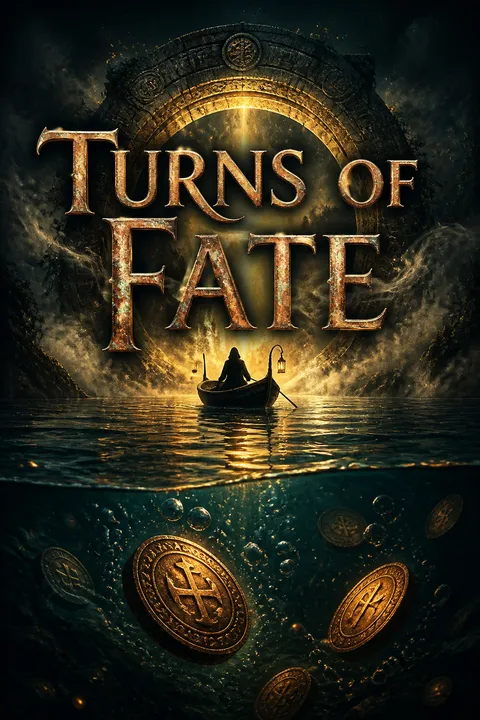

Plot Summary
Coins for the Ferryman
Detective Beth Fahey, new to Penwych's special investigations team, is sent to the Isle of Wyrd to investigate a bizarre shooting involving a "ghost gun." Her captain, Charles Forrester, warns her of the island's dangers and the Arcana, supernatural beings who rule Wyrd. Beth's journey across the Fate River is both literal and symbolic—a crossing into the unknown, where payment is always required and bargains are binding. Her first encounter with Lucas Frost, Wyrd's Sorcerer King, and the enigmatic Ladies Three, sets the tone: on Wyrd, words and intentions have power, and every transaction has a price. Beth's successful navigation of her first case marks her as different, both to her colleagues and to the Arcana.
Bargains and Boundaries
Beth learns that the Arcana's bargains are ironclad but often misunderstood by outsiders. The ghost gun's price—years of life for each bullet—shocks her, and she witnesses how fate and choice intertwine on Wyrd. The Arcana's morality is alien: they are honest but not compassionate by human standards. Beth's ability to see and accept the strange earns her both trust and suspicion. Meanwhile, the boundaries between Wyrd and the human world are reinforced: after dark, the island becomes perilous, and even the police are warned not to linger. The chapter establishes the central tension—how humans and the uncanny coexist, and the costs of crossing boundaries, literal and metaphorical.
The Ghost Gun's Price
Beth's investigation into the ghost gun reveals the Arcana's transactional justice. The man who used the gun loses seventy years of his life, and the intended victims survive because "it wasn't their time." The Arcana's system is both fair and terrifying, indifferent to human expectations. Beth's willingness to pay the price for answers—three favors owed—cements her as a player in Wyrd's ongoing drama. The ghost gun becomes a symbol of how Wyrd enforces consequences, and Beth's handling of it marks her as someone the Arcana watch closely. The chapter explores the theme of unintended consequences and the weight of choices.
Moon Gates and Warnings
The moon gates, mystical portals scattered across Wyrd, are revealed as both transportation and transformation devices. When a group of teenage bullies, Dare's Doggs, recklessly use a moon gate, one is transformed into a "rat-faced chicken" and killed by a harpy, while others vanish or are lost. The Arcana's warnings about intention and fate are ignored, with tragic results. Beth and her team are left to pick up the pieces, realizing that Wyrd's rules are unforgiving. The moon gates symbolize the peril of careless desire and the unpredictability of the uncanny. Beth's empathy for the victims and her growing understanding of Wyrd's logic deepen her connection to the island.
Rachel's Desperate Escape
Rachel Nightingale, a novelist trapped in an abusive relationship, flees to Wyrd seeking sanctuary. Her journey is fraught with fear and uncertainty, but the Arcana recognize her desperation and offer her a chance to change her fate—at a steep price. Rachel's transformation into a lark, a literal and metaphorical rebirth, is orchestrated by the Arcana as both protection and punishment. Her story parallels Beth's, highlighting themes of agency, survival, and the cost of freedom. Rachel's willingness to pay with flesh and identity underscores the Arcana's transactional worldview and the transformative power of Wyrd.
Transformation's Cost
Rachel's transformation is both physical and existential. The Arcana orchestrate an elaborate scheme to erase her from her old life, using doppelgängers and supernatural means to thwart her abuser. The process is painful and requires Rachel to relinquish her assets, her body, and her past. The Arcana's methods are efficient but chilling, emphasizing that safety and new beginnings come at a cost. Rachel's year as a lark is a period of healing and self-discovery, but also of isolation and longing. The chapter explores the limits of transformation and the enduring scars of trauma.
The Fate of Bullies
The aftermath of the moon gate incident is grim: some bullies are killed, others are lost in Wyrd's labyrinthine neighborhoods, and one is doomed to ride a ghost bus as a spectral passenger. The Arcana enforce their justice without pity, and the human world struggles to comprehend the disappearances and deaths. Beth's team is left to manage the fallout, facing public outrage and personal guilt. The chapter examines the ripple effects of violence and the impossibility of returning to innocence once the uncanny has been unleashed. The fate of the bullies serves as a cautionary tale about the dangers of hubris and the limits of human control.
The Arcana's Interest
Beth's repeated success in navigating Wyrd's mysteries draws the Arcana's attention. It is revealed that she is part Arcana, descended from a branch that has long watched over her. This heritage explains her affinity for the uncanny and her ability to survive Wyrd's challenges. The Arcana debate her fate, recognizing her as both a bridge and a potential threat. Beth's growing sense of belonging on Wyrd is contrasted with her alienation from her human colleagues, who begin to suspect her loyalties. The chapter delves into themes of identity, legacy, and the tension between destiny and choice.
Disappearances and Destinies
A series of disappearances—some accidental, some intentional—highlight the dangers of Wyrd's neighborhoods and the seductive pull of the strange. Some who cross the river seeking adventure or escape are lost forever, while others find sanctuary or new purpose. Beth and Jack Frost undertake a perilous search for missing people, navigating shifting geographies and time zones. The journey tests Beth's resolve and reveals the limits of even Arcana power. The chapter underscores the unpredictability of fate and the necessity of accepting loss as part of the bargain with the uncanny.
The Teeth and the Lark
Rachel, now Rahele Larke, is given a home in the Teeth, a neighborhood for those who need to disappear. Beth, now working for the Arcana, helps her settle in and reconnect with Faulkner, another transformed soul. The Teeth symbolize both refuge and exile, a place where the past can be left behind but never entirely forgotten. Beth's role as a bridge between worlds is solidified, and the community of the uncanny is shown to be both nurturing and insular. The chapter explores themes of healing, adaptation, and the creation of chosen family.
Bonnie's Betrayal
Bonnie Wilson, Beth's former guardian, betrays her by revealing her Arcana heritage to the public, sparking a witch hunt and forcing Beth to flee Penwych. Bonnie's actions are motivated by greed and resentment, but she ultimately pays a fatal price, hunted down by supernatural debt collectors. The chapter examines the corrosive effects of secrets, the dangers of scapegoating, and the inevitability of retribution in a world governed by supernatural justice. Beth's forced exile marks the end of her old life and the beginning of her true integration into Wyrd.
The Price of Secrets
Beth's transition from detective to Arcana security officer is fraught with loss and uncertainty. She must abandon her human life, her career, and her connections, but gains a new sense of purpose and community. The Arcana's acceptance is conditional, and Beth must continually prove her loyalty and competence. The chapter explores the tension between secrecy and revelation, the pain of leaving behind what is familiar, and the hope of finding a place where one's true self is valued. Beth's journey is emblematic of the sacrifices required to belong in a world that fears difference.
The Ghost Ships Return
The ghost ships—the Bonnie Lass and the Last Breath—reappear, carrying souls who have made bargains with the Arcana or are trapped by unfinished business. These spectral vessels serve as both warning and opportunity, offering passage to those who need to disappear or atone. The stories of Alan Naylor, Patrick Russell, and others intertwine, illustrating the Arcana's role as facilitators of fate and the thin line between life and death. The ghost ships are a powerful metaphor for the persistence of the past and the possibility of redemption, but also for the inescapability of consequences.
The Summer of Reckoning
As summer ends, tensions between Wyrd and the human towns reach a boiling point. The deaths of the bullies, the exposure of Beth's heritage, and the mysterious disappearances fuel anti-Arcana sentiment and calls for retribution. The Arcana respond with both indifference and subtle retaliation, enforcing new rules and boundaries. Beth and Colin Forrester, now working in Destiny Park, navigate the shifting landscape of suspicion and fear. The chapter explores the fragility of coexistence, the dangers of mob mentality, and the resilience required to survive in a world where justice is never simple.
The Fish and the King
Reginald Hampton, transformed into a fish for cheating the Ferryman, spends a year in the river before being caught and killed by his brother Alistair, who unwittingly serves him as the main course at a dinner party. The grotesque irony of the scene underscores the Arcana's philosophy: what goes around comes around. The cycle of vengeance, betrayal, and transformation is complete, and the Hamptons' downfall is both poetic and horrifying. The chapter serves as a culmination of the book's themes—fate, justice, and the inescapability of one's actions.
What Goes Around
As autumn arrives, the ferry prepares to stop running, and the boundaries between Wyrd and the human world are reinforced. The consequences of bargains made and broken play out: Yaron Kali dies, aged by his repeated trespasses; Acid, the last of the bullies, becomes a warning ghost on the spectral train; and Beth, now fully integrated into Wyrd, finds peace and purpose. The Arcana's justice is shown to be relentless but fair, and the human characters must come to terms with the limits of their power. The chapter is a meditation on closure, acceptance, and the necessity of letting go.
The End of the Ferry
With the ferry's departure, Wyrd enters its quiet season. Beth, Rahele, Colin, and the other residents settle into new roles and relationships, finding meaning in their chosen community. The Arcana's world is revealed as both perilous and nurturing, a place where fate can be shaped but never entirely controlled. The book ends on a note of hope and continuity: new beginnings are possible, but only for those willing to pay the price and embrace the unknown. The story's emotional arc comes full circle, affirming the value of courage, compassion, and the willingness to change.
Analysis
Anne Bishop's Turns of Fate is a richly layered meditation on the interplay between fate, free will, and the cost of transformation. Through the intertwined stories of Beth Fahey, Rachel Nightingale, and the denizens of Wyrd, Bishop explores the consequences of choice in a world where every desire and transgression is met with a precise, often brutal, reckoning. The Arcana's transactional justice is both alien and eerily familiar, reflecting the real-world complexities of justice, retribution, and the search for belonging. The novel's structure—braiding police procedural with mythic fantasy—allows for a nuanced exploration of trauma, agency, and the longing for sanctuary. Bishop's use of recurring motifs and symbols deepens the emotional resonance, while her unflinching portrayal of the costs of survival and change grounds the supernatural in the realities of human experience. Ultimately, Turns of Fate is a story about the necessity of embracing one's true self, the courage required to cross into the unknown, and the hope that new beginnings are possible—even when they come at a price. The book's lessons are clear: fate can be shaped, but never without sacrifice; justice is relentless, but not always merciful; and the only way forward is through honesty, empathy, and the willingness to change.
Review Summary
Characters
Beth Fahey
Beth Fahey is the protagonist whose journey from skeptical detective to Arcana security officer forms the heart of the novel. Raised by a resentful guardian after her parents' disappearance, Beth is marked by a fascination with the uncanny and a resilience forged by adversity. Her ability to see and accept Wyrd's strangeness sets her apart, both attracting the Arcana's interest and alienating her from her human colleagues. Psychoanalytically, Beth embodies the struggle for identity and belonging, torn between her human upbringing and her Arcana heritage. Her development is a gradual embrace of her true self, culminating in her acceptance of a new life on Wyrd. Her relationships—with Forrester, Jack, Lucas, and Rachel—are defined by loyalty, empathy, and a willingness to pay the price for truth and justice.
Lucas Frost
Lucas Frost is the enigmatic ruler of Wyrd, embodying the Arcana's power, detachment, and honor. He is both protector and judge, facilitating bargains and enforcing consequences with an amoral but consistent logic. Lucas's relationship with Beth is complex: he recognizes her potential as a bridge between worlds and is both mentor and gatekeeper. Psychologically, Lucas represents the archetype of the wise but dangerous ruler, whose authority is rooted in both strength and vulnerability. His interactions with his wife Justine, his brother Jack, and the other Arcana reveal a deep sense of responsibility and a willingness to adapt. Lucas's development is subtle, marked by a growing appreciation for human resilience and the necessity of change.
Jack Frost
Jack Frost, Lucas's brother, is the Arcana's enforcer and Beth's primary trainer. He is both protective and exacting, embodying the dangers and discipline required to survive Wyrd. Jack's relationship with Beth is marked by mutual respect, occasional frustration, and a shared sense of duty. He is less forgiving than Lucas, but his loyalty is unwavering. Psychologically, Jack represents the shadow side of the uncanny—ruthless, efficient, and unyielding. His development is tied to his recognition of Beth's capabilities and the necessity of letting go. Jack's role as both guide and gatekeeper is central to Beth's transformation and the maintenance of Wyrd's boundaries.
Rachel Nightingale / Rahele Larke
Rachel Nightingale's arc is one of escape, transformation, and rebirth. Fleeing an abusive relationship, she bargains with the Arcana for a new life, sacrificing her body and identity to become a lark. Her year as a bird is both healing and isolating, a period of reflection and growth. Rachel's eventual return to human form as Rahele Larke is a testament to the possibility of renewal, but also to the enduring scars of trauma. Her relationships—with Beth, Faulkner, and the Arcana—are defined by gratitude, vulnerability, and a cautious optimism. Psychologically, Rachel embodies the struggle for agency and the courage required to claim a new destiny.
Charles Forrester
Captain Charles Forrester is the leader of Penwych's special investigations team and a father struggling to balance duty and love. His ability to work with the Arcana is both a gift and a burden, and his relationship with Beth is marked by mentorship and mutual respect. Forrester's arc is defined by his efforts to protect his family—especially his son Colin—from the dangers of Wyrd, while accepting that some fates cannot be controlled. Psychologically, Forrester represents the archetype of the good man in a world where justice is never simple. His development is a gradual acceptance of the limits of human power and the necessity of trust.
Colin Forrester
Colin Forrester, Charles's son, is a symbol of innocence and adaptability. His journey through Wyrd—surviving bullies, learning from the Llamalidians, and working in Destiny Park—mirrors Beth's arc of transformation and belonging. Colin's curiosity and resilience allow him to thrive in the uncanny, and his relationships with Beth, his family, and Faulkner highlight the importance of empathy and open-mindedness. Psychologically, Colin represents the potential for growth and the hope of a new generation that can bridge the gap between worlds.
The Ladies Three (Justine, Zerah, Lysandra)
The Ladies Three are the Arcana's oracles, each embodying a different aspect of fate: cards, scales, and sketchbook. They are both terrifying and compassionate, enforcing the rules of Wyrd with impartiality. Their interactions with Beth, Rachel, and other supplicants reveal the Arcana's logic: bargains are binding, and payment is always exacted. Psychologically, they represent the inevitability of consequence and the necessity of choice. Their development is collective, adapting to the changing needs of Wyrd and the humans who seek their aid.
Jack Faulkner
Faulkner, once human and now a crow, is both comic relief and a poignant reminder of the costs of transformation. His friendship with Rachel/Rahele is a source of comfort and growth for both. Faulkner's arc is one of acceptance and adaptation, embodying the possibility of finding meaning in new forms. Psychologically, he represents the resilience of the self and the enduring need for connection.
Bonnie Wilson
Bonnie Wilson, Beth's former guardian, is the antagonist whose actions precipitate Beth's exile and the public's anti-Arcana hysteria. Motivated by greed and resentment, Bonnie's betrayal is both personal and symbolic—a warning about the dangers of secrets and the destructive power of spite. Her eventual downfall is both justice and tragedy, illustrating the Arcana's relentless enforcement of bargains and the inescapability of fate.
Yaron Kali
Yaron Kali, a professor obsessed with the uncanny, serves as a warning about the dangers of unchecked curiosity. His repeated trespasses into Wyrd result in his rapid aging and eventual death, a consequence of breaking the Arcana's rules. His arc is a meditation on addiction, the limits of human understanding, and the necessity of respecting boundaries. His fate contrasts with Beth's, highlighting the difference between respectful engagement and reckless intrusion.
Plot Devices
Bargains and Transactional Justice
The central plot device is the Arcana's system of bargains: every desire, every crossing, every act of violence or desperation requires payment—sometimes in money, sometimes in years of life, sometimes in flesh or identity. This transactional justice is enforced with supernatural precision, and attempts to cheat or evade payment result in dire consequences. The device serves to externalize the theme of fate versus free will, making the costs of choice explicit and unavoidable.
Moon Gates and Transformation
The moon gates are both literal and metaphorical plot devices, serving as portals to other places, times, and forms. They symbolize the unpredictability of the uncanny and the dangers of careless desire. The gates' one-way nature and their responsiveness to intention reinforce the book's themes of agency and consequence. Transformation—whether voluntary or accidental—is both a means of escape and a source of peril, highlighting the fluidity of identity and the risks of change.
Ghost Ships and Hauntings
The ghost ships—the Bonnie Lass and the Last Breath—are recurring motifs that embody the persistence of unfinished business and the possibility of atonement. They serve as both warning and opportunity, offering passage to those who need to disappear or atone. The ships' spectral nature and their connection to the Arcana's bargains reinforce the book's meditation on the thin line between life and death, and the enduring consequences of choice.
Narrative Structure and Multiple Perspectives
The novel employs a braided narrative structure, shifting between Beth's investigations, Rachel's transformation, the fate of the bullies, and the machinations of the Arcana. This structure allows for deep foreshadowing—early cases and warnings echo in later events, and minor characters' choices ripple outward to affect the main plot. The use of police procedural elements grounds the supernatural in the mundane, while the interludes with the Arcana and the ghost ships provide a mythic counterpoint.
Thematic Repetition and Symbolism
Motifs of crossing, payment, transformation, and return recur throughout the novel, reinforcing the central themes of fate, justice, and the cost of change. Symbols such as coins, moon gates, and the lark serve as touchstones for the characters' journeys, providing both continuity and resonance. The repetition of warnings—"words have power, intentions matter"—serves as both narrative device and thematic anchor.
About the Author
Other books by Anne Bishop
Download PDF
Download EPUB
.epub digital book format is ideal for reading ebooks on phones, tablets, and e-readers.








































