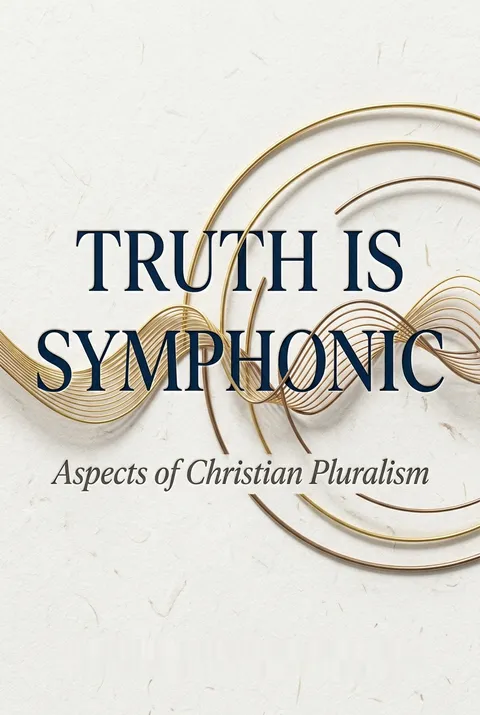

Key Takeaways
1. Truth is Symphonic: Unity in Plurality
The orchestra must be pluralist in order to unfold the wealth of the totality that resounds in the composer's mind.
Divine composition. God's revelation is like a symphony, where diverse instruments (Creation, worldviews, religions) play distinct parts, yet are integrated into a unified whole by the composer, God. Each instrument retains its unique timbre, contributing to a richness that a single sound cannot achieve.
Transcendent unity. The world's inherent pluralism, far from being chaotic, is designed to align with a transcendent unity found only in God. Just as an orchestra tunes up for a common endeavor, diverse elements find their meaning and integration when they "sound together" in allegiance to this divine unity.
Beyond unison. True unity is not a forced unison but a symphony, where differences are preserved and celebrated. This divine symphony reveals why each part exists, transforming initial strangeness and contradiction into a harmonious, integrated whole, far more beautiful than mere sameness.
2. God's Sovereign Word: Free and Unpredictable
The God who is always making all things new is at the same time the God of faithfulness, who remains true to himself and thus also true to Israel.
Absolute freedom. God's truth is not a system or a thing, but "The One," infinitely free and self-determining. His words are determinate yet unpredictable, revealing a sovereign freedom that cannot be reduced to human formulas or anticipated by logic.
Paradoxical dealings. God's actions, though never contradictory, often appear so to human reason, like his wrath turning to mercy or his anointing a king only to reject him. This pluralism of divine dealings testifies to his absolute self-determination, defying human attempts to grasp a single principle.
Love as principle. The sole hermeneutical principle for understanding God's multifaceted word is love. This free self-communication demands pure receptivity, a "making room" for God's initiative, rather than trying to overpower or manipulate his revealed secret with theological rationalism.
3. Jesus Christ: The Embodied Paradox of Truth
The "I" of Jesus Christ is the measure of God’s distance from and nearness to man, that unimaginable nearness of him who is, and remains, even more unimaginably sublime above everything in the world.
Incarnate Word. Jesus Christ is God's free, sovereign Word embodied in a human life, uniting divine glory with human experience. This makes everything infinitely more complex, as the focus of inaccessible light penetrates human existence without ceasing to be divine.
Uncontainable mystery. The mystery of Christ's "I" cannot be encapsulated in concepts or formulas, as it bridges the absolute and the relative. His deeds and words radiate from this center, revealing a greater kinship between opposites like sovereignty and servanthood, power and defenselessness.
Living source. Christ is an ever-flowing source, continually breaking up human attempts to materialize or systematize divine truth. His words are "spirit and life," written on the heart, always pointing beyond the letter to the embodied reality of God's Spirit.
4. The Church: Christ's Body, Transparent Yet Paradoxical
The Church is the place he himself has chosen, the place where he wishes to be present and accessible.
Christ's presence. The Church is not a mere institution but Christ's chosen place of presence, the fulfillment of God's Incarnation in the community of believers. It is his body, meant to be transparent, allowing Christ to shine through its two-thousand-year history.
Suffering and triumph. Like Christ, the Church's "organs" (office, sacraments, preaching) must share in his heightened paradox, dying and descending into the concealing opposite to rise again. It is strong when weak, triumphing as a spiritual power even when oppressed or threatened.
Catholic unity. The Church's ambition to embrace the world's unity is obedience to Christ, not arrogance. It is called to gather the world under Christ's headship, offering a model of unity that the world strives for but cannot find on its own.
5. Maximality of Love: The Criterion for Christian Truth
For the encounter to take place, the expression must cause the act of God’s love for us to appear more divine, more radical, more complete and at the same time more unimaginable and improbable.
Divine extravagance. The criterion for theological pluralism is the "maximality" of God's love, as encountered in Jesus Christ's divinely willed poverty and humiliation. Any explanation that makes the mystery rationally clear, diminishing God's distinct divinity, risks heresy.
Childlike acceptance. This maximal love demands total acceptance, like a child, rather than rational domestication. It is not about believing propositions alone, but about God entering our nature through Christ's life, death, and Resurrection, made alive by the Holy Spirit within us.
Dogma's purpose. Dogma defines the maximum extent of God's love, serving as a signpost:
- Warning against deflecting from the mystery.
- Encouraging deeper engagement with God's love.
- Uniting seemingly irreconcilable truths.
It points to the inexhaustible mystery of God as triune love.
6. Total Identification: Faith in Christ and His Church
So it is impossible to identify oneself totally with Christ and only partially with the Church.
Unqualified surrender. Christian faith demands total, unqualified surrender to Christ's love, which is beyond human knowledge. Partial identification or faith with reservations is self-contradictory, as Christ and his body, the Church, are one.
Ideal in the real. One cannot appeal to an ideal Church against the empirical Church's inadequacies. The ideal is found in the real, requiring believers to bring their objections into this identification and work for amelioration from within, through love.
Sacramental priority. The Church's sacramental framework ensures that reception precedes response, guaranteeing Christ's presence and the priority of the Church over the individual believer. This structure, including office, is pure service, designed to keep direct access to salvation open.
7. Believing and Doing: An Inseparable Dynamic
This is the work of God, that you believe in him whom he has sent.
Circular relationship. Believing (orthodoxy) and doing (orthopraxy) form a continuous circle, each proceeding from and returning to the other. God does not recognize faith without works, nor does genuine action exist without belief.
Inner dimension. "Continuing in the word" is an inner dimension of faith, not mere external activity. It's a dynamic, living response to God's grace, where love naturally flows from faith, and action proves the sincerity of belief.
God's orthopraxy. Ultimately, human orthopraxy penetrates to the core of orthodoxy, where man's faith becomes an affirmation of and participation in God's own "praxis." This "abiding" in God's love is the spur and principle for all right action, preventing compulsive, hurried undertakings.
8. Jesus' Absences: Revealing God's Transcendent Presence
Again, I am leaving the world and going to the Father.
Presence through absence. Jesus' life is marked by deliberate withdrawals and departures, revealing God's transcendence even as he becomes immanent. His "going to the Father" is the means by which he returns in a pneumatic, non-sensible presence, as in the Eucharist.
School of faith. These absences, from his unrecognized presence to his definitive Ascension, train the disciples in a faith that transcends sensory experience. The "little while" of his visible presence gives way to a deeper, spiritual presence that demands belief without seeing.
Hierarchy of closeness. Jesus' selective manifestations (e.g., Transfiguration, Gethsemane) establish a "hierarchy of absences" in the Church. Accepting the Lord's offered mode of nearness, even if it means distance, is crucial for participating in his saving absence.
9. Office and Existence: Inseparable in Christian Leadership
All the chief actors in Old and New Testament history are characterized by a unity of their mission and their life.
Total commitment. From Moses to Paul, God grants significant office only when the office-bearer commits their whole life to the mission. This expropriates the individual for service to God's people, demanding unlimited obedience and vital communication with the divine commissioner.
Christ's model. Jesus perfectly unites office and existence, being both the Father's Word and Son, priest and victim. New Testament office, therefore, is not optional but requires total life offering, a participation in Christ's priest-victim identity, marked by suffering and humility.
Building up the community. While office-bearers are judged by God, their lives are open to the community's critical assessment, provided critics examine their own faith and stand at the center of Christian existence (the Cross). Authority's purpose is always to build up the community, not to tear down.
10. Joy and the Cross: The Consuming Paradox of Christian Life
With all our affliction, I am overjoyed.
Glad tidings. Christianity is fundamentally "glad tidings," rooted in God's "greater joy" in pardoning sin and finding the lost. This "full" eschatological joy, brought by the Holy Spirit, is a response to God's self-giving love.
Suffering's depth. Yet, this joy coexists with the absolute seriousness of Christ's Cross, his God-forsakenness. Christian suffering is not merely a function of joy but a participation in Christ's ultimate pain, where joy is withdrawn, and the disciple must plumb the depths of contradiction.
Transformative paradox. The Christian paradox is to embrace the Cross with joy, understanding suffering as an "education" for joy. This "godly grief" leads to steadfastness and hope, transforming pain into a "quasi" suffering, a "slight, momentary affliction" against the "eternal weight of glory," ultimately consuming and burning with Christ's love.
Review Summary
Readers of Truth Is Symphonic generally praise the work highly, averaging 4.41 out of 5. Reviewers highlight von Balthasar's succinct yet brilliant presentation of his theological methodology, with his hallmark aesthetic approach condensed effectively. The first section receives particular acclaim, while the second section's illustrative content is seen as supplementary. His analyses of Marxism and Buddhism stand out as thought-provoking. One reviewer evokes Augustine in comparing von Balthasar's writing to encountering a first-class thinker deeply immersed in Scripture.
Download PDF
Download EPUB
.epub digital book format is ideal for reading ebooks on phones, tablets, and e-readers.








































