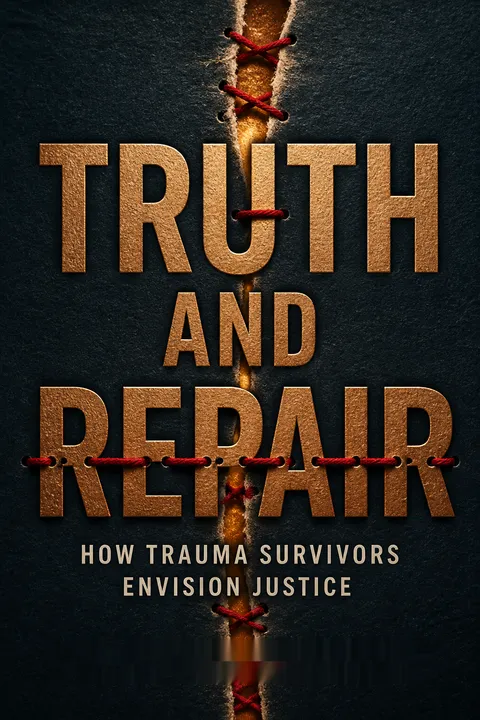

Key Takeaways
1. Justice for Trauma Survivors Demands Truth and Repair, Not Just Punishment.
If trauma originates in a fundamental injustice, then full healing must require repair through some measure of justice from the larger community.
Trauma's social roots. Trauma is not merely an individual psychological affliction but a profound social problem, deeply intertwined with issues of social justice. The violence at its core aims at domination, making empowerment a central principle of recovery. Survivors often find healing not in isolation, but within a supportive community.
Beyond individual healing. While establishing safety, grieving, and making meaning are crucial stages of recovery, the ultimate, often overlooked, stage is justice. This justice extends beyond personal healing to address the systemic injustices that enabled the trauma. Survivors seek a collective recognition of their suffering and a societal commitment to making things right.
A new vision of justice. Survivors envision a justice system that prioritizes truth and repair over mere punishment and monetary damages. They ask for their truth to be recognized, the harm repaired, and offenders held accountable in ways that foster healing for all involved. This perspective challenges conventional legal frameworks, which often marginalize victims.
2. Tyranny, Rooted in Dominance, Is the Antithesis of Justice.
Common to all three definitions is the idea of power exercised without limits.
Power without limits. Tyranny is defined by the cruel and unfair exercise of unrestrained power, where the strong dictate terms and the vulnerable submit. This dynamic is enforced through violence and the constant threat of it, often invisibly, with laws and customs supporting the dominant group. Victims under tyranny lack basic rights and recourse.
Methods of coercive control. Beyond overt violence, tyranny employs various methods to enforce obedience and break the victim's will. These include controlling bodily functions, capricious rule enforcement, and random intermittent rewards. These tactics aim to instill fear and gratitude, reducing individuals to submission and stripping them of agency.
Breaking the spirit. To achieve complete domination, tyrants also seek to break the victim's spirit through isolation, degradation, and forcing them to violate their own moral codes. These methods induce profound shame, making victims feel defiled and unworthy. Such malignant shame is a powerful tool of oppression, leaving indelible psychological wounds.
3. Patriarchy Exemplifies Pervasive Tyranny, Sustained by Impunity and Bystander Complicity.
The most widespread and enduring form of tyranny is patriarchy.
Global, enduring oppression. Patriarchy, a social system of male dominance, is a prime example of pervasive tyranny, spanning millennia and coexisting with diverse governments. It is ultimately enforced by violence, with sexual violence being a signal crime that sexualizes dominance and teaches women their subordinate place.
Crimes of impunity. Violence against women and children often operates with impunity, defended by layers of custom, secrecy, and denial. Law enforcement and justice systems frequently fail to hold perpetrators accountable, sending a message that male violence is acceptable. This institutional betrayal deepens the trauma for survivors.
Bystander complicity. The silence and inaction of bystanders—friends, family, and officials—feel like profound betrayal, isolating victims and abandoning them to their fate. This complicity, whether active or passive, perpetuates tyranny. Overcoming this requires bystanders to acknowledge their moral responsibility and act in solidarity with survivors.
4. Acknowledgment of Truth and Harm Is the Essential First Step Towards Justice.
Every survivor I interviewed for this book, and I daresay every survivor with whom I have ever worked, has wished above all for acknowledgment and vindication.
Truth-telling as resistance. Public truth-telling is the survivor's first act of resistance against the secrecy and denial that protect perpetrators. Survivors unanimously desire for their truth to be known, not just by perpetrators but also by complicit bystanders. This collective challenge to hidden truths is the moral community's first act of solidarity.
Beyond bare facts. Acknowledgment extends beyond merely admitting the facts of the crime; it demands recognition of the profound harm inflicted. Survivors reject trivialization, ridicule, or blame, seeking respect for their suffering and validation of its seriousness. They want communities to understand that sexual violence is a major public health problem, not a private misfortune.
Moral vindication. Survivors seek moral vindication, desiring that bystanders unequivocally denounce the crime and affirm that they did not deserve the abuse. This shifts the burden of shame from the victim to the perpetrator, restoring the survivor's honor and connection with the community. The existing justice system, however, often makes this vindication difficult to achieve.
5. Genuine Apology, Rooted in Remorse, Is Healing but Rarely Offered.
True apology also offers a promise, implicit or explicit, that the offender has undergone a moral awakening: that he is a changed man and will never repeat his crime.
The power of true remorse. Survivors yearn for genuine apologies where perpetrators admit their crimes, take full responsibility with remorse, recognize the suffering caused, and commit to making amends. Such apologies are personal, emotional, and can reverse the power dynamic, restoring the victim's dignity and fostering spontaneous forgiveness.
Rarity and ambivalence. Unfortunately, full and genuine apologies are rare, often replaced by denial, excuses, or blame, which compound the harm. Many survivors are ambivalent about seeking apologies, fearing manipulation or not desiring reconciliation. They distrust the sincerity of abusers, who may offer apologies as a tactic of control.
Forgiveness redefined. Forgiveness is complex; it can mean unilaterally letting go of rage for personal healing, independent of the perpetrator's remorse. However, survivors should never be pressured to forgive, especially without true repentance. Religious leaders and scholars emphasize that genuine repentance (teshuvah) must precede forgiveness, otherwise it is callous and destructive to the moral community.
6. Accountability Must Prioritize Healing and Prevention Over Pure Retribution.
Although survivors are so often stereotyped as vengeful and excessively punitive, most of those I interviewed seemed remarkably uninterested in punishment.
Beyond punishment. Many survivors are ambivalent about punishment, finding it does little to repair the harm done. They prefer rehabilitation, focusing on healing themselves and preventing future harm rather than solely on retribution. This perspective clashes with the criminal justice system, where punishment is the primary metric.
Systemic failures. The criminal justice system often alienates victims, reducing them to peripheral witnesses and subjecting them to hostile interrogation. It offers little incentive for offenders to admit guilt, instead encouraging denial and victim-blaming. This systemic failure drives survivors to seek alternatives that prioritize their well-being and offer opportunities for personal exchange and acknowledgment.
Restorative justice potential. Restorative Justice (RJ) offers an alternative vision, focusing on repairing harm through consensual processes like conferencing or peace circles. It requires offenders to acknowledge responsibility and aims for reintegrative shaming, inviting them back into the community through amends. While promising for certain crimes, RJ faces challenges with severe violence, institutional complicity, and ensuring consistent, effective outcomes.
7. Restitution Extends Beyond Money to Community-Wide Institutional and Cultural Change.
Many survivors understand that their suffering is not simply a personal misfortune but rather the result of a larger social problem.
Beyond financial compensation. While monetary damages can be symbolic and provide practical relief, many survivors prioritize community amends in the form of institutional and cultural change. They view their suffering as a symptom of larger societal problems, seeking systemic shifts rather than just individual payouts.
Progressive reparations. The Victims of Crime Act (VOCA) offers a progressive model, using fines from convicted offenders to fund a national trust for victim compensation and services. This approach allows perpetrators as a group to make amends to victims as a group, fostering community acknowledgment and repair without individual confrontation.
Healing justice in action. Restitution can manifest in diverse ways, from creating safe workplace environments through disciplinary action and education, to grassroots initiatives like "Have Justice—Will Travel" that bring legal and social services directly to victims. Innovative courts, like the Human Trafficking Intervention Court, also demonstrate how legal systems can shift from punishing victims to providing care and pathways to independence.
8. Rehabilitation of Offenders Requires Community Engagement and a Public Health Approach.
Survivors often see rehabilitation as a better form of justice than punishment.
Limited understanding. Despite survivors' preference for rehabilitation, the justice system has historically underinvested in it, leaving a significant knowledge gap. We lack comprehensive data on who perpetrators are, what drives their actions, and what truly leads to moral awakening and safe reintegration, especially for the majority who remain undetected.
Challenging conventional wisdom. The popular belief that most perpetrators were themselves abused as children is often unsubstantiated, particularly for the majority of offenders who are never caught. Many perpetrators appear "frighteningly normal" and hold misogynistic attitudes, suggesting that opportunistic offending within a permissive culture is a significant factor.
Survivor-centered models. Effective rehabilitation models, like the Duluth Model for intimate partner violence, are victim-centered, understanding violence as a choice for dominance, not anger. They require coordinated efforts from police, courts, and treatment programs, emphasizing consistent consequences and community building. Vicarious Restorative Justice (VRJ) also offers a promising avenue, allowing survivors to share their impact with groups of offenders, fostering empathy and a path to amends.
9. Prevention of Violence Demands Transforming "Rape Culture" Through Education and Bystander Action.
If the campus can be a place of danger, it can also be a place of intellectual and political awakening.
Campus as a microcosm. College campuses, despite being high-risk environments for sexual assault, offer a contained setting for prevention experiments. They can model an alternative moral community, fostering a culture of sexual mutuality and respect, and serving as a laboratory for survivors' justice.
The "tripod" of prevention. Effective campus responses require a "tripod" approach: preventive education, robust victim support, and consistent discipline for perpetrators. Education, as primary prevention, involves naming the problem, promoting sexual self-determination, and countering the eroticized misogyny of pornography.
Empowering bystanders. Bystander intervention training is crucial, engaging students to identify high-risk situations and develop the courage and skills to intervene safely. This shifts the social dynamic, making perpetrators, not victims, face social isolation and shame, and has shown promise in reducing the incidence of violence.
10. The "Longest Revolution" for Women's Liberation Requires Dismantling All Forms of Oppression.
The longest revolution, to succeed, required women’s empowerment in all four domains.
Intersectional struggle. Women's liberation, termed "the longest revolution," is a complex, ongoing struggle across four domains: production, reproduction, sex, and child-rearing. Progress in one area can be undermined by backlash in another, highlighting the need for comprehensive, intersectional approaches.
The Survivors' Agenda. Led by women of color, the Survivors' Agenda is a blueprint for this revolution, linking the fight against racism and sexual violence. It calls for reimagining community safety, creating alternatives to punitive legal systems, and centering justice on survivor healing and prevention.
A radical vision for the future. This vision challenges deeply embedded structures of oppression, advocating for a renewed moral community where everyone is respected, included, and has a voice. It demands determined community investment in public health and education to transform cultures that glorify white male supremacy and address the root causes of violence.
Review Summary
Truth and Repair receives mixed reviews (4.2/5 stars). Readers praise Herman's compassionate exploration of trauma survivors' needs for acknowledgment, accountability, and restorative justice rather than punishment. Many appreciate her critique of the criminal justice system's failure to serve survivors. However, significant criticism centers on her conflation of sex work with trafficking, support for the Nordic Model over decriminalization, and outdated second-wave feminist views. Reviewers note the book's lack of discussion about LGBTQ+ survivors and trans experiences. Despite these limitations, most find it valuable for understanding survivors' perspectives on healing and justice.
People Also Read





About the Author
Other books by Judith Lewis Herman
Download PDF
Download EPUB
.epub digital book format is ideal for reading ebooks on phones, tablets, and e-readers.








































