

Key Takeaways
Treat disruptive kids as canaries warning of a toxic classroom
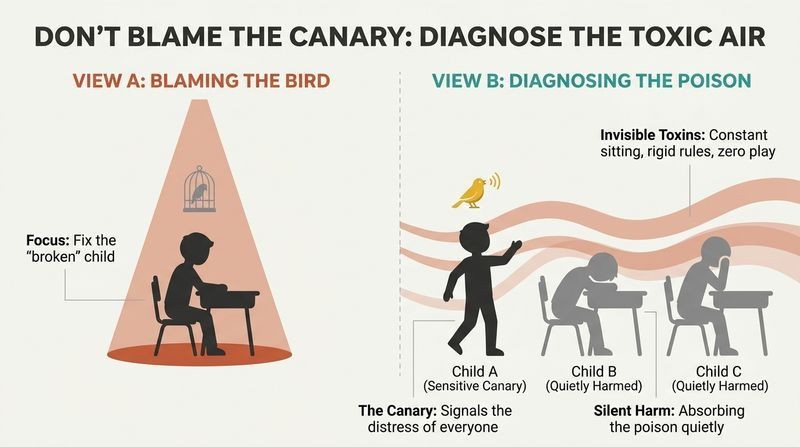
The miner's canary reframes misbehavior. Early coal miners carried caged canaries underground because the birds' sensitive lungs detected carbon monoxide before it killed the humans. When the canary collapsed, miners fled. Shalaby argues the child who acts out is the classroom's canary: more sensitive than peers to conditions that harm everyone, singing loudly to warn that something in the shared air is poisonous.
Blame the poison, not the bird. She borrowed this from Thomas, a father whose kindergartner was labeled broken while doctors searched his brain for pathology. The toxins are ordinary and invisible: being told exactly what to do all day, sitting still for hours, boring disconnected tasks, almost no free play, and few chances to build real relationships. Less sensitive children simply breathe them in.
The reframe echoes the social model of disability, which locates handicap in inaccessible environments rather than bodies. It also resonates with organizational psychology's canary literature on whistleblowers punished for surfacing dysfunction. One tension worth naming: the metaphor can understate genuine neurological difference. A child with a mood disorder is not merely reacting to a bad room. Shalaby concedes this, noting canaries have fragile lungs by nature, yet the analogy risks sliding into pure environmental determinism. The strongest version holds both truths at once: individual vulnerability and structural harm interact. Fix the air and the sensitive still breathe easier, even if they remain more sensitive than the rest.
Read misbehavior as a verb, a system, not a broken child
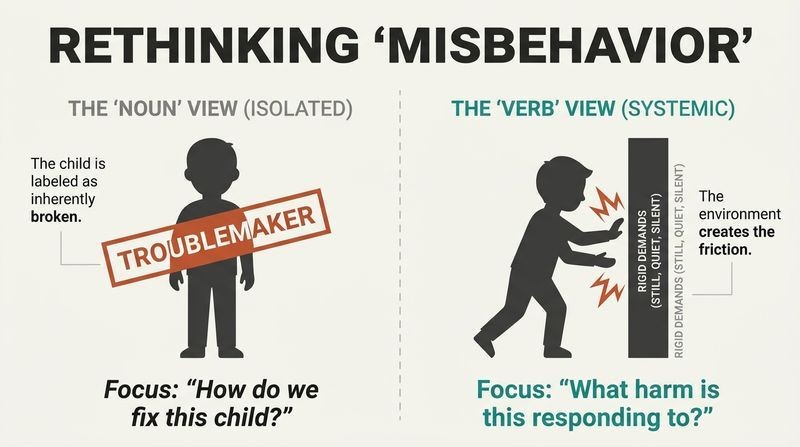
Trouble-making is something schools do, not a personality. Shalaby distinguishes troublemaker as a noun, an identity stamped on a child, from trouble-making as a verb, a process produced when a particular child meets a particular school's rules. The same behavior flagged as pathological in one classroom goes unnoticed in another. A problem child is not objectively problematic; the label emerges from interaction.
Schools engender, exclude, then erase trouble. They engender it by rewarding a narrow good student (quiet, still, compliant, deferential to adult power). They exclude the children who resist through time-outs, hallway banishment, and the principal's office. Then they try to erase it by making these kids invisible through redirection and medication. The question shifts from How do we fix him? to What harm is this behavior responding to?
This is Foucault translated for first grade. Discipline and Punish argued institutions manufacture docile bodies through surveillance and normalization, and Shalaby shows the machinery running in six-year-olds. The verb-versus-noun move mirrors labeling theory in sociology, where deviance is a social reaction rather than an inherent trait. What sharpens her account is the developmental data: nearly half of kindergarten teachers report most of their class cannot follow directions, which suggests the standard, not the children, is miscalibrated. A fair challenge: some structure genuinely serves learning, and not every rule is oppression. The book is stronger at diagnosing harm than at specifying which constraints are worth keeping.
Exclusion never builds community, it quietly dismantles it
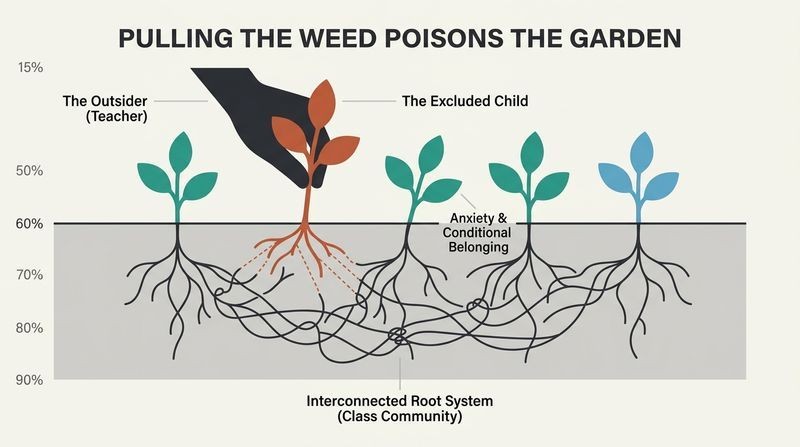
Pulling weeds poisons the garden. Shalaby borrows educator Jeff Duncan-Andrade's image: teachers justify removing disruptive kids by comparing them to weeds pulled for the health of other plants. But children are indigenous to the classroom; they share culture, neighborhood, and age far more than they share anything with their teacher, who is the outsider. When one child is publicly sent away, every watching child learns that belonging is conditional, revocable at adult whim.
Emily's exhausting year proves it. A committed, nonauthoritarian teacher at a social-justice school could not build the community she wanted precisely because she kept excluding Sean and Marcus. The more she removed the disruptors to protect the group, the more the group learned that membership must be earned through docility, and the fragile community never formed.
The insight aligns with restorative justice research showing that punitive exclusion raises recidivism and erodes trust, whereas repair strengthens group bonds. It also connects to attachment theory: conditional belonging signals to a developing brain that safety is unreliable, which amplifies threat responses and, ironically, more acting out. There is a genuine dilemma the book underplays, though. A teacher managing twenty-five children in real time cannot always pause for a communal healing circle while one child hurls chairs. Emily's fatigue is not a failure of will but a structural constraint of ratios and scheduling. Abolishing exclusion demands resources and staffing that most schools, especially poor ones, simply do not have.
Standing out gets punished when the norm is whiteness
Zora was the only brown face in a sea of white. Biracial, bold, loud, and creative, she perched paper birds on clay royalty when told to glue a single animal, and turned science drawings into comic theater. At home her artist parents painted the staircase with commands like Be fearless and Stand tall, teaching her that standing out was survival strategy for people of color in hostile spaces. Her father cheered mid-poem in his bright yellow blazer while white parents clapped politely.
School demanded the opposite. Her teacher, Mrs. Beverly, worried aloud whether her constant redirection was making Zora more white, water-diluting a proud child into a white-bread norm. Black preschoolers are suspended at 3.8 times the rate of white peers. Zora heard her name corrected fifteen times a day.
W.E.B. Du Bois named this a century ago as double consciousness, the exhausting sense of measuring yourself through the contemptuous eyes of others, and Shalaby shows a seven-year-old already carrying it. Carter G. Woodson's argument in The Mis-Education of the Negro sharpens the stakes: schooling that teaches Black children to imitate whiteness produces conformists, not original thinkers, developing nobody's unique gifts. Mrs. Beverly is drawn sympathetically, which matters; she is not a villain but a caring professional trapped in a system that rewards assimilation. The uncomfortable truth is that her pragmatic bet, that conformity buys future access, is not wrong, only tragic. Both things can be true simultaneously.
School's hidden curriculum forces kids to abandon their own plans
Lucas could not stop being Lucas. Perseverating, inflexible, and hilarious, he got up mid-read-aloud to fetch a different book, crushed a classmate's Legos because his dinosaur needed something to attack, and policed lunch tables as the self-appointed fair police. His teacher called him egocentric, meaning literally that the world outside him barely registered.
Philip Jackson named the invisible lessons. In his 1968 study Life in Classrooms, Jackson described the hidden curriculum: the unspoken demand that students substitute the teacher's plans for their own, tolerating constant delay, denial, interruption, and social distraction produced by crowding. Learning to want what the teacher wants, even when it hurts, is the real first-grade lesson. Lucas made this visible every time he chose his book over hers, forcing the teacher to say plainly: you don't get to decide that.
Jackson's framework remains startlingly durable because classroom architecture barely changed in five decades. The hidden curriculum concept anticipated later work by Bowles and Gintis, who argued schools reproduce the disposition of the compliant worker, punctual, deferential, tolerant of boredom. Self-determination theory from psychology offers a counterweight and a warning: autonomy, competence, and relatedness are the documented engines of intrinsic motivation, and a setting that systematically crushes autonomy predictably kills the love of learning. Yet Lucas also genuinely needed to learn reciprocity; his twin brother developed a twisted neck from Lucas sitting on him in the womb. The developmental task is real. The question is whether obedience training is the way to teach it.
A child's endless questioning is democratic muscle, not defiance
Sean argued about everything. He disputed which coat, whether the scooter needed WD-40, and demanded hamburgers by broken-record repetition. His mother Kate treated each no as the opening of negotiation, explaining her reasoning because she believed questioning would serve him in life. At school the same trait read as badgering, and he was sent to take breaks and eventually medicated.
Willful defiance is a civil rights issue. Shalaby connects Sean to the 2013 Los Angeles school board vote ending suspensions for willful defiance, a vague catchall (mouthing off, bad attitude, refusing to remove a hat) that accounted for 54% of California suspensions and 25% of expulsions, disproportionately of children of color. Democracy requires dispute. A child who demands justification for authority could be cultivated as a citizen rather than punished as an outcast.
The distinction between individual, aggressive questioning and organized, strategic dispute is the book's most practical educational proposal. It maps onto the difference between reactance, a psychological kick against control, and civic agency, a learned skill. Political scientists note that democracies depend on citizens who can contest authority procedurally, through petition, debate, and coalition, rather than merely emotionally. Sean has the raw disposition; school could teach him the craft. The honest limit: a classroom cannot function if every directive triggers a twenty-minute Socratic seminar, and Kate's one-on-one patience does not scale to twenty-five kids. The goal is not to celebrate all defiance but to redirect its energy toward literacy as power.
Anger in children is often fear or loneliness wearing a mask
Sean's medication revealed the truth. Before ADHD medication, when Sean felt sad he became belligerent, so nobody could see the sadness beneath the disruption. On medication, unable to distract himself, he simply cried, telling his teacher nobody cared about him. His outbursts had been grief in disguise. Marcus, a Black first-grader whose father was incarcerated, was medicated for anger, not attention.
Look for pain behind the performance. Shalaby argues Marcus's rage was likely fear, the reasonable fear of a Black boy who visits a good man treated as bad in prison, in a country where boys who look like him are killed for being tall or buying candy. Discipline, yes, she urges, but not punishment. Respond to the outburst by searching for the harm it signals rather than isolating the child who signals it.
This tracks closely with trauma-informed pedagogy and the work of psychiatrist Bruce Perry, who shows that chronic stress dysregulates the developing nervous system, producing behavior that looks like willful aggression but functions as a survival response. Affective neuroscience supports the mask thesis: the threat circuitry underlying fear and the RAGE system are neighbors, and children lack the vocabulary and prefrontal control to distinguish or name them. The racial dimension is crucial and well-founded; research consistently finds Black children perceived as older, angrier, and less innocent than white peers exhibiting identical behavior. The sobering implication is that medicating anger without addressing its source treats the smoke while the fire burns.
Kids misbehave loudest precisely when they feel most invisible
Hypervisibility and invisibility feed each other. All four children were hypervisible as troublemakers, their names constantly in teachers' mouths, yet invisible as full human beings with lives outside school. The more teachers tried to quiet and normalize them, the more outrageously the children performed to be seen. Zora launched a paper seagull to pretend-poop on a classmate. Sean walked through the group to stand in front of the book. Marcus chirped like a bird until impossible to ignore.
The song gets louder when refused. Shalaby frames this with the Freedom School anthem line: the more you refuse to hear my voice, the louder I will sing. Schools expect children to pay attention, but children, being human, need to get attention: loving, patient recognition in which they feel genuinely seen, heard, and understood.
The escalation loop is well documented in behavioral psychology as an extinction burst: ignore a behavior that once earned response and it intensifies before fading, or, if the underlying need persists, never fades at all. The deeper point connects to the sociology of recognition; philosophers like Axel Honneth argue that misrecognition, being seen falsely or not at all, is a genuine injury that provokes struggle. Children lack exit options, so they escalate voice. A useful nuance: attention-seeking is not manipulation to be starved but a signal to be decoded. The practical trouble is distinguishing a bid for connection from a bid for control, since the surface behavior can look identical and teachers must respond in seconds.
Let a child be helpful, and watch the defiance dissolve
Marcus wanted to help, not obey. He rejected any dynamic where an adult held power over him (Nobody is the boss of Marcus Andrews) but eagerly sought helping relationships. He comforted crying classmates nobody else tended, taped up a photo he had torn, and did his partners' worksheets for them. His teacher prized independence; Marcus was fueled by interdependence. When offered any reward he wanted, he asked to help in the kindergarten rooms, to be a big brother at school.
Care motivates more than authority. Shalaby's four tips for Marcus, let him be heard, known, helpful, and proud, echo what leading education scholars advocate. A librarian who simply asked what she could do, then sent him home with books, drew the first genuine smile anyone had seen from him.
This inverts the standard behaviorist toolkit of points and privileges by treating contribution itself as the reward, which aligns with self-determination theory's finding that relatedness and competence drive engagement more durably than external tokens. There is also strong evidence from peer-tutoring and service-learning research that giving help boosts the helper's achievement and belonging, sometimes more than receiving it. The racial and gender dynamics Shalaby flags deserve emphasis: a Black boy surrounded by white women cast as rescuers occupies a subordinate posture even in kindness. Reframing him as a leader who gives care, rather than a problem who receives it, is not sentimental. It is a redistribution of power.
Be love: discipline through repair, never punishment through banishment
Classroom management is not neutral technique. Shalaby dismisses the endless shelf of tip books, noting the advice has barely changed since 1964 while three-year-olds are suspended at record rates. Management is relational, human, political work, saturated with power. Her alternative is a stance, not a script: be love. Not niceness or politeness, but a fierce, insistent commitment that no child's personhood be assaulted through humiliation, marginalization, or exclusion.
Prepare kids for freedom, not prison. Isolating and excluding children trains them for a prison culture that depends on confinement. A classroom built for freedom practices the skills a free world requires, healing over harm, community over solitary confinement. Ask instead: what human need does this behavior express, how does it mirror a problem in the world, and how might we heal it together?
The book's culminating move is unapologetically utopian, invoking Grace Lee Boggs and the call to raise solutionaries. Its power is also its vulnerability. Abolitionist pedagogy offers a compelling moral vision but thin operational detail, and the honest reader wants to know what to do at 10:47 a.m. when a chair is airborne. Shalaby anticipates this, insisting she offers a way to be rather than a way to do, and pointing toward restorative practices with real evidence behind them: schools using restorative circles show meaningful drops in suspension and improved climate. The deepest claim, that safety comes from unconditional belonging rather than surveillance, is testable, radical, and increasingly supported by research on psychological safety in groups.
Analysis
Troublemakers is a work of person-centered ethnography dressed as an intervention in education policy, and its method is its argument. By using Sara Lawrence-Lightfoot's portraiture, which begins by asking What is good here?, Shalaby inverts the diagnostic gaze that ordinarily falls on so-called problem children. The four portraits (Zora, Lucas, Sean, and Marcus, all first- or second-graders identified by strong teachers as their most challenging students) function less as case studies than as parables. Each child illuminates a different facet of a single thesis: that schools manufacture the very trouble they punish, and that the children who refuse to comply are our most reliable instruments for detecting institutional harm.
The book's intellectual lineage is explicitly critical and abolitionist. It draws on Foucault's account of disciplinary power, Jackson's hidden curriculum, Du Bois's double consciousness, and the contemporary school-to-prison pipeline literature. What distinguishes Shalaby is her refusal to let the analysis remain safely macro. She insists on the granular: fifteen name-corrections in a morning, a paper seagull, a torn family photo taped back together. This is the book's rhetorical genius and its methodological risk. Four children in two unusually progressive schools cannot bear the weight of national generalization, and Shalaby knows it; she chose good schools precisely to show that the problem is systemic rather than the fault of bad actors. The tradeoff is that skeptics can dismiss the sample size.
The most defensible core is diagnostic: the demonstration that identity as troublemaker is co-produced, that exclusion corrodes community, and that anger frequently masks fear and grief. The most contestable is prescriptive: be love is a stance more than a system, and the crushing reality of ratios, scheduling, and under-resourcing (dramatized by Emily's exhaustion and by Detroit's mold-infested schools) means the gap between vision and Tuesday morning remains wide. Still, the book succeeds at its actual aim, which is to make the ordinary cruelties of schooling visible enough that they can no longer be mistaken for neutrality.
Review Summary
Troublemakers receives mostly positive reviews, with readers praising its fresh perspective on "troublemaking" students and call for more empathetic, love-centered teaching approaches. Many educators found it thought-provoking and transformative, recommending it as essential reading. Critics felt it lacked practical solutions and unfairly portrayed teachers. The book challenges traditional classroom management, urging educators to see disruptive behavior as a call for freedom and belonging rather than a problem to be fixed.
Glossary
Miner's canary
Sensitive child signaling classroom toxicityShalaby's central metaphor, borrowed from a father named Thomas and from Guinier and Torres. Just as coal miners carried canaries whose fragile lungs detected lethal gas before it harmed humans, a misbehaving child is more sensitive than peers to harmful school conditions. The child's disruptive singing warns that something in the shared environment is toxic. The remedy is to clean the air, not blame or remove the bird.
Trouble-making (verb) versus troublemaker (noun)
Behavior as process, not identityA distinction Shalaby draws to relocate the problem of misbehavior. Troublemaker as a noun treats trouble as a fixed identity imprinted on an individual child. Trouble-making as a verb treats it as a process produced in the interaction between a specific child and a specific school's rules and demands. The shift moves attention from fixing broken children to examining the institutional harms they respond to.
Being out-standing
Standing out as prideful resistanceShalaby's play on words describing Zora's family strategy. Rather than blending into a hostile white school, Zora's parents model standing out boldly, through bright clothing, loud voices, and painted staircases, as a proud response to environments that marginalize people of color. At school this same out-standing quality is punished as noncompliance, creating a painful conflict between home values and school demands.
Hidden curriculum
Unspoken lessons of school complianceA concept from Philip Jackson's 1968 study Life in Classrooms that Shalaby applies to Lucas. Beyond academic content, schools teach children to substitute the teacher's plans for their own and to endure delay, denial, interruption, and social distraction caused by crowding. Learning to want what authority wants, even against one's own desires, is the covert but central lesson of early schooling.
Willful defiance
Vague charge for classroom disruptionA subjective disciplinary category (mouthing off, bad attitude, refusing directives, causing disruption) that Shalaby connects to Sean. In California it accounted for 54% of suspensions and 25% of expulsions, applied disproportionately to children of color. Los Angeles ended suspensions for it in 2013. Shalaby reframes willful defiance as potential democratic capacity, the questioning of unjust authority, rather than pathology.
Be love
Relational stance replacing punitive managementShalaby's proposed alternative to conventional classroom management. Not politeness or niceness, but a fierce, political commitment that no child's personhood be assaulted through humiliation or exclusion. It means disciplining rather than punishing, healing rather than harming, and restoring community rather than banishing from it, preparing children for freedom instead of for prison culture.
Portraiture
Goodness-seeking ethnographic research methodA qualitative research methodology developed by Sara Lawrence-Lightfoot that Shalaby uses to document the four children. It begins by asking What is good here?, deliberately seeking goodness and complexity rather than pathology. This empathic orientation let Shalaby observe the children both in classrooms and at home, revealing full human beings rather than caricatured troublemakers.
FAQ
1. What is "Troublemakers: Lessons in Freedom from Young Children at School" by Carla Shalaby about?
- Focus on "troublemakers": The book explores the experiences of four young children labeled as "troublemakers" in elementary school, examining how their behaviors challenge the norms and expectations of schooling.
- Freedom and love in education: Shalaby argues for centering freedom and love in educational practice, suggesting that schools should be places where children learn to be free and are treated as full human beings.
- Critique of school discipline: The book critiques traditional approaches to classroom management, highlighting how exclusion, punishment, and conformity harm children, especially those who do not fit the norm.
- Portraiture methodology: Using detailed portraits, Shalaby documents the lives of Zora, Lucas, Sean, and Marcus, showing how their struggles reveal deeper issues within the structure and culture of schools.
2. Why should I read "Troublemakers" by Carla Shalaby?
- Fresh perspective on discipline: The book challenges common assumptions about misbehavior and discipline, offering a humanizing and empathetic lens for understanding so-called "problem children."
- Insight for educators and parents: It provides practical and philosophical insights for teachers, parents, and anyone interested in child development or educational reform.
- Addresses equity and justice: Shalaby connects classroom practices to broader issues of social justice, race, and democracy, making the book relevant for those concerned with equity in education.
- Inspiration for change: The stories and analysis encourage readers to reimagine schools as spaces of freedom, love, and authentic community, rather than control and exclusion.
3. Who is Carla Shalaby, and what is her approach in "Troublemakers"?
- Background and expertise: Carla Shalaby is a former elementary school teacher, researcher, and director of elementary education programs at Brown University and Wellesley College, with a doctorate from Harvard.
- Portraiture methodology: She uses a research approach called "portraiture," developed by Sara Lawrence-Lightfoot, which combines ethnography and narrative to highlight the goodness and complexity of children.
- Empathic, relational stance: Shalaby positions herself as an attentive listener, advocate, and co-learner, seeking to understand children’s behaviors within their social and cultural contexts.
- Focus on learning from children: Rather than offering prescriptive solutions, she centers the voices and experiences of children, treating them as teachers from whom adults can learn about freedom and humanity.
4. What are the main concepts and definitions in "Troublemakers" by Carla Shalaby?
- Freedom and love: Shalaby defines freedom as the right to be fully human, with dignity, self-determination, and the ability to flourish; love is seen as a fierce, political, and relational practice in education.
- Troublemaker as canary: She uses the metaphor of "miners’ canaries" to describe troublemaking children as early warning signals of toxic conditions in schools, rather than as inherently problematic individuals.
- School culture and conformity: The book critiques the hidden curriculum of obedience, conformity, and exclusion, arguing that schools often value compliance over creativity, independence, and community.
- Trouble-making as a verb: Shalaby reframes "troublemaking" as an action produced by the interaction between children and school structures, not as a fixed identity.
5. How does Carla Shalaby portray the four children—Zora, Lucas, Sean, and Marcus—in "Troublemakers"?
- Zora: A biracial girl in a predominantly white, affluent school, Zora is bold, creative, and energetic, often punished for standing out and refusing to conform.
- Lucas: A white boy with ADHD, Lucas is inflexible, humorous, and deeply invested in his own interests, struggling with the demands of sharing space and following rules.
- Sean: A white boy in a diverse urban school, Sean is willful, argumentative, and sensitive, often in conflict due to his persistent questioning and need for connection.
- Marcus: A Black boy in the same urban school, Marcus is charismatic, relational, and empathetic, but frequently in trouble for challenging authority and seeking authentic relationships.
6. What is the "miners’ canary" metaphor in "Troublemakers," and why is it important?
- Origin of the metaphor: The "miners’ canary" refers to the practice of using canaries in coal mines to detect toxic gases; the birds’ distress signals danger to humans.
- Application to children: Shalaby likens troublemaking children to canaries, suggesting their disruptive behaviors are signals of harmful conditions in schools, not personal failings.
- Shifts blame from child to system: This metaphor encourages educators to look for "poison in the air"—the toxic aspects of school culture—rather than pathologizing or punishing children.
- Call to action: The metaphor urges adults to listen to these children’s "freedom songs" and address the root causes of their distress, rather than silencing or excluding them.
7. How does "Troublemakers" by Carla Shalaby critique traditional classroom management and discipline?
- Punitive practices: The book highlights how exclusion, isolation, and public shaming are common responses to misbehavior, often justified as necessary for classroom control.
- Pathologizing children: Shalaby critiques the tendency to label, medicate, or diagnose children who do not comply, rather than questioning the appropriateness of school demands.
- Exclusion and community: She argues that exclusion does not build community but destroys it, teaching children that belonging is conditional and reinforcing social hierarchies.
- Alternative vision: The book advocates for discipline as healing and restorative, rooted in love and inclusion, rather than punishment and removal.
8. What does Carla Shalaby mean by "teaching love and learning freedom" in "Troublemakers"?
- Love as public practice: Shalaby calls for a fierce, political love that insists on the dignity and full humanity of every child, especially in moments of conflict or misbehavior.
- Freedom as classroom practice: She envisions classrooms as microcosms of authentic democracy, where children practice self-determination, voice, and collective responsibility.
- Discipline as restoration: Teaching love means responding to trouble with curiosity, empathy, and a commitment to restoring community, not with exclusion or control.
- Learning from children: Shalaby suggests that adults must learn freedom from children, who are natural imaginers and questioners, and who can lead the way toward more just and loving schools.
9. How does "Troublemakers" address issues of race, class, and equity in schools?
- Disproportionate discipline: The book documents how children of color, especially Black boys, are more likely to be labeled as troublemakers, punished, and excluded from classroom communities.
- School-to-prison pipeline: Shalaby connects early exclusionary practices to broader patterns of criminalization and incarceration, particularly for marginalized groups.
- Cultural mismatch: She highlights how school norms often reflect white, middle-class values, making it harder for children from different backgrounds to belong without assimilating.
- Call for justice: The book urges educators to recognize and challenge the ways schools maintain racial and social hierarchies, advocating for practices that honor all children’s identities and experiences.
10. What practical advice or methods does Carla Shalaby offer to teachers in "Troublemakers"?
- Be love, not regular: Shalaby encourages teachers to "be love"—to model inclusion, healing, and curiosity—rather than relying on standard punitive practices.
- Respond with curiosity: When faced with misbehavior, teachers should ask what need or harm the behavior might be responding to, and involve the whole class in problem-solving.
- Build authentic relationships: She emphasizes the importance of knowing children as people, not just students, and creating opportunities for them to be heard, known, and celebrated.
- Center community and restoration: Discipline should focus on restoring relationships and community, not on exclusion or isolation; involve children in creating and maintaining a caring classroom culture.
11. What are the key takeaways from "Troublemakers: Lessons in Freedom from Young Children at School"?
- Misbehavior is communication: Children’s disruptive behaviors are often expressions of unmet needs, distress, or resistance to harmful conditions, not simply defiance or pathology.
- Schools must change, not just children: The book calls for systemic change in school culture, rules, and practices, rather than focusing solely on fixing or medicating children.
- Freedom and love are essential: True education requires centering freedom and love, treating children as full human beings with rights, voices, and agency.
- Listen to the "troublemakers": The children most often excluded have the most to teach us about what is toxic or unjust in our schools, and about how to build more humane, democratic communities.
12. What are the best quotes from "Troublemakers" by Carla Shalaby, and what do they mean?
- "The more you refuse to hear my voice, the louder I will sing." – This lyric, used as an epigraph, encapsulates the book’s message that children will persist in seeking recognition and freedom, even when silenced.
- "I think of the children who make trouble at school as miners’ canaries." – This quote reframes misbehavior as a warning signal, urging adults to look for systemic problems rather than blaming children.
- "If you be love, as a teacher, then what you model is the belief—through the everyday things you do—that no human being deserves to suffer any threat to or assault on her personhood."
Download PDF
Download EPUB
.epub digital book format is ideal for reading ebooks on phones, tablets, and e-readers.








































