
Plot Summary
The Perfect Wife's Mask
Camille, a young woman desperate to embody the ideal "tradwife," meticulously crafts her home and image for her husband Graham and her online followers. She believes that being the perfect homemaker—cooking, cleaning, and always smiling—will bring her happiness and love. Yet beneath the surface, Camille's sense of self is fragile, shaped by childhood loss and a need for approval. Her marriage, once passionate, is now distant, and her inability to conceive gnaws at her. Camille's identity is so entwined with her role as wife and future mother that she cannot imagine another path. The pressure to perform, both online and at home, leaves her isolated, anxious, and increasingly desperate for validation.
Manifesting Motherhood
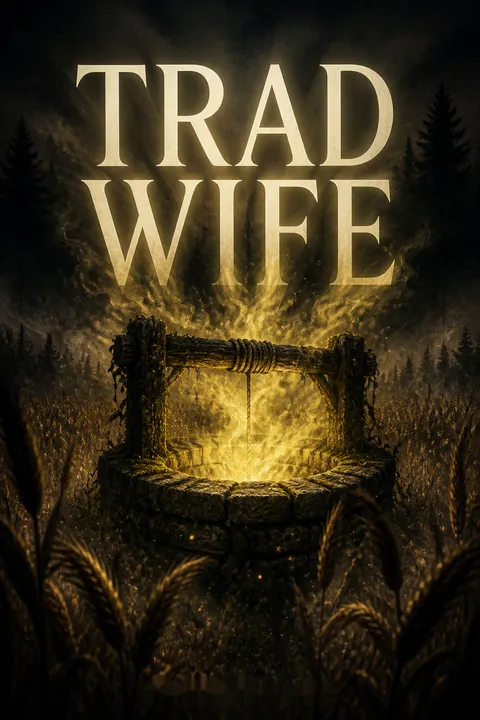
Camille's longing for a baby becomes an obsession, fueled by social media influencers who seem to have it all. She tries to manifest pregnancy through rituals, positive thinking, and relentless self-improvement. When another negative test devastates her, she turns to superstition, tossing a penny into an old, ominous well on her property and making a wish for a child. The act is both hopeful and haunting, as the well seems to swallow her wish—and something in the darkness stirs. Camille's need for motherhood is no longer just about love; it's about purpose, identity, and the hope that a baby will fix everything broken in her life.
Social Media and Smiles
Camille's life is a performance for her followers. She carefully stages photos and videos, emulating top influencers like Mara Shoemaker, whose rustic, child-filled life is the gold standard. Every meal, every room, every smile is curated for likes and validation. Yet the gap between Camille's online persona and her reality widens. Graham grows more distant, and Camille's sense of inadequacy deepens. She is haunted by the sense that she is failing at the one thing that matters—motherhood. The pressure to be perfect, to never frown, to always be grateful, becomes suffocating, and Camille's grip on reality begins to slip.
The Wishing Well's Bargain
After wishing for a baby at the well, Camille begins to experience strange phenomena: time slips, shadows, and a sense of being watched. The well becomes a symbol of her longing and her fear, a liminal space between hope and horror. Camille's dreams are invaded by a monstrous, angelic eye that questions her motives for wanting a child. The voice is both accusatory and seductive, promising her what she desires but demanding honesty about her needs. The boundaries between prayer, superstition, and something supernatural blur, and Camille senses that her wish has set something in motion that cannot be undone.
Shadows in the Wheat
Camille's world grows increasingly surreal. She sees shadows at the door, hears footsteps in empty rooms, and feels a presence lurking in the wheat fields and woods. Her sense of time and self erodes. The well's darkness seems to seep into her home and body. Camille's isolation intensifies as Graham becomes more absent and her online community's support feels hollow. The haunting is both literal and metaphorical—a manifestation of her repressed desires, fears, and the cracks in her carefully constructed life. The supernatural and psychological merge, leaving Camille unsure what is real.
The Angel's Question
In her dreams, Camille is confronted by a terrifying, winged eye that demands to know why she wants a baby. The interrogation strips away her platitudes and exposes her deepest insecurities: her need to be needed, her fear of abandonment, her belief that motherhood will give her purpose and keep her husband tethered. The angel promises her a child, but the encounter is invasive and painful, leaving Camille shaken and uncertain whether she has made a deal with something divine or monstrous. The dream's intensity bleeds into her waking life, as her body and mind begin to change.
Influencer Envy
Camille's obsession with Mara Shoemaker and other influencers intensifies. She mimics their routines, diets, and aesthetics, convinced that if she can just be more like them, she will be rewarded with the life she craves. But cracks appear: online trolls question her authenticity, and a former acquaintance exposes Camille's abandoned science background, undermining her credibility. The online community that once sustained her now judges and isolates her. Camille's sense of self fractures further, and she becomes more reliant on the supernatural promise of the well and the angel's bargain.
The Neighbor's Warning
Renee, a neighbor and fellow stay-at-home mom, enters Camille's life, offering friendship but also probing questions. Renee's presence is both comforting and unsettling—she is intrusive, boundaryless, and eventually reveals that the woods are dangerous, hinting at local legends of disappearances and predation. Renee's own life is a cautionary tale of divorce, custody loss, and addiction, mirroring Camille's fears of failure and abandonment. When Renee witnesses the strangeness in Camille's home, her fate becomes entwined with the darkness Camille has unleashed.
Hauntings and Hallucinations
As her pregnancy progresses at an impossible rate, Camille's body changes in unnatural ways: insatiable hunger for raw meat, hair loss, and a growing, kicking child far too soon. She vomits blood and mud, and her dreams become more vivid and violent. The boundaries between haunting and hallucination dissolve. Camille's sense of reality is further eroded by Graham's gaslighting and infidelity, and by the online world's increasing hostility. The supernatural bargain exacts its price, and Camille's transformation accelerates.
The Creature Appears
The monstrous, angelic creature from Camille's dreams manifests in her home. It is both terrifying and seductive, with wings, claws, and a body that is both human and inhuman. Camille, desperate and abandoned by Graham, submits to the creature, believing it to be an angel sent to answer her prayers. Their union is both violent and ecstatic, a consummation of Camille's wish and her surrender to forces beyond her control. The encounter leaves her pregnant with something not entirely human.
A Wish Fulfilled
Camille's pregnancy accelerates rapidly, her body deteriorating as the child inside her grows. She is consumed by hunger for raw and living flesh, and her cravings become uncontrollable. The baby's movements are violent and unnatural. Camille's isolation is complete—Graham is absent or hostile, Renee is suspicious, and her online world has turned against her. The supernatural pregnancy is both a fulfillment of her wish and a curse, as Camille's body and mind are consumed by the monstrous life growing within her.
The Impossible Pregnancy
Camille gives birth alone, aided only by the creature. The labor is excruciating and unnatural, and the child—Sweetheart—is born with white eyes, gray-green skin, and inhuman strength. Camille is both horrified and enraptured by her daughter, convinced that this child is the answer to all her prayers. Sweetheart's needs, however, are not human: she refuses milk and formula, hungers for flesh and blood, and grows at an impossible rate. Camille's love becomes a kind of madness, as she sacrifices her own body to feed her child.
Consuming Hunger
Sweetheart's appetite grows, and Camille is forced to feed her with her own flesh and blood. When that is not enough, Sweetheart turns to others—first Renee, then a police officer investigating Renee's disappearance, and finally Graham himself. Camille's own hunger for raw, living flesh intensifies, and she joins her daughter in consuming the bodies of those who threaten their secret. The line between victim and predator blurs, and Camille embraces her monstrous new identity.
The Baby's Appetite
As Sweetheart's needs escalate, Camille's ability to hide the truth collapses. The outside world—neighbors, police, and the online community—begins to close in. Camille's social media persona unravels, and she posts a final, defiant video exposing her true self and her monstrous family. The illusion of the perfect tradwife is shattered, and Camille rejects the expectations that have imprisoned her. She chooses her daughter and the creature over the world that never truly accepted her.
The Truth About Graham
Camille discovers Graham's infidelity and emotional abandonment. When he finally confronts her, seeking to end their marriage and take control of Sweetheart's future, Camille realizes that he is a threat to her child and herself. In a final act of violence and liberation, Camille and Sweetheart kill and consume Graham, completing Camille's transformation from victim to predator, from tradwife to something unholy and free.
The End of Illusions
With Graham gone and her social media persona destroyed, Camille abandons the last vestiges of her former self. She recognizes that the roles she tried to inhabit—perfect wife, mother, influencer—were cages built by others and by her own longing for approval. Camille embraces her monstrous nature, finding power and purpose in her love for Sweetheart and her connection to the creature. The family is now complete, united by blood, hunger, and the rejection of societal norms.
Blood and Bone
Camille, Sweetheart, and the creature form a new kind of family, bound not by tradition but by shared monstrosity and mutual need. They leave behind the house, the wheat fields, and the world of humans, venturing into the forest to begin a new life. Camille's transformation is complete—her body and soul have been remade by her wish, her hunger, and her love. The story ends with the family together, unholy and free, devouring the world that once tried to contain them.
Becoming Unholy
Camille sheds the last remnants of her humanity, both physically and psychologically. Her eyes turn white, her body becomes scaled and strong, and her heart ceases to beat. She is no longer the woman who wished for a child to save her marriage or her self-worth. She is something new—powerful, monstrous, and liberated. Camille's journey is one of self-destruction and rebirth, a rejection of the roles imposed on her and an embrace of her true, feral nature.
Into the Forest
Camille, Sweetheart, and the creature disappear into the forest, leaving behind the ruins of their old life. The forest, once a place of fear and danger, becomes a sanctuary—a place where they can exist outside the expectations and judgments of society. The story closes with the family together, ready to devour and transform whatever comes next, a metaphor for the radical act of self-creation and the rejection of oppressive norms.
Analysis
Trad Wife is a razor-sharp, subversive horror novel that dissects the myth of the perfect wife and mother in the age of social media. Saratoga Schaefer uses body horror and supernatural elements to expose the violence and emptiness at the heart of patriarchal expectations. Camille's journey—from desperate tradwife to monstrous, liberated mother—is both a cautionary tale and a dark fantasy of self-creation. The novel interrogates the ways women are taught to erase themselves for the sake of others, to perform happiness and gratitude while starving inside. Social media, with its curated perfection and relentless judgment, becomes both a mirror and a prison. The supernatural bargain at the well literalizes the costs of self-abnegation: Camille's wish for a child is granted, but only by destroying her body, her marriage, and her illusions. The monstrous child, Sweetheart, is both a punishment and a gift—a new form of love that rejects the boundaries of tradition and embraces feral, transformative hunger. In the end, Trad Wife is a radical call to devour the roles that confine us and to create new forms of family, identity, and freedom, no matter how unholy they may seem.
Review Summary
Trad Wife by Saratoga Schaefer receives mixed reviews (3.88/5) with readers praising its visceral body horror and social commentary on tradwife influencer culture, comparing it to Rosemary's Baby. Most found the premise—a desperate influencer accepting demonic impregnation—compelling and unputdownable, with many appreciating the extreme gore and feminist themes about autonomy and toxic relationships. Critics note predictable plotting, flat characters, and repetitive sections. The ending divides readers, though many enjoyed its "good for her" conclusion. Warnings abound about graphic content including cannibalism and intense body horror, making it unsuitable for squeamish readers.
People Also Read





Characters
Camille
Camille is the protagonist, a young woman whose identity is built on being the perfect wife and aspiring mother. Scarred by the early loss of her mother and a childhood spent caring for her father, Camille craves approval and fears abandonment. Her psychological need to be needed drives her to extremes—suppressing her own desires, curating her life for social media, and ultimately making a supernatural bargain for a child. Camille's journey is one of unraveling: as her wish is granted in monstrous form, she is forced to confront the emptiness of the roles she has inhabited. Her transformation from victim to predator, from tradwife to unholy mother, is both horrifying and liberating. Camille's arc is a dark exploration of female hunger, self-destruction, and the possibility of rebirth outside patriarchal expectations.
Graham
Graham is Camille's husband, a man who values traditional gender roles and expects Camille to embody the perfect wife. Initially attentive, Graham becomes increasingly distant, emotionally unavailable, and eventually unfaithful. He is both a product and enforcer of patriarchal norms, using religion and social expectations to control Camille. Graham's inability to provide emotional intimacy or support, and his refusal to acknowledge Camille's suffering, make him both a source of longing and resentment. His eventual betrayal and death at Camille's hands symbolize the collapse of the oppressive structures that have defined her life.
Sweetheart
Sweetheart is Camille's daughter, born of a supernatural union with the creature. She is both the fulfillment of Camille's wish and the embodiment of her deepest fears. Sweetheart is physically inhuman—white-eyed, gray-skinned, unnaturally strong and hungry. Her needs are insatiable, and she quickly becomes a predator, consuming flesh and blood to survive. Yet Camille's love for her is absolute, transcending horror and revulsion. Sweetheart represents both the monstrous consequences of Camille's desires and the possibility of a new, unbounded form of motherhood—one that rejects societal norms and embraces feral, transformative love.
The Creature / Angel
The creature is a supernatural being that answers Camille's wish for a child. It appears as a terrifying, winged, and scaled entity—part angel, part demon, part primal force. In Camille's dreams, it interrogates her motives and ultimately consummates her wish in a violent, ecstatic union. The creature is both a literal and symbolic figure: it represents the dark, repressed aspects of female desire, the hunger for more than what society allows, and the possibility of transformation through destruction. Its relationship with Camille is both predatory and nurturing, and it becomes the father of Sweetheart and the architect of Camille's metamorphosis.
Renee
Renee is Camille's neighbor, a stay-at-home mom whose life is unraveling due to divorce, addiction, and loss of custody. She offers friendship to Camille but also serves as a warning—a vision of what happens when a woman fails to meet societal expectations. Renee's boundaryless affection and probing questions unsettle Camille, and her eventual death at Sweetheart's hands marks the point of no return for Camille's monstrous family. Renee's fate is a commentary on the precariousness of female security and the dangers of internalized judgment.
Mara Shoemaker
Mara is a social media influencer whose perfect, rustic, child-filled life is the model Camille aspires to. Mara is both a real person and a symbol—the unattainable standard of femininity, motherhood, and online success. Her approval is Camille's holy grail, but Mara's eventual rejection exposes the emptiness and cruelty of the influencer world. Mara's presence in the story highlights the toxic effects of comparison, the commodification of motherhood, and the impossibility of living up to curated ideals.
Officer Lipton
Officer Lipton is the local police officer who investigates Renee's disappearance. His presence brings the outside world's scrutiny to Camille's door, threatening to expose the monstrous truth. Lipton's fate—consumed by Sweetheart and Camille—marks the family's final break from society and law. He represents the limits of institutional authority in the face of the supernatural and the consequences of probing too deeply into hidden domestic horrors.
Camille's Father
Camille's father is a background presence, shaping her psyche through his emotional distance and insistence on traditional gender roles. After her mother's death, he relies on Camille for care and validation, reinforcing her belief that her worth lies in service to others. His approval is both a comfort and a chain, and his legacy haunts Camille's choices and self-image.
Rose
Rose is Graham's online mistress, a faceless presence whose existence shatters Camille's illusions about her marriage. Rose is less a character than a catalyst—her relationship with Graham exposes the hypocrisy and fragility of the tradwife ideal, and her name becomes a bitter echo of the "sweetheart" Camille so desperately wanted.
The Online Community
The collective presence of Camille's followers, trolls, and influencer peers serves as both audience and judge. Their approval is fleeting, their criticism devastating. The online community amplifies Camille's insecurities, polices her authenticity, and ultimately turns on her when she can no longer maintain the illusion. They are the chorus of societal expectations, both seductive and destructive.
Plot Devices
The Wishing Well
The wishing well is the central symbol and plot device, representing Camille's longing, superstition, and the dangerous consequences of unchecked desire. It is both a literal place—where Camille makes her wish for a child—and a metaphorical abyss, swallowing her hopes and returning them in monstrous form. The well's darkness is a portal to the supernatural, a place where bargains are struck and boundaries dissolve. It foreshadows the arrival of the creature and the unraveling of Camille's reality.
Social Media as Mirror and Cage
Social media is both a narrative structure and a psychological device. Camille's life is shaped by the need to perform for an audience, to curate every detail for approval. The online world amplifies her insecurities, exposes her secrets, and ultimately turns on her. The structure of posts, comments, and influencer hierarchies mirrors the surveillance and judgment Camille experiences in her marriage and community. Social media is both a mirror of her desires and a cage that traps her in impossible expectations.
The Monstrous Pregnancy
Camille's supernatural pregnancy is a vehicle for exploring themes of female hunger, bodily autonomy, and the violence of societal expectations. The rapid, unnatural gestation, the cravings for flesh, and the physical deterioration are both literal and symbolic. The pregnancy is a crucible that destroys Camille's old self and forges a new, monstrous identity. It is foreshadowed by dreams, hallucinations, and the creature's interrogation, and it drives the plot toward its bloody climax.
The Angel/Creature
The creature's dual nature—as angel and monster—serves as a device for interrogating Camille's motives and desires. Its presence blurs the line between blessing and curse, salvation and damnation. The creature's questions force Camille to confront her true needs, and its consummation of her wish is both a fulfillment and a punishment. The ambiguity of the creature's nature allows the story to explore the dark side of wish fulfillment and the dangers of self-deception.
Foreshadowing and Unreliable Perception
The narrative is structured around Camille's increasingly unreliable perception. Dreams, hauntings, and hallucinations foreshadow the supernatural events and mirror her psychological unraveling. The boundaries between reality and fantasy dissolve, leaving both Camille and the reader unsure what is real. This device heightens the horror and underscores the story's themes of repression, longing, and transformation.
Consumption as Metaphor
The motif of consumption—eating, being eaten, devouring—is central to the plot and themes. Camille's hunger for love, approval, and purpose becomes literal as she and her daughter consume flesh and blood. The act of eating becomes a metaphor for the costs of self-sacrifice, the violence of societal expectations, and the possibility of transformation through destruction. The story's climax—Camille and Sweetheart consuming Graham—literalizes the devouring of patriarchal control and the birth of a new, monstrous self.
Download PDF
Download EPUB
.epub digital book format is ideal for reading ebooks on phones, tablets, and e-readers.








































