


Plot Summary
Spade in the Shepherd
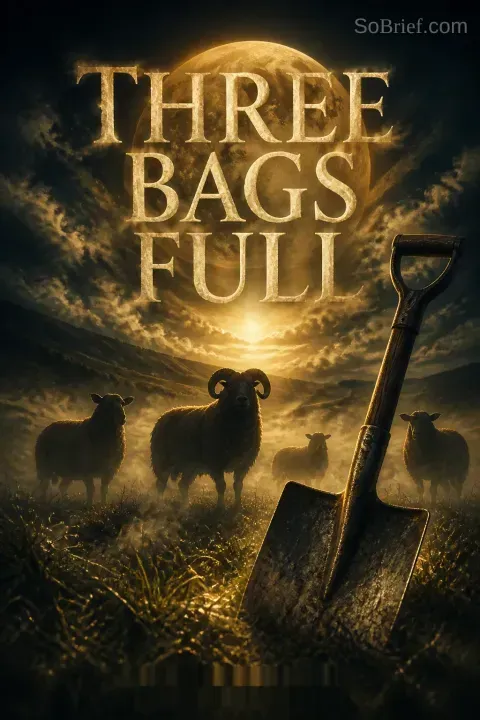
The flock discovers their shepherd George9 sprawled near the hay barn with a spade driven through his body. Miss Maple,1 the cleverest ewe, calms the panicking sheep and examines the corpse. She finds a single hoofprint on his stomach and detects a faint smell of Guinness and tea on his breath.
Convinced that George9 was murdered, she persuades the flock to seek justice. They assign watches: Sir Ritchfield6 on the hill, Zora5 on the cliff ledge, Othello2 near the dolmen.
When humans arrive – the drunk Tom O'Malley,14 then the butcher Ham,10 Gabriel the shepherd,12 and red-haired Lilly – the sheep observe their strange reactions and whispered arguments. Miss Maple1 begins compiling a list of questions: Why did George9 come to the meadow at night? Where is his faithful dog Tess?
The opening establishes the sheep as collective detectives, their inquiry rooted in sensory perception rather than human logic. Miss Maple's discovery of the hoofprint introduces the central mystery of whether one of their own could be involved, while the humans' arrival immediately presents a web of suspicion. The sheep's decision to pursue justice, despite their instinct to forget, marks their departure from passive livestock to active agents, setting up the novel's central theme: that even the most powerless can demand accountability.
The Human Herd Descends
A crowd of villagers, led by Tom O'Malley,14 invades the meadow to gawk. Tom14 gives a wildly embellished account of finding the body, claiming blood splattered everywhere.
While children chant about the 'Goblin King,' the sheep overhear fragments: some speculate about debts, others about George's9 strange habits, and a young man insinuates George9 was too fond of his sheep. The butcher10's gray wolfhound chases the flock, but Othello2 charges and sends the dog yelping with a gored belly, scattering the humans in terror.
Later, Kate Glenn and Father William13 – the long-nosed priest the sheep call 'God' – visit the caravan, discussing the will and the butcher10's interest in the flock. Kate reveals George9 had been acting oddly, reading love stories in secret.
The human crowd mirrors the sheep's own social structure, complete with hierarchies, rumors, and scapegoating. Othello's violent defense earns him both fear and respect, while the villagers' gossip provides the sheep with their first clues: the mention of a will, the fear of Ham, and mysterious hints about George's hidden life. The children's 'Goblin King' chant plants a folkloric thread that will later connect to the sheep's own ghost fears and the supernatural logic of the murder.
Night Raid on the Caravan
That night, the sheep witness three intruders – Tom,14 Harry, and Josh – trying to break into George's9 caravan. They wear stocking masks and mutter about finding 'the grass' before the police do, convinced George9 was a drug dealer.
A fourth figure, the 'master hunter',12 lies hidden atop the dolmen, radiating a scent of smoke and onions. A sleek car with a silent driver arrives, and the man knocks a coded rhythm on the caravan door before trying the lock. The masked men flee into the hayloft.
After everyone leaves, the sheep find a strange object under the dolmen: a thin gold chain with a cross pendant, dropped by one of the intruders. Heather, who had secretly kept the shiny Thing, is scolded by the flock. Miss Maple1 insists they keep it as evidence.
This scene introduces the drug subplot and the concept of 'evidence' as a physical object. The sheep's observation of multiple hidden actors reveals that George's death is entangled in a network of secrets far beyond a simple murder. The gold chain becomes a tangible clue that the sheep can use, grounding their investigation in the material world while highlighting their fundamental confusion about human 'Things'. The night raid also elevates Gabriel – later revealed as the master hunter – from a mere shepherd into a complex, surveilling figure.
Picnic with a Soul Thief
Beth Jameson,8 the gaunt religious woman who distributes tracts, spreads a checkered cloth on the meadow for a picnic with Rebecca,11 a stranger in a red dress. The sheep creep close to listen. Beth8 reveals a crucial detail: George9 was poisoned before the spade was used, meaning the spade was not the murder weapon.
She speaks of an old superstition – that the Devil's hounds wait to devour a dead person's soul unless the body is pinned down – and suggests someone feared George's9 ghost would haunt them. Beth8 also mentions Ham's10 security camera and the strange changes that came over Glennkill seven years ago. Meanwhile, the sheep notice that Rebecca11 carries a familial scent: she is George's9 daughter.
Beth's theological explanation transforms the murder from a physical crime into a metaphysical one, aligning with the sheep's own animistic worldview. The revelation that George was poisoned first reframes the investigation, turning the spade from weapon to symbolic instrument. Beth's palpable loneliness and her obsession with souls introduce a psychological dimension: the murderer may be driven not by greed but by a desperate need to possess what they lack. The arrival of Rebecca, George's daughter, plants the promise of a new shepherd and a potential solution to the flock's abandonment.
Othello Haunts the Confessional
Othello2 slips into the dark church and hides in the confessional booth. Father William13 enters and, thinking Othello2 is a parishioner, begins to mutter – but the ram's bleat sends the priest13 screaming. Later, Ham10 wheels his chair into the church, and the two men drink whiskey while the sheep listen through a window.
They discuss the old murder of a man named McCarthy, who was killed by a mob of villagers seven years earlier. George9 and Ham10 stumbled upon the body and, fearing they'd be blamed, hid evidence and copied a security video to protect themselves.
George9 spent the years since as an outcast, dealing drugs and taunting the villagers with his knowledge. Ham10 also reveals that someone stole his gold chain and dropped it at George's9 crime scene to frame him. As Mopple3 peers in, Ham10 spots him and gives chase.
This is the keystone revelation: George's death is not an isolated event but the aftershock of a communal murder. The villagers' long-buried guilt and fear of exposure provide a motive for wanting George silenced, while the sheep now understand why their shepherd was so isolated. Othello's role as accidental 'demon' perfectly exploits human superstition, and the gold chain connects the past crime to the present investigation. The scene also complicates Ham: the butcher is both a potential threat and a fellow outsider, bound to George by shared secrets.
Melmoth's Deadly Quarry Tale
A shaggy gray ram with curved horns appears in the meadow: Melmoth,4 Sir Ritchfield's6 twin who vanished years ago. The flock is awed and uneasy. Melmoth4 tells his story: as a young ram, he fled the flock and was pursued by George9 and Ham10 into the hills.
They cornered him in a stone quarry, but before they could capture him, they discovered a human leg bone protruding from the scree. The body was McCarthy's, killed by a mob of villagers who feared his plan to build a slaughterhouse.
George9 cut a key from Melmoth's4 neck to keep as a memento and let the ram go free. That night, George9 and Ham10 decided to protect themselves by documenting the crime. Now Melmoth4 has returned, guided by a sense of timing and the news of George's9 death borne by crows.
Melmoth's flashback functions as the novel's moral center: the collision of private fear with public horror. George's choice to spare Melmoth and claim the key humanizes him, revealing a shepherd capable of mercy even as he entangled himself in blackmail and drugs. The story also provides the crucial link between the spade used on George and the spade that killed McCarthy – a deliberate echo, intended to signal that the same community's darkness has resurfaced. Melmoth himself, a liminal figure who moves between worlds, becomes the flock's shaman and teacher.
Meat Breed Uprising
Gabriel,12 acting as temporary shepherd, erects a wire fence and brings his own flock: short-legged, hornless sheep with pale, restless eyes. They graze obsessively, and one night they break through the fence and advance on George's9 Place, the memorial patch the flock created.
George's9 sheep form a protective circle, but they are outnumbered. Zora5 notices a strange ram among Gabriel's12 flock who seems aware and tells her that they are a 'meat breed,' fattened for slaughter, and that Gabriel12 is death. The revelation horrifies Zora.5 With Othello's2 help, Melmoth4 herds the invaders back using his eerie presence.
Afterward, Melmoth4 begins training the flock: he teaches them to pay total attention, to stand their ground against sheepdogs, and to overcome fear by facing it directly. He sends them on exercises to the crows' tree, the hole under the pine, and the village.
The meat breed episode introduces the novel's most explicit confrontation with mortality: the sheep discover that their relationship with humans is not merely one of care but of exploitation and consumption. Zora's horror mirrors the reader's unease, while the doomed ram's quiet acceptance is a portrait of dignity in the face of an abyss. Melmoth's training program transforms the flock from passive grazers into mindful actors – a philosophical education in resilience and presence that will prove essential in the climax. The defense of George's Place also cements the memorial as a symbol of collective memory and resistance.
Fortune for a Flock
Under the old lime tree, the lawyer reads George's9 will to the assembled villagers. George9 bequeaths his library to Kate, his Bible to Beth,8 and his pistol to Ham.10 Then he leaves the bulk of his fortune – amassed through drug smuggling – to his sheep, stipulating that they must be taken to Europe as he once promised.
A shepherd must be appointed, and the sheep themselves must choose. Gabriel12 steps forward eagerly, but Rebecca11 also volunteers. The sheep, recognizing Rebecca's11 scent as kin and remembering her kindness, trot one by one to stand beside her.
The lawyer declares the vote unanimous. The villagers are stunned; Ham's10 face falls. Rebecca,11 the new shepherdess, moves into the caravan and begins reading aloud, fulfilling one of the will's conditions.
The will reading transforms the sheep from passive legacy to active heirs, granting them legal personhood of a sort. George's posthumous gift is a redemption of his earlier failure to take them to Europe, while the choice between Rebecca and Gabriel becomes a moral referendum: Rebecca represents connection and kinship, Gabriel the cold efficiency of the meat industry. The villagers' dismay reflects their dawning realization that the secrets George held over them are now vested in creatures they cannot control. The scene also sets up the final conflict, as Gabriel's ambition is thwarted and Rebecca inherits not just sheep but danger.
The Shepherd's Last Walk
That night, Rebecca11 and Beth8 talk outside the caravan. Beth,8 clutching the dirty rag that once was George's9 handkerchief, explains: a week before his death, George9 came to her late at night and said he was going to kill himself.
He had lost the courage to go on, haunted by years of isolation and the burden of the villagers' crime. Beth8 tried to dissuade him, but he was resolute. She agreed to help, and when she found him dead in the meadow, she drove the spade through his body – both to fulfill his wish that the villagers would think it murder, and because she desperately wanted to pin his soul to the earth so she could keep it.
She speaks not with guilt but with a terrible, tender love. The sheep hear this and, though they struggle to understand suicide, they sense the depth of her devotion and George's9 despair.
Beth's confession reframes the entire narrative: the murder was a suicide, and the spade an act of misguided love. Her religious mania and unrequited passion for George have fused into a tragic ritual, while George's decision reveals a man broken by the weight of his own secrets – even the prospect of Europe could not save him. The scene underscores the novel's compassion for its flawed humans: Beth is not a villain but a woman who has spent her life waiting for a connection that never came, and her terrible act is the only embrace she could manage. For the sheep, the concept of suicide is baffling, challenging their innate drive to survive.
Ghost Logic Solves the Crime
After Beth's8 confession, Miss Maple1 lies awake, connecting fragments. She recalls the passage Rebecca11 read from Wuthering Heights about murdered souls haunting their killers, and realizes the spade was meant to prevent George's9 ghost from walking.
But she now sees that the haunting came anyway: not as a specter, but as the sheep themselves, acting as George's9 avatars. She concludes that Beth,8 though not a murderer in the conventional sense, was responsible for the desecration and should be exposed so that justice – whatever that means – can be done.
But the sheep cannot speak; they must find another way. Maple1 remembers the Smartest Sheep contest and devises a plan: they will stage a play for the humans, using scent clues and the gold chain to point to Beth.8
Maple's deduction is the culmination of the novel's epistemological experiment: she solves the mystery not through forensic reasoning but through literary analogy and a sheep's intuitive grasp of haunting. The spade becomes a symbol not of death but of the desperate human need to control what comes after. The decision to stage a performance shifts the sheep's investigation from passive observation to active intervention, and the choice of the contest – a place where sheep are already on display – is a brilliant inversion of the usual power dynamic.
Sheep Stag a Dying
Four sheep – Othello,2 Zora,5 Miss Maple,1 and Mopple3 – trot into the Mad Boar pub during the annual Smartest Sheep contest. Under the spotlights, they perform their play: Zora5 acts out George's9 death and resurrection, Miss Maple1 mimes poisoning and then stamps her hoof on Zora's5 chest to represent the spade, while Mopple3 waves a rag soaked in Beth's8 scent and Miss Maple1 holds the gold chain.
The audience is baffled until Tom O'Malley,14 drunk, shouts that the sheep are showing what happened to George.9 The room falls silent. Beth,8 seeing her handkerchief and the chain, rises and delivers a halting confession.
She tells the villagers about George's9 final visit, his suicide, and her terrible spade ritual. Ham,10 in his wheelchair, weeps with remorse. The secret is out.
The contest scene is the novel's triumphant climax, a moment of pure theatrical justice where the voiceless find a voice through performance. The sheep's play – a combination of scent, gesture, and symbol – bypasses human language barriers and strikes directly at the emotional truth of the events. Tom O'Malley's drunken blurt catalyzes the revelation, but it is Beth's own overwhelmed conscience that finalizes it. The scene also echoes the novel's earlier debates about stories and endings: the sheep have, against all odds, forced a real detective story to a satisfying close.
Europe Beckons, Ghost Cloud Drifts
In the days after the contest, Rebecca11 reads newspaper accounts to the sheep, and Beth8 leaves Glennkill for an island monastery. Ham10 visits the meadow and apologizes to Heather, acknowledging that the sheep are more than dumb animals. The lawyer begins arranging the journey to Europe.
One evening, Melmoth4 leads the flock to the cliffs, tells them a story about goodbyes, and then simply disappears. Zora5 spots a shaggy gray cloud racing over the sea and declares he has become a cloud sheep.
Othello,2 watching from the edge, sees Melmoth4 as a tiny gray dot on the beach and understands he has chosen to wander again. Rebecca,11 with Tess at her side, promises to read The Silence of the Lambs next. The sheep settle into the contentment of a flock that has faced death and earned a future.
The resolution balances loss with renewal. Melmoth's departure – whether literal or spiritual – completes his arc as a liminal figure who belongs everywhere and nowhere, and his legacy of attentive resilience now lives in the flock. The cloud sheep myth, which the sheep have believed all along, provides comfort and continuity, transforming absence into ascension. The journey to Europe, once a broken promise, becomes a symbol of hope and collective purpose, while Rebecca's role as reader and shepherd restores the ritual of storytelling that George began. The novel ends on a note of quiet triumph: the sheep have not only solved a murder but have secured their own story.
Analysis
Leonie Swann's Three Bags Full is a murder mystery that uses its unconventional detectives to explore the nature of perception, community, and justice. By filtering the story through the sensory and cognitive world of sheep, Swann defamiliarizes human behavior, exposing the absurdities of greed, superstition, and violence. The sheep interpret everything literally and through smell, which leads to constant comic misunderstandings, but also to a shocking clarity: they cannot be lied to about what matters. The novel argues that truth is not solely a product of reason but of patience, attention, and a willingness to sit with questions without rushing to answers. The flock's collective intelligence – each sheep contributing a unique gift (memory, speed, scent, courage) – models a form of epistemology that values diversity over individual brilliance. At the same time, the human characters reveal the corrosive power of secrets: the village of Glennkill has been rotting from within ever since McCarthy's murder, and George's9 suicide is the final symptom of that communal sickness. Justice arrives not through the police (Inspector Holmes is notably incompetent) but through the sheep's stubborn, unglamorous investigation and their theatrical act of witness. In the end, the novel suggests that justice is a story that must be told and heard, and that even the most voiceless creatures can force a reckoning if they refuse to forget.
Review Summary
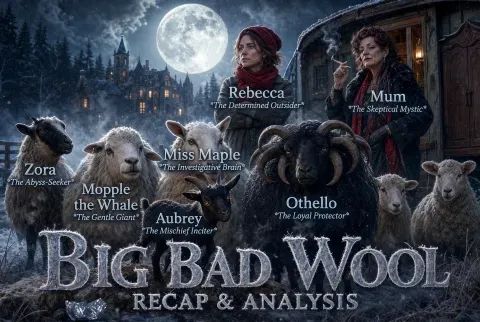
Three Bags Full receives mixed but generally positive reviews, averaging 3.59/5. Readers widely praise the novel's unique premise—a flock of sheep investigating their shepherd's murder—and the charming, distinct personalities of characters like Miss Maple, Mopple the Whale, and Othello. The sheep's perspective is frequently lauded as clever and humorous, offering sharp social commentary on human nature. Common criticisms include a slow middle section, a disappointing mystery resolution, and the detective plot feeling secondary to the book's philosophical themes.
Characters
Miss Maple
Cleverest sheep, investigatorA Cladoir ewe with an unusually sharp mind and an unshakeable sense of responsibility. She solves problems by gathering facts, forming questions, and making logical leaps that often confound her flockmates. She is pragmatic but driven by a deep loyalty to George9 and a belief that stories must have proper endings. Her intelligence isolates her at times, but she never wavers in her pursuit of truth, even when the other sheep prefer to forget.
Othello
Black four-horned ram, lead ramA Hebridean ram with a mysterious past in Dublin Zoo and the circus, Othello is scarred both physically and emotionally. He carries an ancient anger against human cruelty but has learned patience and strategy from a mysterious gray ram (Melmoth4). He becomes the flock's protector and eventual lead ram, using his combat skills and his intimidating appearance to terrify humans. His devotion to the idea of 'justice' fuels the investigation.
Mopple the Whale
Memory sheep, fat ramA stout Merino ram with a prodigious appetite and a perfect memory. Once he has seen or heard something, he never forgets it, making him the flock's living record. Mopple is gentle, easily frightened, and prone to colic after eating geraniums, but his hunger-driven bravery surprises even himself. He is the one who first confronts Ham10 and later becomes an unlikely hero, learning that attention and courage can overcome fear.
Melmoth
Wandering twin, shamanic teacherSir Ritchfield's6 long-lost twin, a shaggy gray ram who has roamed the world for years after fleeing the flock. He returns with a flock of crows on his back and a mind full of stories and hard-won wisdom. Melmoth speaks in riddling, poetic phrases, but his insights are profound. He teaches the sheep to pay attention, to herd themselves, and to use their fears as weapons. His presence connects the past (McCarthy's murder) to the present, and his departure at the end is both a loss and a transcendence.
Zora
Blackface ewe, cliff philosopherThe only horned ewe in the flock, Zora is fearless on the heights and spends hours on a rocky ledge contemplating the abyss and the cloud sheep. She believes that conquering the abyss leads to becoming a cloud sheep itself. She is proud, somewhat solitary, but fiercely loyal. Her encounter with the condemned meat-breed ram is a turning point that awakens her to the harsh realities of human exploitation.
Sir Ritchfield
Old lead ram, Melmoth's twinThe aging lead ram whose eyesight is still sharp but whose memory is full of holes. He is stubborn, sometimes pompous, but deeply cares for the flock. His guilt over Melmoth's4 disappearance has burdened him for years, and his secretive behavior after George's9 death is an attempt to protect his returned brother. He gradually relinquishes leadership, accepting that he can no longer hold the flock together alone.
Cloud
Woolliest ewe, gentle peacemakerThe most magnificently fleeced sheep in the flock, Cloud is calm, soothing, and somewhat dreamy. She once spent a terrifying day in the church as a lamb and recalls the experience with cloudy detail. She mothers the lambs, separates disputes, and prefers comfort to conflict. Her religious encounter gives her an odd authority when the flock discusses 'God13.'
Beth Jameson
Pamphleteer, soul-hungry womanA thin, sour-scented woman who distributes religious tracts and has been secretly in love with George Glenn9 for years. She believes his soul is in danger and dreams of saving it – or possessing it. Her faith is a thicket of genuine devotion, suppressed desire, and desperate loneliness. When George9 asks for her help in dying, she complies, and her subsequent act with the spade is a twisted expression of love. She is ultimately a tragic figure, not a villain.
George Glenn
Dead shepherd, estranged fatherThe shepherd whose murder the sheep investigate. George was a gruff, solitary man who preferred his flock to people, read them love stories, and dreamed of traveling to Europe with them. He stumbled upon a village murder seven years earlier and spent the rest of his life as an outsider, dealing drugs and holding the secret over the villagers' heads. His suicide is the result of exhaustion, isolation, and the loss of hope. His posthumous will – leaving his fortune to his sheep – is his final act of love and rebellion.
Abraham 'Ham' Rackham
Butcher, guilt-ridden giantA huge, menacing butcher with sausage-like fingers, Ham was George's9 only friend and accomplice in hiding McCarthy's murder. He is feared by the villagers and the sheep alike, but beneath his brutal exterior lies a sentimental man who installed a security camera to watch his unrequited love, Kate Glenn. After a fall from the cliffs (caused by a terrified Mopple3), he becomes wheelchair-bound and consumed by guilt. His eventual apology to Heather marks a genuine moral awakening.
Rebecca Flock
George's daughter, new shepherdessA tall, red-dressed woman who arrives in Glennkill to investigate her father's death and ends up inheriting him – his land, his sheep, and his secrets. She is pragmatic, brave, and carries George's9 same irreverent humor. Her willingness to read aloud to the sheep and to follow the will's eccentric instructions earns their loyalty. She becomes the shepherd George9 could not be: present, engaged, and ready to take them to Europe.
Gabriel O'Rourke
False shepherd, dog trainerA shepherd in sheep's-wool cape who wins sheepdog trials and speaks soothing Gaelic. He initially charms the flock, but they soon discover he is the 'master hunter' who watched the caravan break-in and that his own sheep are a meat breed destined for slaughter. He views animals as commodities and seeks the role of shepherd only for the salary. His cold efficiency is the novel's clearest example of industrial exploitation masked as care.
Father William
Guilt-ridden parish priestKnown to the sheep as 'God' for his long nose and habit of talking about 'the Lord,' he is a weak, frightened man tormented by his complicity in the village's silence after McCarthy's murder. He drinks whiskey with Ham10 and is haunted by what he believes are demonic sheep. His power as a confessor is undermined by his own unconfessed sins.
Tom O'Malley
Drunk, accidental truth-speakerA permanently tipsy man whose foot struck George's9 body when he tried to steal the spade. He is the first to report the death and later, in a flash of alcoholic insight at the Smartest Sheep contest, he yells that the sheep are acting out the murder. His careless words bridge the gap between the sheep's performance and human understanding.
Plot Devices
The Spade
Symbolic murder weapon, connective clueA gardening spade that was used to impale George's9 body after his death. It connects the present crime to the past: the same tool was used to kill McCarthy seven years earlier. For the sheep, it becomes a central puzzle – why use a spade on a dead body? – and the answer leads them to the metaphysical layer of the mystery. The spade also symbolizes the way humans bury their secrets and the violent lengths they will go to control the dead.
The Gold Chain
Stolen evidence, scent signatureA thin gold chain with a cross pendant, originally owned by Ham10 and later found under the dolmen by the sheep. It was dropped by Josh in an attempt to frame Ham10 for George's9 murder. The sheep, calling it the 'Thing,' keep it as a clue because of its association with Beth8 (who wears a similar cross) and its powerful human scent. They later use it in their contest performance to physically indicate the culprit.
The Drugs (Grass)
Hidden contraband, motive for intrusionPackets of marijuana that George9 smuggled via his sheep and stored in the caravan and under the dolmen. The villagers' frantic search for the 'grass' reveals George's9 secret life as a dealer and provides a reason why so many people were desperate to access the caravan. The drugs also fund the enormous fortune he leaves to his sheep, enabling their journey to Europe. For the sheep, 'grass' remains a comical mystery: they cannot understand why humans covet dried plants.
The Will
Legal document, reward mechanismGeorge's9 last testament, which disinherits his human heirs in favor of his sheep. It stipulates that his fortune must be used to take the flock to Europe, with a shepherd of their choosing who must read to them daily. The will is the climax of the legal subplot, transforming the sheep from witnesses to heirs, and it provides the final incentive for the villagers' greed and Gabriel's12 scheming. It also serves as George's9 posthumous redemption: his love for the flock outlasts his despair.
The CCTV Video
Insurance evidence, hidden leverageA videocassette recording from Ham's10 butcher shop that captured the villagers discussing McCarthy's murder and thus served as blackmail protection for both Ham10 and George9. George9 hid it, and its location remains unknown until the night-time intruders search for it. At the end, a mysterious man gives the cassette to Inspector Holmes, ensuring that the old crime will finally be prosecuted. The video is the physical manifestation of the villagers' guilt and the truth that 'gets out' at last.
Sheep Detective Story Series
About the Author
Other books by Leonie Swann
Download PDF
Download EPUB
.epub digital book format is ideal for reading ebooks on phones, tablets, and e-readers.








































