
Summary Temporarily Unavailable
This summary is temporarily unavailable and is currently being updated. You can still explore the FAQs and other metadata below.
Key Takeaways
1. Columbus's Own Records Hint at Prior African Contact
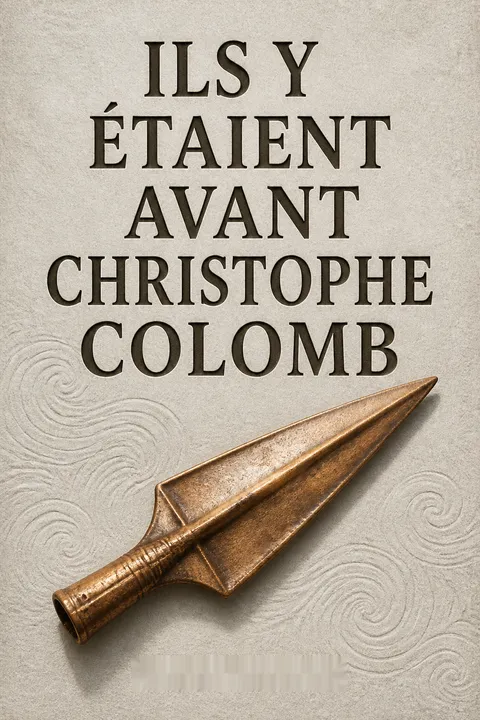
The Indians of this Española said there had come to Española a black people who have the tops of their spears made of a metal which they call gua-nin of which he [Columbus] had sent samples to the Sovereigns to have them assayed, when it was found that of 32 parts, 18 were of gold, 6 of silver and 8 of copper.
Early encounters. Christopher Columbus's own journals and letters, along with accounts from his companions like Friar Bartolomé de las Casas, contain intriguing references to African presence in the New World before his arrival. During his first voyage, Columbus noted that the indigenous people of Hispaniola spoke of "Negro people" arriving from the south and southeast. These Africans brought spears tipped with a metal called "guanin," which, upon assay in Spain, matched the unique gold-copper alloy found in African Guinea.
Portuguese intelligence. King Don Juan of Portugal, during a meeting with Columbus in 1493, revealed his own intelligence about African voyages to lands across the Atlantic. He spoke of "boats had been found which started out from Guinea and navigated to the west with merchandise," leading him to propose a demarcation line 370 leagues west of the Cape Verde Islands. This line, later formalized in the Treaty of Tordesillas, strategically placed Brazil within Portugal's sphere, a region directly accessible by the North Equatorial current from West Africa.
Further evidence. On his third voyage in 1498, Columbus himself encountered more direct evidence of African contact along the South American coast. His men found "handkerchiefs of cotton very symmetrically woven and worked in colors like those brought from Guinea, from the rivers of Sierra Leone and of no difference." These textiles resembled West African headdresses and loincloths, further corroborating the accounts of prior African presence and trade.
2. Archaeological Discoveries Uncover an Ancient African Presence
The Negroid element is well proven by the large Olmec stone monuments as well as the terracotta items and therefore cannot be excluded from the pre-Columbian history of the Americas.
Colossal Olmec heads. Archaeological excavations in Mexico have unearthed massive stone heads, particularly in the Olmec heartland (La Venta, San Lorenzo, Tres Zapotes), dating back to 800-700 B.C. These colossal sculptures, some weighing up to forty tons and standing nine feet high, depict unmistakably Negroid features:
- Full, vivid lips
- Broad, generously fleshed noses
- Distinctive facial contours
- Domed, military-style helmets
Widespread skeletal evidence. Beyond the monumental sculptures, physical anthropological studies have identified Negroid skeletal remains in various pre-Columbian sites across the Americas. These finds challenge the long-held belief of America's complete isolation before 1492:
- Darien (Panama, 1513): Spanish explorer Balboa encountered African war captives among indigenous tribes.
- Cartagena (Colombia): Fray Gregoria Garcia reported Spanish encounters with "slaves of the lord—Negroes."
- U.S. Virgin Islands (dated A.D. 1250): Two Negroid male skeletons with "dental mutilation characteristic of early African cultures."
- Pecos River (Texas/New Mexico): Skulls resembling "crania of Negro groups coming from those parts of Africa where Negroes commonly have some perceptible infusion of Hamitic blood."
Artistic realism. The realism and individual racial particulars of these sculptures and terracotta figures, spanning various pre-Columbian periods, strongly suggest that the artists had direct visual contact with African individuals. This artistic evidence, combined with the widespread skeletal finds, provides compelling proof of an African presence in ancient America, necessitating a re-evaluation of pre-Columbian history.
3. The Mariner Prince of Mali Launched Transatlantic Expeditions
Sultan, we sailed for a long while until we came to what seemed to be a river with a strong current flowing in the open sea. My ship was last. The others sailed on. but as they came to that place they were pulled out to sea and disappeared.
Abubakari II's ambition. In 1310 A.D., Abubakari II, the emperor of the vast and wealthy Mali Empire in West Africa, harbored a profound ambition to explore the "green sea of darkness" (the Atlantic Ocean). Bored with conventional conquests and pilgrimages, he sought to discover what lay beyond the western limits of his empire, inspired by scholars who theorized about a gourd-shaped world.
First expedition. Abubakari II commissioned the construction of 200 master boats and 200 supply boats, provisioning them for two years. He ordered his captains not to return until they reached the ocean's end or exhausted their supplies. Only one captain returned, reporting a "strong current flowing in the open sea" that pulled the other ships away into the unknown.
Second expedition. Undeterred, Abubakari II became even more resolute. He abdicated his throne in 1311, appointing his brother Kankan Musa as regent, and personally led a second, even larger expedition. Dressed in white robes and a jeweled turban, he sailed from the Senegambia coast into the Atlantic, never to return. This historical account, preserved in Arab documents and Mali oral traditions, provides a documented instance of a large-scale, intentional transatlantic voyage from Africa.
4. African Seafaring Prowess Enabled Pre-Columbian Crossings
Once you are on the West of Africa run the interesting alternatives should be noticed; the better your ship, the more easily you will cross to America on purpose, the worse your ship, the more easily you will cross by mistake.
Advanced African watercraft. Contrary to popular European assumptions, West Africans possessed sophisticated shipbuilding and navigational knowledge long before Columbus. Accounts from Portuguese explorers like Cadamosto (1455) describe large, swift dugouts (zopoli) on the Gambia River, capable of carrying 25-30 men. Further research reveals:
- Bozo people built huge provision boats (up to 12 tons) on the Niger.
- Somono people had vast fishing fleets.
- Medieval Mali and Songhay empires maintained riverine navies.
Feasible ocean routes. The Atlantic Ocean, far from being an impassable barrier, features powerful currents that act as "marine conveyor belts" from Africa to America.
- Canaries Current: Flows south along Africa, then west as the North Equatorial Current, striking the American coast from the Guianas to the Antilles.
- South Equatorial Current: Also flows west, leading directly to South America.
- Accidental drifts: Numerous modern crossings by small, "primitive" craft (rafts, dugouts, dories) demonstrate the feasibility of accidental drift voyages, even with minimal provisions, due to these currents and the availability of seafood and rainwater.
Navigational expertise. West Africans, particularly the Mandingo, were skilled navigators. They used astronomical computations and instruments like the compass for desert travel, referring to the Sahara as "the sandy sea." It is highly probable they applied similar knowledge to ocean voyages, especially for planned expeditions like Abubakari II's, which would have been equipped with such aids.
5. Egyptian-Nubian Culture Left Indelible Marks on Early America
Is there any other spot on earth so completely enwrapped in darkness, so mute in the face of all our questions? . . . How to explain why several of the urn figures seem to depict an Egyptian sphinx, another the bird-headed god, Ra , and why the reliefs in the “Gallery of the Dancers” are partly in Assyrian style, partly the portrayal of Negroid types? How? Why? Whence?
African roots of Egyptian civilization. Ancient Egypt, often viewed in isolation, was profoundly influenced by Black Africa. Archaeological findings in the Sahara and Sudan indicate that many Egyptian cultural elements originated south and west of the Nile:
- Mummification: Earliest known mummy (Negroid child) found in Fezzan (3500 B.C.), predating Egyptian mummies.
- Divine kingship: African invention, differing radically from Asian forms.
- Art and deities: Prototypes of bird/animal deities and ceremonial costumes traced to Saharan rock art.
- Agriculture: Sudanic complex (West Africa) domesticated cotton, bottle gourd, watermelon, tamarind by 4500 B.C., influencing Egypt.
Nubian ascendancy and cultural revival. The 25th Dynasty (800-654 B.C.) saw black Nubian kings from Kush reunify and rule Egypt, ushering in a renaissance. These "black pharaohs" restored classical Egyptian traditions, including:
- Pyramid building (truncated step-pyramids)
- Royal mummification
- Hypostyle columns in temples
- Royal incest to preserve "solar blood"
Transatlantic cultural complex. The presence of a complex of Egyptian-Nubian cultural traits in Mesoamerica, particularly in the Olmec heartland (800-700 B.C.), suggests a transatlantic transfer during this period. This includes:
- First American step-pyramid at La Venta, sun-star oriented like Egyptian prototypes.
- Mummification techniques in Peru (evisceration, bandages, antiseptic substances) identical to Egyptian.
- Egyptian-style sarcophagi with flared bases in Palenque.
- Cardinal color schemes for burial jars (Horus jars) matching ancient Mexican.
- Trepanning (skull surgery) in Egypt, Mexico, and Peru.
- Deliberate skull deformation in Egyptian and American upper classes.
- Fitted megalithic masonry (Egypt, Peru).
- Remarkable conformity between Egyptian and Mexican calendars (e.g., Feb 26 start, 12 months, 5 "useless" days, shared symbols).
- Royal paraphernalia: ceremonial umbrella and litter.
- Ritual use of purple dye from murex shell.
6. Mandingo Traders Forged Cultural and Linguistic Links in Mexico
We observe the fusion of two forces, tradition and newness, to produce the Aztec empire. . . This fusion was accelerated by the arrival of a series of cultured immigrants who brought with them ancient knowledge The most Interesting are those whom the chronicles name Those Who Returned.
Arrival of "Those Who Returned". Medieval Mexican chronicles speak of "cultured immigrants" or "Those Who Returned" arriving from the south and southeast, bringing "ancient knowledge" and new goods. These black-skinned traders, identified as Mandingo from West Africa, appeared in Mexico around the early 15th century, following earlier African settlements in Darien and South America.
Werewolf cult parallels. The Mandingo introduced a werewolf cult (nama) that found striking parallels in the Mexican Coyotli-naual worship among the amanteca (trader/feather-worker caste).
- Deity representation: God clothed in werewolf skin with human mask.
- Ritual objects: Knobbed sticks, rattles (gourd rattle, "maraca" in American languages, "mantaraka" in Bambara).
- Ceremonies: Twice-yearly festivals, self-flagellation, blood-dropping rituals.
- Linguistic links: "Amanteca" from Mandingo "aman-tigi" (head of faith), "nagual" (mystical knowledge) from Mande "na" root.
Ek-chu-ah, the black trader god. The Maya god Ek-chu-ah, deity of traders and traveling merchants, exhibits distinct African characteristics:
- Appearance: Black skin, warlike, armed with a lance.
- Habits: Carries merchandise on his head (an African custom).
- Features: Often depicted as an old man with a toothless jaw and a long nose (derived from the bird-beak idol of Mandingo nama worship).
- Associations: Linked to bee culture, mirroring Mandingo nama worship.
Shared trade items and names. Mandingo traders introduced new goods and linguistic terms into Mexican markets:
- Textiles: Mantles (chimalli) and waistcloths (maxtli) with names traceable to Arabic/Mande origins.
- Royal insignia: Triple crescent motif, similar to Mandingo n'tenne.
- Conical hats: "Copilli" (Mexican) from Arabic/Mande "ko-fil-a," often star-decorated like African magician's caps.
- Marketplace names: "Tian-quiz-co" (Mexican) from West African "tan-goz-mão."
- Lion skins: Found in Mexican markets, despite lions not being native to the Americas in historic times, suggesting African origin.
7. Botanical Evidence Confirms Pre-Columbian Plant Transfers
The adoption of a new plant is no simple matter. It requires the adoption of a whole complex of knowledge about the plant’s ecological requirements, and often also about the human usages of the plant. The presence of even one transferred plant means that a quite effective contact has been made between two peoples.
African cotton's journey. Genetic analysis of New World cultivated cottons (G. hirsutum and G. barbadense) reveals they are hybrids of an Old World diploid (G. herbaceum, an African species) and a wild New World type. Experiments by botanist S.G. Stephens demonstrated that cotton seeds cannot survive transatlantic oceanic drift, strongly implying human transport from Africa to America thousands of years ago. Conversely, New World cotton (G. hirsutum var. punctatum) was found in the Cape Verde Islands by 1466, indicating African voyages brought it back from the Americas before Columbus.
Pre-Columbian bananas and yams. Banana leaves and seedless fruit (Musa paradisiaca) have been excavated from pre-Columbian Peruvian mummy packs. While bananas originated in Asia, they were cultivated in West Africa by the 13th century. The presence of a small, white banana variety in Haiti and Peru, matching West African types, suggests introduction by African explorers. Similarly, the West African yam (Dioscorea cayennensis) has been identified in pre-Columbian American strata, with early Spanish chroniclers noting its introduction by "Negroes."
Maize in the Old World. Zea mays (maize or Indian corn), an indigenous American plant, has been found in pre-Columbian archaeological sites across Africa, Asia, and Europe.
- Africa: Maize cob impressions on pottery in Ile Ife, Nigeria (pre-Columbian), and widespread cultivation in Guinea by 1500. Linguistic evidence links African maize names (e.g., "zaburro," "aburro") to Arab introductions, not European.
- Asia: Chinese Ming Dynasty documents (15th century) describe an "unknown cereal with extraordinary large ears" in East Africa, identified as maize. Indian maize names like "Mekka sorghum" point to Arab origins.
- Europe: Early European names for maize (e.g., "Turkish wheat," "Saracen wheat") link it to the Mohammedan world, not America.
These botanical transfers, particularly those requiring human agency, provide compelling evidence of sustained pre-Columbian contact between Africa and the Americas.
8. Smoking and Pipes: An African Innovation in the New World
The black people have practiced the same manner and use of the tobacco as ye Indians have.
Tobacco's medicinal origins. Smoking, initially a medicinal practice, involved burning viscous substances to produce fumes for fumigation or inhalation. Greco-Roman medicine passed these techniques to the Arabs, who used a plant called "tubbaq" (from Syrian for "viscum" or "glue"). Africans adopted these smoke cures, using their own indigenous tobacco species (Nicotiana rustica) and other aromatic herbs.
African innovation in oral smoking. While Arabs used tobacco medicinally, Africans developed oral smoking for pleasure, meditation, and magic. This innovation, along with refined pipe designs, spread to the Arab world. The word "tubbaq" became widely used in Africa for the act of smoking and the pipe itself, not just the plant.
Transatlantic diffusion of smoking culture. The habit of oral smoking, specific medicinal and magical uses of tobacco, and the associated terminology and artifacts were transferred from Africans to Americans in pre-Columbian times:
- Linguistic parallels: "Tubbaq" (smoking/pipe) in American languages, "dyamba/duli" (smoke) in Mande and various South American languages.
- Ritual uses: Identical divinatory practices where priests inhale smoke to induce trances and receive visions.
- Pipe designs: Pre-Columbian American pipes, particularly Mound Builder "monitor" types, feature:
- Flat bases, similar to Mandingo amulets (cibe).
- African totem animals (elephant, manati, snake, crocodile).
- Negroid human heads with African coiffures (topknots, side knots) and facial striations.
- Tranquilizing effects: Both Africans and Americans used tobacco to alleviate weariness and induce a state of calm, as noted by Monardes.
9. Ancient Chinese and Arab Records Document Transatlantic Voyages
Far beyond the Western Sea of the Arabs’ countries [Atlantic Ocean] lies the lands of Mu-lan-p‘i. [The ships which sail there] are the biggest of all. One ship carries a thousand men; on board are weaving looms and marketplaces. If it does not encounter favorable winds it does not get back to port for years.
Chinese accounts of Arab voyages. Sung Dynasty Chinese geographical works (12th-13th centuries) describe Arab ships sailing "due west for full one hundred days" from the "Western Sea of the Arabs' countries" (the Atlantic Ocean) to a new land called "Mu-lan-p'i" ("land reached by great ships"). These massive ships, carrying hundreds to a thousand men, were described as floating "houses" with weaving looms and marketplaces on board.
New World products identified. The Chinese documents detail unusual plants and animals found in Mu-lan-p'i, which Professor Hui-Lin Li has identified as indigenous American species:
- Large grain: "Three inches long" with long storage properties, identified as maize (Zea mays).
- Gigantic gourd: "Big enough to feed twenty or thirty persons," identified as pumpkin (Cucurbita pepo).
- Fruits: "Pomegranate" (annum species like sweetsop, soursop), "peach" (avocado or papaya), "citron" (pineapple).
- Strange sheep: "Unusual height with large tails," identified as llama and alpaca.
Piri Reis map and cartographic precision. The Piri Reis map (1513), reconstructed from older sources, accurately depicts the east coastline of South America in its correct longitudinal relationship to Africa, centuries before Europeans had the technology to determine longitude. This suggests prior knowledge from a civilization with advanced astronomical and navigational skills, such as the Arabs or Chinese, who used Cairo as a global computational center.
Berber-American linguistic links. A study by Jules Cauvet identified 77 shared clan and place names between North African Berber groups and various American Indian tribes. These linguistic parallels, not found elsewhere, suggest direct contact and migration, with some American names directly traceable to African origins. This evidence, combined with documented instances of Americans shipwrecked in the Old World (e.g., in Germany, 50 B.C.), indicates a two-way traffic across the Atlantic.
Last updated:
Report IssueReview Summary
They Came Before Columbus presents a controversial thesis about African presence in pre-Columbian America. Reviews are deeply polarized: supporters praise Van Sertima's extensive botanical, linguistic, and archaeological evidence, calling it groundbreaking scholarship that challenges Eurocentric history. Critics argue the evidence is circumstantial, pointing to flawed arguments about Olmec heads being "obviously African" and the absence of disease immunity that would indicate sustained contact. Several reviewers note the book lacks conclusive proof of extensive African-American trade networks, while others find it eye-opening and essential reading for understanding hidden historical connections.
People Also Read




About the Author
Dr. Ivan Van Sertima was born in Guyana and educated at the School of Oriental and African Studies at London University and Rutgers Graduate School, earning degrees in African Studies and Anthropology. He worked as a literary critic, linguist, and anthropologist, serving as Professor of African Studies at Rutgers and Visiting Professor at Princeton. His accomplishments include nominating candidates for the Nobel Prize in Literature, joining UNESCO's International Commission for Rewriting the Scientific and Cultural History of Mankind, founding the Journal of African Civilizations, and authoring numerous influential anthologies. He defended his thesis before the Smithsonian in 1991 and challenged the Columbus myth before Congress in 1987.
Download PDF
Download EPUB
.epub digital book format is ideal for reading ebooks on phones, tablets, and e-readers.








































