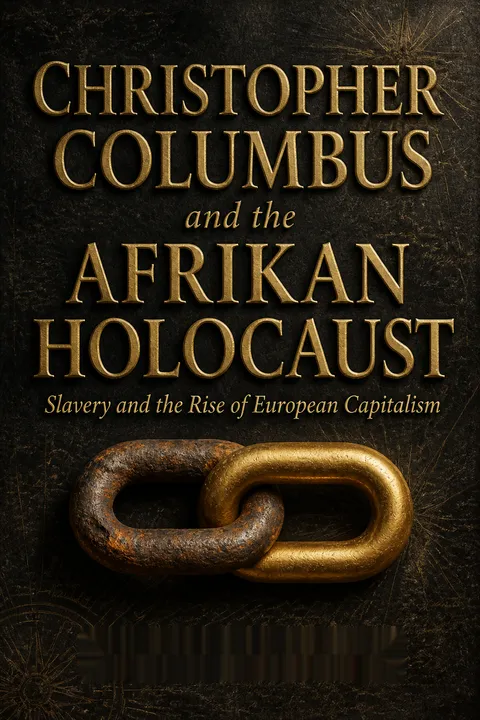

Key Takeaways
1. Christopher Columbus: A Symbol of Exploitation, Not Discovery
Christopher Columbus discovered absolutely nothing, that he was an adventurer, an opportunist, and a willful murderer and a liar and that what he set in motion was the basis of Western capitalism and exploitation of both Africans and Indigenous Americans who had committed no crimes against European people and did not know of European intention to conquer and enslave them.
Challenging the narrative. The traditional narrative of Christopher Columbus as a heroic "discoverer" is a systematic falsification of history. Evidence suggests numerous pre-Columbian contacts with the Americas, including African expeditions from Mali in the 1300s and Viking settlements around 1000 A.D. Columbus was not the first to reach the Americas, nor was his voyage driven by noble curiosity.
Opportunist and murderer. Columbus was an adventurer driven by extreme craving to plunder and enslave, as evidenced by his own diaries and the accounts of Catholic cleric Bartolomeo de las Casas. He immediately saw the Indigenous Americans as potential servants and slaves, initiating a genocidal process that wiped out millions. His actions set a precedent for later European conquistadors who raped and pillaged.
Legacy of exploitation. Columbus's voyages marked the starting point of world capitalism and European colonial domination, establishing a global system of exploitation rooted in materialism, capitalism, and imperialism. This system was built on the super-exploitation of Indigenous Americans and the enslavement of Africans, leading to institutionalized White supremacy and a clash where African and Native American humanism lost to European materialism.
2. The African Holocaust: The Greatest Crime in Human History
The holocausts against the African Americans and the Indigenous Americans mistakenly called Indians was more than a hundred times worse than the European Holocaust that we know so much about.
Unparalleled scale. The African Holocaust, initiated by Columbus and the subsequent transatlantic slave trade, represents the greatest single crime in world history. Its magnitude, spanning centuries and claiming tens of millions of lives, dwarfs other historical tragedies, including the European Holocaust, yet it remains largely unmemorialized.
Systematic dehumanization. This holocaust was not merely about forced labor; it was a systematic process of dehumanization, cultural destruction, and protracted genocide. Africans were reduced to living commodities, their humanity denied to justify their enslavement and the economic enrichment of Europe.
Ongoing impact. The reverberations of this holocaust continue to affect African people globally, manifesting in various forms of oppression and underdevelopment. The lack of proper memorialization for its victims is a profound delinquency, akin to not burying the dead, leaving their voices unheard and their suffering unacknowledged.
3. European Capitalism Forged in African Enslavement
The link between capitalism and slavery was forged.
Economic engine. The transatlantic slave trade was the central pillar of the emerging European-American system of materialism, nurturing the exploitation of new lands, labor, and resources. This system laid the foundation for modern European capitalism and the Industrial Revolution, particularly in England.
Papal sanction. The Catholic nations of Portugal and Spain, with papal authorization to "reduce to servitude all infidel people," initiated the genocidal process. Later, Protestant nations like Holland and Britain, driven by greater business efficiency, transformed slavery into a massive, highly profitable enterprise.
Global domination. This economic system produced European world domination, centered around intercontinental trade and capitalism. The wealth extracted from the unpaid labor of Africans and the resources plundered from the Americas fueled Europe's rise from the Dark Ages, enabling its expansion and control over global land, labor, and resources.
4. Africa's Golden Ages Preceded European Contact
Most people in the world who have had an age of grandeur or a Golden Age, have had only one. As did the Romans, the Greeks rose and fell and never rose again. I maintain that African people have had three Golden Ages and could have a fourth one.
Ancient grandeur. Africa was the birthplace of humanity and the cradle of civilization, experiencing multiple "Golden Ages" long before Europe emerged as a functioning entity. The First Golden Age saw the rise of ancient Egypt, with figures like Imhotep, the world's first multi-genius and father of medicine.
Western Sudan empires. Africa's Third Golden Age flourished in the Western Sudan (Inner West Africa) with magnificent empires like Ghana, Mali, and Songhai. These states boasted:
- Advanced political organization and social well-being
- Vast wealth, particularly in gold
- Intellectual centers like the University of Sankore at Timbuktu
- Scholars renowned throughout the Muslim world, surpassing many European savants
Cultural sophistication. These African civilizations were highly sophisticated, with established systems of banking, credit, and literature. They were comparable, and often superior, to contemporary European kingdoms, demonstrating a rich cultural and intellectual heritage that predated and often surpassed European development.
5. European Expansion: Driven by Greed, Justified by Dehumanization
Europeans had to create a rationale and a series of myths to justify their new position and what they intended to extract from non-European people.
Post-Crusades Europe. Europe, emerging from the lethargy of the Middle Ages, famines, and plagues, was hungry and seeking new resources. The Crusades, though military failures, provided an impetus for exploration and trade, exposing Europeans to the advanced cultures of the East.
Search for wealth. Initially seeking gold and a route to Asian spices, Europeans ventured down the African coast. They encountered well-organized African societies but, driven by a competitive nature and a desire for exploitation, soon turned from guests to conquerors and slave traders.
Myths of justification. To rationalize their actions, Europeans created pervasive myths:
- People in darkness: Claiming to bring light, they destroyed existing civilizations.
- No legitimate God: Dismissing non-European religions as unworthy.
- Primitive/Aborigine: Derogatory reinterpretation of "first" or "original."
- Invader as civilizer: Spreading their way of life at the expense of victims, destroying civilization in the name of it.
This colonization of information and the image of God served to deny the conquered peoples their history, culture, and spirituality.
6. The Middle Passage: A System of Unparalleled Cruelty
The Middle Passage, the condition of the transfer of the Africans across the Atlantic to the various ports of embarkation where they were to be sold as slaves, is the most tragic story of forced migration in human history.
Dehumanization perfected. The Middle Passage was a horrific process designed to transport captured Africans across the Atlantic, transforming them into living commodities. This forced migration ignored their humanity, laying the foundation for modern capitalism through a world trade system built on their suffering.
Unimaginable conditions. Slaves were packed "like books on a shelf" in cramped holds, with barely enough room to lie down, enduring unbearable heat and the stench of excrement and infected sores. Chained in pairs, they faced constant fear of rebellion and the ever-present threat of disease and death.
Tight pack vs. loose pack. Slave traders debated the "tight pack" versus "loose pack" methods, weighing the economic benefits of loading more slaves (tight pack, higher mortality) against ensuring healthier arrivals (loose pack, lower mortality). This debate starkly illustrates the complete disregard for African lives, reducing them to mere cargo.
7. Slavery's Devastating Impact and African Resilience
The greatest destroyer of African culture, the greatest exploiter of the African, was the plantation system of the New World.
Cultural destruction. The plantation system in the New World systematically destroyed African culture, particularly in the United States, where efforts were made to erase memory of their free past. African drums, ornamentation, and religion were outlawed, severing cultural continuity and deliberately breaking family units.
Varied systems. While all slavery was brutal, systems differed:
- Caribbean/South America: Slaves often formed majorities, maintained some cultural mobility, and were bought in larger lots from similar regions, preserving language and family ties. This facilitated more successful revolts.
- United States: Slaves were bought in small lots and frequently resold, deliberately breaking family and tribal loyalties, creating divisions like "field Black" and "house Black."
Resistance and contribution. Despite extreme dehumanization, Africans never passively accepted their condition. They staged numerous revolts, contributed significantly to the economies of the New World, and fought for the liberation of countries like Haiti and Cuba. Their resilience and contributions were fundamental to the making of the Americas.
8. The Imperative of African Unity and Self-Determination
There is no solution for African people, except for some form of Pan African Nationalism, no matter how you cut it.
Reclaiming agency. After centuries of exploitation and the squandering of European wealth on wars, Africans must recognize that their former masters will not willingly relinquish control. The path to true liberation lies in Pan-African Nationalism, transcending religious, political, and social divisions to face the world as one people.
Economic self-reliance. Africans must build their own economies, moving beyond consumerism and dependence on external powers. This involves:
- Unifying Caribbean islands into economic and defense unions.
- Developing self-sufficient agricultural systems.
- Leveraging the skills of African veterans for nation-building.
- Investing in industries that serve the vast African global population.
Revolutionary change. True freedom requires a "sacrificial generation" willing to innovate, not imitate, and to prioritize collective well-being over individual gain. This means developing a new concept of education that empowers Africans to understand their history, tap into their potential, and shape their own destiny, starting with self and community.
9. Reclaiming History: Challenging Eurocentric Narratives
All of the fight over curricula was set in motion because Christopher Columbus and others set in motion a concept of divine White right/manifest destiny.
Colonization of information. Europeans not only colonized lands and resources but also information about world history, creating a narrative that presented them as culturally pure and divinely mandated to lead. This led to the systematic misrepresentation or omission of non-European achievements.
Myths of superiority. The concept of "divine White right" and "manifest destiny" fostered the assumption that Europeans had inherent rights over other peoples, often justified by a bogus concept of a "chosen" people. This ideology underpinned the destruction of indigenous populations and the enslavement of Africans.
Truth-seeking. Reclaiming history involves challenging these Eurocentric myths and understanding the true motivations behind European expansion. It means acknowledging pre-Columbian contacts, the advanced nature of African civilizations, and the destructive impact of European "civilization" on the rest of the world.
10. Memorializing the Victims: A Call to Remember and Rebuild
I maintain that the people of the entire African world, both in Africa and abroad, are delinquent in their responsibility to their ancestors until some proper memorials are erected in every place in the world where there is an African population.
Unburied dead. The absence of proper memorials for the victims of the African Holocaust is a profound failure, leaving millions unacknowledged. This collective amnesia prevents a full reckoning with the past and hinders the healing and rebuilding necessary for African people globally.
A sacred mission. Memorializing the dead is not just about erecting monuments; it's about remembering, teaching future generations, and committing to revolutionary change. It means preserving the physical evidence of slavery—chains, irons, dungeons—to ensure that such atrocities are never repeated.
New humanity. By understanding their history and uniting, African people can offer the world a new humanity, demonstrating the stupidity of conflict and the power of self-reliance. Their mission is not to conquer but to contain Europe's dominance through honorable trade and to build a world of safety and respect for all.
People Also Read

Download PDF
Download EPUB
.epub digital book format is ideal for reading ebooks on phones, tablets, and e-readers.








































