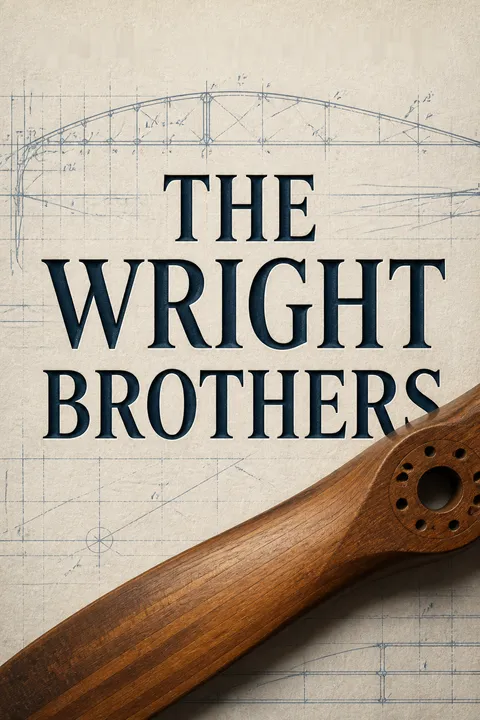

Key Takeaways
1. A Childhood Spark Ignited a Lifelong Obsession
According to brothers Wilbur and Orville Wright of Dayton, Ohio, it began for them with a toy from France, a small helicopter brought home by their father, Bishop Milton Wright, a great believer in the educational value of toys.
Early inspiration. The dream of flight for Wilbur and Orville Wright was sparked by a simple French toy helicopter, a gift from their father, Bishop Milton Wright. This early exposure to mechanical wonders, combined with their father's belief in educational toys, fostered a deep-seated curiosity and mechanical aptitude in the boys. Orville, even in grade school, was already tinkering with wood, telling his teacher he was making a machine he and his brother would someday fly.
Family foundation. The Wright household, though modest, was a crucible of intellectual curiosity and strong character. Bishop Wright, an itinerant preacher, instilled in his children a love for reading, independent thought, and unwavering perseverance. Their mother, Susan Koerner Wright, a "regular genius" with her hands, passed on her mechanical aptitude, while their sister Katharine, a college graduate, provided emotional support and a lively intellectual sparring partner.
Wilbur's turning point. A severe hockey accident in his youth, which left Wilbur with broken teeth and prolonged depression, inadvertently redirected his path from Yale to intense self-study. This period of seclusion, filled with extensive reading, particularly on the history of flight and the works of pioneers like Alphonse Pénaud and Sir George Cayley, deepened his resolve and laid the theoretical groundwork for their future endeavors.
2. Systematic Study and Ingenious Innovation Paved the Way
“The birds’ wings are undoubtedly very well designed indeed, but it is not any extraordinary efficiency that strikes with astonishment but rather the marvelous skill with which they are used.”
Learning from nature. Inspired by the death of German glider pioneer Otto Lilienthal, the brothers embarked on a systematic study of flight, particularly the mechanics of birds. They devoured scientific treatises, including Etienne-Jules Marey's Animal Mechanism and J. Bell Pettigrew's Animal Locomotion, and spent hours observing buzzards and gannets at the Pinnacles, a rugged stretch along the Miami River. This meticulous observation led Wilbur to conclude that true mastery of flight lay in control and balance, not just lift.
The wing-warping breakthrough. A pivotal moment came when Wilbur demonstrated his "wing warping" concept using a cardboard box, showing how twisting wingtips could control roll and turn, mimicking a bird's dynamic adjustments. This innovative idea, combined with a movable forward rudder (elevator) for pitch control, formed the core of their control system, a significant departure from previous experimenters who relied on shifting body weight.
Scientific rigor. Recognizing the unreliability of existing aeronautical data, the brothers built their own small-scale wind tunnel in their bicycle shop. For three months, they meticulously tested 38 different wing surfaces, using hacksaw blades as airfoils. This painstaking "laboratory work" yielded accurate data on lift and drag, proving crucial for designing their subsequent gliders and ultimately, their powered Flyer.
3. Unwavering Perseverance Through Adversity Defined Their Journey
“We came down here for wind and sand and we have got them.”
Embracing challenges. The Wright brothers' expeditions to Kitty Hawk, North Carolina, were fraught with challenges, from treacherous sea voyages and primitive living conditions to relentless mosquito swarms and violent storms. Despite these adversities, they embraced the harsh environment, recognizing that the strong, steady winds and soft sand dunes were ideal for their gliding experiments. Their resilience was evident in their ability to repair damaged gliders and continue their work after setbacks.
Learning from failure. Their first full-sized glider in 1900, though disappointing in performance, provided invaluable lessons, particularly about the need for more precise control. The 1901 glider, initially performing worse than expected due to an overly curved wing, was rebuilt and refined, leading to successful glides and further validation of their wing-warping system. Each failure was treated as a learning opportunity, reinforcing their belief that practical experience in the air was paramount.
Mental fortitude. Beyond the physical hardships, they faced intellectual frustration when established scientific tables proved inaccurate, forcing them to "discover everything ourselves." This period of intense, self-funded research, often extending late into the night, showcased their extraordinary determination. Their ability to maintain focus and good humor, even amidst arguments and exhaustion, was a testament to their shared purpose and unyielding resolve.
4. The First Powered Flight: A Quiet Triumph Against Skepticism
“It was only a flight of twelve seconds,” he would also stress later, “and it was an uncertain, wavy, creeping sort of a flight at best, but it was a real flight at last.”
Building the engine and propellers. Faced with the lack of a suitable lightweight engine, the brothers, with the brilliant mechanic Charlie Taylor, designed and built their own four-cylinder gasoline engine in just six weeks. Simultaneously, they tackled the complex problem of propeller design, viewing it as a rotating wing and developing their own data. This self-reliance in engineering was critical to their success.
Langley's public failure. Just days before their historic flight, Samuel Langley's heavily funded "Great Aerodrome" publicly crashed into the Potomac, further solidifying public and scientific skepticism about human flight. This widely publicized failure contrasted sharply with the Wrights' quiet, methodical approach and their eventual success, which cost them less than $1,000 of their own money compared to Langley's $70,000 in public funds.
The historic moment. On December 17, 1903, at Kill Devil Hills, with only five witnesses, Orville Wright made the first sustained, controlled, powered flight in history, lasting 12 seconds and covering 120 feet. Later that day, Wilbur flew 852 feet in 59 seconds. Despite the monumental achievement, the initial public and press reaction was largely indifferent or dismissive, with one editor famously stating, "If it had been fifty-seven minutes, then it might have been a news item."
5. Mastering the Air: Huffman Prairie Forged the Practical Airplane
“The best dividends on the labor invested,” they said, “have invariably come from seeking more knowledge rather than more power.”
A new testing ground. In 1904, the Wrights moved their experiments to Huffman Prairie, a cow pasture near Dayton, seeking a more convenient location for continuous practice. Despite its challenges—groundhog hummocks, barbed wire, and public visibility—they adapted, building a new shed and devising a gravity-powered catapult to achieve consistent takeoffs, independent of strong winds. This period was crucial for refining their flying techniques and machine.
Relentless refinement. The Flyer II and Flyer III underwent continuous modifications and repairs, with each crash or mishap providing new insights. They learned to make controlled turns, fly S-shaped courses, and recover from stalls. Their philosophy emphasized "seeking more knowledge rather than more power," leading to critical design changes like moving the forward rudder further for better longitudinal control, transforming the Flyer III into the world's first truly practical airplane.
Local indifference, a prophet's recognition. Despite making over 100 flights in 1905, including one lasting 39 minutes and covering 24 miles, the local Dayton press and public remained largely uninterested. It was Amos I. Root, an Ohio beekeeper and amateur scientist, who, after witnessing their flights, published the first accurate and enthusiastic account in his trade journal, Gleanings in Bee Culture, recognizing the Wrights as "scientific explorers" ushering in a new era.
6. Europe Embraced the Genius While America Hesitated
“We do not wish to take this invention abroad, unless we find it necessary to do so, and therefore write again, renewing the offer.”
Governmental apathy. Despite their proven success at Huffman Prairie, the Wrights faced repeated rejections from the U.S. War Department, which, scarred by the Langley debacle, demanded impractical conditions like public demonstrations at no cost to the government. This bureaucratic inertia and skepticism forced the patriotic brothers to consider foreign markets, reluctantly offering their invention to other nations.
European interest. In contrast, European nations, particularly Britain and France, showed keen interest. British military officers visited Dayton, and a French syndicate, led by Arnold Fordyce, initiated serious negotiations for the purchase of a Wright Flyer. This international attention, fueled by the growing aviation enthusiasm in Europe, highlighted the stark difference in perception compared to their homeland.
Wilbur's diplomatic mission. In 1907, Wilbur embarked on his first solo trip to Europe, tasked with negotiating sales agreements. Despite initial skepticism from the European press, who labeled them "Fliers or Liars," Wilbur's quiet confidence, meticulous explanations, and refusal to be swayed by political maneuvering or bribery attempts, gradually won over influential figures like Hart O. Berg and French military officials. His intellectual depth, evident in his appreciation for Parisian art and architecture, further impressed those he met.
7. Wilbur's European Triumph: From Skepticism to Global Acclaim
“Gentlemen, I’m going to fly.”
A dramatic debut. After months of painstaking repairs to the Flyer, damaged in transit, and enduring intense press scrutiny and skepticism, Wilbur finally staged his first public demonstration at Le Mans, France, on August 8, 1908. Before a modest but expectant crowd, including prominent French aviators and skeptics like Ernest Archdeacon, Wilbur calmly announced, "Gentlemen, I'm going to fly."
A masterful performance. His initial flight, lasting less than two minutes but demonstrating unprecedented control, including graceful turns and a precise landing, electrified the crowd. The French press, which had previously mocked him, erupted in headlines proclaiming, "This man has conquered the air!" and "He is not a bluffer!" Louis Blériot, a leading French aviator, declared, "A new era in mechanical flight has commenced."
Sustained brilliance. Over the following months at Le Mans and later at Pau, Wilbur continued to dazzle, setting new world records for endurance, speed, and altitude, and making the first passenger flights. He trained French pilots, including the Comte de Lambert, and captivated royalty like King Alfonso XIII of Spain and King Edward VII of England. His quiet dignity, meticulous craftsmanship, and unwavering focus transformed him into a global celebrity, admired for his genius and character.
8. Orville's Fort Myer Ordeal: A Tragic Setback, A Resilient Spirit
“It was probably thirty seconds before Will appeared.”
Orville's turn in the spotlight. While Wilbur captivated Europe, Orville prepared for public demonstrations at Fort Myer, Virginia, for the U.S. Army. Despite lingering injuries from his 1905 crash and the pressure of performing before high-ranking officials and a growing public, Orville quickly set new world records for endurance and passenger flights, proving the Flyer's capabilities and silencing American skeptics.
The tragic crash. On September 17, 1908, during a flight with Lieutenant Thomas Selfridge, a propeller blade cracked, causing the Flyer to lose control and plunge to the ground from 125 feet. Selfridge tragically became the first fatality in powered flight, and Orville suffered severe injuries, including a fractured leg and broken ribs. The accident was a stark reminder of the inherent dangers of early aviation.
Katharine's unwavering support. In the wake of the crash, Katharine rushed to Orville's side, taking an indefinite leave from her teaching job. She became his devoted nurse, fending off reporters, managing correspondence, and providing emotional strength during his long and painful recovery. Her presence was indispensable, highlighting the profound family bond that underpinned their extraordinary achievements.
9. A Grand Homecoming and the First Flight Together
“Higher, Orville, higher!”
A hero's welcome. After their triumphs in Europe and Orville's recovery, the Wrights returned to a hero's welcome in New York and Dayton in May 1909. Dayton, which had largely ignored their early experiments, now celebrated them with a two-day "Great Homecoming," featuring parades, speeches, and a "Court of Honor." This belated recognition underscored the shift from local indifference to national pride.
Resuming trials. Despite the fanfare, the brothers quickly returned to work, preparing a new Flyer for the delayed Fort Myer trials. Orville, still limping but determined, resumed flying, eventually passing the Army's rigorous speed and endurance tests, securing a $30,000 contract. This success solidified the U.S. government's commitment to their invention.
A symbolic flight. On May 25, 1910, at Huffman Prairie, in a moment of profound significance, Wilbur and Orville flew together for the first time, with Orville at the controls. This symbolic flight, breaking their long-standing rule of never flying together, marked the culmination of their shared dream. Later that day, their 82-year-old father, Bishop Milton Wright, took his first flight with Orville, famously exclaiming, "Higher, Orville, higher!"
10. The Enduring Legacy: Patent Battles and a Visionary Future
“When we think what we might have accomplished if we had been able to devote this time to experiments,” Wilbur wrote to a friend in France, “we feel very sad, but it is always easier to deal with things than with men, and no one can direct his life entirely as he would choose.”
The cost of success. The years following their triumphs were consumed by the demands of the Wright Company and relentless patent infringement lawsuits, particularly against Glenn Curtiss. These legal battles, though ultimately won by the Wrights, diverted precious time and energy from further experimentation, a source of deep regret for Wilbur, who prioritized scientific advancement over commercial disputes.
Wilbur's untimely death. Exhausted by the pressures of business and litigation, Wilbur fell ill with typhoid fever and died on May 30, 1912, at the age of 45. His death was a profound loss, not only for his family but for the burgeoning field of aviation, leaving Orville to carry on their legacy alone. Bishop Wright eulogized him as a man of "unfailing intellect, imperturbable temper, great self reliance and as great modesty."
Orville's later years and vindication. Orville continued to fly and innovate for several more years, setting new records and contributing to aviation research. He faced a protracted battle with the Smithsonian Institution, which, in an attempt to rehabilitate Samuel Langley's reputation, initially downplayed the Wrights' achievements. It took decades for the Smithsonian to fully acknowledge the Wrights' primacy, a testament to Orville's unwavering commitment to historical accuracy and his brother's memory. He lived to see aviation transform the world, reflecting on its destructive potential but ultimately affirming its profound benefit to humanity.
Review Summary
Reviews of The Wright Brothers are overwhelmingly positive, averaging 4.18 out of 5. Readers praise McCullough's ability to bring the Wright family to life through meticulous research, personal letters, and diaries. Reviewers highlight the brothers' remarkable determination, intellectual curiosity, and humble origins as bicycle mechanics who revolutionized human history. Many appreciated learning about their sister Katharine's crucial supporting role. Some noted the book's relatively brief length left them wanting more biographical detail, and a few found the author's self-narration of the audiobook merely adequate rather than polished.
People Also Read







About the Author
Other books by David McCullough






Download PDF
Download EPUB
.epub digital book format is ideal for reading ebooks on phones, tablets, and e-readers.








































