
Key Takeaways
1. The grassroots mobilization of Scottish women shattered a political monoculture
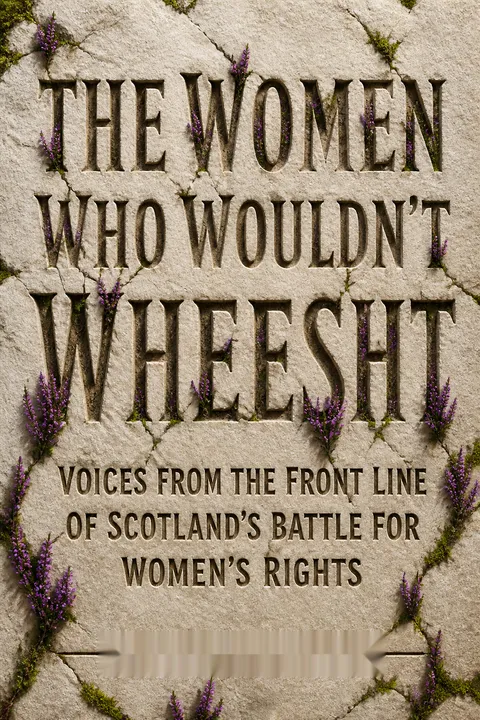
Those three words were my message to anyone who found my speaking up for my daughter’s dignity distracting or unkind. I would not shut up. I would not stand aside.
The birth of defiance. The "Women Won't Wheesht" movement began as a quiet, desperate plea by a mother defending her disabled daughter's right to same-sex intimate care. It quickly transformed into a powerful grassroots battle cry that united women across Scotland who refused to be silenced by politicians.
Guerrilla feminist tactics. Lacking the massive state funding enjoyed by trans advocacy groups, these women relied on creative, low-cost, and highly visible methods to spread their message. They bypassed mainstream media gatekeepers by utilizing:
- Social media platforms like Mumsnet and Twitter to coordinate campaigns and share information.
- Tying suffragette-coloured ribbons (green, white, and purple) to lampposts, trees, and postboxes.
- Placing painted slates with feminist quotes in public spaces across the country.
- Dressing historic statues, such as Greyfriars Bobby, in "Adult Human Female" T-shirts.
Rebuilding the sisterhood. Abandoned by established, government-funded feminist organizations like Engender, these women built a decentralized, self-funded network of action groups from scratch. This cooperative constellation crossed deep party and constitutional divides, proving that the material reality of biological sex was a unifying force capable of challenging the political establishment.
2. Institutional "policy capture" quietly replaced biological sex with gender identity
We had a group of people who were very convinced that what you felt yourself to be was more important than anything else.
Stealth policy changes. Long before the public or Parliament debated gender recognition reform, state-funded lobby groups like the Equality Network and the Scottish Trans Alliance (STA) successfully embedded self-identification (self-ID) principles across Scottish public services. This quiet revolution occurred without public consultation or rigorous impact assessments.
Capturing key institutions. Key public bodies adopted policies that prioritized subjective gender identity over objective biological sex, often framing any objections from women as akin to bigotry or racism. These captured institutions included:
- The Scottish Prison Service (SPS), which allowed male prisoners to be housed in the female estate based on self-declaration.
- NHS Scotland, which integrated self-ID into hospital ward placement policies, threatening female-only spaces.
- State-funded women's support services, which were pressured to adopt "trans-inclusive" models to secure government grants.
The erasure of data. This institutional shift threatened the collection of robust, sex-disaggregated data, which is essential for identifying and tackling sex discrimination. By attempting to conflate sex and gender identity in the national census and police recording systems, public bodies risked making women's unique material realities legally and statistically invisible.
3. Women who spoke out faced severe professional, social, and physical hounding
There is no male equivalent to the dehumanising TERF, spat from the lips of men enjoying fragile thuggery, gifted such power by this movement to abuse, to smear, to hound.
The cost of heresy. Women who publicly questioned gender identity ideology or defended sex-based rights were subjected to a vicious, coordinated campaign of social ostracization, professional ruin, and physical threats. This modern-day witch hunt was designed to enforce a strict "no debate" orthodoxy across academia, the arts, and politics.
Targeted professional destruction. Prominent female figures faced severe consequences for refusing to submit to the new linguistic and ideological demands. Specific examples of this hounding include:
- Rector Ann Henderson being bullied and falsely accused of transphobia by student groups and trade unions at Edinburgh University.
- Poet Jenny Lindsay being blacklisted, losing commissions, and facing attempts to cancel her book launches.
- Author Gillian Philip being summarily fired from her writing job for using a supportive hashtag for J.K. Rowling.
- Academic Shereen Benjamin facing repeated blockades and security threats for trying to screen a feminist documentary.
The chilling of free speech. This hostile environment forced many women into self-censorship to protect their livelihoods and families. The process itself became the punishment, as activists weaponized institutional complaints procedures and hate-crime reporting to silence anyone who asserted that biological sex is an immutable reality.
4. The courts became a vital battleground to defend the legal definition of "woman"
Provisions in favour of women, in this context, by definition exclude those who are biologically male.
Taking the state to court. Lacking representation in a captured Parliament, grassroots women's groups like For Women Scotland (FWS) turned to the legal system to challenge the Scottish Government's overreach. They raised hundreds of thousands of pounds through small, individual crowdfunded donations to mount historic judicial reviews.
Challenging legislative overreach. The legal battles focused on preventing the Scottish Government from rewriting the definition of "woman" to include biological males, which violated the UK-wide Equality Act 2010. Key legal milestones included:
- FWS winning an appeal against the Gender Representation on Public Boards Act, ruling that "woman" in this context excludes biological males.
- Fair Play for Women challenging the census guidance in court to preserve the biological definition of the sex question.
- Subsequent rulings clarifying that a Gender Recognition Certificate (GRC) alters a person's sex for the purposes of the Equality Act, exposing the complexity of single-sex exemptions.
Exposing political contradictions. These court cases forced the Scottish Government to publicly articulate the legal consequences of a GRC, exposing a massive contradiction. While ministers assured Parliament that a GRC was just a "piece of paper" with no impact on women's spaces, their lawyers argued in court that it fundamentally altered a person's legal sex.
5. Self-ID policies compromised safeguarding in prisons and single-sex spaces
Police Scotland wouldn’t arrest my rapist, but they will threaten to arrest me and women like me for sitting quietly.
The reality of male violence. The replacement of biological sex with self-declared gender identity directly compromised the safety, dignity, and privacy of women in vulnerable, single-sex environments. Women survivors of male violence argued that the presence of male-bodied individuals in these spaces triggered trauma and forced women to self-exclude from vital services.
The prison safeguarding crisis. The most egregious consequence of these policies was the housing of violent male sex offenders in the female prison estate. Former prison governor Rhona Hotchkiss and other campaigners highlighted:
- The placement of double rapist Adam Graham/Isla Bryson in Cornton Vale women's prison.
- The high proportion of trans-identified male prisoners who are convicted sex offenders.
- The emotional and psychological distress inflicted on vulnerable female prisoners who could not escape the presence of male-bodied inmates.
The betrayal of survivors. State-funded organizations like Rape Crisis Scotland and Scottish Women's Aid were accused of betraying the very women they were established to protect. By prioritizing gender identity over biological sex, these services could no longer guarantee female-only care, leaving traumatized women with nowhere to turn.
6. The capture of schools and youth services put vulnerable children at risk
What were you thinking? Why would you impose an adult agenda on children? There is no such thing as a 'trans brain'.
Affirmation in education. Under the influence of state-funded charities like LGBT Youth Scotland, Scottish schools adopted a highly ideological "affirmation-first" approach to children experiencing gender distress. This guidance encouraged schools to socially transition children—changing their names, pronouns, and uniforms—often without the knowledge or consent of their parents.
The medicalization of youth. Parents and child-development experts raised the alarm over the rapid, unevidenced medicalization of gender-dysphoric children at clinics like the Sandyford in Glasgow. This pathway often led to:
- The prescription of experimental puberty blockers and cross-sex hormones.
- Irreversible physical changes, including double mastectomies and infertility.
- The disproportionate targeting of autistic, same-sex attracted, and traumatized young people who struggled to fit into rigid gender stereotypes.
The parental struggle. Parents who questioned this orthodoxy found themselves isolated, ignored by schools, and in some cases reported to social services for "emotional abuse" for refusing to affirm their child's transition at home. The tragic stories of detransitioners like Ritchie Herron and Sinead Watson served as a warning of the human cost of this unregulated medical experiment on children.
7. The suppression of parliamentary debate exposed a deep democratic deficit
Our parliament abjectly failed to hold the cabinet to account, or to nurture debates beyond the government agenda.
A captured legislature. The passage of the Gender Recognition Reform (Scotland) Bill revealed a profound democratic deficit within the Scottish Parliament. Under the authoritarian leadership of Nicola Sturgeon, the political establishment operated as a monoculture, actively suppressing dissenting voices and rushing through legislation without proper scrutiny.
Silencing the critics. The parliamentary committee responsible for the bill systematically shut out critical evidence and refused to meet with female survivors of male violence. This suppression of debate was characterized by:
- Stacking witness lists with state-funded lobby groups that supported the bill.
- Treating independent experts, like UN Special Rapporteur Reem Alsalem, with hostility and marginalizing their testimony.
- Voting down common-sense amendments, including those designed to prevent sex offenders from changing their legal gender.
The late-night marathon. The final Stage 3 debate was pushed through in a chaotic, late-night marathon just before Christmas, forcing exhausted MSPs to vote on complex amendments in the middle of the night. This undemocratic rush was designed to minimize public awareness and push the bill through before the political backlash could grow.
8. A cross-party sisterhood united political rivals and triggered a historic downfall
The more she ignored us, the stronger we became.
Uniting across the divide. The battle for women's rights forged an unprecedented cross-party alliance among women who would normally be fierce political opponents. SNP, Labour, and Conservative women set aside their deep differences over Scottish independence and unionism to stand shoulder to shoulder against the erasure of their sex-based rights.
The rebellion within. This grassroots pressure eventually triggered a historic rebellion within the ruling SNP, culminating in the resignation of Community Safety Minister Ash Regan and nine backbenchers voting against the government. This crack in the party's iron discipline exposed the limits of Nicola Sturgeon's control and set the stage for her political demise.
The final reckoning. The ultimate collapse of the GRR Bill, blocked by the UK government under Section 35 of the Scotland Act, and the public scandal surrounding the housing of a double rapist in a women's prison, shattered Sturgeon's progressive reputation. Her sudden resignation in February 2023 was a historic victory for the ordinary, self-funded women who refused to "wheesht" and successfully took on the political establishment.
Download PDF
Download EPUB
.epub digital book format is ideal for reading ebooks on phones, tablets, and e-readers.








































