

Key Takeaways
Every meltdown is a hidden classroom for building your child's brain
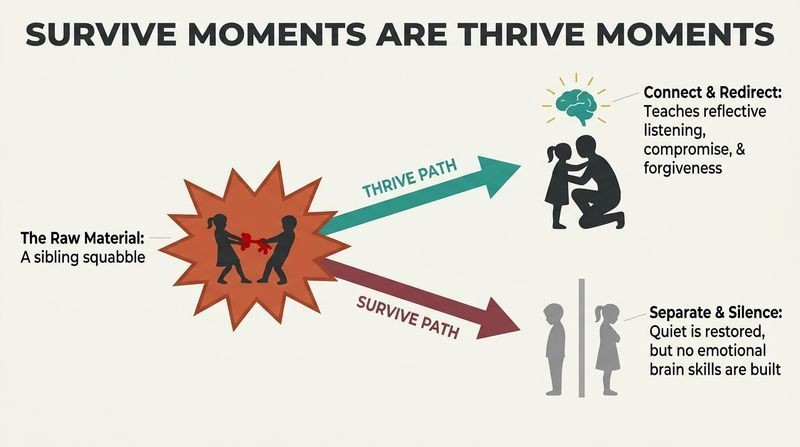
Survive moments are thrive moments. Siegel and Bryson reframe the worst parts of parenting (the restaurant tantrum, the homework war, the third sibling fight in three minutes) as the exact moments where the deepest teaching happens. You do not need to carve out special enrichment time. The stressful, screaming, crayon-on-the-wall episodes are the raw material.
The authors point out that most parents know more about their child's body temperature than about their child's brain, even though the brain governs discipline, decisions, and relationships. Their promise: understand a few brain basics and you stop merely getting through the day and start shaping who your kid becomes. A sibling squabble, handled well, teaches reflective listening, compromise, and forgiveness instead of just being silenced by separating the combatants.
What's striking is the inversion of the perfectionist parenting culture the authors mock with their lavender-misting superparent. Rather than adding more (more classes, more organic kale), they reclaim time you already spend. This echoes Vygotsky's zone of proximal development: learning happens in supported struggle, not curated calm. The claim has limits, though. Treating every tantrum as a teachable moment risks exhausting parents who are themselves depleted, and the book's own honesty about sleep-deprived rage suggests timing matters. The reframe is most useful as permission rather than obligation: you are allowed to teach in the mess, not required to optimize every minute.
Mental health means floating between the banks of chaos and rigidity
Integration is the whole game. The book's central concept is integration: linking the brain's distinct parts so they work as a coordinated whole, the way lungs, heart, and stomach each do their job yet cooperate. When integration breaks down, you get dis-integration: tantrums, meltdowns, and shutdowns.
Siegel pictures mental health as a canoe drifting down a river of well-being. One bank is chaos (out of control, flooded by emotion). The other is rigidity (over-controlled, refusing to adapt). A toddler who won't share is hugging rigidity. The same toddler who then throws sand in fury has crashed into chaos. Health is the flexible current in between. This gives parents a diagnostic: spot chaos or rigidity and you know integration has been blocked, so your job is to guide the canoe back to center.
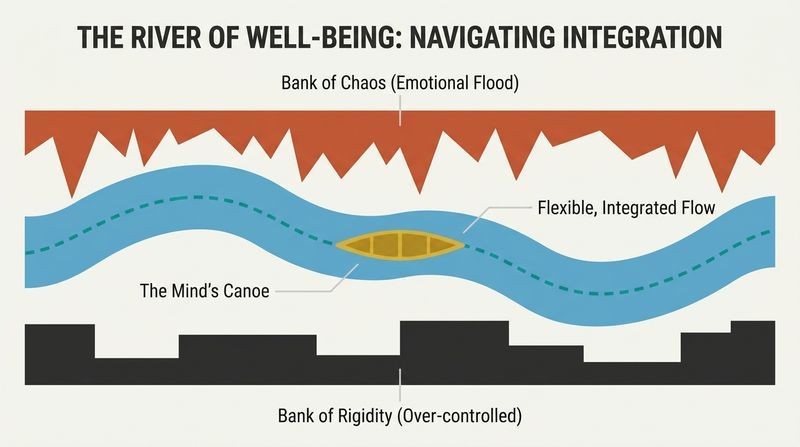
The chaos-rigidity spectrum is a genuinely useful clinical lens, and it maps onto modern affective neuroscience: dysregulation runs in both directions, hyperarousal and hypoarousal, a point Stephen Porges makes in polyvagal theory and Bessel van der Kolk echoes in trauma work. Defining mental health by flexibility rather than the mere absence of symptoms is also refreshingly positive. One caution: the metaphor can imply a single correct middle, when temperament means different children have wider or narrower rivers. A naturally intense child living near the chaos bank is not broken, and the goal is widening the channel, not forcing everyone into identical calm.
When a child is flooded, soothe the heart before reasoning with the head
Connect first, redirect second. The left brain is logical, linguistic, and literal; the right brain is emotional, nonverbal, and autobiographical. Young children, especially under three, live mostly in the right brain. When a child is drowning in big feelings, logic from your left brain hits their unreceptive right brain like a brick wall.
Bryson describes her seven-year-old appearing at bedtime, furious she never leaves him notes, his birthday is too far away, and he hates homework. Arguing the facts would have backfired. Instead she pulled him close, rubbed his back, and used a warm tone until he felt heard. This emotional tuning-in, which the authors call attunement, lets a child feel felt. Only after connecting right-brain to right-brain did she address the actual issues. Five minutes, not a battle.
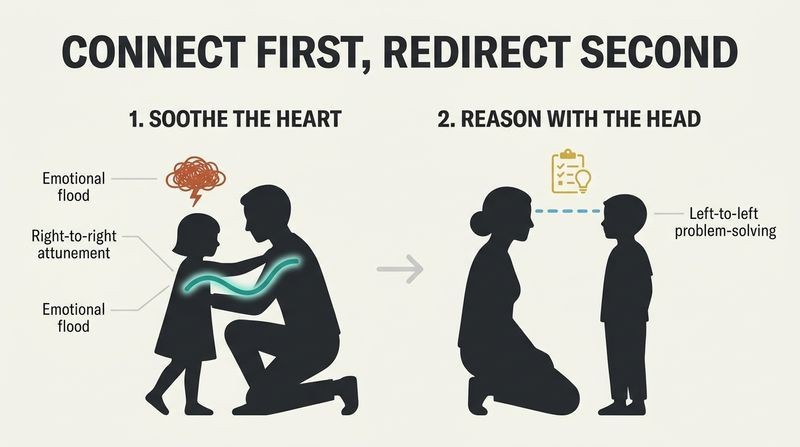
This sequencing matches a robust finding in interpersonal neuroscience: co-regulation precedes self-regulation. A caregiver's calm nervous system literally helps settle a child's stress response before the prefrontal cortex can re-engage. It also aligns with Carl Rogers's insight that people cannot change until they feel understood, and with hostage negotiation training, where rapport precedes problem-solving. The honest tension the authors flag is manipulation: does connecting reward bad behavior? Their answer is sound. Connection is not capitulation; boundaries stay intact. The skill lies in distinguishing a child who is genuinely flooded from one who is strategically testing, which the upstairs-downstairs tantrum distinction helps clarify.
Naming a scary feeling out loud literally quiets the brain's alarm
Tell the story to tame the fear. When a frightening experience floods the right brain, helping a child narrate it brings the logical left brain online to make sense of the chaos. The authors cite research that simply labeling an emotion calms the activity of the right hemisphere's emotional circuitry.
Examples recur throughout: two-year-old Marco, whose babysitter had a seizure while driving, kept repeating his words for the ambulance until his mother retold the crash story again and again, defusing it. Nine-year-old Bella refused to flush a toilet after one overflowed, until her dad walked her through the event repeatedly. The technique works because a coherent story requires both hemispheres: the left orders events and supplies words, the right supplies the felt emotion. This is the science behind why journaling and talking through trauma heal.
Dan Siegel did not invent this, but the phrase captures decades of work. Matthew Lieberman's fMRI studies at UCLA showed that affect labeling, putting feelings into words, dampens amygdala activity and recruits the right ventrolateral prefrontal cortex. James Pennebaker's expressive-writing research found measurable immune and health benefits from narrating difficult events. The deeper principle is that coherence, not mere ventilation, heals: a jumbled retelling can re-traumatize, while an organized narrative with a clear arc integrates the memory. One nuance worth adding: forcing a reluctant child to talk backfires, as the authors note, so invitation and indirect settings (drawing, car rides) often work better than face-to-face interrogation.
Your child's rational brain is a construction site until age 25
The upstairs brain is unfinished. Picture the brain as a two-story house. The downstairs (brainstem and limbic region) handles breathing, instinct, fight-or-flight, and raw emotion, and it works from birth. The upstairs (the cortex, especially the prefrontal area) handles sound decisions, emotional control, empathy, and morality, and it is not fully built until the mid-twenties.
This single fact reframes discipline. The behaviors we demand (think before acting, regulate feelings, consider others) depend on a part of the brain still under construction with patches of sky where the roof should be. Worse, the amygdala, an almond-sized watchdog, can hijack the whole system, slamming a baby gate at the bottom of the stairs so the upstairs becomes unreachable. That is flipping your lid. Kids are often doing their best with the brain they have.
The neurodevelopmental claim is well supported: longitudinal MRI work by Jay Giedd at the NIH showed prefrontal gray matter keeps maturing into the mid-twenties, with myelination of integrative fibers continuing even longer. This has reshaped everything from car-rental policies to the 2005 Roper v. Simmons ruling barring the juvenile death penalty. The parenting payoff is empathy: expecting adult impulse control from a six-year-old is like expecting a half-built staircase to bear weight. The risk, which the authors carefully head off, is the get-out-of-jail-free card. Understanding why a child cannot always self-regulate is not the same as excusing harmful behavior; it changes how you teach, not whether you set limits.
Diagnose the tantrum: negotiate with strategy, comfort with chaos
Two tantrums need opposite responses. Once you grasp upstairs versus downstairs, you see tantrums come in two kinds. An upstairs tantrum is a deliberate, strategic fit; the child could stop instantly if you gave in. This calls for firm boundaries and clear consequences: never negotiate with a terrorist. An downstairs tantrum is a genuine hijack; stress hormones have flooded the body and the upstairs brain is offline. This calls for nurturing, soothing, and physical comfort, because no lesson can land while the brain cannot listen.
The companion move is engage, don't enrage. Bryson's four-year-old stuck his tongue out across a restaurant. Instead of commanding obedience (which fires the reptilian downstairs), she asked what he felt and invited him to negotiate a fair number of bites with his dad. He proposed ten bites, more than half the quesadilla, and peace held.
The upstairs-downstairs tantrum distinction is one of the book's most practical contributions, because it resolves the old behaviorist debate (ignore all tantrums) with a conditional rule. It resembles the difference between instrumental aggression and reactive aggression in developmental psychology, which also demand different interventions. The honest difficulty is real-time diagnosis: an exhausted parent in a grocery aisle cannot easily tell strategy from genuine overwhelm, and a child can shift from one to the other mid-episode. A useful heuristic the authors imply: if connection and a change of scene rapidly de-escalate, it was likely downstairs; if the screaming is contingent on getting the toy, it was upstairs. The engage approach also builds the very skills it relies on.
Move the body to unlock a brain that has seized up
Motion changes emotion. When a child loses access to the upstairs brain, physical movement can restore balance because changing the body's state changes the brain's chemistry. A mother describes her overwhelmed ten-year-old, Liam, curled under a beanbag chair refusing help with homework, who suddenly bolted out the front door and ran several blocks. He returned calm and ready to work, saying only that running fast for as long as he could made him feel better.
The authors note that emotion often begins in the body: a churning stomach signals anxiety before you consciously feel nervous. Smiling can lift mood, and slow deep breaths calm a racing system. A Little League coach had discouraged players jump up and down in the dugout, shifting their energy enough to rally and win. When words fail, get the canoe back to the center of the river through the body.
The bottom-up direction of regulation is genuinely important and often neglected by talk-heavy interventions. William James proposed over a century ago that bodily states generate emotion rather than only follow it, and modern research backs the loop: exercise reduces cortisol and boosts BDNF and mood-regulating neurotransmitters, while controlled breathing activates the vagus nerve and parasympathetic calm. Amy Cuddy's posture work proved controversial on replication, but the breathing and aerobic findings are solid. The practical genius is that movement requires no verbal cooperation from a flooded child, sidestepping the brick wall problem entirely. The limit is that movement resets arousal but does not, by itself, teach the lesson; it opens the door that connection and narrative then walk through.
Buried memories drive baffling fears; drag them into the light
Make implicit memory explicit. Memory is not a file cabinet or photocopier. It is association: neurons that fire together wire together, so present experiences trigger linked past ones, often without our awareness. Implicit memory (encoded from birth, even in the womb) stores emotions, sensations, and expectations we never consciously recall. Explicit memory is the conscious, deliberate kind. The hippocampus is the puzzle-assembler that turns scattered implicit pieces into a coherent explicit picture.
Bryson's son suddenly refused swim lessons, gripped by stomach butterflies he could not explain. Years earlier, strict instructors had dunked him and forced him off a diving board. Once she helped him connect the old fear to the present dread, talk to his brain, and label it kill the butterflies, the fear lost its grip. Hidden memories that stay buried become land mines; named, they become manageable.
This is a developmentally translated account of how trauma and conditioning operate beneath awareness, consistent with LeDoux's research on the amygdala's fast, unconscious fear pathways and with the clinical logic behind exposure therapy and EMDR. The remote-control technique (pause, rewind, fast-forward a painful story) cleverly gives the child a sense of agency, which matters because perceived control is itself a buffer against fear, as Martin Seligman's learned-helplessness work demonstrated in reverse. A worthwhile caution: parents are not therapists, and the authors wisely flag that serious trauma needs professional help. Also, the reconstructive nature of memory cuts both ways; suggestive retelling can distort, so the goal is the child's own narrative, gently scaffolded, not a parent-imposed version.
Teach kids they have a feeling, they are not the feeling
Return to the hub of the wheel. Siegel pictures the mind as a bicycle wheel. The rim holds everything you can notice (thoughts, feelings, memories, sensations, perceptions). The hub at the center is the calm place of awareness from which you choose where to focus. Mindsight is the capacity to see your own mind and the minds of others. Getting stuck on a few painful rim points (a perfectionist boy fixated on a possible B, a child terrified of a ceiling fan) traps you in chaos or rigidity.
The crucial lesson is the difference between feel and am. Children say I am stupid or I am sad, mistaking a temporary state for a permanent trait. Reaching the hub lets them say instead, I feel sad right now. Since an emotion typically rises and passes in about ninety seconds, feelings are weather, not climate.
The feel-versus-am distinction is small linguistically and enormous psychologically. It is the same cognitive defusion that Acceptance and Commitment Therapy teaches adults: observing a thought as a passing mental event rather than fusing with it as identity. The hub-and-rim model is essentially mindful awareness made child-friendly, and the neuroscience is plausible: directing attention strengthens prefrontal regulation, and what fires together wires together, so practiced attention reshapes circuitry. The ninety-second figure, popularized by neuroanatomist Jill Bolte Taylor, refers to the physiological surge of an emotion clearing the bloodstream; the feeling lingers only when we keep re-triggering it with thought, which is precisely why returning to the hub works.
SIFT your inner world: sensations, images, feelings, and thoughts
Name the four streams inside. To use mindsight, children first have to notice what is actually happening within them. SIFT is the toolkit: Sensations (a tight stomach, heavy shoulders), Images (a remembered scary scene or a hoped-for outcome), Feelings (helping kids move beyond fine and bad to disappointed, jealous, or anxious), and Thoughts (the words we tell ourselves, which we can argue with when they are untrue).
Bryson improvised a windshield of awareness in the car, pointing to smudges and bug splatters as different feelings her son was carrying about a postponed ballgame. The four streams influence each other: tense muscles feed angry thoughts, and hostile thoughts tighten muscles. By teaching kids to SIFT, parents expand a child's emotional vocabulary from black-and-white into full color, giving them insight and, with it, the power to shift their own state.
SIFT is a clean mnemonic for interoception, the perception of one's internal bodily state, which research increasingly links to emotional intelligence and resilience. The move from fine to a precise emotional label matters: studies on emotional granularity by Lisa Feldman Barrett show that people who differentiate their feelings finely regulate them better and even drink less and cope more flexibly under stress. The book's insistence that thoughts can be questioned is essentially cognitive restructuring for kids, the engine of CBT. One practical extension: modeling matters more than instruction here, since children learn emotional vocabulary largely by hearing adults name their own inner streams aloud, turning the dinner table into a quiet apprenticeship in self-awareness.
The brain is built for we; stack fun higher than sibling conflict
Wired for connection. The brain is a social organ, not a lone object in a skull. Mirror neurons, discovered when a macaque's brain fired both when it ate a peanut and when it merely watched a researcher eat one, may be the root of empathy: we soak up others' intentions and emotions like sponges, which is why we yawn when others yawn and tense when our kids are stressed.
Two practical moves follow. First, raise the family fun factor: shared play triggers dopamine, the reward chemical, teaching kids that relationships are rewarding. Strikingly, the best predictor of good adult sibling relationships is not low conflict but high fun in childhood; the danger sign is indifference, not arguing. Second, connect through conflict: use fights to teach perspective-taking, reading nonverbal cues, and genuine repair (not just apologizing, but making things right).
The mirror-neuron story is irresistible but worth handling with care: the original Rizzolatti findings were in monkeys, and the extent and function of a human mirror system remain debated among neuroscientists, so empathy is better described as multiply determined than as the product of one cell type. The relational thesis itself, however, is rock solid and echoes Harry Harlow's attachment studies and the Harvard Study of Adult Development, which found relationship quality the strongest predictor of lifelong wellbeing. The fun-over-conflict insight is the freshest practical nugget: it reframes the goal of sibling parenting away from suppressing fights and toward stocking the relationship with enough shared joy to outweigh inevitable friction.
Make sense of your own childhood or you will hand down its wounds
Your story shapes your parenting. The strongest predictor of how securely your child attaches is not how your own parents raised you, nor how many parenting books you read. It is how coherently you have made sense of your own childhood: your life narrative. Unexamined, painful implicit memories leak out and get passed to the next generation. Siegel describes panicking at his newborn's cries until he traced the dread to a buried memory of drawing blood from screaming children during his pediatric internship.
The liberating finding: even people with difficult or painful childhoods can raise securely attached, deeply loved children, provided they reflect on and integrate their past. Early experience is not fate. When you reflect rather than react, you break a cross-generational cycle of pain and replace it with an inheritance of nurturance.
This is the single most important and best-validated claim in the book. It rests on Mary Main's Adult Attachment Interview, where narrative coherence (not the pleasantness of the childhood) predicts a child's attachment security with remarkable consistency, a finding replicated across cultures. The mechanism is elegant: a parent who has integrated their own story can stay present and regulated when a child's distress would otherwise trigger old wounds. It echoes the therapeutic premise that the unexamined past repeats itself. The empowering corollary deserves emphasis for readers carrying guilt or hard histories: the work of reflection, sometimes with a therapist, is genuinely sufficient, and it is never too late to begin rewriting the narrative.
Analysis
The Whole-Brain Child succeeds because it pulls off a difficult translation: it converts genuine interpersonal neurobiology into kitchen-table tactics without dumbing it down into slogans. Its organizing idea, integration, is more rigorous than the self-help norm. Rather than offering behavioral tricks, Siegel and Bryson argue that nearly every parenting struggle is a momentary failure of the brain's parts to coordinate, and that the parent's job is to scaffold that coordination until the child can do it alone. This is a developmental, relational model of discipline (discipline as teaching, not punishing), and it quietly dethrones both permissive and authoritarian extremes.
The book's intellectual lineage is strong: attachment theory (Bowlby, Ainsworth, Main), affective neuroscience (LeDoux's amygdala, Lieberman's affect labeling), and mindfulness research converge in its pages. Its metaphors (the river of well-being, the upstairs-downstairs house, the hub-and-rim wheel) are unusually durable because they are diagnostic, not merely decorative; a parent can actually use them in the moment to locate what is going wrong.
The limitations are worth naming. The brain science is occasionally tidier than reality: strict left-brain/right-brain localization is a simplification, and the mirror-neuron account of empathy remains contested. The book also assumes a parent with the bandwidth to pause, reflect, and narrate, a luxury under poverty, single-parenting strain, or untreated parental mental illness. And the relentless reframing of every hard moment as opportunity can read as pressure rather than relief.
Yet its deepest claim, that a parent's own self-understanding, not their pedigree or technique, most powerfully shapes a child, is both the most surprising and the best-evidenced. That insight elevates the book from a tactics manual to something closer to a generational ethic: heal yourself enough to stay present, and the rest follows.
Review Summary
The Whole-Brain Child receives mostly positive reviews for its practical strategies to help children develop emotional intelligence. Readers appreciate the scientific explanations of brain development and actionable advice for parents. Some criticize the simplification of neuroscience concepts and repetitiveness. The book is praised for its accessibility and potential to improve parent-child relationships. Many reviewers consider it a must-read for parents and educators, though some find it more suitable for younger children. Overall, it's seen as a valuable resource for understanding and nurturing children's developing brains.
People Also Read









FAQ
What's "The Whole-Brain Child" about?
- Integration of the Brain: The book focuses on integrating different parts of a child's brain to help them thrive emotionally, socially, and intellectually.
- 12 Strategies: It offers 12 strategies to nurture a child's developing mind, helping them manage emotions and improve decision-making.
- Parenting Challenges: The authors address everyday parenting struggles and provide tools to transform these challenges into opportunities for growth.
- Scientific Foundation: The book is grounded in neuroscience, explaining how understanding the brain can improve parenting techniques.
Why should I read "The Whole-Brain Child"?
- Practical Parenting Tools: It provides actionable strategies that can be immediately applied to improve your child's emotional and mental well-being.
- Scientific Insights: The book offers insights into the latest brain research, helping parents understand the science behind their child's behavior.
- Improved Relationships: By fostering better communication and understanding, the book aims to strengthen the parent-child relationship.
- Long-term Benefits: The strategies not only address current challenges but also prepare children for future success and happiness.
What are the key takeaways of "The Whole-Brain Child"?
- Integration is Key: The book emphasizes the importance of integrating different parts of the brain for balanced emotional and intellectual development.
- Connect and Redirect: One of the main strategies is to connect with a child's emotions before redirecting their behavior.
- Storytelling for Healing: Using storytelling to help children process and understand their emotions is a powerful tool for emotional regulation.
- Mindsight Development: Teaching children to understand their own minds and the minds of others is crucial for empathy and self-awareness.
How does "The Whole-Brain Child" define integration?
- Brain Parts Working Together: Integration involves linking different parts of the brain to work as a cohesive whole, enhancing emotional and cognitive functions.
- Horizontal and Vertical Integration: The book discusses integrating the left and right hemispheres (horizontal) and the upstairs and downstairs brain (vertical).
- Improved Decision-Making: Integrated brains can better regulate emotions, make sound decisions, and understand themselves and others.
- Foundation for Mental Health: Integration is presented as essential for mental health, helping children avoid chaos and rigidity in their behavior.
What is the "Connect and Redirect" strategy in "The Whole-Brain Child"?
- Emotional Connection First: The strategy involves first connecting with a child's emotional state before attempting to redirect their behavior.
- Right Brain to Right Brain: Parents are encouraged to use nonverbal communication to connect with the child's right brain.
- Logical Redirection: Once the child feels understood, parents can engage the left brain to discuss behavior and solutions.
- Effective Discipline: This approach is shown to be more effective than immediate punishment, fostering understanding and cooperation.
How does "The Whole-Brain Child" suggest using storytelling?
- Name It to Tame It: Storytelling helps children articulate their emotions, making them more manageable.
- Left and Right Brain Integration: By telling stories, children use both hemispheres of the brain, integrating emotions with logic.
- Healing Past Experiences: Retelling stories of past events can help children process and heal from difficult experiences.
- Empowerment Through Narrative: Children gain control over their emotions by understanding and narrating their experiences.
What is "Mindsight" according to "The Whole-Brain Child"?
- Understanding the Mind: Mindsight is the ability to understand one's own mind and the minds of others.
- Wheel of Awareness: The book introduces a model where the mind is a wheel, with awareness at the hub and various mental activities on the rim.
- Focus and Control: Mindsight helps children focus their attention and gain control over their emotional states.
- Empathy and Insight: Developing mindsight enhances empathy and self-awareness, crucial for healthy relationships.
How does "The Whole-Brain Child" address tantrums?
- Upstairs vs. Downstairs Tantrums: The book differentiates between tantrums that are strategic (upstairs) and those that are emotional (downstairs).
- Appropriate Responses: Upstairs tantrums require firm boundaries, while downstairs tantrums need soothing and connection.
- Understanding Brain Hijack: During a downstairs tantrum, the amygdala hijacks the brain, making logical reasoning ineffective.
- Calming Techniques: The book suggests calming the child first before addressing behavior, to re-engage the upstairs brain.
What role do mirror neurons play in "The Whole-Brain Child"?
- Social Brain Function: Mirror neurons help us understand and resonate with others' emotions and intentions.
- Emotional Contagion: These neurons explain why we often mimic the emotions and actions of those around us.
- Empathy Development: Understanding mirror neurons can help parents teach empathy and relational skills to their children.
- Interpersonal Integration: The book emphasizes using mirror neurons to foster deeper connections and understanding in relationships.
How does "The Whole-Brain Child" suggest handling sibling conflict?
- Connection Through Conflict: The book views conflict as an opportunity to teach essential relationship skills.
- Empathy and Perspective: Encourage children to see through each other's eyes and understand different perspectives.
- Nonverbal Communication: Teach children to listen to what's not being said, understanding body language and facial expressions.
- Repair and Reconciliation: Emphasize the importance of making amends and repairing relationships after conflicts.
What are some of the best quotes from "The Whole-Brain Child" and what do they mean?
- "Survive and Thrive": This quote encapsulates the book's goal of helping parents not just survive parenting challenges but use them to help their children thrive.
- "Integration is the Key": This highlights the central theme that integrating different parts of the brain leads to better emotional and cognitive functioning.
- "Connect and Redirect": A strategy that emphasizes the importance of emotional connection before behavioral correction.
- "Name It to Tame It": Encourages using storytelling to help children articulate and manage their emotions.
What is the long-term impact of using strategies from "The Whole-Brain Child"?
- Future Relationships: Children learn skills that improve their ability to form healthy, meaningful relationships.
- Emotional Resilience: The strategies help children develop resilience, allowing them to handle life's challenges more effectively.
- Generational Influence: By raising whole-brain children, parents can positively impact future generations.
- Lifelong Skills: The book's strategies equip children with skills that benefit them throughout their lives, in both personal and professional contexts.
About the Author
Other books by Daniel J. Siegel







Download PDF
Download EPUB
.epub digital book format is ideal for reading ebooks on phones, tablets, and e-readers.








































