
Key Takeaways
1. A Young Nation's Unpreparedness for War
At the last minute Britain withdrew its orders restricting trade. But the news reached Washington too late. The mouse and the lion were already at war.
Underestimated threat. In the summer of 1814, the United States, a mere thirty-eight years old, found itself at war with the formidable British Empire, a conflict known as the War of 1812. Britain, having just seen Napoleon Bonaparte fall from power, was now free to unleash its full military might, including thousands of combat-ready soldiers, on its former colony. This shift in focus meant a direct threat to American cities, a danger largely dismissed by key U.S. officials.
Cockburn's terror. Prior to the full invasion, Admiral George Cockburn had already established a fearsome reputation along the Chesapeake Bay, terrorizing coastal towns with looting and burning. His barbarity earned him the nickname "Houseburn" from the American press, and a reward was even posted for his head. Despite these clear warnings of British intent and capability, the capital city of Washington remained largely unprepared for a direct assault.
Ignored warnings. As British ships sailed up the Patuxent River with 4,500 seasoned soldiers, Washington was gripped by panic, with roads choked by fleeing residents. Yet, Secretary of War John Armstrong stubbornly insisted the city was in no danger, believing Baltimore to be the true target. His refusal to deploy local militia or take basic precautions left the capital vulnerable, setting the stage for a shocking and humiliating invasion.
2. Leadership's Fatal Miscalculations
“He said he had not,” the president noted, “adding, that as the battle would be between Militia and regular troops, the former would be beaten.”
Denial and inaction. Secretary of War John Armstrong's unwavering belief that Washington was safe proved catastrophic. Despite urgent pleas from militia leaders and mounting intelligence of a large British expedition, he refused to deploy troops or safeguard national treasures. He famously scoffed, "what the [devil] will they do here. . . . No, no! Baltimore is the place, sir; that is of so much more consequence."
Inexperienced command. The defense of Washington fell to Brigadier General William Winder, a political appointee with limited combat experience. While Winder commanded 7,000 men, only 900 were professional soldiers; the vast majority were untested militiamen. Facing 4,500 disciplined British veterans, Winder's forces were ill-equipped and poorly led, a fact Armstrong himself chillingly acknowledged just hours before the battle.
Strategic blunders. As the British advanced, Winder struggled to determine their route, initially positioning many militiamen incorrectly. When the true target, Bladensburg, became clear, his troops were rushed into position. The lack of a coherent plan, combined with Armstrong's defeatist attitude and Winder's inexperience, created an environment ripe for disaster, leaving the capital's fate hanging by a thread.
3. Dolley Madison's Defiance and Iconic Act
“I am determined not to go myself until I see Mr. Madison safe.”
A First Lady's resolve. As the British advanced, First Lady Dolley Madison remained in the White House, spyglass in hand, anxiously awaiting news of her husband, President James Madison, who had gone to the battlefield. Despite repeated pleas from the mayor and others to flee, she refused to leave until she knew James was safe. Her calm demeanor and unwavering loyalty stood in stark contrast to the city's widespread panic.
Beloved "Presidentess." Dolley Madison was a celebrated figure, known for her beauty, charm, and popular "Wednesday squeezes" at the White House, which brought together diverse crowds. She was admired for her simple elegance and outgoing nature, often seen with her trademark flamboyant turbans. Even Admiral Cockburn, the British commander, had made personal threats against her, boasting he would "make his bow" in her drawing room and parade her through London.
Saving a national treasure. With the enemy closing in, Dolley undertook one final, crucial task: saving the full-length portrait of George Washington from the dining room. Insisting it be unscrewed from the wall, she oversaw its removal, declaring, "It is done! and the precious portrait placed in the hands of two gentlemen of New York, for safe keeping." This act of defiance, preserving a vital symbol of the young nation, became a cornerstone of her enduring legend.
4. The "Bladensburg Races": A Humiliating Defeat
“Never did men with arms in their hands, make better use of their legs.”
Unequal forces. At noon on August 24, 1814, American militiamen, numbering around 7,000 but largely untrained, faced 4,500 disciplined British veterans at the narrow bridge in Bladensburg. British officer George Gleig noted the stark contrast between the "laughable appearance" of the American "country people" and the "perfect regularity" of the uniformed British regulars. The stage was set for a lopsided confrontation.
The rout begins. As the British advanced, American cannons initially inflicted casualties, but the British pressed forward with relentless discipline, trampling over their dead. The untested American militiamen, unnerved by the onslaught, broke ranks and fled in disarray, throwing their own lines into confusion. The battle quickly devolved into a frantic stampede, earning it the mocking nickname "the Bladensburg Races."
Barney's last stand. Amidst the chaos, Commodore Joshua Barney, a Revolutionary War hero, and his 500 sailors and marines offered the only significant resistance. They fiercely defended their position with five cannons, driving back the British repeatedly. Even after Barney was wounded and his ammunition ran out, his men fought hand-to-hand until ordered to retreat. Admiral Cockburn himself praised them, saying, "They have given us the only fighting we have had."
5. Washington Ablaze: A Capital's Systematic Destruction
“A noble library, several printing offices, and all the national archives were likewise committed to the flames, which, though no doubt the property of Government, might better have been spared.”
Self-inflicted destruction. As dusk fell and the British entered Washington, the first major fires were set by Americans themselves. Commodore Thomas Tingey, head of the Washington Navy Yard, followed orders to burn the yard to prevent its valuable ships and equipment from falling into enemy hands. Storehouses, lumber, and two nearly completed warships, the Columbia and Argus, were torched, creating a blaze so intense it lit up the night sky.
Capitol's inferno. The British, led by General Ross and Admiral Cockburn, then turned their attention to the Capitol. After an initial ambush from a private house, which they promptly burned, they systematically destroyed the symbol of American authority. Cockburn reportedly mocked "Yankee democracy" before ordering the building set ablaze. Mahogany furniture fueled the flames, cracking columns, and consuming the Library of Congress, reducing its 3,000 books to ashes.
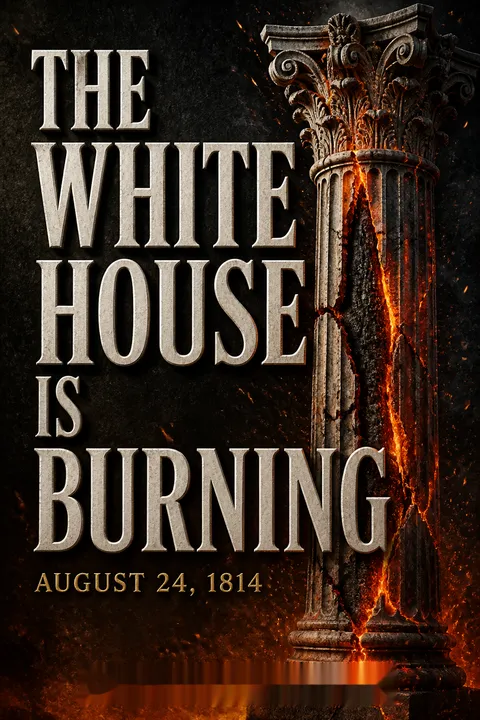
The White House burns. Next, the invaders marched down Pennsylvania Avenue to the President's House. They looted souvenirs, including President Madison's hat and Dolley's cushion, and feasted on the meal prepared for American officers. Then, with "wild-fire" and lamp oil, they set the White House ablaze. The fires burned so hot that metal lightning rods warped like snakes, leaving only a blackened shell. The Treasury Building also fell victim to the flames.
6. Eyewitnesses to History: Chaos and Courage
“A sight, so repugnant to my feelings, so dishonourable; so degrading to the American Character, and at the Same time, so Awful.”
Fleeing in terror. The invasion plunged Washington into chaos, forcing thousands to flee. Margaret Smith, awakened in the night, described the frantic departure of her family, while teenage Private John Pendleton Kennedy, initially excited for battle, found himself in a "mad scramble" and later part of "a fine scamper" during the retreat. The roads were choked with people, carts, and government agents desperate to save important papers.
Unsung heroes. Amidst the panic, acts of quiet heroism unfolded. State Department clerk Stephen Pleasonton, defying Secretary Armstrong's dismissiveness, meticulously packed and transported the Declaration of Independence, the Constitution, and George Washington's letters to safety in Virginia. He slept through the invasion, exhausted but successful in preserving the nation's most sacred documents.
Diverse perspectives. The burning capital was witnessed by a diverse array of individuals. Fifteen-year-old slave Paul Jennings, who helped Dolley Madison save the Washington portrait, later saw a "rabble" looting the White House. Nine-year-old slave Michael Shiner watched the British army advance, describing them as "flames of fier all red coats." Dr. James Ewell, a local resident, watched from his window, his "tortured feelings" reflecting the city's despair.
7. Nature's Fury and the British Retreat
“Great God, Madam! Is this the kind of storm to which you are accustomed in this infernal country?”
Accidental explosion. The day after the burning, as British troops continued their destructive work, a massive explosion rocked Washington. At Greenleaf's Point, while destroying an ammunition dump, barrels of gunpowder thrown down a well ignited, creating a crater twenty feet deep and killing thirty British soldiers instantly. The gruesome scene was described by one officer as "a thousand times more distressing than the loss we met with in the field the day before."
A tempest descends. As if in divine retribution, a violent storm, possibly a tornado or hurricane, struck the city around noon. It was the worst storm residents could remember, tearing roofs off houses, lifting cannons, and forcing soldiers to flatten themselves to the earth. Lieutenant Gleig was thrown from his horse, and thirty more British soldiers, who had survived the battle and the explosion, were buried under falling debris.
Silent withdrawal. The combined shock of the explosion and the storm, coupled with the exhaustion of his troops and rumors of rallying American forces, convinced General Ross to withdraw. That evening, under an eight o'clock curfew, British troops silently prepared their departure. They trimmed watch fires to burn brightly, left fuel, and marched off in "profound silence," successfully clearing the town unnoticed. The occupation had lasted just over twenty-four hours.
8. From Ashes to Identity: Rebuilding a Nation
“It was gratifying to be able once more to salute the President of the United States with the compliments of the season in his appropriate residence.”
Blame and vindication. In the immediate aftermath, James Madison faced severe criticism and was depicted in political cartoons as a coward fleeing the burning capital. However, the successful defense of Baltimore and the decisive victory at the Battle of New Orleans, though fought after the peace treaty was signed, shifted public perception. Madison was eventually hailed as a hero for bringing the war to a close, retiring more popular than when he began.
Rebuilding and resilience. Talk of rebuilding Washington began almost immediately, with a strong consensus that moving the capital would be another British victory. President Madison insisted the White House be rebuilt exactly as it had stood. The project took three years, and in October 1817, President James Monroe moved into the refurbished White House, which made its public debut on New Year's Day 1818, symbolizing the nation's resilience.
A new American identity. The War of 1812, despite the humiliation of Washington's burning, profoundly changed American self-perception. The nation had gone "toe to toe" with the world's greatest naval power and held its own. The "mouse" was no longer an infant nation but a growing power, earning respect on the global stage. Today, the White House, with its enduring scorch marks on original stone, stands as a powerful symbol of this transformation and the nation's enduring strength.
Review Summary
The White House Is Burning receives strong praise (4.01/5) for making the 1814 British burning of Washington, D.C. accessible and engaging through extensive primary sources—letters, diaries, and eyewitness accounts. Reviewers appreciate the multiple perspectives including Dolley Madison, British officers, American soldiers, and enslaved people. The narrative style keeps readers engaged despite historical detail. Teachers and homeschoolers find it excellent for grades 4-12, praising the vivid illustrations, thorough research, and 116-page length. Some note occasional repetitiveness or dense passages, but most consider it exceptional nonfiction that reads like fiction.
People Also Read


Download PDF
Download EPUB
.epub digital book format is ideal for reading ebooks on phones, tablets, and e-readers.








































