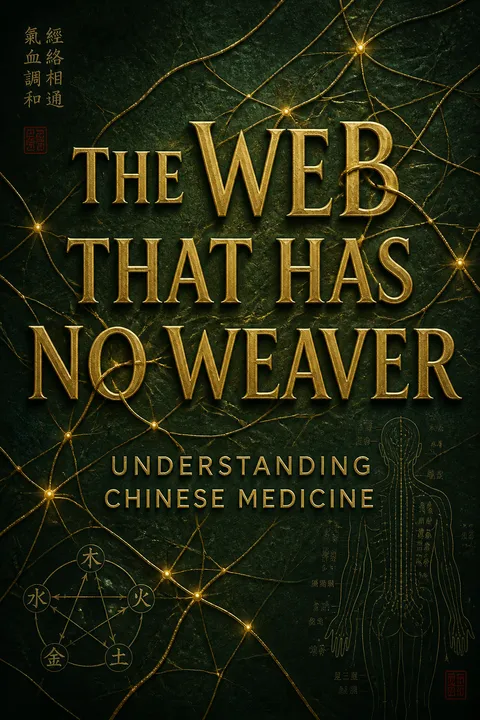

Key Takeaways
1. Medicine East and West represent two fundamentally different logical structures
The Western physician starts with a symptom, then searches for the underlying mechanism—a precise cause for a specific disease.
Two distinct paradigms. Western medicine operates on an analytical, reductionist logic, seeking to isolate a singular, material cause behind a disease. In contrast, Chinese medicine uses a synthetic, organismic logic, focusing on the relationships between co-occurring symptoms to describe a whole person's state of balance or imbalance.
Patterns versus diseases. While a Western doctor diagnoses a specific disease entity like a peptic ulcer, a Chinese physician identifies a "pattern of disharmony." This pattern is a holistic, almost poetic configuration of the patient's physical, emotional, and environmental state.
Clinical implications. This divergence means that patients with the same Western diagnosis may receive entirely different Chinese treatments.
- A single Western disease like a stomach ulcer can manifest as "Damp Heat Affecting the Spleen" in one patient.
- Another patient with the same ulcer might be diagnosed with "Deficient Yin Affecting the Stomach."
- Treatment is tailored to the individual's unique pattern rather than a standardized disease category.
2. Yin and Yang are dynamic, relative categories of relationship and change
Yin and Yang must, necessarily, contain within themselves the possibility of opposition and change.
The relational matrix. Yin and Yang are not material forces or absolute entities, but rather relational labels used to describe how things function in connection to one another. Yin represents qualities like cold, rest, darkness, and interiority, while Yang represents heat, movement, light, and exteriority.
Five core principles. The relationship between these polar complements is governed by five dynamic laws that explain all natural processes. These principles emphasize that nothing exists in isolation and that balance is a constantly shifting, active state.
- Opposition: Everything has a Yin and a Yang aspect.
- Interdependence: Yin and Yang mutually create and define each other.
- Mutual consumption: An excess of one leads to a deficiency of the other.
- Intertransformation: Yin and Yang continuously transform into one another.
- Infinite divisibility: Any Yin or Yang aspect can be further divided into Yin and Yang.
A cosmos in miniature. Because the human body is viewed as a microcosm of the universe, health is defined as the harmonious, self-regulating play of these opposing yet complementary tendencies. Sickness is simply a state of disharmony where the dynamic equilibrium has been disrupted.
3. The human body is sustained by five fundamental textures: Qi, Blood, Essence, Spirit, and Fluids
Qi is the thread connecting all being.
The basic ingredients. The human landscape is composed of five fundamental substances or "textures" that represent different states of materialization and energy. These textures—Qi, Blood, Essence (Jing), Spirit (Shen), and Fluids—sustain all physical and psychological life.
Dynamic and receptive forces. Qi and Blood represent the primary Yang and Yin polarities of daily life. Qi is the active, warming, and transformative force of movement, while Blood is the nourishing, cooling, and receptive substance that supports physical form and mental tranquility.
Deep and fluid textures. The remaining textures govern long-term development and daily maintenance.
- Essence (Jing) is the inherited and acquired potential that guides growth, reproduction, and aging.
- Spirit (Shen) is the unique human capacity for self-awareness, consciousness, and moral alignment.
- Fluids (Jin-ye) are the lighter and heavier bodily liquids that moisten and lubricate the tissues.
4. The five Spirits govern human virtues, emotions, and existential meaning
Spirit is the capacity of the human being to be 'an initiator, a participant, and a guardian of the universe.'
The embodied soul. In Chinese medicine, the mind and body are an indissoluble unity, and the Spirit (Shen) is divided into five distinct aspects, each housed in a specific Yin Organ. These five Spirits govern not only psychological health but also the cultivation of human virtues and existential meaning.
Virtue and emotional balance. When these Spirits are intact, they transform raw emotional energy into balanced, life-affirming virtues. If they are disrupted, they manifest as emotional excesses, existential dread, or mental confusion.
- The Shen (Heart) governs connection, propriety, and appropriate social interaction.
- The Hun (Liver) represents the Non-Corporeal Soul, governing benevolence and empathy for suffering.
- The Po (Lungs) represents the Animal Soul, governing justice, grief, and the appreciation of transient beauty.
- The Yi (Spleen) represents the Consciousness of Potentials, governing creativity, focus, and faithfulness.
- The Zhi (Kidneys) represents the Will, governing resolution, wisdom, and acceptance of destiny.
Existential clinical focus. By treating the physical body, the Chinese physician simultaneously treats these spiritual and emotional dimensions. Healing is not merely about removing physical symptoms, but about helping the patient reclaim their authentic path and inner wisdom.
5. Chinese anatomy is functional, viewing Organs as intersecting spheres of activity
The Spleen of Chinese medicine is different from the spleen recognized in the West.
Anatomy of function. Unlike Western medicine's focus on fixed physical structures, Chinese medicine defines Organs by their functional activities and relationships. The Organs are seen as dynamic, intersecting matrixes of physiological and psychological processes rather than material, dissectible parts.
Yin and Yang Organs. The body's internal landscape is divided into five Yin Organs (Zang) and six Yang Organs (Fu). The Yin Organs are deeper and responsible for storing and regulating the fundamental textures, while the Yang Organs are more superficial and handle digestion and excretion.
- The Spleen rules digestion, transformation, and the raising of food essences.
- The Liver stores Blood, ensures the smooth flow of Qi, and regulates emotions.
- The Kidneys store Essence, rule water metabolism, and act as the root of life.
- The Heart rules the Blood and Blood Vessels while housing the Spirit.
- The Lungs rule respiration, regulate the water channels, and govern the skin.
A holistic network. Because the Organs are defined by their relationships, a disharmony in one Organ inevitably reverberates through the entire system. The Chinese physician treats the body by restoring the cooperative, functional balance between these organic spheres of influence.
6. The Meridians form an invisible network carrying Qi and Blood to unify the body
The Meridians move the Qi and Blood, regulate Yin and Yang, moisten the tendons and bones, benefit the joints.
The invisible lattice. The Meridians (Jing-luo) are an unseen network of pathways that connect the interior Organs with the exterior surface of the body. They act as a communication system, distributing Qi and Blood to every tissue, joint, and limb to maintain systemic harmony.
The basis of acupuncture. Because the Meridians emerge on the skin's surface, stimulating specific points along these channels can directly affect the internal Organs. Acupuncture and moxibustion utilize these points to regulate the flow of Qi, disperse blockages, and restore balance.
- The system consists of twelve regular Meridians, each corresponding to a specific Organ.
- Eight Extra Meridians, including the Governing and Conception Vessels, act as reservoirs of energy.
- Countless minor Luo Meridians form a net-like web across the entire body.
Diagnostic and therapeutic pathways. Pain or dysfunction along a Meridian pathway often indicates a disharmony in its corresponding internal Organ. By understanding this network, the physician can use surface points to treat deep-seated internal imbalances.
7. Illness arises when internal harmony is disrupted by climate, emotions, or lifestyle
In Chinese medicine, the treatment is always for the condition itself, regardless of the 'cause.'
Circular causality. Chinese medicine does not view disease as an external invader to be destroyed, but as a state of internal disharmony. What Western medicine calls "causes" of disease are viewed by Chinese medicine as participating elements within a larger pattern of imbalance.
The three categories. The factors that precipitate disharmony are divided into three broad categories: environmental climates, emotional excesses, and lifestyle habits. These factors resonate with the body's internal state, creating corresponding "weather patterns" within the human landscape.
- The Six Pernicious Influences (Wind, Cold, Heat, Dampness, Dryness, Summer Heat) represent environmental or internal climates.
- The Seven Emotions (elation, anger, sadness, grief, worry, fear, fright) can injure the Organs when experienced excessively.
- Way of Life factors include diet, sexual activity, physical labor, and inherited constitution.
Internal weather. If a person's internal Spleen Qi is weak, they may develop "Internal Dampness" even without exposure to a wet environment. The goal of the physician is to rebalance the internal climate so the body can withstand both external and internal storms.
8. The Four Examinations gather clinical signs to weave a pattern of disharmony
One elderly Chinese physician, a teacher of the author, described the tongue as a piece of litmus paper that reveals the basic qualities of a disharmony.
Sensory data collection. To discern a patient's pattern of disharmony, the Chinese physician relies on the Four Examinations: Looking, Listening/Smelling, Asking, and Touching. This process gathers a vast array of subjective and objective signs without relying on invasive technology.
The tongue and pulse. The two most critical pillars of the examinations are observing the tongue and feeling the pulse. These two diagnostic tools provide a direct, highly reliable reading of the state of the internal Organs and fundamental textures.
- Looking: The physician examines the patient's demeanor, facial color, and the tongue's body and moss.
- Listening and Smelling: The doctor listens to the voice, cough, and respiration, and notes bodily odors.
- Asking: The patient is questioned about chills, fever, perspiration, pain, sleep, appetite, and excretions.
- Touching: The physician palpates the abdomen, acupuncture points, and takes the radial pulse.
Weaving the pattern. No single sign has meaning on its own; a rapid pulse or a red tongue must be interpreted within the context of all other findings. The physician synthesizes these diverse sensory clues into a coherent, poetic, and actionable clinical image.
9. The ultimate art of Chinese medicine culminates in the intuitive Penetrating Divine Illumination
The Penetrating Divine Illumination is the 'secret' method buried within the Four Examinations and pattern discernment that easily eludes the novice physician; it can only be consciously grasped by the seasoned veteran.
Beyond linear logic. While the beginner must painstakingly analyze individual signs and symptoms, the master physician operates on a level of intuitive immediacy. This highest stage of clinical artistry is known as the "Penetrating Divine Illumination" (Tong Shen Ming).
Intuitive resonance. At this level, the physician does not merely add up symptoms to find a diagnosis, but immediately apprehends the patient's entire human landscape in a single stroke. This is a state of deep, empathetic resonance between the Qi and Spirit of the physician and the patient.
The wordless treatment. The very act of being deeply witnessed and understood by a master physician initiates the healing process.
- The clinical encounter itself becomes a powerful therapeutic intervention.
- The physician's presence, words, and empathy directly "move the Essence and transform the Qi."
- Acupuncture and herbs are merely physical extensions of this profound, non-physical connection.
Download PDF
Download EPUB
.epub digital book format is ideal for reading ebooks on phones, tablets, and e-readers.








































