
Key Takeaways
1. Reconstruction was a revolutionary, highly democratic era sparked by black military service
Once a black man got 'an eagle on his button, and a musket on his shoulder, and a bullet in his pocket,' Douglass reasoned, there was 'no power on earth' that could 'deny that he has earned the right of citizenship in the United States.'
A sudden revolution. The Civil War transformed from a war for Union into a war for liberation, driven by the escape of thousands of slaves and the eventual enlistment of over 178,000 black soldiers. These men, including the sons of Frederick Douglass and Major Martin Delany, proved their valor at bloody battles like Fort Wagner, shattering racist myths about their courage and capabilities.
Claiming citizenship. Military service became the ultimate political tutorial, teaching black men to read, organize, and lead. Veterans returned home with a new sense of manhood and a determination to demand equal rights, forming the backbone of the postwar political class.
Key impacts of service:
- Over 130 black veterans went on to hold political office during Reconstruction.
- Campfire discussions served as early political schools for future leaders.
- Armed service dismantled the psychological shackles of slavery, allowing men to look former masters in the eye.
2. Andrew Johnson's presidential Reconstruction enabled the return of Confederate elites and the Black Codes
For this accidental president, black liberation was the end of the process, not the first step in a march toward political and social equality, and he had no desire to employ the army to ensure constitutional rights for freedmen.
An accidental adversary. Following Lincoln's assassination, Andrew Johnson assumed the presidency and immediately signaled to white southerners that he would demand almost nothing of them. Hostile to black equality and a former slaveholder himself, Johnson offered wholesale pardons to wealthy Confederates and allowed them to reclaim political power.
The Black Codes. Emboldened by Johnson's leniency, newly elected southern legislatures enacted the Black Codes, a set of highly restrictive laws designed to force freed people back into plantation labor. These codes criminalized black vagrancy, banned blacks from owning land, and allowed for the forced apprenticeship of black children.
Reconstruction derailed:
- Mississippi and Texas refused to ratify the Thirteenth Amendment under Johnson's watch.
- Former Confederate Vice President Alexander Stephens was elected to the U.S. Senate.
- The codes effectively attempted to restore slavery in everything but name, sparking outrage in the North.
3. The Freedmen's Bureau and Sherman's Field Order No. 15 ignited dreams of land ownership
Every colored man will be a slave,' Sergeant Prince Rivers explained, 'and feel himself a slave, until he can raise him own bale of cotton and put him own mark upon it and say Dis is mine!'
Forty acres and a mule. In January 1865, General William T. Sherman issued Special Field Order No. 15, setting aside 400,000 acres of coastal land for the settlement of freed families in forty-acre plots. This order, later codified by the creation of the Freedmen's Bureau, ignited a passionate belief among former slaves that they would receive land as back pay for generations of uncompensated toil.
The battle for soil. Under the leadership of General Oliver O. Howard and local agents like Tunis Campbell, the Bureau settled thousands of families on abandoned estates. However, President Johnson's subsequent amnesty proclamations ordered these lands returned to pardoned Confederates, forcing the Bureau to evict black families and push them into yearly labor contracts.
Economic independence contested:
- Over 40,000 freed people were settled on coastal lands before being evicted by presidential order.
- The Freedman's Savings Bank was established to help veterans and freedmen build capital, but it collapsed in 1874 due to white mismanagement.
- Despite evictions, some blacks successfully pooled resources to buy land, laying the groundwork for a small black landowning class.
4. Black churches and northern missionaries built the foundations of community and literacy
The church's new minister, Reverend E. J. Adams, described by a black Philadelphia reporter as 'looking truly like an African prince,' lectured from the Book of Kings and assured his brethren that the promise of the Old Testament had at long last been fulfilled.
Spiritual and civic hubs. Independent black churches, particularly the African Methodist Episcopal (AME) and Baptist congregations, emerged from the shadows of slavery to become the center of black community life. These churches served not only as places of worship but as schools, political meeting halls, and mutual aid societies.
The crusade for literacy. Northern missionary societies, primarily the American Missionary Association (AMA), sent hundreds of dedicated teachers—mostly young, white, northern women—to educate the freed people. Despite facing intense social ostracism and physical danger from hostile local whites, these "Yankee schoolmarms" worked alongside black teachers to establish schools across the South.
Educational and community milestones:
- By 1869, the Freedmen's Bureau and missionary societies educated over 150,000 students in 3,000 schools.
- Black adults crowded into night and Sunday schools, demonstrating an insatiable desire for literacy.
- At least 243 black ministers were elected to political office, bridging the gap between faith and political activism.
5. The black convention movement organized a national crusade for civil and political rights
We demand suffrage in return for our sacrifices,' he shouted, as the audience 'rose en masse to cheer him.'
A national network. Long before they could vote, black Americans organized a sophisticated network of state and national conventions to demand full citizenship. Beginning with the Syracuse convention of 1864, these meetings established the National Equal Rights League, which quickly spread chapters across both the North and the occupied South.
Uncompromising demands. Convention delegates, including prominent figures like Frederick Douglass, Octavius Catto, and John Mercer Langston, drafted petitions and lobbied Congress for impartial suffrage, integrated public transit, and equal protection under the law. They consistently used the sacrifice of black Union soldiers to shame reluctant northern politicians into action.
Key convention achievements:
- The movement successfully pressured northern states like Pennsylvania and New York to integrate streetcars.
- Conventions in southern cities like New Orleans, Richmond, and Nashville united diverse black populations across class and color lines.
- A black delegation directly confronted President Johnson in the White House, exposing his deep-seated racism to the public.
6. The progressive alliance in Congress overrode Johnson and enacted radical constitutional reforms
While Congress is passing acts to reconstruct the South, the President is driving a carriage and six through them.
Congressional Reconstruction. Outraged by the Black Codes and Johnson's defiance, Radical Republicans led by Thaddeus Stevens and Charles Sumner formed a progressive alliance with black activists. This coalition bypassed the White House, overriding presidential vetoes to pass the Civil Rights Act of 1866 and the Military Reconstruction Acts of 1867.
Constitutional revolution. To secure these legislative gains against future conservative majorities, the alliance enacted the Fourteenth and Fifteenth Amendments. These revisions clarified federal citizenship, guaranteed equal protection under the law, and prohibited states from denying the franchise based on race.
Limiting executive power. To prevent Johnson from undermining their laws, Congress passed the Tenure of Office Act and the Army Appropriations Act, which restricted the president's control over the military and his own cabinet. When Johnson defied these laws by attempting to fire Secretary of War Edwin M. Stanton, the House successfully impeached him, though the Senate fell one vote short of conviction.
7. We Knows That Much Better Than You Do: Voting Rights and Political Service
[!NOTE]
"We knows that much better than you do" was a black minister's response to a northern visitor who questioned whether freedmen understood the difference between the political parties.
A sudden rise to power. Armed with the Reconstruction Acts and the Fifteenth Amendment, black men registered to vote in massive numbers. By 1868, they constituted a majority of registered voters in several southern states, paving the way for an unprecedented era of black political service.
Governing the South. Black politicians served at every level of government, from local constables and sheriffs to state legislators and federal congressmen. They enacted progressive reforms that benefited poor citizens of both races, establishing the South's first public school systems and expanding civil rights.
Key political milestones:
- Hiram Revels and Blanche K. Bruce represented Mississippi in the United States Senate.
- South Carolina's state legislature featured a black majority in its lower house, electing black speakers and committee chairs.
- Pinckney B. S. Pinchback briefly served as the acting governor of Louisiana, the first African American to hold a state executive office.
8. An Absolute Massacre: White Violence and the End of Reconstruction in the South
The unsheeted ghosts of the two thousand murdered negroes in Texas, cry, if the dead ever invoke vengeance, for the punishment of Andrew Johnson.
A campaign of terror. Reconstruction did not fail; it was violently overthrown by a relentless campaign of white supremacist terrorism. Paramilitary organizations like the Ku Klux Klan and the White League, comprised largely of Confederate veterans, waged a guerrilla war against black voters, Union League organizers, and white Republicans.
Targeted assassinations. Rather than engage in public riots that attracted federal troops, vigilantes methodically targeted the rising generation of Republican leaders. They assassinated state legislators like Benjamin F. Randolph, lynched local organizers, and burned down hundreds of black churches and schools to destroy the institutional foundations of black advancement.
Key atrocities of the counterrevolution:
- The Memphis and New Orleans riots of 1866 resulted in the slaughter of dozens of black veterans and political activists.
- The Colfax Massacre of 1873 and the Hamburg Massacre of 1876 saw the execution of black militiamen after they surrendered.
- Eventual northern weariness and the withdrawal of federal troops under the Compromise of 1877 left southern blacks defenseless against white redemption.
9. We Shall Be Recognized As Men: The Reconstruction Era in Memory
It is supposed that at least ten thousand colored persons, old and young, have learned to spell and read in Texas within the year,' the agent testified.
The propaganda of history. Following the fall of Reconstruction, white southern writers and northern academics collaborated to distort the memory of the era. The "Dunning School" of history portrayed Reconstruction as a tragic period of black misrule and corruption, providing a scholarly justification for the disenfranchisement of black voters and the implementation of Jim Crow laws.
Popularizing the myth. This distorted history was popularized through romantic novels like Thomas Dixon's The Clansman and blockbuster films like D. W. Griffith's The Birth of a Nation and Margaret Mitchell's Gone with the Wind. These works glorified the Ku Klux Klan and depicted black politicians as buffoons, cementing a racist narrative in the American consciousness for generations.
The fight for historical truth:
- W. E. B. Du Bois published Black Reconstruction in America in 1935 to challenge the Dunning School and highlight the democratic achievements of the era.
- Black educators and journalists kept the memory of Reconstruction's progressive reforms alive within their communities.
- Modern scholarship has vindicated Du Bois, recognizing Reconstruction as a noble, albeit violently suppressed, experiment in interracial democracy.
Review Summary
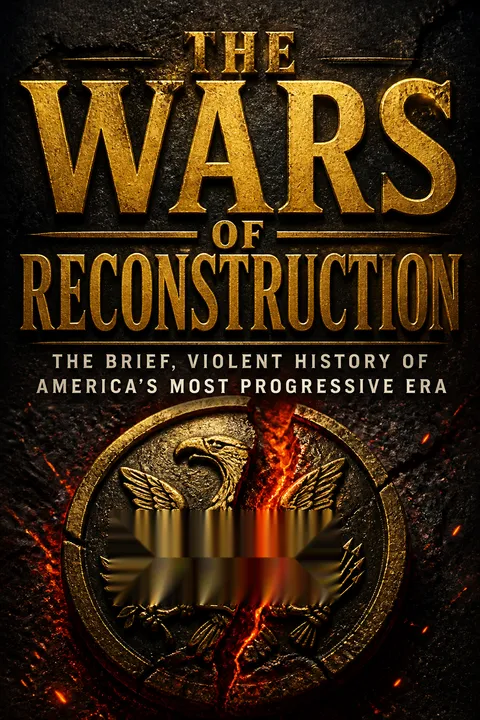
The Wars of Reconstruction receives strong praise for its accessible, detailed account of post-Civil War America, correcting Lost Cause myths while centering Black Americans' experiences. Reviewers appreciate Egerton's focus on local activists, his documentation of widespread racial violence, and his argument that Reconstruction was overthrown rather than failed. Some critics note the narrative can feel dense, disorganized, or repetitive, particularly in early chapters, and that scholars familiar with Du Bois or Foner may find little new. Overall, most readers consider it essential, illuminating history with clear contemporary relevance.
Download PDF
Download EPUB
.epub digital book format is ideal for reading ebooks on phones, tablets, and e-readers.








































