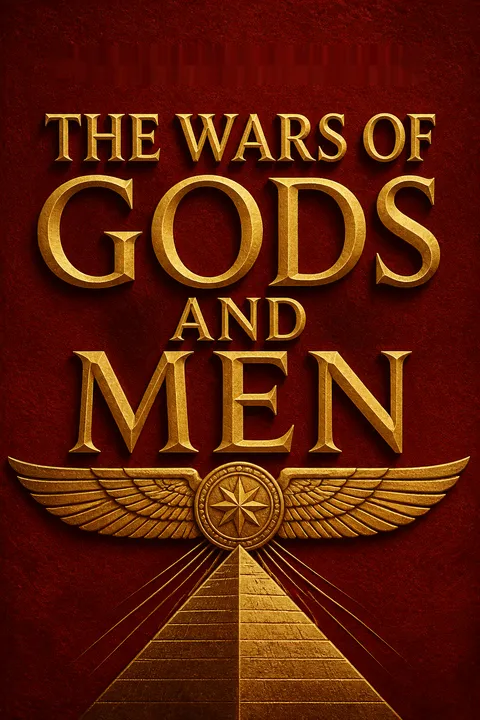

Key Takeaways
1. Ancient Texts Reveal Gods as Advanced Beings
This is fact, not fiction; it has all been written down long ago—in the Earth Chronicles.
Reinterpreting mythology. Ancient texts from Sumer, Egypt, Greece, and India, often dismissed as mere mythology, are presented as historical records detailing the activities of technologically advanced beings, referred to as "gods." These "Earth Chronicles" describe celestial travel, sophisticated weaponry, and complex social structures among these entities. The author posits that these accounts are not allegorical but literal descriptions of events.
Cross-cultural consistency. Across diverse ancient civilizations, narratives consistently depict gods intervening in human affairs, engaging in wars, and possessing extraordinary powers.
- Greek tales (Iliad, Theogony) describe Zeus and other Olympians using "Thunder-Stones" and "Radiating Thunderbolts."
- Egyptian inscriptions detail Horus flying in a "Winged Disk" and wielding "Divine Iron."
- Hindu Vedas speak of "aerial cars" (Vimanas) and "bolt-hurling Thunderers."
- Mesopotamian texts refer to DIN.GIR ("Righteous Ones of the Rocketships") and their advanced technology.
This widespread consistency suggests a common, non-mythological origin for these stories.
Technological marvels. The "gods" are consistently portrayed with capabilities far beyond human understanding of their time, but strikingly similar to modern technology. Their "weapons of brilliance" caused blinding light and immense heat, akin to nuclear explosions. Their vehicles, described as "celestial boats" or "whirlbirds," could traverse skies and even space, suggesting advanced aerospace engineering. The author argues that these descriptions are not primitive imaginings but observations of advanced technology.
2. Divine Lineage Fueled Wars for Earthly Supremacy
Indeed, it was as the Wars of the Gods that the Wars of" Man began.
Succession and rivalry. The primary driver of conflict among the gods was a complex system of lineage and succession, often involving half-siblings and intricate marital rules. This led to intense rivalries, betrayals, and violent power struggles for control over Earth and its resources. The Greek tale of Uranus, Cronos, and Zeus, and the Egyptian conflict between Osiris, Seth, and Horus, are prime examples of these divine dynastic struggles.
Mesopotamian pantheon. The Sumerian Anunnaki, led by Anu, Enlil, and Enki, also experienced profound internal conflicts rooted in their hierarchical structure and rules of inheritance.
- Enki, Anu's firstborn by a concubine, was initially heir.
- Enlil, Anu's son by his half-sister, superseded Enki as legal heir.
- This rivalry between Enki and Enlil, and their respective descendants (e.g., Marduk vs. Ninurta), became a recurring theme in divine and human history.
These divine disputes often mirrored and instigated human conflicts, as mortals were enlisted to fight on behalf of their patron deities.
Global impact of divine wars. The wars of the gods were not confined to a single region but had global repercussions, shaping the geography and political landscape of the ancient world. These conflicts often involved devastating weaponry and led to the destruction and reshaping of entire regions. The author suggests that human wars were often extensions or reflections of these larger divine power struggles, with gods actively participating alongside mortals.
3. Humanity's Genesis: A Genetic Experiment for Gold
The Sumerian texts reveal that the 'missing link' was a feat of genetic manipulation performed in a laboratory.
Gold as a vital resource. The Anunnaki, visitors from the planet Nibiru, initially came to Earth to extract gold, a metal crucial for the survival of their home planet's atmosphere. Their initial attempts at extraction from seawater proved insufficient, leading to a shift towards labor-intensive mining operations in Africa (the Abzu). This demanding work caused discontent among the Anunnaki rank and file.
The Anunnaki mutiny. After 144,000 Earth-years of arduous toil in the gold mines, the Anunnaki mutinied, refusing to continue the backbreaking labor. This crisis prompted a council of the Great Anunnaki, where Enki, the chief scientist, proposed a radical solution: the creation of a "Primitive Worker" to take over the toil. This decision marked a pivotal moment in human history.
Genetic engineering of Homo sapiens. Enki, with the help of the chief medical officer Sud (Ninharsag), genetically engineered Homo sapiens.
- They combined the "essence" of a young Anunnaki male with the egg of an Apewoman.
- The fertilized egg was implanted into the womb of a female Anunnaki.
- This process, involving in vitro fertilization and embryo implantation, resulted in the birth of the "Primitive Worker," initially incapable of procreation.
Later, Enki, without Enlil's full consent, granted these hybrid beings the ability to procreate, an event echoed in the biblical tale of Adam and Eve in the Garden of Eden.
4. Earth's Post-Deluge Reshaping and Strategic Facilities
The four regions they created.
The Deluge and its aftermath. Approximately 13,000 years ago, a global Deluge, caused by Nibiru's gravitational pull destabilizing Antarctica's ice cap, wiped out Earth's first civilization. After the waters receded, the Anunnaki, having survived in orbit, returned to a devastated planet. They decided to re-establish human civilization and re-divide Earth into four regions, three for mankind's emerging civilizations and one for their exclusive use.
Reconstruction and new infrastructure. The Anunnaki initiated massive reconstruction efforts, particularly in Mesopotamia and Africa.
- Ninurta led the damming and irrigation of Mesopotamia, making it habitable again.
- Enki focused on reclaiming the Nile Valley, dividing Africa among his sons.
- The "Fourth Region," Tilmun (the Sinai peninsula), was designated as the new Spaceport, placed under the neutral guardianship of Ninharsag.
This strategic division and reconstruction laid the foundation for the post-Diluvial world.
Space-related facilities and their purpose. The new Spaceport in the Sinai, along with its guidance and control centers, was crucial for maintaining contact with Nibiru.
- The Giza pyramids were built as twin beacons, anchoring the Landing Corridor for shuttlecraft.
- Mount Moriah (future Jerusalem) became the Mission Control Center, equidistant from the Spaceport and the Baalbek Landing Platform.
These facilities were designed with advanced astronomical and engineering principles, reflecting the Anunnaki's sophisticated knowledge and their continued need for Earth's resources.
5. The Pyramid Wars: Battles for Control of Space Assets
The story of the conflict between Horus and Seth represents a historical event.
Conflict over strategic sites. Despite the initial agreement for neutrality, control over the vital space facilities—especially the Giza pyramids and the Sinai Spaceport—became a flashpoint for renewed divine conflicts. The First Pyramid War erupted between the Enki-descendant Horus and Seth, who had usurped control of Lower Egypt and the pyramids. This war saw gods actively involving human armies for the first time.
Horus's victory and Seth's banishment. Horus, aided by advanced weaponry like the "Winged Disk" and "Divine Iron," relentlessly pursued Seth towards the pyramids. After fierce battles, including aerial combat and engagements in the watery regions separating Egypt from Sinai, Seth was defeated and banished to Asian lands. This outcome placed the crucial space-related sites under the control of Enki's descendants, a situation unacceptable to the Enlilites.
The Second Pyramid War. Approximately 300 years later, the Enlilites, led by Ninurta, launched the Second Pyramid War to reclaim the space facilities. This brutal conflict involved chemical warfare and culminated in the siege of the Great Pyramid, where Marduk (identified as Azag, "The Great Serpent") and his allies had taken refuge. Ninharsag intervened to negotiate a surrender, leading to Marduk's imprisonment within the pyramid.
6. Marduk's Imprisonment and the Great Pyramid's Secrets
Marduk was imprisoned alive in the 'Mountain Tomb,' there is no doubt; texts that have been found and authoritatively translated attest to that.
The Great Pyramid as a prison. Following the Second Pyramid War, Marduk was sentenced to be buried alive within the Great Pyramid. This was a unique punishment, designed to incapacitate him without outright execution, as he was deemed responsible for the death of Dumuzi and for using the pyramid for combat. The pyramid's Ascending Passage was sealed with granite plugs, trapping Marduk in the King's Chamber.
The pyramid's true function. The Great Pyramid, stripped of its apex stone and internal "stones" (crystals and instruments) by Ninurta after the war, was originally a sophisticated control and guidance center.
- It housed the "GUG Stone" for direction-determining, amplified by resonant chambers.
- Its passages and galleries contained various "stones" that emitted light and radiation for guiding shuttlecraft.
- The structure was designed with precise astronomical and geometric alignments, serving as a beacon and control center for the Spaceport.
The Arab discovery of its empty chambers and the later "Well Shaft" puzzles are explained by its post-war dismantling and Marduk's rescue.
Marduk's rescue and exile. Mesopotamian texts, particularly the "Death and Resurrection of Bel-Marduk" script, describe how Marduk's son Nabu, with the help of other gods, engineered his father's escape. They bored a twisting shaft (the irregular "Well Shaft" segment C) through the pyramid's masonry to reach him. After a dramatic rescue involving an explosion to clear a passage, Marduk was freed but went into exile in "Hatti-land" (Asia Minor) for 24 years, awaiting his return to power.
7. Abraham's Strategic Role in Divine Conflicts
The mission of Abraham was a military one: to protect the space facilities of the Anunnaki—the Mission Control Center and the Spaceport!
Abraham's Nippurian origins. Abraham, initially named Abram, was not a nomadic wanderer but a high-ranking Sumerian nobleman from Nippur, the original Mission Control Center. His family, a royal priesthood, was deeply involved in Sumerian affairs. The biblical term "Ibri" (Hebrew) is reinterpreted as "Nippurian," signifying his origin from NI.IB.RU, the "Crossing Place."
A military and diplomatic mission. Abraham's journey from Harran to Canaan, at the age of 75 (2048 B.C.), coincided with the downfall of King Shulgi and the re-emergence of Marduk's influence. Abraham's mission was divinely ordained to protect the Anunnaki's vital space facilities in Canaan and the Sinai.
- He established his base near Jerusalem (Mount Moriah), the Mission Control Center.
- He journeyed to the Negev, the gateway to the Sinai Spaceport.
- His entourage included an elite corps of cavalrymen ("Naar men"), suggesting a military capacity.
Ancient accounts, including Josephus, depict Abraham as a skilled military commander and diplomat.
The War of the Kings. Abraham's strategic importance became evident during the War of the Kings (2041 B.C.), where an eastern alliance, led by the Elamite Khedorla'omer and backed by the Enlilites, sought to suppress rebellions and prevent Marduk and Nabu from gaining control of the space facilities. Abraham, positioned at Kadesh-Barnea (the Sumerian BAD.GAL.DINGIR, a fortified outpost near the Spaceport), successfully blocked the invaders' advance. This act, recorded in both biblical and Mesopotamian texts, underscores his crucial role in the divine conflicts.
8. The Nuclear Holocaust: A Divine Doomsday for Sumer
The destruction of the cities of the plain, we believe, was only a sideshow: concurrently, the Spaceport in the Sinai peninsula was also obliterated with nuclear weapons, leaving behind a deadly radiation that lingered on for many years thereafter.
The decision for ultimate force. After Marduk's return to Babylon and Nabu's growing influence in Canaan, the Council of the Gods, in disarray, ultimately sanctioned the use of "Awesome Weapons" to prevent Marduk from seizing supremacy and to deny him the Spaceport. Nergal and Ninurta were tasked with deploying these nuclear weapons, despite Enki's strong objections and Ninurta's initial reluctance to cause indiscriminate destruction.
Obliteration of the Spaceport and Canaanite cities. The primary target was the Spaceport in the Sinai, which was "upheavaled" by a nuclear blast.
- The "Mount Most Supreme" (the command complex) was smashed.
- The landing fields were obliterated, leaving a vast, unexplainable scar visible from space today.
- The surrounding plain was covered with blackened, radioactive debris.
Concurrently, Nergal unleashed weapons on the Canaanite cities of the Jordan Plain (Sodom and Gomorrah), which were supporting Nabu. These cities were "upheavaled" by "brimstone and fire," turning their inhabitants into "vapor," as Lot's wife experienced.
The Evil Wind and Sumer's demise. The nuclear explosions generated an immense, radioactive "Evil Wind" that swept eastward across Mesopotamia. This unseen death, described in Sumerian Lamentation Texts, caused widespread desolation, not by physical destruction of cities, but by poisoning the land and its inhabitants.
- Cities were abandoned, rivers became bitter, fields grew only weeds.
- People suffered gruesome deaths from radiation sickness.
- The gods themselves fled their cities, witnessing the catastrophe with horror.
This nuclear holocaust, occurring in 2024 B.C., marked the abrupt end of Sumerian civilization, leaving behind a poisoned land and a new world order.
Review Summary
The Wars of Gods and Men receives mixed reviews averaging 4.1/5 stars. Supporters praise Sitchin's translation of ancient Sumerian texts and his theory that extraterrestrial Anunnaki influenced human civilization, finding his evidence of ancient nuclear warfare compelling. Critics argue the book is dry, repetitive, and suffers from confirmation bias, with later installments lacking the enthusiasm of his first book. Many appreciate the mythological parallels drawn across cultures, though skeptics question the credibility of interpreting ancient myths literally as alien encounters. The book divides readers between those captivated by alternative history and those seeking rigorous academic evidence.
People Also Read



Earth Chronicles Series

About the Author
Other books by Zecharia Sitchin
Download PDF
Download EPUB
.epub digital book format is ideal for reading ebooks on phones, tablets, and e-readers.








































