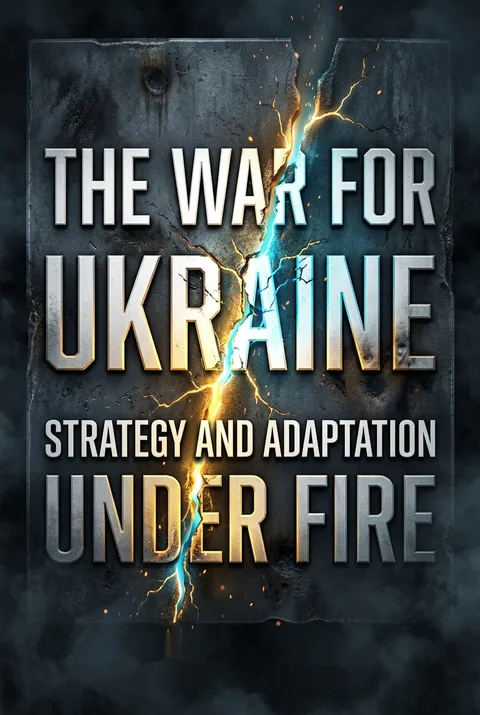

Key Takeaways
1. Russia's Invasion: A Strategy Built on Delusion and Miscalculation
The Russian invasion, while taking nearly 22 percent of Ukrainian territory in the coming weeks, foundered on poor strategic assumptions, good Ukrainian leadership (particularly the inspiration of President Zelenskyy but also effective battlefield leaders), a lack of unity of command between different Russian commands, and bad Russian tactical leadership.
Delusional foundations. Russia's grand strategy, shaped by perceptions of vulnerability and historical narratives, led President Putin to believe Ukraine was not a "real state" and posed a threat due to NATO expansion and alleged "neo-Nazis." This worldview underpinned a flawed initial invasion plan, envisioning a swift, ten-day campaign to seize Kyiv, capture leaders, and install a compliant regime, with minimal Ukrainian resistance or Western intervention.
Flawed assumptions. Putin's strategic assumptions proved catastrophically wrong. He underestimated Ukraine's will to fight and its military capabilities, while overestimating Russian forces' ability to achieve a quick victory. This led to a critical mismatch between ambitious political objectives and insufficient military means, as the invasion force of approximately 190,000 troops was too small to conquer a nation the size of Ukraine if it resisted.
Operational breakdown. The initial plan's failure was exacerbated by poor logistical preparation and a lack of unified command, with different military regions controlling separate axes of advance. This resulted in Russian forces quickly bogging down, suffering heavy losses, and facing severe supply shortages, ultimately compromising any hope of short-term success and forcing a strategic reassessment.
2. Ukraine's "Strategy of Corrosion": Leveraging Asymmetry and Resilience
The strategy of corrosion therefore is distinct from attrition and exhaustion because of the breadth of society that is now involved in warfare, and because of the unparalleled means that each society has to attack each other, not just through their representative military institutions but also directly.
Evolving purpose. Ukraine's strategic response, initially defensive, quickly evolved under President Zelenskyy to encompass broader political objectives, including the restoration of territorial integrity, war crimes trials, and a definitive end to the war. This vision, articulated in his G20 speech, aimed to unify the Ukrainian people and rally international support.
Corroding the enemy. Ukraine adopted a "strategy of corrosion," distinct from traditional attrition or exhaustion, by engaging every element of its society—military, government, commercial, and civil—to degrade Russia's physical, moral, and intellectual capacity to fight. This approach sought to make the war more costly for Russia across multiple domains, often employing indirect methods to exploit Russian weaknesses.
Integrated resilience. Key to this strategy are seven elements: clear purpose, a global influence campaign, integrated civil-military actions, foreign support, national mobilization, fighting a just war, and continuous learning. Ukraine's emphasis on societal resilience, including robust cyber defenses and the meshing of civilian and military intelligence, has been crucial in sustaining its defense and countering Russian aggression.
3. The West's Evolving Role: Balancing Support with Escalation Avoidance
The only time Ukraine and the West will be able to seriously claim a true victory is when, and if, the fighting ends in an acceptable peace. This means the United States and its partners need to look beyond the current battlefield. They need to determine what grand strategy they should pursue to shape the longer-term course of the war and its lasting peace.
Strategic vacuum. Despite providing massive aid, the West, particularly the United States, initially lacked a clear, overarching grand strategy for the war, focusing instead on immediate battlefield support. U.S. objectives evolved to include weakening Russia, ensuring a stable Europe, and deterring China, recognizing that Russian success in Ukraine would have global implications.
Multifaceted support. The U.S. strategy involves rallying a coalition of over fifty nations to provide military, economic, humanitarian, and intelligence support, coordinated through forums like the Ukraine Defense Contact Group. Military assistance has progressively become more sophisticated, ranging from anti-tank missiles to advanced air defense systems and long-range artillery.
Cautious engagement. A critical component of Western strategy is avoiding direct conflict with Russia and preventing escalation, especially nuclear. This has led to a difficult balancing act, with limitations on certain weapon systems and a refusal to deploy NATO personnel to Ukraine. However, this caution has also resulted in slow decision-making and "self-deterrence," frustrating Ukraine's ability to capitalize on Russian vulnerabilities.
4. Leadership in Wartime: A Stark Contrast Between Zelenskyy and Putin
In a great crisis, the eve of a war, it matters who has the final authority to say stop or go. It also matters who is leading the country that is under attack and how its leader chooses to respond. As modern history has amply demonstrated, the greatest conflicts, and their outcomes, have often been shaped as much by personal leadership as by objective factors such as resources or military might.
Zelenskyy's charisma. Ukrainian President Volodymyr Zelenskyy, a former comedian, has demonstrated exceptional strategic leadership. His mastery of language, effective use of modern media, frequent battlefield visits, and authentic, empathetic demeanor have unified his people, inspired his military, and garnered immense international support. His famous "I need ammunition, not a ride" quote galvanized Western leaders.
Putin's isolation. In stark contrast, Vladimir Putin, with over two decades in power, exhibits a centralized, authoritarian leadership style. He relies on a small circle of "yes men," avoids frontline visits, and projects an image of detached power, often using historical narratives to justify his actions. This isolation has led to flawed assumptions and a lack of diverse perspectives, hindering effective strategic decision-making.
Impact on strategy. The asymmetry in leadership styles has profoundly impacted the war. Zelenskyy's collaborative approach with his defense minister and commander-in-chief fostered an adaptive civil-military relationship, allowing for dynamic feedback and effective strategy implementation. Putin's rigid hierarchy, however, stifles honest reporting and innovation, contributing to Russia's strategic and military shortcomings.
5. Russian Adaptation: Slow, Centralized, and Costly
Those who fail are usually replaced or threatened with punishment. Far from incentivising success, this often leads to dishonest reporting in which the blame for failure is transferred onto others. This … obscures the actual operational problems that must be solved.
Flawed foundations. Despite multiple post-Soviet military reforms and operational experience in Chechnya, Georgia, and Syria, Russia's adaptive capacity was hindered by deeply ingrained institutional factors. These included an overly centralized command culture, force design shortfalls (e.g., understaffed battalion tactical groups), a disconnect between military theory and practice, and a pervasive culture of fear that stifled honest reporting and innovation.
Strategic shifts. Faced with initial failures, Russia undertook strategic adaptations, notably the partial mobilization of its population in September 2022 to replace combat losses and expand its military. This, along with a move towards more unified command under generals like Surovikin and Gerasimov, aimed to stabilize front lines and shift focus to attritional warfare and attacks on Ukrainian critical infrastructure.
Operational and tactical evolution. Operationally, Russia narrowed its objectives to the Donbas and constructed extensive defensive lines, like the "Surovikin Line," in southern Ukraine. Tactically, it adapted from initial maneuver failures to massed artillery, human wave attacks (e.g., Wagner Group's "meat assaults"), and improved armor employment. The increased use of drones for reconnaissance and loitering munitions, coupled with enhanced electronic warfare and signature management, also marked significant, albeit costly, adaptations.
6. Ukrainian Adaptation: Agile, Innovative, and Driven by Necessity
The Ukrainians have demonstrated a better learning culture in this war, and it is an important asymmetry between the two sides.
Post-2014 transformation. Ukraine's capacity for wartime adaptation was built on a decade of reforms following Russia's 2014 invasion. This included a shift towards NATO standards in military organization, training (with Western assistance), and equipment. Key legislative changes, like the 2018 Law on National Security and the 2021 Military Security Strategy, laid the groundwork for a national resistance framework and emphasized asymmetric operations.
Strategic agility. Ukraine's strategic adaptations include a rapid transition to NATO-style military systems, exemplified by the influx of Western artillery, armored vehicles, and air defense systems. This physical rearmament was complemented by an intellectual shift towards precision-based fires and mission command, championed by leaders like former Commander-in-Chief Valerii Zaluzhnyi.
Operational and tactical innovation. Operationally, Ukraine developed a highly effective integrated air, missile, and drone defense network, adapting rapidly to Russian strike tactics and incorporating advanced Western systems. Tactically, it excelled in anti-armor ambushes, small-unit combined-arms operations (e.g., Kharkiv and Kherson offensives), and the widespread deployment of autonomous systems. Digital battle command and control systems like Delta and GIS Arta have drastically reduced detection-to-destruction times, enhancing battlefield effectiveness.
7. The New Face of Warfare: Technology, Information, and Human Ingenuity
The war in Ukraine has resulted in innovative combinations of old and new warfare techniques.
Meshed intelligence. The war has blurred the lines between classified and open-source intelligence, creating a "meshed civil-military intelligence" environment. Commercial satellite imagery, citizen reporting via mobile apps, and AI-powered analytics (e.g., Palantir) provide unprecedented real-time battlefield visibility. This democratization of intelligence has fundamentally changed collection, analysis, and dissemination.
Strategic influence. Strategic influence operations have reached new levels of sophistication and pervasiveness. Ukraine has effectively leveraged social media and a global network of citizen information warriors to counter Russian narratives, solicit aid, and maintain international support. Russia, too, has employed extensive disinformation campaigns, particularly in the Global South, demonstrating the critical role of influencing perceptions in modern conflict.
Autonomy and counter-autonomy. The conflict has seen a "Cambrian explosion" in the use of uncrewed and autonomous systems, from commercial drones modified for combat to military-grade loitering munitions. These systems have drastically closed the "detection-to-destruction" gap. However, counter-autonomy capabilities have lagged, leading to a continuous adaptation battle where both sides rapidly innovate in drone deployment, electronic warfare, and defensive measures.
8. Lessons for Future Conflict: The Enduring Nature of War and the Imperative to Adapt
It appears that humankind is cursed to periodically produce, and enable, those who cannot be deterred and who view warfare as a useful way of gaining power, wealth, or respect in international affairs.
Enduring continuities. The war in Ukraine reaffirms several enduring aspects of conflict:
- War's centrality: Conflict remains a persistent feature of human affairs.
- Surprise: Adversaries constantly seek to achieve tactical and strategic surprise.
- Alliances: Partnerships are crucial for collective defense and sustaining fighting power.
- Strategy matters: Effective strategic thinking and planning are paramount.
- Leadership: Good leadership, especially in crisis, is indispensable.
- Industrialization: Modern warfare demands massive industrial capacity and resource mobilization.
- Adaptation: Continuous learning and adaptation are essential for survival and success.
Changing character. While the nature of war endures, its character is transforming, driven by new technologies and societal shifts. The meshing of civil-military intelligence, the sophistication of strategic influence operations, and the proliferation of autonomous systems are fundamentally altering how conflicts are fought and perceived. Military institutions must integrate these new realities into their doctrines, organizations, and training.
Imperative to adapt. The conflict underscores that technology alone is not a "silver bullet"; human ingenuity, teamwork, and leadership remain paramount. Nations must invest in robust defense industrial bases, cultivate institutional learning cultures, and prepare for prolonged, industrial-scale conflicts. Honoring the sacrifices in Ukraine means not only supporting them but also adapting Western military and national security institutions to deter future authoritarian aggression.
People Also Read








Download PDF
Download EPUB
.epub digital book format is ideal for reading ebooks on phones, tablets, and e-readers.








































