
Key Takeaways
1. Whiteness as an Ideological Construct, Not a Biological Fact
Race, for Fields, is then entirely socially and historically constructed as an ideology in a way that class is not.
Socially constructed. The book fundamentally argues that "whiteness" is not an inherent biological trait but a powerful social and historical construct, an ideology. Unlike class, which has objective dimensions rooted in ownership of production, race is a fluid concept shaped by societal needs and power dynamics. This ideological nature means racial attitudes can be "promiscuous critters," coexisting with seeming opposites.
Beyond biology. This perspective challenges the notion of race as a fixed, natural category. Instead, it highlights how different social classes, at different times, construct racial meanings to serve specific purposes. For instance, early American settlers used "whiteness" to justify the dispossession of Native Americans and the enslavement of Africans, linking it to concepts of work and civilization.
Ideology's power. Understanding race as an ideology is crucial because it reveals how deeply ingrained beliefs can shape material realities and social structures. It means that racial categories are not inevitable but are products of human choices and historical circumstances, making them subject to change and contestation.
2. The "White Problem" and Its Costs to White Workers
As long as you think you're white, there's no hope for you.
Self-inflicted wounds. The book delves into what Black writers like W.E.B. Du Bois and James Baldwin termed the "white problem"—the question of why white workers chose to define themselves by their whiteness and the profound, often self-defeating, consequences of this choice. This identity, while offering certain privileges, ultimately distorted their aims and ideals, leading them to prioritize power over other men rather than comfort for all.
Distorted vision. Du Bois argued that white supremacy undermined not just working-class unity but the very vision of many white workers, connecting racism among whites with a disdain for hard work itself, a seeking of satisfaction off the job, and a desire to evade rather than confront exploitation. This "white blindspot" caused them to mistake their specific interests for the general interest, hindering broader social progress.
Beyond economic gain. While "white skin privilege" offered material benefits, the "white problem" extends beyond simple economic calculations. It encompasses the psychological and moral costs of internalizing a supremacist ideology, leading white workers to accept stunted lives for themselves and to perpetuate systems that ultimately harmed everyone.
3. Du Bois's "Psychological Wage" for White Labor
But vital for the white workers Du Bois studied most closely was, as he puts it in a brilliant, indispensable formulation, that even when they 'received a low wage [they were] compensated in part by a . . . public and psychological wage.'
Status as compensation. W.E.B. Du Bois's concept of the "public and psychological wage" is central to understanding why white workers embraced whiteness despite economic exploitation. This "wage" comprised non-material benefits that compensated for low pay and alienating labor, North and South. It offered a sense of status and deference simply for being white.
Tangible benefits of whiteness:
- Public deference and courtesy titles
- Free admission to public functions and parks
- Police drawn from their ranks, treating them with leniency
- Votes that influenced personal treatment, if not economic situation
- Access to better-funded, conspicuously placed white schools
Defining self by negation. These privileges allowed white workers to define and accept their class positions by fashioning identities as "not slaves" and "not Blacks." This comparative advantage, however, often proved spurious, as it diverted attention from their shared class interests with Black workers and ultimately "ruined democracy" by fostering a capitalism "adopted, forwarded and approved by white labor."
4. Revolutionary Ideals Shaped White Worker Identity
The success of the Revolution in spreading independence as a reality and as an ideal among whites and its failures in addressing Black oppression helped to change all that.
Independence as ideal. The American Revolution instilled a powerful ideal of independence, particularly for white men, who were taught to expect both political and economic autonomy in the new republic. However, the simultaneous proliferation of slave labor and "hireling" wage labor created a tension between this ideal and the economic realities.
Defining freedom against slavery. To reconcile the republican ideal with growing economic dependency, white workers began to sharply differentiate their "free labor" from the "bondage" of Black slaves. This process was facilitated by the decline of white indentured servitude, which had previously blurred the lines of "unfreedom" among whites. The Revolution, while democratizing for whites, failed to address Black oppression, thus solidifying the racial divide.
"Mechanic consciousness." Post-Revolution, terms like "mechanic" gained luster, uniting masters and journeymen in a "mechanic consciousness" that emphasized respect, full citizenship, and social power for "producers." This identity, however, was implicitly tied to whiteness, as Blackness increasingly became synonymous with servility and lack of citizenship, making it easier for white workers to conflate "freeman" with "white."
5. Language Evolved to Reinforce Racial Labor Distinctions
Master is not a word in the vocabulary of hired people. Bos, a Dutch one of similar import, is substituted. The former is used by negroes and is by free people considered as synonymous with slavekeeper.
Rejecting "servant" and "master." The linguistic shifts in the early 19th century vividly illustrate how white workers actively constructed their racial identity in opposition to Blackness. Terms like "servant" and "master" became intolerable for white laborers, who associated them with Black slavery and European "slavishness." This led to the adoption of new euphemisms.
New terms, new meanings:
- "Help" or "hired hand": Replaced "servant" for farm and domestic workers, initiated by the workers themselves to assert their freedom and distance from Black servitude.
- "Boss": Replaced "master" among artisans, a Dutch word with the same meaning but without the negative connotations of "slavekeeper." This change reflected anxieties about capitalist discipline without directly challenging the system.
Racialized republicanism. These linguistic innovations were not merely about asserting republican liberty; they were deeply racialized. White workers identified their freedom and dignity in work as being suitable for those who were "not slaves" or "not negurs." This process solidified a "herrenvolk republicanism" where white freedom was defined by the exclusion and degradation of Black people.
6. "White Slavery" Metaphor: A Double-Edged Critique
Freemen of the North are now on a level with the slaves of the South.
Critique and contradiction. From the 1830s to 1850s, white workers, particularly artisans, increasingly used terms like "white slavery" or "slavery of wages" to critique the growing dependency of wage labor. This rhetoric, while militant, was fraught with internal contradictions, as it simultaneously highlighted their own oppression and reinforced the racial hierarchy.
Reasons for the metaphor's rise:
- Abolitionist movement: Forced a re-examination of the line between slavery and freedom.
- Industrial discipline: Artisans' struggles for a ten-hour day and against "profit-driven masters" made them feel "fettered."
- Employer comparisons: Employers sometimes compared white labor to British or Black slaves to justify long hours, provoking a strong reaction.
Proslavery implications. Despite its critical edge, the "white slavery" metaphor often served proslavery ends. Many labor radicals argued that white slavery was worse than Black chattel slavery, portraying Southern slaves as better cared for than Northern wage workers. This stance, often embraced by radical Democrats like Mike Walsh, allowed them to attack Northern capitalism while supporting Southern slavery, appealing to a "herrenvolk republicanism" that prioritized white interests.
7. Minstrelsy: Projecting Anxieties onto Black Caricatures
Whatever his attraction, the performers and audience knew that they were not the Black dandy personified by Zip Coon.
Cultural safety valve. Blackface minstrelsy, a hugely popular form of entertainment, served as a cultural safety valve for white working-class anxieties during industrialization. It allowed white men to project their fears and longings—regarding industrial discipline, sexuality, and pre-industrial life—onto exaggerated Black caricatures. The performers, often former artisans, created a new sense of "whiteness" by defining themselves against a constructed "blackness."
Dual identity:
- Claiming Blackness: Minstrels often claimed "authenticity" as "students of the negro," borrowing from African-American music and dance.
- Asserting Whiteness: Simultaneously, they emphasized their own whiteness, with playbills showing performers "As Plantation Darkeys" and "As Citizens," reinforcing that blackface was a temporary disguise.
Racialized escapism. Minstrelsy offered a space to "act black"—to indulge in wildness, eroticism, and pre-industrial joys—while constantly reaffirming white superiority. This racial disguise homogenized cultural oppositions, allowing both "rough" and "respectable" working-class elements to find common ground in a shared, albeit empty, "whiteness." The humor often came at the expense of real Black people, reinforcing stereotypes and justifying racial violence.
8. Irish Immigrants' Fierce Embrace of Whiteness
Irishmen and Irishwomen! treat the colored people as your equals, as brethren.
Racial ambiguity. Irish Catholic immigrants, particularly during the Great Famine era, faced intense nativist prejudice that often racialized them as "low-browed and savage," "simian," and "bestial"—traits strikingly similar to those ascribed to Blacks. They were often seen as a separate, "dark" race, and their "whiteness" was openly questioned.
Rejecting solidarity. Despite shared experiences of oppression and initial calls for solidarity from figures like Daniel O'Connell, Irish-Americans largely rejected alliances with Black Americans. O'Connell's plea to "treat the colored people as your equals" was met with fierce opposition from Irish-American newspapers and communities, who prioritized their own acceptance as "white" Americans.
Political and economic imperative. The embrace of whiteness by Irish immigrants was a strategic move for political and economic survival. They found allies in the Democratic party, which offered them an "inclusive patriotism to white male Americans" and protection from nativist attacks. This "white vote" allowed them to secure jobs, often by displacing Black workers, and to assert their belonging in a society that increasingly defined citizenship by race.
9. Race Riots: Manifestations of White Working-Class Anxieties
Race riots were, as a Cincinnati observer put it in 1843, a 'festival', a 'carnival' and an American 'Saturnalia'.
Ritualized violence. Antebellum race riots, often initiated by white working-class mobs, were not merely random acts of violence but ritualized expressions of deep-seated anxieties. These mobs, sometimes in blackface, targeted both symbols of Black success (churches, temperance halls) and sites of interracial mixing (taverns, brothels), demanding that African-Americans remain in their "place" as "anticitizens."
Projection of fears. The riots served as a violent projection of white workers' own fears regarding industrial discipline, social mobility, and sexual norms. For instance, attacks on Black temperance halls occurred amidst white working-class struggles with alcohol consumption, while anti-amalgamation hysteria coincided with challenges to traditional patriarchal expectations among white males.
Self-defeating logic. While offering a perverse "festival" for participants, these riots ultimately undermined white working-class solidarity. They diverted attention from class grievances against powerful elites, instead focusing aggression downwards onto the most vulnerable. The ease with which Blacks could be victimized, coupled with the lack of vigorous prosecution for attacks on them, reinforced this destructive pattern.
10. Emancipation's Transformative Impact on White Labor
Labour cannot emancipate itself in the white skin where in the black it is branded. But out of the death of slavery a new life at once arose.
Marx's insight. Karl Marx famously linked Black emancipation to the rise of white labor, arguing that "labour cannot emancipate itself in the white skin where in the black it is branded." The Civil War and the abolition of slavery, particularly between 1863 and 1865, dramatically altered the landscape for white workers, creating unprecedented possibilities for their own liberation.
Challenging old definitions. Emancipation fundamentally challenged the ability of white workers to define themselves as "not slaves" and "not Black." With millions of African-Americans gaining freedom and constitutional rights, the old racial counterpoint that had underpinned white identity was destabilized. This forced a re-evaluation of what "free labor" truly meant.
New aspirations. The post-Civil War era saw a surge in white labor organizing, including the eight-hour movement, which drew inspiration from the "jubilee" of emancipation. Labor leaders like Ira Steward explicitly connected the fight for shorter workdays and workers' rights to the abolitionist struggle for equality, arguing that Black liberation served as a model for white workers' own "emancipation" from wage slavery.
11. The Enduring Legacy of "White Workerism"
Tactics have a way of becoming habits.
Persistent habits. Despite the transformative potential of emancipation, the "habit of whiteness" proved deeply entrenched. White workers, while occasionally embracing interracial solidarity, often remained uncertain allies of Black freedom, continuing to view war and emancipation through a racial lens and resisting full integration in unions and workplaces.
Reinforcing racial hierarchies:
- Craft unionism: Many white craft unions reinforced white supremacy by excluding Black workers, linking unskilled labor with degradation, and making integrated work unthinkable in many trades.
- Anti-immigrant sentiment: The tactic of questioning the suitability of newcomers on racial grounds extended to Southern and Eastern European immigrants, who were not always received as unambiguously white.
- Racialized work ethic: White workers continued to hold Blacks in contempt as "lazy" or, paradoxically, as too accepting of "nigger work," failing to appreciate the "Black work ethic" or the lessons African-Americans could offer from their experience with regimented labor.
Unfulfilled promise. The post-Civil War era saw a missed opportunity for a truly unified, deracialized labor movement. While some labor leaders made efforts towards interracial cooperation, the broader white working class often prioritized racial exclusion over class solidarity, perpetuating a system where "whiteness" continued to offer psychological wages at the expense of collective liberation.
Review Summary
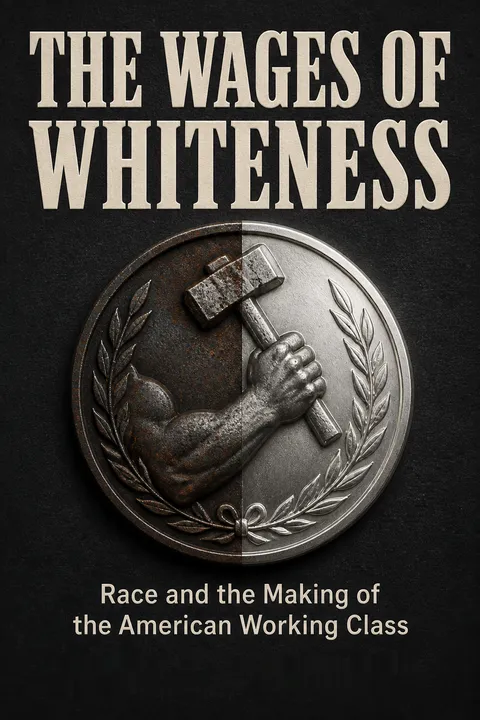
The Wages of Whiteness explores how white workers in 19th-century America constructed racial identity to cope with industrial capitalism's anxieties. Drawing on W.E.B. Du Bois's concept of whiteness as a "psychological wage," Roediger argues white workers chose racial privilege over class solidarity, particularly Irish immigrants who asserted whiteness to gain acceptance. The book examines blackface minstrelsy and language shifts as cultural expressions of this identity formation. Reviewers praise its groundbreaking analysis of race and class intersections, though some note dense academic prose and structural issues. Critics value its continuing relevance to contemporary race-class debates despite being published in 1991.
People Also Read
About the Author
Other books by David R. Roediger
Download PDF
Download EPUB
.epub digital book format is ideal for reading ebooks on phones, tablets, and e-readers.








































