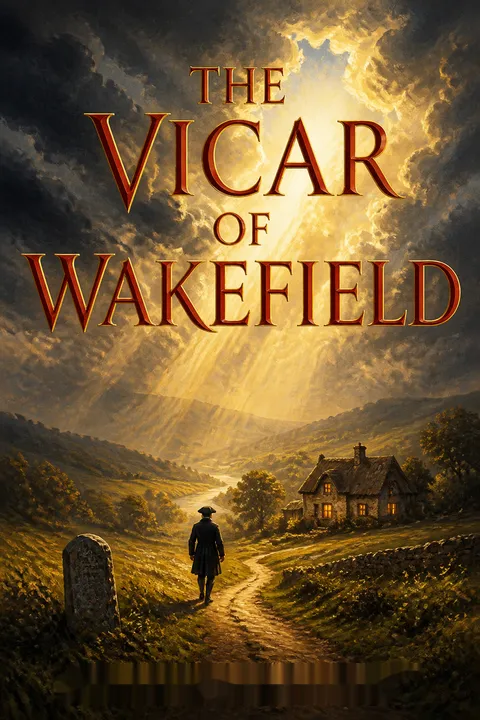

Plot Summary
The Wakefield Ideal
Dr. Primrose, the kindly and virtuous vicar, leads his family in the quintessential country life. Their happiness is grounded in love, morality, and rural simplicity—his wife, Deborah, manages the household, while their six children grow up vigorous and well-minded. The eldest son, George, is destined for a bright future; Olivia and Sophia, his beautiful daughters, each dream in her own way of love and romance. Their home radiates hospitality and contentment, untouched by the world's ambitions or vices. This genteel poverty, combined with unshakeable faith, sets the tone for their resilience in the face of adversity—a foreshadowing of the storms and trials that will test, and ultimately deepen, their familial bonds.
Ruin and Revelation
The family's happiness is brutally interrupted when Dr. Primrose, unworldly and trusting, loses his entire fortune through the bankruptcy of a merchant. Their son George's engagement with Arabella Wilmot, a marriage of love and social advantage, is instantly broken off as their now humble status becomes known. Both families reel; pride, hope, and plans are dashed. Yet Primrose's moral fortitude remains: he vows never to compromise his values to regain status or comfort, igniting a resolve to face penury with dignity and to lead his family through loss with wisdom and courage.
The Humble New Home
Forced to leave their comfortable home, the Primrose family moves to a remote, modest parsonage. Every aspect of life becomes an exercise in humility and adaptation to their "fall." Primrose's optimism encourages his family to accept their new circumstances, even as their pride and vanishings of former joys prick them painfully. George departs for London to seek his fortune, and the rest of the family braces for hardship. The arrival of the eccentric but generous Mr. Burchell hints at future, unpredictable aid.
The Country's Simple Pleasures
The family learns to value new friends and small pleasures in rural life. Their neighbors, especially Farmer Flamborough, provide companionship unmarred by the artifice of wealth. Sunday church, lively feasts, and songs replace urban amusements. The Primrose daughters struggle with humility— torn between longing for accomplishment and acceptance of their social fall. Still, the vicar insists that the greatest happiness is found in self-respect, kindness, and the simple routines of home.
Landlord and Lure
Squire Thornhill, their handsome and famously rakish landlord, quickly becomes a figure of fascination and danger. He showers attention and gifts on Olivia—while Mrs. Primrose and the daughters nurse ambitions of marrying into prosperity. Meanwhile, Mr. Burchell proves a steadfast, humble friend, saving Sophia from a near-drowning. The two men's contrasting natures—Thornhill's superficial charm and Burchell's sincerity—set up dramatic tensions in the daughters' romantic dreams and the family's future.
Invitations and Disguises
The family is drawn into Thornhill's glittering circle, meeting sycophants, false high-society ladies, and scheming acquaintances. Olivia becomes enthralled by Thornhill, Sophia by Burchell. Mrs. Primrose, chasing gentility, steers her daughters to seek fortune through ambition and social climbing. Trivial vanities and the lure of "polish" begin to erode their unity and values—even as the vicar tries to warn them of the dangers in aspiring above their station. Disasters of pride loom as fortune-tellers and gossip stir further hopes and imaginings.
Courtship and Disappointment
Moses, the dutiful son, is sent to the fair to sell the family's only horse. He's swindled into trading it for worthless green spectacles—Deceit is all around, and pride is still readily bruised. The family faces ridicule and embarrassment, yet Dr. Primrose tries to use each disaster to teach humility and the emptiness of appearance. Olivia and Sophia remain enraptured by the promise of romantic ascendancy, even as Thornhill's intentions grow less clear and Mrs. Primrose's hopes run high.
Temptations, Guests, and Go-betweens
Olivia becomes the focus of Thornhill's attention, and Mrs. Primrose pushes for an alliance. Sophia, meanwhile, is quietly courted by Burchell. Social visits, dances, and portrait commissions both feed and test their pride. When Olivia is encouraged to feign attachment to a rival suitor to provoke Thornhill, the emotional waters become even murkier. The vicar, troubled, observes with foreboding as virtue teeters under temptation, persuasion, and the seductions of luxury.
The Snare of Aspiration
Pressured by Thornhill's ambiguous promises and the envy of her mother and sister, Olivia elopes, believing he will marry her. The family is devastated, the vicar's moral certainties shattered. His grief and rage are only softened by Mrs. Primrose's raw pain. The illusion of upward mobility crumbles, replaced by a harsh lesson: aspiration without discernment invites disaster. The vicar prepares for a father's long, humiliating search for a lost child, beset by doubt and fear.
Vanity's Sting
The vicar's search is fruitless, and news of Olivia's betrayal and public disgrace shocks and wounds the family. She had been deceived by a false marriage and exposed to ruin. The vicar, heartbroken, forgives and welcomes her back, but her spirit is broken. The family's misfortunes compound: the house burns down, goods are lost, and humiliation is complete. Only faith, endurance, and the renewal of forgiveness hold the family together as adversity presses in.
The Great Fall
Unable to pay rent, the family is evicted and Dr. Primrose is thrown into debtor's prison. His family is scattered and homeless; Sophia is kidnapped, Olivia is ill, and George is arrested after an attempt at revenge. In the darkness of gaol, among criminals and the wretched, the vicar's spirit is again tested. Far from despair, he undertakes to reform and encourage his fellow inmates, insisting that virtue and hope are not the playthings of circumstance. Adversity becomes his sermon, suffering his teacher.
Betrayal Unmasked
Unexpectedly, hope returns: Sophia is rescued by Burchell, who is revealed as the wealthy and powerful Sir William Thornhill, uncle of the villainous squire. Thornhill's plot to seduce and ruin both daughters is exposed, as is his staged heroism and legal manipulation. Burchell's endurance, humble honor, and secret benevolence contrast sharply with Thornhill's prettily-dressed vice. Revelations cascade; false friends are unmasked, and the arc of justice at last turns in earnest.
Suffering and Endurance
While the legal tangle is unspun, Dr. Primrose's example of moral resilience inspires all around him. Olivia, restored, finds her marriage to Thornhill was real and thus her honor secured. Both George and Sophia are cleared and reunited with their loves. The family, once the object of pity, becomes a model of forgiveness and recovery. Virtue is rewarded not by riches or high station but by the deep bonds of love, compassion, and mutual redemption.
Gaol and Grace
Even while imprisoned, Dr. Primrose finds purpose in offering solace and guidance to his fellow inmates. He orchestrates practical reforms in the gaol, teaches, and preaches hope. Through adversity, he discovers that suffering, far from destroying character, tempers and matures it. The family's sorrows begin to mend through shared affection and a shift in fortune; grace and charity, not fate, become their sustaining powers.
Rescues and Restorations
Thanks to Burchell/Sir William's intervention, the legal machinations against the family unravel, and the truth about Thornhill's villainy leads to restitution. George's name is cleared, the rightful fortunes restored, and romantic bonds—George with Arabella, Sophia with Burchell/Sir William—are joyfully joined. Even the cynical Jenkinson redeems himself, aiding the climax of justice and reunion. The family's endurance is crowned by forgiveness, generosity, and the restoration of wholeness.
The Labyrinth of Law
All the legal knots are untied with wisdom and clemency. Debts are paid, marriages legitimated, and property returned. Past wrongs are forgiven, even to Thornhill, who is allotted a modest competence. The lessons of adversity remain: humility, compassion, and honest labor are life's surest foundations. The family's circle is enlarged with new alliances and friendships; their happiness is renewed not through riches, but in shared suffering, forgiveness, and hope.
Revelations and Redemptions
In the wake of disaster, both personal and social, the vicar reflects on providence, human weakness, and the healing wrought by time, love, and virtue. Prosperity returns, but the family values now rest not on wealth but on unity, integrity, and the wisdom born of adversity. The tale closes with communal celebration, a blending of classes and forgiveness, and the insight that true riches are found beyond appearances—in grace, patience, and enduring trust.
Analysis
Goldsmith's The Vicar of Wakefield
is a novel that balances sentiment, satire, and fable—deploying its engaging, at times comic, family tale to probe deep questions of virtue, suffering, and social aspiration. At its heart stands Dr. Primrose, whose faith in goodness, even when tested by betrayal and loss, is both inspiration and warning. Goldsmith critiques the societal hunger for wealth and status, showing how vanity and ambition render the innocent vulnerable to deception and ruin. He uses reversals of fortune—sometimes comic, often tragic—to reveal the falsity of appearances and the hazards of pride. Yet the novel is also deeply hopeful: misfortune becomes the crucible in which humility, compassion, and steadfast love are made resilient. Even criminals can be redeemed, and even the most absolute loss—family, reputation, liberty—can be transformed through forgiveness and faith. The form itself enacts Goldsmith's belief in the providential order: all is disorder until truth is revealed, disguises dropped, and characters judged for their conduct rather than their circumstances. For modern readers, the lessons endure: humility in the face of adversity, suspicion of prestige without principle, and unwavering commitment to kindness and integrity. Goldsmith's message is both consoling and practical: true happiness lies not in fortune, but in enduring ties, self-knowledge, and the quiet heroism of patience and charity.
Review Summary
People Also Read

Characters
Dr. Charles Primrose
Dr. Primrose is the moral and emotional center of the story: a vicar whose faith in virtue, charity, and the goodness of others is both his strength and naivety. His journey is one from comfort through deprivation, humiliation, and crisis—yet even in privation and disgrace, his steadfastness glows. He mentors his family through loss, misfortune, and temptation, insisting on honorable conduct even as reality punishes idealism. Psychologically, he is a man whose faith is not easily eroded by practical disaster, but who must reckon with his pride, his capacity for anger, and the temptation to despair. In facing ruin, he is tested as deeply as Job—learning that true virtue is tested in adversity, and that humility, forgiveness, and charity are the soul's greatest riches.
Deborah Primrose
Mrs. Primrose is at once humorous and sympathetic—a housewife obsessed with her daughters' prospects, clinging to social aspirations even as the family falls. She schemes constantly to restore their former standing, pushing her daughters toward advantageous marriages. Though her pride sets in motion disastrous events (especially Olivia's elopement), her maternal love never fades. As their fortunes unravel, her pride softens into wisdom, and she emerges as both penitent and steadfast. Her growth is measured by the deepening of her compassion and her eventual contentment with the simple joys of family.
George Primrose
Educated at Oxford and the family's pride, George is eager both to win distinction and to secure love. His early hopes—marrying Arabella Wilmot and forging an honorable career—are dashed by financial ruin. Cast into the world, he wrestles with betrayal, disappointment, and impractical dreams, even falling victim to the snares of poverty and deceit. George's character matures through suffering: his faith, loyalty, and sense of honor ultimately steer him from reckless vengeance toward forgiveness, enabling his reunion with both fortune and true love.
Olivia Primrose
Olivia's longing for admiration and romantic fulfillment, stoked by her mother's aspirations, leads her into Thornhill's trap. Her elopement and ruin become the family's greatest trial and her own passage into disillusionment and repentance. She is easily seduced by appearances, but her core is innocent and trusting. Her path is one from vanity to humility, disgrace to redemption—a journey that illustrates both the dangers of credulity and the healing power of forgiveness and familial love.
Sophia Primrose
Sophia is less dazzling than Olivia, but more sensible, reserved, and self-sacrificing. Her affections are placed with Mr. Burchell, whose integrity she senses beneath his modest exterior. Sophia's quiet endurance and loyalty are a counterpoint to Olivia's impulsiveness. When she is kidnapped, her faith and courage help sustain the family's hope. Psychologically, she symbolizes the virtues of patience, discernment, and inner strength. Her eventual marriage to Burchell/Sir William is a reward for her integrity and humility.
Mr. Burchell / Sir William Thornhill
Burchell at first appears a mysterious, eccentric wanderer, the family's humble friend. Only later is he revealed as Sir William Thornhill—wealthy, respected, and the true opposite of his scheming nephew. His method is observation and disguised benevolence: he tests character, offers counsel, rescues in crisis, and, at last, delivers both Sophia and the family from ruin. His kindness is balanced by insight and authority; his hidden status allows him to discern true virtue from hypocrisy. His eventual marriage to Sophia signals moral and social restoration.
Squire Thornhill
Young, dazzling, and unscrupulous, Thornhill is the novel's chief antagonist. He exploits his privileges as landlord and gentleman—seducing, betraying, and manipulating, all masked by superficial generosity and wit. His character reveals the dangers of unchecked hedonism, social power without moral purpose, and the seductions of appearances. His machinations nearly destroy the Primrose family; but his eventual unmasking, poverty, and social fall illustrate poetic justice and the essential superiority of virtue.
Moses Primrose
Moses's well-meaning nature and lack of worldly cunning set him up for several humiliations—most notably trading the family's only horse for valueless spectacles. He reflects the comic side of innocence, the risks of credulity, and the family's repeated lesson: that good intentions are not always rewarded in a corrupt world. Throughout, his harmlessness and eagerness to please make him lovable, and his loyalty to the family's fortunes unwavering.
Arabella Wilmot
Arabella is George's intended, representing both romantic and economic aspirations. Her refusal of George after his family's fall reflects the harshness of social calculations, but her return and reunion with him are acts of sincerity and loyalty. Arabella's composure and integrity, tested by Thornhill's lies and her own family's ambitions, ultimately shine—her union with George marking the restoration of hope and the triumph of steadfast love.
Jenkinson
Jenkinson is a slippery, multifaceted character: a con man who cheats Moses, then becomes an inmate and, in the end, redeems himself by aiding in Thornhill's unmasking. Jenkinson's flexibility, worldly experience, and comic anti-hero persona provide both danger and unexpected salvation for the Primrose family. His redemption serves as a narrative of moral correction, showing that even the most wayward can be reformed by sympathy and circumstance.
Plot Devices
Disguise and Hidden Identity
The narrative uses disguise both literally and figuratively: Sir William Thornhill adopts the identity of Mr. Burchell to test others' character; false high-society ladies deceive the family; Thornhill beguiles with charm; and even Jenkinson's multiple roles serve the plot. These masks reveal the novel's core concern—judging reality versus appearances, virtue versus show. The ultimate revelation of Burchell as Sir William is the climax where moral worth and authority are grounded in true identity, not social position.
Fortune's Rise and Fall
The Primroses' path is marked by a fall from comfort to penury, further humiliations, and their ultimate restoration. Each reversal is a test—pride, humility, endurance, faith—forcing the characters to confront their aspirations and illusions. Goldsmith uses these fluctuations both to critique social mobility and to demonstrate the shaping power of resilience, forbearance, and hope in adversity.
Irony and Satire
Through wit and comic situations—Moses's spectacles, the misadventures in pursuit of gentility, and the "high society" impostors—the novel satirizes social pretensions, class distinctions, and the folly of aspiring above one's true station. Irony underscores the contrast between genuine virtue and societal markers of respectability, warning against the perils of pride and the world's corrupting influences.
Foreshadowing and Moralization
The narrator's voice often pauses to moralize or reflect, shaping expectations—warnings about pride, lessons drawn from suffering, predictions of calamity or redemption. Goldsmith's use of these devices directs the reader to consider not just the plot, but the underlying ethical themes: humility, forgiveness, the rewards of charity, and the ultimate wisdom of Providence.
Embedded Tales and Parables
The vicar's sermons, stories, and lectures—whether biblical, personal, or fable—anchor the novel's philosophy. Songs and poems within the text provide poignant commentary on folly, suffering, and redemption. These interpolations render the text as both narrative and instructive fable, inviting reflection on the larger social and moral order.
Restoration and Reversal
The resolution depends on hidden truths being unveiled, falsehoods exposed, and virtue recognized. Legal and social wrongs are righted only when the real identities and intentions come to light. Malefactors (Thornhill) fall, and the virtuous (Primroses, Sophia, George) are rewarded, demonstrating a clear, if idealized, vision of providential justice.
Download PDF
Download EPUB
.epub digital book format is ideal for reading ebooks on phones, tablets, and e-readers.








































