

Key Takeaways
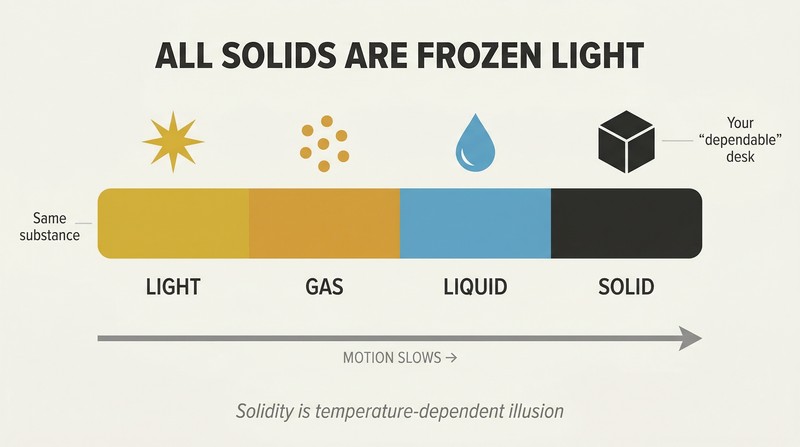
Your most solid reality is just light frozen by slowed motion
Russell's radical opening claim is that every solid you've ever touched — granite, iron, diamond — is the same substance as starlight, merely slowed and crystallized into apparent permanence by motion. Just as ice is water held in form by cold, iron is light held in form by decelerated rotation and accumulated pressure. Raise any substance to its melting point and it liquefies; raise it further and it vanishes into gas.
This means solidity is temperature-dependent illusion. If Earth's average temperature were higher, iron would flow like water. If lower, our oceans would be building material. Russell argues your 'dependable' desk is no more permanent than a snowflake — its permanence is conditioned entirely by the pressure zone and temperature of your planet's position.
The universe is one thinking substance pretending to be many things
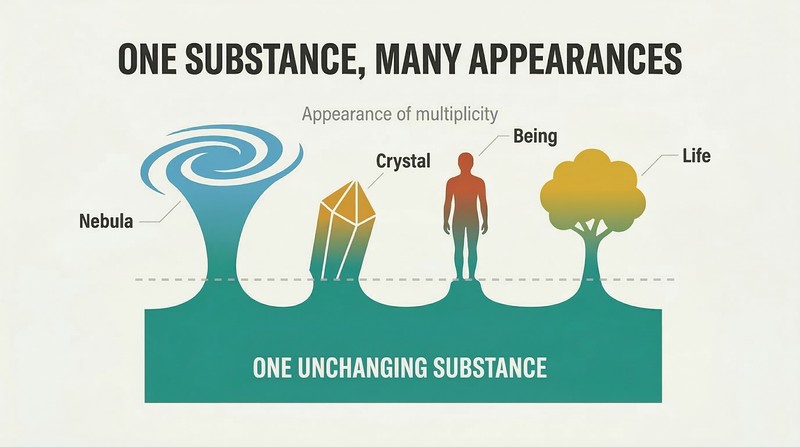
Russell's central thesis — the Universal One — holds that Mind, light, matter, energy, and spirit are five names for one indivisible substance. There are not two substances in the universe; there cannot be. What appears as separate elements, objects, and beings are merely different states of motion within this single substance, like different-shaped bubbles churned from one ocean.
Russell compares the 'created universe' to foam in a ship's wake — myriads of rotating particles that appear individually separate but are never actually divided from the water. A spiral nebula looming against deep space is, he argues, exactly analogous to that foam viewed from a great height. When motion ceases, all apparent forms disappear back into the one substance, unchanged. Nothing was ever truly created or destroyed — only rearranged.
Sex opposition — not biology — is the cosmic force behind all creation
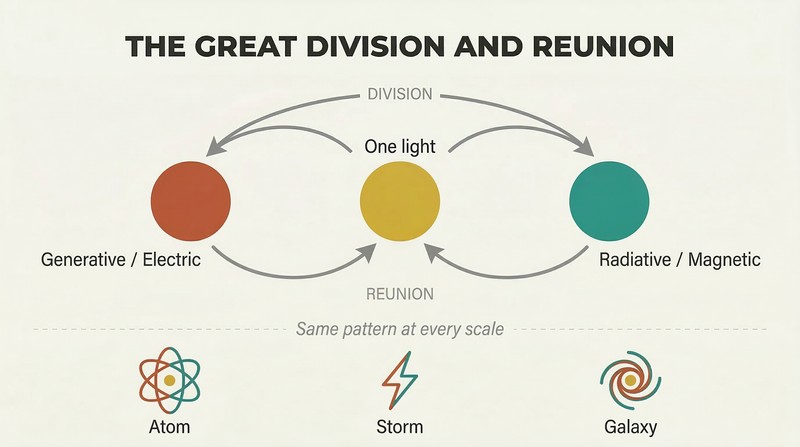
Sex, Russell insists, begins with light, not with organic life. It is the division of the one father-mother substance into apparent opposites — male and female, electric and magnetic, generative and radiative — that drives every force and motion in the universe. A lightning flash equalizing charged storm clouds is sex expression. An atom of sodium uniting with chlorine is sex expression. The rotation of galaxies is sex expression.
Russell identifies sex as the 'great third principle' that Sir Oliver Lodge said was missing from physics. Without the desire for division into two, and the equal desire for reunion into one, neither force nor motion could continue. Every light unit, every atom, every star is both male and female but preponderantly one — and this imbalance is what keeps the cosmos in restless motion.
All power in the universe comes from one source: thinking
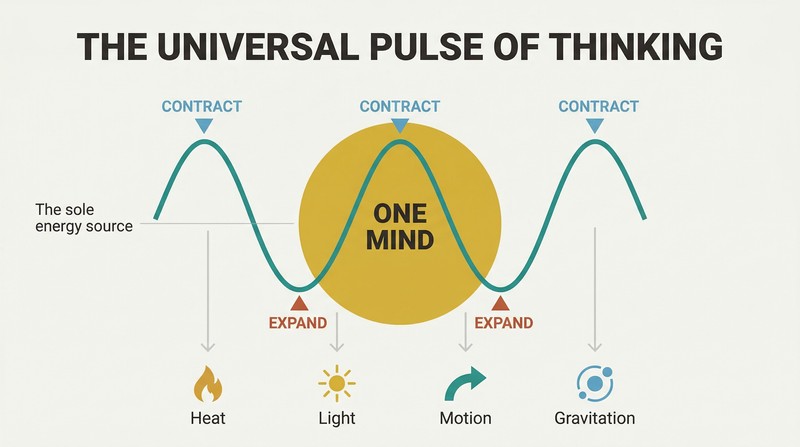
Thinking is not metaphorical energy — Russell means it literally. The electro-magnetic oscillation between the generative action impulse and the radiative reaction impulse of universal thinking is, he claims, the sole energy source of everything: heat, light, motion, gravitation. The process is mechanical, periodic, and measurable.
Every concentrative thought contracts like an inhalation; every relaxation expands like an exhalation. This cosmic breathing — Russell's universal pulse — runs from thirty trillion pulsations per second in a light unit to an eleven-year inhalation cycle in our sun. The more concentrated one's thinking, the greater the power generated. Russell draws a direct parallel: just as a dynamo generates electricity, every mass — and every mind — generates energy proportional to its desire and effort.
Shift from outer-mind sensing to inner-Mind knowing
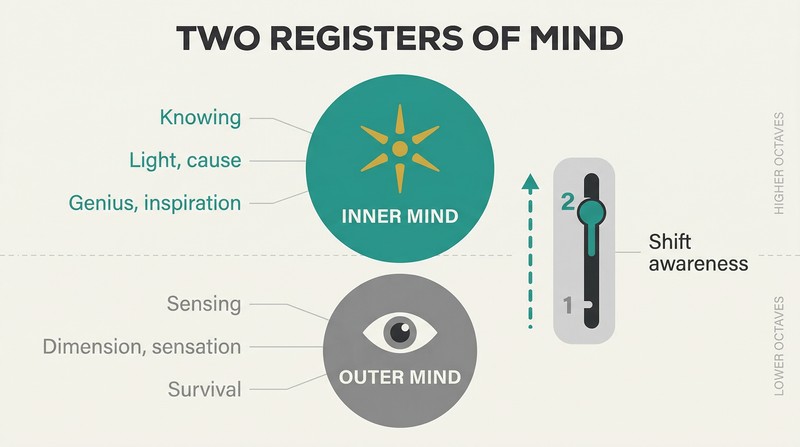
Russell divides the mind into two registers. The outer mind thinks in the low octaves of bodily integration — it handles dimension, sensation, and survival. It is the mind humans share with animals. The inner Mind thinks in higher octaves of light, where dimension disappears and cause becomes visible. Genius, inspiration, and 'instinct' all originate here.
A beaver builds dams without instruction because the memory of millions of generations of dam-building is stored in the inert gases of its soul as chemical registration. Human genius operates identically: the inspired poet or inventor is not inventing something new but recollecting old knowledge from inner Mind. Russell compares shifting between these registers to shifting gears in a car — the higher gears are already built in, waiting for the driver's awareness.
Starlight never travels to you — it reproduces within you
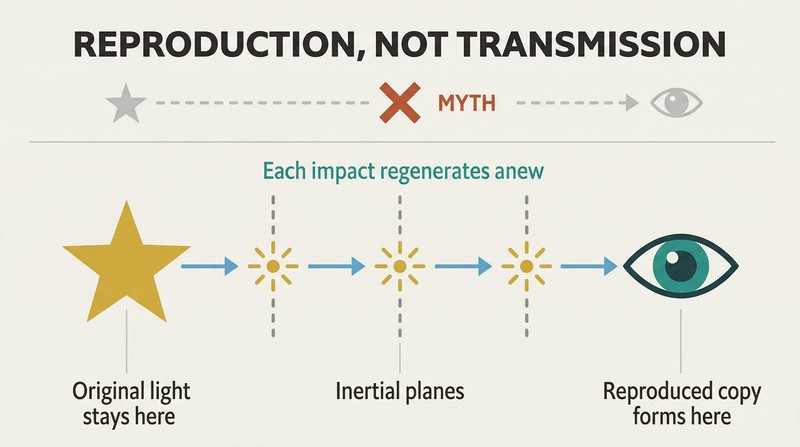
Light does not travel, Russell argues — it reproduces itself, part by part, through sequential impacts against inertial planes of pressure equilibrium. What you see as a star is not an image transmitted across space but an exact reproduced chemical counterpart of the star, regenerated within your own higher-potential body by impact.
The analogy: a voice echoing off a cliff. The original sound never left the speaker's mouth in the form you hear returning. The echo is a regenerated reproduction caused by the radiating sound waves impacting against a surface of higher potential and reversing direction. Russell applies this principle universally — radio, vision, heat from the sun — all are reproductions, not transmissions. This dissolves the need for an 'ether' through which waves must travel.
All 100+ elements are one substance locked at different potentials
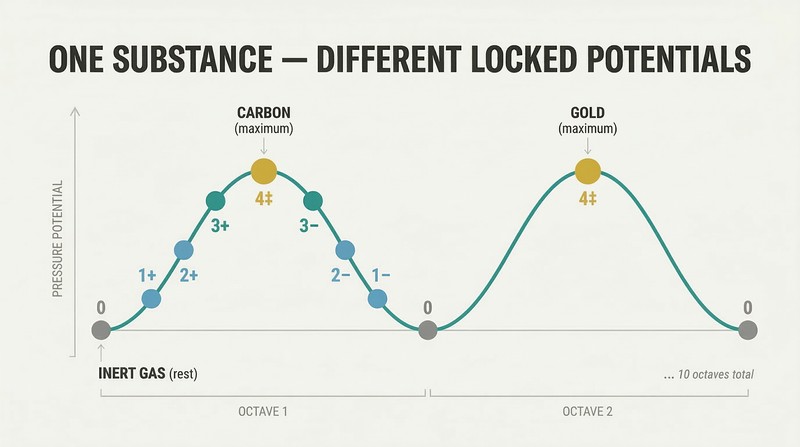
Russell's periodic table is musical. He arranges all matter into ten octaves of seven tones each, governed by a single formula of locked potentials: 0, 1+, 2+, 3+, 4‡, 3−, 2−, 1−, 0. The zero represents inertia (the inert gases ), the numerals represent orderly progressions of increasing then decreasing pressure opposition, and 4‡ is the bisexual maximum (carbon).
This means gold is not a fundamentally different substance from carbon — it is the same universal substance locked at a different potential position with different dimensional measurements. Russell predicted two unknown elements: Hydron, an inert gas lighter than helium ideal for airships, and Luminon, the basis for cold light requiring one forty-thousandth the energy of a tungsten filament. He claimed man could transmute elements once he understood these dimensional relationships.
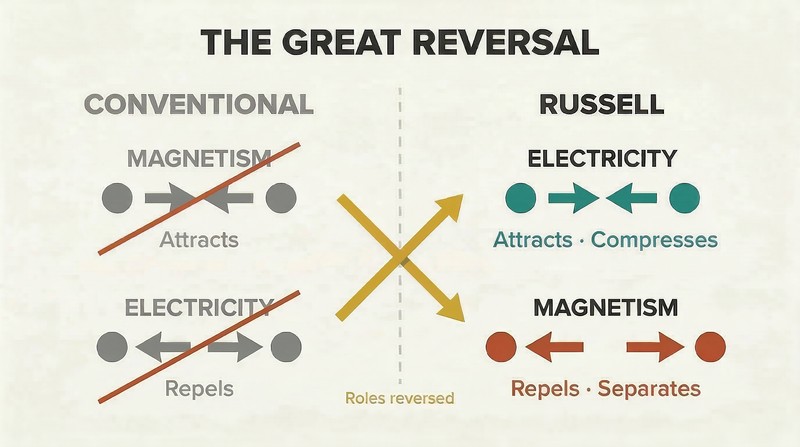
Russell reverses physics: electricity attracts, magnetism repels
Conventional science says opposites attract. Russell says that's an illusion. Positive charge attracts positive charge — this is why density increases toward gravitational centers where positive charge is maximum. Magnetism, far from attracting, is the separative force that pries matter apart and pushes toward equilibrium.
The familiar 'magnet' picking up iron filings is actually demonstrating heightened electrical generation, not magnetic attraction. Russell argues the iron bar has been electrified — not magnetized — by the generative coil. The 'magnetic field' is merely the expelled discharge of an overcharged system. He uses the same principle to explain gravitation: a planet doesn't 'attract' by mass alone but by its relative positive charge, potential position, pressure, temperature, and all eighteen dimensions of motion simultaneously.
Death is a regenerative sleep, not extinction of the self
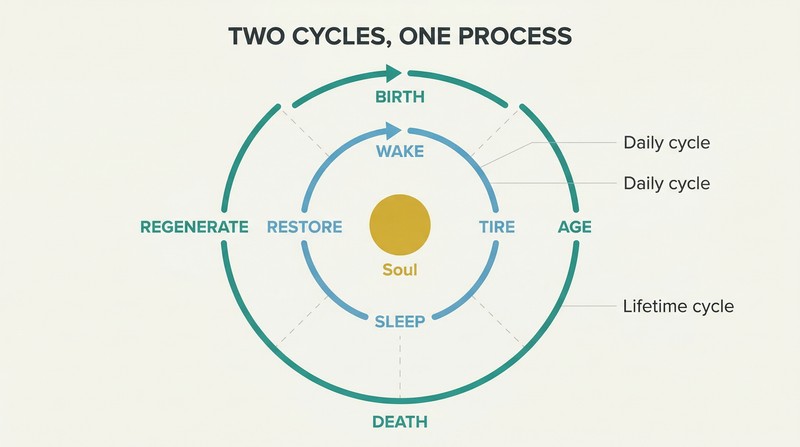
Russell redefines the life-death cycle as identical in principle to the sleep-wake cycle. Each night, the body's centrifugal, expansive, radiative impulse dominates — you degenerate in preponderance until the centripetal, generative impulse reasserts itself and you wake regenerated. Death is simply the moment when the degenerative impulse wins a longer round.
The soul — Russell's term for the chemical record of all thinking, stored in the master-tone inert gases — persists through this longer sleep as a matrix for bodily regeneration. 'Out of the soul the body is again born.' He draws a direct parallel: the inert gases of each octave contain a complete record of every effect of motion within that octave, just as the soul contains every action and reaction of a thinking being. Reincarnation, to Russell, is as inevitable as dawn following night.
Every atom and every person must generate or degenerate
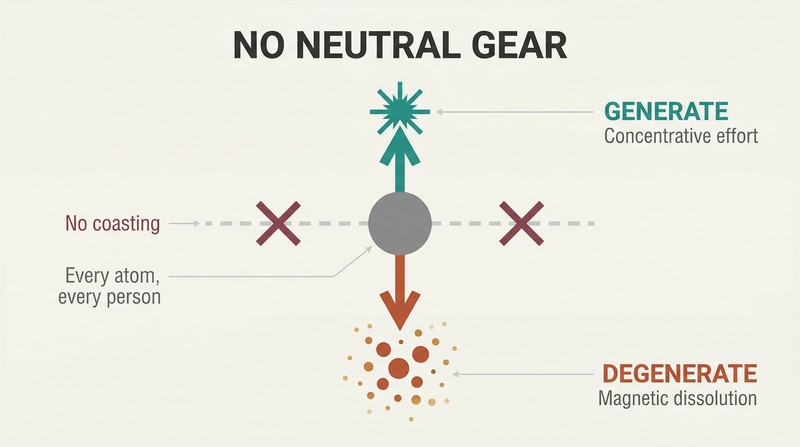
Russell's most actionable principle is that nothing in the universe gets to coast. Every light unit, planet, and person either actively generates energy through concentrative effort against resistance — or passively degenerates as magnetic dissolution takes over. There is no neutral gear. The lines of least resistance lead back to inertia; every inch of progress must be earned and then stabilized with opposing pressure walls.
Degeneracy of the body begins when physical work relaxes; degeneracy of mind begins when concentrative thinking relaxes. Russell compares accumulated potential to a compressed spring — once the generative force lets up even slightly, magnetism's elastic counter-pressure begins prying things apart. Work born of desire, performed in ecstasy, is the only principle that sustains the appearance of existence.
Analysis
Walter Russell's The Universal One (1926) occupies an extraordinary position in intellectual history: it is simultaneously visionary and unfalsifiable, prescient and pseudoscientific, poetic and maddening. Russell, a polymath sculptor-architect-painter with no formal physics training, produced a 114,000-word cosmology that attempts nothing less than unifying mind, matter, and God into a single mechanical system — decades before quantum field theory would suggest that particles are indeed excitations of underlying fields, and that matter and energy are interchangeable (E=mc²).
The book's strengths are real. Russell's insistence that all elements are one substance in different states of motion anticipates nuclear transmutation, which became routine by the 1940s. His ten-octave periodic table, while not adopted by science, is a genuinely creative reorganization that highlights harmonic relationships Mendeleev's table obscures. The 'sex principle' as cosmic polarity maps cleanly onto the yin-yang framework of Taoist philosophy and onto the charge-symmetry principles of modern particle physics. His claim that 'light reproduces rather than travels' is a surprisingly elegant reframe of wave mechanics that sidesteps the ether problem without invoking relativity.
The weaknesses are equally real. Russell's reversal of electromagnetic attraction — positive attracts positive — contradicts overwhelming experimental evidence. His predicted elements Hydron and Luminon have never been discovered. His dismissal of Einstein's curved spacetime while simultaneously claiming all direction is curved reveals internal contradictions. Most critically, Russell's system is constructed to be unfalsifiable: since all apparent phenomena are 'illusions of motion,' any experimental disconfirmation can be dismissed as misreading an illusion.
What endures is Russell's philosophical architecture. The idea that knowledge is recollection rather than acquisition echoes Plato's anamnesis. The formula of locked potentials (0-1-2-3-4-3-2-1-0) is a genuinely useful mental model for understanding cyclical processes — economic, biological, creative. And the core injunction to 'generate or degenerate' remains as brutally applicable to personal development as to atomic physics. Russell's real gift was not physics but metaphor: he gave twentieth-century readers a way to feel the unity underlying apparent diversity, which remains the deepest aspiration of both science and spirituality.
Review Summary
The Universal One receives mostly positive reviews, with readers praising its comprehensive take on the universe and existence. Many find it mind-blowing and paradigm-shifting, though some struggle with its complexity. Reviewers appreciate Russell's attempt to unify scientific concepts into a single theory, describing it as a flowing scientific yet spiritual poem. Critics argue it's nonsensical or difficult to understand without a strong science background. Overall, readers are divided between those who find it profoundly enlightening and those who dismiss it as pseudoscience.
Glossary
Motion-in-opposition
Unequalized pressures creating apparent matterRussell's term for the state of motion where electric and magnetic pressures are unequalized and sustained in opposition, producing what humans perceive as solid matter. This is the active, visible state of the universe where form appears. The point of maximum motion-in-opposition is the nucleal center of any system where opposing pressures reach their peak.
Motion-in-inertia
Equalized pressures where form disappearsRussell's term for the state where electric and magnetic pressures are perfectly equalized—neither force dominates. In this state, form disappears, sex desire becomes negative, and valence is zero. It corresponds to the inert gases (master-tones) in chemistry and to the soul's resting state between incarnations. It is the dimensionless reality underlying all dimensional illusion.
Light units
Fundamental particles of all matterRussell's term for the inconceivably small corpuscular particles of Mind substance that are churned into motion by electro-magnetic thinking forces. Also called corpuscles, they are the building blocks of all matter—living, breathing, pulsing male-female particles that inhale and exhale, generate and radiate, integrate into form and disintegrate back into the one substance. All atoms and elements are organized systems of light units.
Genero-activity
Generative force building higher potentialRussell's term for the process of increasing potential by accumulating energy into lower octaves of greater power but lesser speed. It is the centripetal, contractive, heat-absorbing, electrically dominant force that builds the elements, integrates mass, and drives evolution. Genero-activity is the inhalation or 'winding' phase of the cosmic clock—the father force that creates the appearance of form.
Formula of locked potentials
Universal pattern governing all motionRussell's master formula describing the orderly periodicity of all effects of motion: 0=, 1+, 2+, 3+, 4‡, 3−, 2−, 1−, 0=. Zero represents inertia (the inert gases), numerals represent progressive tonal positions of increasing then decreasing pressure opposition, and 4‡ is the bisexual maximum (carbon). With two exceptions (mass and tone), every dimension of every element follows this octave pattern across ten octaves.
Master-tones
Inert gases recording all motionRussell's name for the inert gases (helium, neon, argon, krypton, xenon, etc.) which occupy the zero position of each octave. They represent motion-in-inertia and contain a complete chemical record of every effect of motion within their octave—functioning as the soul or memory of that octave. Russell argues they should not be classified among the reactive elements because they will not combine with other elements.
Power-time dimension
Accumulated energy stored as massOne of Russell's two opposing time dimensions. Power-time is the genero-active dimension where speed has been decelerated and accumulated into potential energy through resistance—like water stored behind a dam. It belongs to electricity and is characterized by restricted orbital area, decelerated rotation, accelerated revolution, and contracted volume. It is the 'winding' of the cosmic clock.
Speed-time dimension
Released energy expressed as velocityThe opposing time dimension to power-time. Speed-time is the radio-active dimension where accumulated power is released and dissipated into velocity through expansion—like a dam bursting. It belongs to magnetism and is characterized by expanded orbital area, accelerated rotation, decelerated revolution, and increased volume. It is the 'unwinding' of the cosmic clock. The two dimensions always balance: what one gains, the other loses.
FAQ
1. What is The Universal One by Walter Russell about?
- Comprehensive cosmic science: The book presents a unified theory of the universe, describing it as a manifestation of one universal substance—light—governed by the energy of a thinking Mind.
- Unification of science and metaphysics: Russell bridges scientific concepts with spiritual philosophy, explaining creation, life, and reality as expressions of the universal Mind.
- Continuous creation: Creation is seen as a rhythmic, ongoing process of integration and disintegration, not a singular event.
- New scientific laws: The book introduces original principles explaining electricity, magnetism, gravitation, and the elements as effects of Mind in motion.
2. Why should I read The Universal One by Walter Russell?
- Revolutionary worldview: The book challenges conventional science, offering a finite, dimensionless universe governed by one substance and force, and proposes a new cosmogony for the "Cosmic Age."
- Bridging science and spirituality: It integrates scientific facts with spiritual insights, helping readers understand their oneness with all creation.
- Practical implications: Russell’s laws suggest ways to harness universal energy, transmute elements, and master matter, potentially revolutionizing science and industry.
- Empowering wisdom: The book encourages inspired thinking and self-realization, promising that understanding one’s divine potential leads to omnipotence.
3. What are the key takeaways from The Universal One by Walter Russell?
- Oneness of all things: Everything in the universe is an expression of the one universal Mind, and separateness is an illusion.
- Matter as light in motion: All matter, energy, and spirit are varying states of the same substance—light—conditioned by motion.
- Creation as rhythmic cycles: The universe operates through cycles of integration (generation) and disintegration (radiation), governed by electro-magnetic pulsations.
- Human potential: By understanding these universal laws, humanity can access greater knowledge, power, and harmony with the cosmos.
4. What are the best quotes from The Universal One by Walter Russell and what do they mean?
- “Everything that is, is of everything else that is. Nothing is of itself alone.” This expresses the law of universal oneness and interconnectedness.
- “Substance has no power to attract, to repel, to unite or to separate. These qualities belong to motion and not to substance.” Russell redefines physical forces as effects of motion, not inherent properties of matter.
- “Man is omnipotent when he but knows his omnipotence.” This quote encourages readers to realize their divine potential through understanding universal laws.
- “The wave is nature’s method of transferring the dimensionless concept of form in inertia to dimensional form in mass in motion.” It highlights the central role of waves and motion in manifesting physical reality.
5. How does Walter Russell define the universal substance and force in The Universal One?
- One universal substance: All matter is composed of a single substance—light—which is both visible and invisible, and is the body of Mind.
- One universal force: The only force is the energy of thinking Mind, which causes all motion and phenomena in the universe.
- No inherent properties: Substance itself does not attract, repel, unite, or separate; these are effects of motion imposed upon it.
- States of motion: Matter, energy, spirit, and Mind are all the same substance in different states of motion and potential.
6. What is the role of Mind and light in the universe according to The Universal One by Walter Russell?
- Mind as creative cause: The universal Mind is the source of all motion, form, and phenomena, with thinking as the cause of all effects.
- Light as substance and language: Light is the substance of Mind in action, and all ideas are registered and expressed through light.
- Matter as crystallized light: All matter is light in a state of motion, and energy is the energy of thinking Mind.
- Inner and outer thinking: The inner Mind operates in higher octaves of light, enabling true comprehension, while the outer mind perceives illusions.
7. How does The Universal One by Walter Russell explain creation and evolution?
- Creation as process: Creation is a continuous, rhythmic process of integrating and disintegrating the one substance, not a one-time event.
- Evolution through cycles: All things evolve through cycles of motion, with no true beginning or end—everything always was and always will be.
- Sex principle in creation: The apparent division of the one force into opposites (electricity and magnetism) enables the universe to express form and reproduce.
- Integration and disintegration: Creation and dissolution are two aspects of the same process, governed by the periodic pulsations of thinking Mind.
8. How does Walter Russell describe the relationship between electricity, magnetism, gravitation, and radiation in The Universal One?
- Unified forces: Electricity and gravitation are expressions of the same force (centripetal, generative), while magnetism and radiation are their reactive counterparts (centrifugal, degenerative).
- Action and reaction: All effects of motion are electro-magnetic, with electricity accumulating and magnetism dissipating mass and energy.
- Simultaneous opposites: Both forces exist in all mass, alternating in preponderance and maintaining universal balance.
- Correcting misconceptions: Russell challenges the idea that opposite charges attract and like charges repel, offering a new explanation for these phenomena.
9. What is the significance of the ten octave cycle of the elements in The Universal One by Walter Russell?
- Elements as motion states: The elements are not separate substances but different states of motion of the one substance, arranged in ten octaves.
- Rhythmic cycles: Each octave represents a full cycle of integration (generation) and disintegration (radiation), with carbon as the pivotal fifth octave.
- Transmutation potential: Understanding the octave cycle allows for the transmutation of elements by altering their states of motion.
- Periodic order: The cycle is periodic and repeatable, governed by the formula of locked potentials, explaining the order of the elements.
10. How does The Universal One by Walter Russell explain attraction, repulsion, and the nature of motion?
- Motion as cause: Attraction and repulsion are not properties of substance but effects of electric (centripetal) and magnetic (centrifugal) motion.
- Simultaneous opposites: Both forces act together in all mass, with one dominating at a time, reflecting the law of opposites.
- Dependence on potential: The ability to attract or repel depends on a mass’s potential, charge, and volume.
- Opposing streams: Mass flows in two opposing streams—charging and discharging—conditioning all physical phenomena.
11. How does The Universal One by Walter Russell describe the universe as finite and dimensionless?
- Finite in cause and effect: The universe is limited to the measurable range of the ten octave cycle of thinking Mind; there is no infinite universe.
- Dimension as illusion: Space, time, form, and separability are illusions caused by states of motion; the one substance is truly dimensionless and indivisible.
- No boundaries: There is no “beyond” or edge to the universe; all effects return to their origin in cyclical, spiral motions.
- Inner Mind comprehension: True understanding comes from the inner Mind, which can think dimensionlessly and perceive the universe as one.
12. What are the practical implications and applications of the universal laws in The Universal One by Walter Russell?
- Harnessing universal energy: Understanding these laws could allow humanity to tap into universal energy, transmute elements, and master matter.
- Scientific and industrial revolution: Russell’s principles offer new approaches to physics, chemistry, and technology, potentially transforming the industrial arts.
- Personal empowerment: Realizing one’s oneness with the universal Mind leads to greater knowledge, power, and creative potential.
- Living in harmony: The book encourages living in accordance with universal laws, fostering inner awareness, inspired thinking, and unity with all creation.
Download PDF
Download EPUB
.epub digital book format is ideal for reading ebooks on phones, tablets, and e-readers.








































