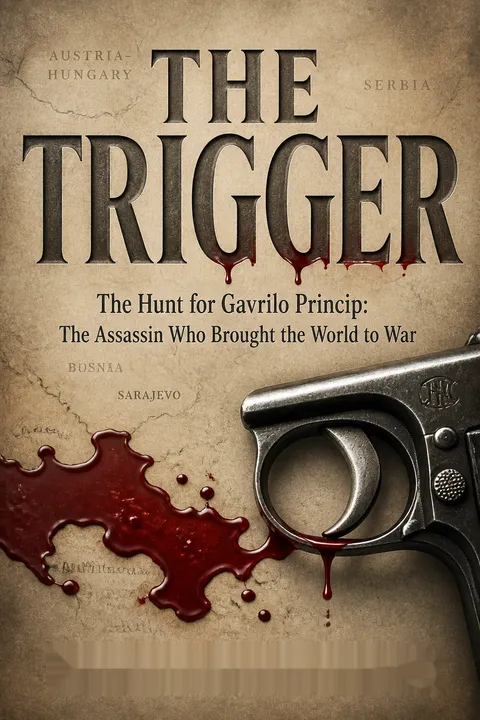

Key Takeaways
1. Princip's Humble Origins and Radical Transformation
The thing that still amazes me about Gavro is how a child from this small place and from that closed time could change the world.
Peasant beginnings. Gavrilo Princip was born in 1894 into extreme poverty in Obljaj, a remote Bosnian Serb village, where six of his nine siblings died in infancy. His family, like many in the region, were feudal serfs, exploited by punitive taxes under successive foreign occupations, first Ottoman, then Austro-Hungarian. This harsh upbringing instilled in him a deep resentment against foreign rule and a fierce protectiveness for the downtrodden.
Academic promise. Despite his rural background, Princip showed early academic talent, excelling in primary school and initially performing brilliantly at Sarajevo's Merchants' School. However, his commitment to conventional education waned as he became increasingly drawn to political activism. His school reports, rediscovered by the author, reveal a sharp decline in grades and a surge in absenteeism, marking his shift from a diligent student to a budding revolutionary.
Slow-burn radicalization. Princip's transformation was gradual, fueled by his voracious reading of revolutionary texts and his exposure to the broader political currents of early 20th-century Europe. He was remembered as a quiet, solitary individual, but one who fiercely defended victims of bullying. This personal trait, combined with the pervasive sense of injustice under colonial rule, laid the groundwork for his eventual embrace of direct action against the Austro-Hungarian Empire.
2. Sarajevo: A Microcosm of Imperial Clash and Identity
Sarajevo was founded where a narrow gorge cut by a small mountain river called the Miljacka blooms into a full valley protected by steeply sided slopes.
A city of layers. Sarajevo, founded by the Ottomans, was a vibrant, multi-ethnic hub known as the "Damascus of the North," where Muslims, Orthodox Christians, Catholics, and Jews coexisted, albeit with occasional friction. Its skyline, once dominated by minarets, began to incorporate Western Christian bell-towers under Austro-Hungarian rule, reflecting the clash of Eastern and Western influences. This blend of cultures and religions made it a unique, yet often tense, urban environment.
Colonial modernization. The Austro-Hungarians, after occupying Bosnia in 1878, embarked on a "cultural mission" to modernize Sarajevo, building a grid of European-style government offices, schools, and infrastructure, including an electric tram system. However, this modernization primarily served imperial interests and did little to alleviate the poverty of the rural population or integrate the diverse communities. The city's old bazaar quarter, Baščaršija, remained a vibrant, traditional hub, a stark contrast to the new colonial architecture.
Youthful ferment. Sarajevo's schools and coffee houses became hotbeds of political discussion, where young Bosnians debated socialism, anarchism, and nationalism. The Mlada Bosna (Young Bosnia) movement, an amorphous group of students from all ethnic backgrounds, coalesced around the shared goal of ending Habsburg rule. Princip, initially timid, was drawn into this intellectual ferment, finding lodging in the city's old quarter and encountering diverse perspectives that challenged his insular upbringing.
3. The Yugoslav Ideal: Princip's Vision for South Slav Unity
I am a Yugoslav nationalist, aiming for the unification of all Yugoslavs, and I do not care what form of state, but it must be free from Austria.
Beyond Serb nationalism. While an ethnic Serb, Princip's primary motivation was not purely Serb nationalism, but the broader "Yugoslav ideal"—the liberation and unification of all South Slavs (Serbs, Croats, and Slovenes) from Austro-Hungarian rule. He saw Serbia, having recently gained independence, as the "Piedmont" that would catalyze this wider South Slav nation. This inclusive vision distinguished him from narrower nationalist factions.
Clash of ideologies. Princip's commitment to Yugoslav unity led to conflicts even within the Serb student community in Sarajevo, where some accused him of not being a "true Serb" for his broader allegiances. His association with Bosnian Muslims and Croats, including fellow conspirators like Mehmed Mehmedbašić, underscored his pan-Slavic aspirations. This ideological nuance is often overlooked in simplified historical accounts.
A utopian dream. Princip's vision was idealistic and perhaps naive, lacking a clear plan for the post-occupation state or how to reconcile the diverse religious and cultural identities within a unified Yugoslavia. However, his unwavering belief in a shared South Slav future, free from foreign domination, was a powerful driving force. This dream, though ultimately unrealized in the long term, shaped his actions and resonated with many young people across the Balkans.
4. The Assassination: A Catalyst in a Web of European Tensions
The trigger for it all had been the shooting in Sarajevo, an event that on a simplistic level could be plotted through artefacts I explored through my journey.
The immediate spark. The assassination of Archduke Franz Ferdinand on June 28, 1914, was the direct "trigger" for World War I. Princip, along with five other young conspirators, targeted the Archduke during his official visit to Sarajevo, viewing him as a symbol of the oppressive Austro-Hungarian Empire. The Archduke's decision to visit on St. Vitus's Day, a sacred Serbian holiday commemorating a historic defeat, further inflamed nationalist sentiments.
Assassin's luck. The plot was amateurish and nearly failed. An earlier grenade attack by Nedeljko Čabrinović missed the Archduke's car, only injuring others. Princip's shot was a stroke of luck, occurring when the Archduke's driver, confused by a last-minute change of route, stopped and reversed the limousine directly in front of Princip. This momentary pause allowed Princip to fire two shots, killing both the Archduke and his wife, Sophie.
Diplomatic dominoes. The assassination, while a local act, was leveraged by Austria-Hungary as a casus belli to declare war on Serbia, which they blamed for supporting the plot. This act set off a chain reaction among Europe's Great Powers, whose complex system of alliances and strategic rivalries had been precariously balanced for decades. The crisis escalated rapidly, leading to a continental war that few initially anticipated would reshape the world.
5. History's Malleability: Princip's Shifting Legacy
The twisting meant that the story of Princip was no longer tethered in reality, but was free-floating and bendable to the vision of any beholder.
A contested figure. Princip's legacy has been continuously reinterpreted and distorted to serve various political agendas throughout the 20th century. Immediately after the assassination, Austro-Hungarian authorities branded him a "murderer" and an agent of Serbia, a narrative that justified their declaration of war. This initial distortion became embedded in the founding narrative of World War I.
From villain to hero. In royalist Yugoslavia (post-WWI), Princip was celebrated as a "herald of freedom" for his role in dismantling the Habsburg Empire and enabling South Slav self-rule. Under Tito's communist Yugoslavia (post-WWII), he was further elevated to a "socialist hero" whose actions expressed "the people's protest against tyranny." This heroic portrayal was evident in the author's visit to Banja Luka, where a rock band performed in front of a massive image of Princip, though many young attendees didn't recognize him.
The modern re-evaluation. The collapse of Yugoslavia and the Bosnian War of the 1990s brought another dramatic shift. Princip's grave was desecrated, and his image as a Serb nationalist was used by some to justify the ethnic cleansing carried out by Bosnian Serb extremists. Today, in Sarajevo, his presence is largely unmarked, reflecting a city grappling with its complex past and a reluctance to celebrate figures associated with past conflicts.
6. The Balkans: A Cycle of Victimhood and Vengeance
The fatal characteristic of this hatred is that the Bosnian man is unaware of the hatred that lives in him, shrinks from analyzing it and hates everyone who tries to do so.
Deep-seated divisions. The author's journey revealed how the Balkans are steeped in a cycle of victimhood and vengeance, where historical grievances are constantly re-litigated. Each ethnic group—Serbs, Croats, Muslims—clings to its own narrative of suffering and past glories, often at the expense of acknowledging the pain of others. This atomistic view, where communities define themselves by distinctiveness rather than shared humanity, fuels ongoing tensions.
Shared historical narrative. Despite their differences, the South Slav peoples share a common historical narrative of suffering under foreign occupation and feudal exploitation. The family stories of Princip (Serb) and Taraba (Croat) were fundamentally similar, differing only in the specific ethnic lens through which they were viewed. This shared experience, however, often becomes a source of division rather than unity.
The toxicity of nationalism. The author observed how nationalism, while initially a force for liberation, can become toxic, reducing complex identities to narrow ethnic loyalties. This reductionism allows for the dehumanization of "the other," leading to atrocities. The inability to transcend these historical narratives and embrace a collective future remains a significant challenge for the region.
7. The Bosnian War (1990s): Echoes of Past Conflicts
The Bosnian War of the 1990s seemed far removed from the fighting of the Great War, a localised, ethnic conflict in the Balkans, a region synonymous in Western eyes with impenetrability, backwardness and violence.
A modern tragedy. The author's personal experiences as a reporter during the 1990s Bosnian War provided a stark contemporary lens through which to view Princip's era. The conflict, characterized by ethnic cleansing, death camps, and systematic atrocities, demonstrated how historical grievances could be weaponized by opportunistic politicians like Slobodan Milošević. The siege of Sarajevo and the Srebrenica genocide became defining horrors, echoing the brutality of earlier conflicts.
Srebrenica's enduring shame. The fall of Srebrenica in July 1995, where approximately 8,000 Bosnian Muslim men and boys were massacred, stands as Europe's worst genocidal war crime since the Holocaust. The author's participation in the Marš Mira (Peace March) through the mountains where survivors fled revealed a landscape littered with mass graves, a chilling testament to the depths of ethnic hatred. This event finally spurred NATO into large-scale military intervention, fundamentally altering international attitudes towards humanitarian intervention.
Jihadist training ground. The Bosnian War also had unforeseen global consequences, serving as a training ground for early jihadists. Foreign fighters, drawn to defend Bosnian Muslims, included individuals later implicated in the 9/11 attacks. This connection highlights how localized conflicts in the Balkans could cast long, global shadows, much like Princip's assassination did decades earlier.
8. The Personal Journey: Understanding History Through Experience
To understand better not just the fouled tomb, but also the ongoing power of the First World War, I decided to return to Bosnia.
Challenging assumptions. The author's journey, retracing Princip's path from Obljaj to Sarajevo and Belgrade, was driven by a desire to understand why Princip's tomb in Sarajevo was desecrated during the 1990s war. This personal quest challenged his schoolboy understanding of WWI as a simple "Us against Them" conflict, revealing the profound complexities and moral ambiguities of Balkan history. The journey was a physical and intellectual exploration, seeking to strip away historical filters.
Connecting past and present. By walking the same mountains, visiting the same towns, and encountering the descendants of those Princip knew, the author gained a visceral understanding of the forces that shaped the assassin. He found parallels between the poverty and resentment of Princip's time and the enduring struggles of modern Bosnians. The journey became a way to connect his own journalistic experiences in the 1990s with the historical events of 1914.
Empathy and disillusionment. Encounters with individuals like Arnie, his Bosnian Muslim guide, revealed the deep trauma and disillusionment left by the 1990s war. Arnie's inability to return to his homeland, despite its beauty, due to the lingering toxicity of ethnic divisions, underscored the profound human cost of these conflicts. The author's journey was not just about Princip, but about understanding the enduring impact of history on individual lives and collective memory.
9. The Role of External Powers and Internal Divisions
The Great Powers, gathering in 1878 for the Congress of Berlin, which was convened to decide the fate of territory lost by the weakening Ottoman Empire, still viewed Europe as a chequerboard of land parcels to be occupied, exploited and occasionally bartered.
Imperial chess game. For centuries, the Balkans were a battleground for external imperial powers—Ottoman, Habsburg, and later Nazi Germany—who viewed the region as a strategic "chequerboard" to be occupied and exploited. The Congress of Berlin in 1878, which handed Bosnia to Austria-Hungary, exemplified this disregard for local populations, sowing seeds of resentment that would later erupt. These interventions often exacerbated existing internal divisions among the South Slavs.
Divide and rule. Imperial regimes consistently employed "divide and rule" tactics, favoring certain ethnic or religious groups to maintain control. The Ottomans elevated local Muslim begs, while the Austro-Hungarians, despite promises of modernization, perpetuated feudal systems and fueled resentment by promoting non-Slav immigrants. This manipulation of local identities contributed to the deep-seated rivalries that Princip witnessed and that exploded in the 1990s.
The Cold War's shadow. Even in the mid-20th century, external powers continued to shape the Balkans. Winston Churchill's decision to back Tito's communist partisans during WWII, based on Fitzroy Maclean's intelligence, effectively pushed Yugoslavia into the Soviet sphere. This strategic calculus, prioritizing geopolitical interests over local political nuances, had profound long-term consequences, trapping South Slavs behind the Iron Curtain for decades.
10. The Enduring Shadow of the "Trigger"
My great-uncle, Captain Alyn Reginald James, had died along with millions of others in a war started after the motives of a young Balkan assassin were distorted.
Distorted origins. The author concludes that the "original sin" of World War I lies in the willful distortion of Princip's motives by Austria-Hungary, who misrepresented him as a purely Serbian agent to justify their attack on Serbia. Other Great Powers, caught in their own strategic ambitions, failed to challenge this misrepresentation, leading to a cascade of diplomatic blunders that plunged Europe into war. This initial distortion created a sense of futility and senselessness that still dogs the memory of the Great War.
A universal struggle. Princip, despite his specific context, represents an "everyman" for the anger felt by millions worldwide against oppressive, unelected structures. His dream of liberation, shared by Irish nationalists, Russian revolutionaries, and anti-colonial movements globally, was a powerful force at the turn of the 20th century. His resort to violence, while tragic, was a common tactic for freedom fighters of his era.
The tragic irony. The ultimate irony is that Princip's utopian dream of South Slav unity failed, corrupted by the very chauvinism he opposed. The Yugoslavia he envisioned ultimately collapsed in the brutal ethnic conflicts of the 1990s, leading to the desecration of his own grave. His story serves as a powerful reminder of nationalism's dangerous potential to distort noble ideals and unleash unimaginable destruction, casting a long shadow over both Balkan and world history.
Review Summary
The Trigger by Tim Butcher follows Gavrilo Princip's journey from his Bosnian village to Sarajevo, where he assassinated Archduke Franz Ferdinand in 1914, sparking World War I. This hybrid work combines travelogue, history, and memoir as Butcher retraces Princip's footsteps while interweaving his experiences as a war correspondent during the 1990s Bosnian War. Reviews praise Butcher's engaging prose and fresh insights into Princip's motivations—portraying him as a Yugoslav nationalist opposing colonialism rather than simply a Serbian extremist. Some critics felt the personal digressions overshadowed Princip's story, though most appreciated the multi-layered approach connecting past and present Balkan conflicts.
People Also Read


Download PDF
Download EPUB
.epub digital book format is ideal for reading ebooks on phones, tablets, and e-readers.








































