
Key Takeaways
1. The Spark of Inspiration: Blurring Reality and War
On one channel, young people were testing their limits and going to extremes to entertain an audience. On another channel, young people were fighting for their country and risking their lives.
A late-night epiphany. The genesis of the dystopian phenomenon occurred when author Suzanne Collins was channel-surfing late at night. She experienced a jarring mental overlap between a reality television competition and actual news coverage of the Iraq War. This unsettling juxtaposition sparked a fundamental question: what would happen if young people were forced to fight to the death for public entertainment?
The core concept. This creative collision birthed the dark, satirical world of Panem, where survival is commodified and violence is broadcast as a civic duty. Collins realized that the intersection of media desensitization and state-sponsored violence was a potent theme for modern audiences. The resulting narrative explores:
- The exploitation of youth for political control
- The voyeuristic nature of modern media consumption
- The desensitization of society to real-world suffering
A natural transition. Having spent years writing for children's television, Collins was uniquely positioned to understand how media structures capture attention. However, she wanted to explore heavier themes—such as the justification and cost of war—that she had touched upon in her previous middle-grade series. This transition to young adult fiction allowed her to delve deeper into the psychological trauma of combat and societal manipulation.
2. Mythological and Historical Foundations of Panem
Like King Minos, Panem’s cold and calculating President Snow sends a clear message to his people. As Collins puts it: “Mess with us and we’ll do something worse than kill you. We’ll kill your children.”
Classical roots of terror. The structure of the Hunger Games is deeply rooted in classical history and Greek mythology, specifically the myth of Theseus and the Minotaur. In the ancient myth, Athens was forced to send seven youths and maidens into a deadly labyrinth as a punishment for rebellion. Collins adapted this cruel concept of "tributes" to establish the absolute authority of the Capitol over the rebellious districts.
Historical parallels. Beyond Greek myth, the story draws heavily from Roman history, particularly the gladiator games and the slave rebellion led by Spartacus. Katniss Everdeen's journey mirrors Spartacus's evolution from a captive forced to fight for entertainment to the reluctant face of a massive revolution. Key historical influences include:
- The Roman concept of panem et circenses (bread and circuses) to control the masses
- The brutal training of gladiators in specialized schools
- The transformation of an oppressed individual into a revolutionary symbol
A legacy of war. Collins's understanding of military history was also shaped by her father, a military specialist and political science doctor who served in Vietnam. He taught his children to critically analyze the causes, realities, and consequences of historical battles rather than sheltering them from the grim truth. This intellectual upbringing infused the trilogy with a realistic, unsentimental perspective on the devastating human cost of warfare.
3. The Power of First-Person, Present-Tense Narrative
I began writing, and the words came out not only in the first person, in the present tense, in Katniss’s voice. It was almost as if the character was insisting on telling the story herself.
An unexpected voice. When Collins sat down to write the novel, she initially planned to use the traditional third-person, past-tense perspective she had utilized in her previous works. However, the character of Katniss Everdeen immediately took over the creative process, demanding to tell her own story in the immediate present tense. This stylistic choice proved crucial, as it locked readers directly inside Katniss's highly focused, survival-oriented mind.
Creating intense intimacy. The first-person, present-tense perspective creates an unparalleled sense of urgency and suspense, as the reader only knows what Katniss knows in any given second. This narrative intimacy forces the audience to experience her fear, strategic calculations, and emotional detachment firsthand. The benefits of this narrative style include:
- Eliminating the distance between the reader and the protagonist
- Heightening the suspense since the protagonist's survival is never guaranteed in the present tense
- Allowing readers to understand the pragmatic, unromantic reality of her choices
Adapting the internal monologue. Translating this intense internal perspective to the screen presented a major challenge for the filmmakers. Because the novel relies entirely on Katniss's silent thoughts, the screenwriters had to find creative ways to externalize her inner world without relying on constant voiceovers. They achieved this by expanding the roles of characters outside the arena, such as the Gamemakers and President Snow, to provide necessary context.
4. Finding the Perfect Katniss: The Casting of Jennifer Lawrence
This is actually a girl whose fierceness comes from a nurturing place, not a conquering place.
An undeniable presence. Casting the lead role of Katniss Everdeen was the most critical decision in bringing the book to life, as the entire film's success rested on her shoulders. Although many actresses auditioned, Jennifer Lawrence stunned the filmmakers with her raw intensity and deep understanding of the character's core motivation. Despite being older and blonder than the book's description, Lawrence possessed the exact emotional essence required for the role.
Nurturing yet fierce. The filmmakers noted that Lawrence perfectly captured the paradox of Katniss: a lethal survivor whose violence is driven entirely by a desire to protect her loved ones. Her audition of the emotional farewell scene demonstrated a fierce, protective instinct rather than a desire for glory. This distinction is vital to the character's appeal, as she is defined by:
- Her deep capacity for self-sacrifice and love for her family
- Her pragmatic, unsentimental approach to survival
- Her refusal to let the Capitol change her moral core
Author and studio approval. Lawrence's performance was so powerful that it instantly won the unanimous support of the studio executives and author Suzanne Collins herself. Collins reassured the young actress that her physical differences were irrelevant because her emotional portrayal of Katniss was flawless. This casting choice set the standard for the rest of the production, allowing the filmmakers to build the rest of the cast around her magnetic presence.
5. Translating the Visual Contrast of Panem to the Screen
We went with sort of an Appalachian coal- mining vibe for the Seam,” says Messina. “But then we added little bits and pieces, things that would have survived through the decades.
Stark environmental division. Production designer Phil Messina faced the monumental task of visually representing the extreme economic inequality of Panem. To establish this contrast, the design team created two entirely distinct visual worlds: the impoverished, industrial District 12 and the grand, oppressive Capitol. The stark difference between these environments serves as a constant visual reminder of the Capitol's exploitation of the districts.
Designing the districts. For District 12, the filmmakers utilized an abandoned North Carolina mill town to capture a bleak, authentic Appalachian coal-mining aesthetic. They carefully balanced historical elements with subtle futuristic touches to create a world that felt both familiar and tragically regressive. Key design strategies for the districts included:
- Using muted, desaturated earth tones to convey poverty and exhaustion
- Preserving the weathered, cookie-cutter architecture of company-owned housing
- Removing natural greenery to emphasize the harsh, industrial environment
The Capitol's imposing grandeur. In contrast, the Capitol was designed to project absolute power, wealth, and authority through massive, solid architecture and vibrant, unnatural colors. The design team avoided whimsical, futuristic spires in favor of heavy, horizontal concrete structures inspired by mid-century World's Fairs. This aesthetic choice emphasizes the cold, unyielding strength of the totalitarian regime, making the Capitol feel like an imposing monument to state control.
6. Rigorous Physical Preparation and Stunt Training
I did every kind of training you can possibly imagine for this role. I had a running coach and I did stunt training so, you know, I did wall climbs and vaults and jumps and all sorts of stuff.
Demanding physical transformations. To make the deadly competition believable, the young cast had to undergo intense physical training long before the cameras started rolling. Jennifer Lawrence trained extensively in archery, running, vaulting, and climbing to ensure she looked completely at home in the wilderness. Meanwhile, other actors had to drastically alter their physical appearances to match their characters' backgrounds.
Contrasting physical regimens. The training programs were tailored to the specific survival styles of each character, highlighting the differences between the tributes. For example, Josh Hutcherson had to gain fifteen pounds of muscle to portray the strong baker's son, while Liam Hemsworth had to restrict his diet to look genuinely hungry. The physical preparation included:
- Rigorous strength and conditioning workouts five days a week
- Specialized weapons training, including swordplay and knife throwing
- Choreographing raw, unpolished fight sequences that resembled playground struggles
Prioritizing safety and realism. Stunt coordinators focused on utilizing the actors' natural physical strengths rather than teaching them stylized martial arts. This approach ensured that the combat in the arena felt wild, emotional, and terrifyingly realistic for a group of teenagers. Despite the use of real weapons and intense physical stunts, the production prioritized safety to protect the young cast during the grueling shoot.
7. Directorial Vision: Immediacy and Character-Driven Action
One of the things that’s most important here is to convey the immediacy, the first-person point of view that the book has. The cinematic style has to reflect that.
A subjective cinematic style. Director Gary Ross was determined to translate the novel's intense first-person perspective into a unique visual language. Rather than shooting a traditional, objective blockbuster, Ross utilized a highly personal, urgent style that kept the audience locked within Katniss's experience. This directorial choice ensured that the film prioritized character emotion over mindless action spectacle.
Guerrilla filmmaking techniques. To achieve this sense of immediacy, the production relied heavily on handheld cameras and tight, intimate framing. This technique gives the film a gritty, documentary-like quality that makes the audience feel as though they are running through the woods alongside the tributes. Key elements of Ross's directorial approach included:
- Restricting the audience's knowledge to match Katniss's limited perspective
- Avoiding highly stylized, glamorized depictions of violence
- Focusing on the psychological toll of the games rather than the spectacle
Collaborative storytelling. Ross worked closely with author Suzanne Collins, transforming her from a distant source novelist into an active screenwriting collaborator. This close partnership ensured that the film remained deeply faithful to the thematic integrity of the book. By focusing on the characters' internal journeys, Ross created a blockbuster that resonates on an intellectual and emotional level.
8. The Deeper Message: Media Satire and Political Responsibility
The way you get to control people is to make them participate, not just subjugate them. If there’s one survivor, one victor, we get them participating in our system.
A warning for the future. At its core, the story serves as a powerful cautionary tale about the dangers of media desensitization and political apathy. Collins designed the dystopian society of Panem to reflect the potential consequences of modern societal trends, such as the obsession with reality television and the detachment from real-world violence. The narrative challenges audiences to examine their own relationship with entertainment and news media.
The mechanics of control. The Hunger Games are not merely a punishment; they are a sophisticated tool of political subjugation that forces the oppressed districts to participate in their own domination. By forcing families to watch their children fight, the Capitol turns tragedy into entertainment, preventing collective rebellion through forced complicity. The story highlights several critical societal issues:
- The disparity between those who feast and those who starve
- The ethical implications of consuming real-world suffering as entertainment
- The responsibility of the younger generation to question authority and fight for justice
An awakening of consciousness. Katniss's journey is ultimately one of political awakening, as she transitions from a simple survivor focused on her family to a reluctant revolutionary. Her defiance in the arena exposes the fragility of the Capitol's control, proving that individual agency can challenge systemic oppression. The film, like the book, urges viewers to consider their own role in shaping the future and to resist the passive consumption of injustice.
Review Summary
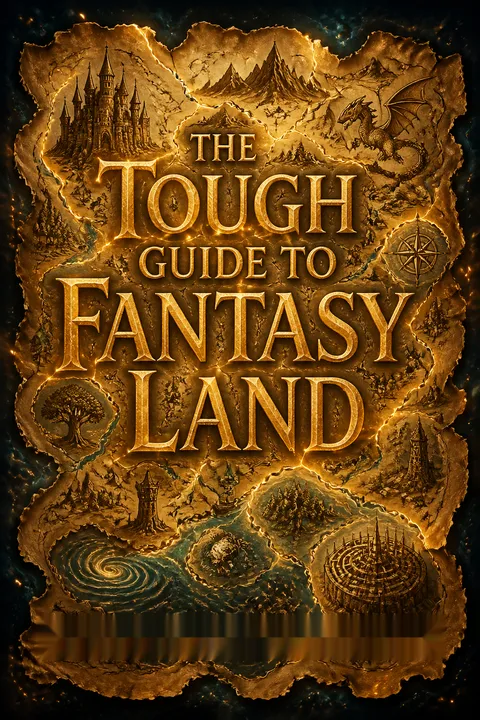
The Tough Guide to Fantasyland is a satirical A-to-Z encyclopedia of fantasy tropes, presented as a mock travel guide for "Tourists" visiting a generic fantasy world. Readers praise its hilarious and accurate observations about clichés like omnipresent stew, color-coded morality, and cross-pollinating horses. While clever and entertaining, most reviewers warn against reading it straight through, recommending instead to dip in occasionally. The book is considered essential reading for fantasy writers to avoid overused tropes, and is compared to Terry Pratchett's humor and TV Tropes website. Jones doesn't mock maliciously but affectionately skewers the genre she clearly knows well.
People Also Read

About the Author
Other books by Diana Wynne Jones
Download PDF
Download EPUB
.epub digital book format is ideal for reading ebooks on phones, tablets, and e-readers.








































