
Plot Summary
Birth Beneath Light Bulbs
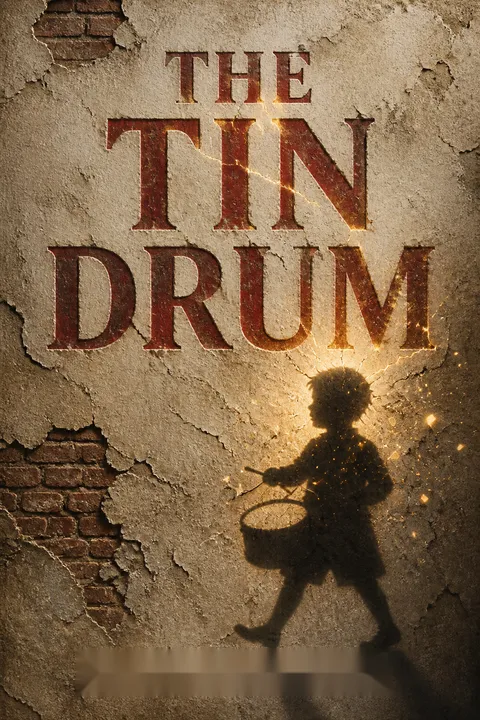
Oskar Matzerath is born in Danzig under the glare of two sixty-watt bulbs, his first moments marked by a moth's frantic dance and the promise of a tin drum for his third birthday. From the start, Oskar claims to be a clairaudient infant, fully formed in mind and will, observing his parents' hopes and the world's expectations with skepticism. The moth's drumming on the light bulbs becomes Oskar's primal rhythm, a motif that will shape his life. He decides early to reject the adult world, especially his father's wish for him to inherit the family grocery, and instead fixates on the drum as his destiny. This moment, both mundane and mythic, sets the tone for Oskar's lifelong resistance to growth and conformity, and his embrace of the drum as his voice and shield.
The Wide Skirt's Refuge
Oskar's story reaches back to his grandmother Anna Bronski, whose four potato-colored skirts become a symbol of refuge and origin. In a Kashubian potato field, Anna shelters the fugitive arsonist Joseph Koljaiczek under her skirts, an act that leads to Oskar's family line. The skirts, rotating in daily ritual, represent both protection and the cyclical nature of history. Anna's practical, earthy presence anchors the family through upheaval, migration, and the shifting borders of Danzig. Her skirts are a recurring image of safety, memory, and the maternal, a place where the persecuted and the lost—like Oskar's grandfather—find momentary peace before being swept into the currents of history and violence.
Drumming Down the Years
Oskar receives his promised tin drum on his third birthday and, after a calculated fall down the cellar stairs, refuses to grow any further. The drum becomes his constant companion, his means of expression, protest, and memory. Through drumming, Oskar narrates his life, shattering the boundaries between past and present, reality and fantasy. His refusal to grow is both a rebellion against adult hypocrisy and a desperate attempt to preserve innocence. The drum's rhythms structure the novel, echoing Oskar's inner turmoil and the chaos of the world around him. As he drums through childhood, adolescence, and war, Oskar's voice—by turns comic, tragic, and surreal—becomes the pulse of a century in convulsion.
Glass-Shattering Song
After his fall, Oskar discovers a supernatural ability: his scream can shatter glass. This power, used in self-defense and protest, isolates him further from the adult world, which fears and misunderstands him. The glass-shattering song becomes a weapon against those who would take his drum or force him to conform. It also marks Oskar as an outsider, a figure of both awe and suspicion. The motif of broken glass recurs throughout the novel, symbolizing the fragility of order, the violence of history, and the destructive potential of art. Oskar's voice, both literal and metaphorical, is a force that disrupts, exposes, and ultimately cannot be contained.
Family Triangles and Betrayals
Oskar's family life is defined by a complex triangle: his mother Agnes, her husband Matzerath, and her cousin/lover Jan Bronski. The ambiguity of Oskar's paternity—whether he is Matzerath's or Jan's son—mirrors the divided loyalties and shifting identities of Danzig itself. The family's photo album, a recurring object, documents their entanglements, betrayals, and moments of fragile happiness. Oskar observes the adults' passions and failures with a mixture of detachment and longing, aware that their secrets and compromises will shape his own fate. The triangle is both personal and political, reflecting the tensions between German and Polish identities, love and duty, past and present.
The Fall and Refusal to Grow
On his third birthday, Oskar deliberately throws himself down the cellar stairs, providing a plausible explanation for his refusal to grow. The adults accept this narrative, and Oskar is subjected to endless medical examinations, but his stunted body becomes his armor against the world's demands. The fall is both literal and symbolic—a rejection of adulthood, sexuality, and complicity. Oskar's perpetual childhood is a form of protest, but also a trap, as he becomes increasingly alienated from those around him. The motif of falling recurs, linking Oskar's personal rebellion to the larger falls—of families, cities, and empires—unfolding around him.
Eels, Gulls, and Good Friday
A pivotal episode unfolds during a family outing to the Brösen jetty, where Oskar witnesses a fisherman extracting eels from a horse's head. The grotesque spectacle traumatizes his mother Agnes, who subsequently develops a compulsive craving for fish, leading to her decline and death. The scene is rich in symbolism: the eels, gulls, and horse's head evoke themes of death, appetite, and the violence lurking beneath everyday life. Agnes's fate is intertwined with Oskar's sense of guilt and helplessness, as he watches her succumb to forces beyond anyone's control. The episode marks the beginning of a series of losses that will define Oskar's journey through war and memory.
The Polish Post Office Siege
As World War II erupts, Jan Bronski is drawn into the doomed defense of the Polish Post Office in Danzig, with Oskar in tow. The siege is chaotic and tragic, culminating in Jan's capture and execution. Oskar, through a mixture of self-preservation and betrayal, survives, but is haunted by guilt over Jan's fate. The episode is a microcosm of the larger destruction engulfing Europe, and Oskar's ambiguous role—witness, participant, and survivor—reflects the moral complexities of the time. The fall of the post office marks the end of Oskar's childhood and the beginning of his long, painful reckoning with history and responsibility.
War, Loss, and Survival
The war years bring relentless loss: the deaths of friends and family, the destruction of Danzig, and the collapse of the world Oskar knew. He survives through adaptability, cunning, and the protective power of his drum. The narrative becomes increasingly fragmented, mirroring the chaos of war and displacement. Oskar's experiences—hiding in cellars, witnessing atrocities, navigating shifting allegiances—are both deeply personal and emblematic of a generation uprooted by violence. The motifs of hunger, cold, and improvisation recur, as Oskar and those around him struggle to find meaning and dignity amid ruin.
Maria, Fizz Powder, and Love
In the aftermath of war, Oskar finds solace and passion with Maria, a shop assistant who becomes his lover and, possibly, the mother of his son Kurt. Their relationship is marked by innocence and sensuality, symbolized by their shared ritual of fizz powder and spit. Yet happiness is fleeting: Maria marries Matzerath, and Oskar is left to grapple with jealousy, longing, and the ambiguous nature of fatherhood. The postwar years are a time of rebuilding and compromise, but also of unresolved desires and the persistence of old wounds. Oskar's love for Maria is both a refuge and a source of pain, echoing the larger themes of loss and survival.
The Dusters and Broken Youth
As a young adult, Oskar becomes involved with the Dusters, a gang of disaffected youth who resist the conformity and hypocrisy of postwar society. Their exploits—petty crime, subversion, and mock rituals—are both a continuation of Oskar's childhood rebellion and a commentary on the failure of adult ideals. The gang's eventual dissolution, and the tragic fates of its members, underscore the impossibility of escaping history and the seductive pull of violence. Oskar's leadership of the Dusters is both empowering and isolating, as he confronts the limits of protest and the costs of refusing to grow up.
Drumming for the Old
Oskar's drumming evolves from private protest to public performance, as he becomes a celebrated entertainer, touring concert halls and nursing homes. His act—reawakening childhood memories in elderly audiences—turns personal trauma into spectacle, and art into commodity. The success brings wealth and recognition, but also a sense of emptiness and complicity. Oskar's relationship with his audience is ambivalent: he offers them catharsis, but also exploits their nostalgia and pain. The motif of the drum, once a symbol of resistance, becomes entangled with the machinery of postwar consumer culture and the commodification of memory.
The Ring Finger's Mystery
Haunted by loss and guilt, Oskar becomes obsessed with a severed ring finger he finds in a field, preserving it in a jar and treating it as a relic. The finger becomes a symbol of unresolved desire, the persistence of the past, and the impossibility of atonement. Oskar's ritual adoration of the finger is both absurd and poignant, a private liturgy for the dead and the lost. The motif of the finger weaves together themes of love, violence, and the search for meaning in a world shattered by history. The episode culminates in Oskar's arrest and trial, as the boundaries between guilt and innocence, reality and fantasy, blur.
The Black Cook's Shadow
Throughout the novel, the figure of the Black Cook—a childhood bogeywoman—haunts Oskar's imagination, embodying his deepest fears and the inescapable approach of death. The Black Cook appears in dreams, songs, and moments of crisis, a symbol of the darkness that underlies both personal and collective history. As Oskar ages, the Black Cook's presence intensifies, merging with memories of war, loss, and the failures of adulthood. The motif is both comic and terrifying, a reminder that the past cannot be escaped, and that every act of forgetting is also an act of repression.
Flight and Arrest
Fleeing guilt and the threat of prosecution, Oskar embarks on a surreal journey westward, pursued by the specter of the Black Cook and the agents of the law. His flight takes him through Germany and France, culminating in a moment of reckoning on a Parisian escalator, where he is arrested and forced to confront the consequences of his actions. The journey is both literal and symbolic—a descent into the underworld of memory and a confrontation with the self. Oskar's arrest marks the end of his flight from responsibility, and the beginning of a new, uncertain chapter.
Thirty Candles, Endless Questions
On his thirtieth birthday, Oskar reflects on his life, his failures, and the possibilities that remain. Surrounded by friends, family, and the ghosts of the past, he contemplates marriage, emigration, and the founding of a new sect. The future is uncertain, and the questions that have haunted him—about guilt, innocence, love, and the meaning of art—remain unresolved. The novel ends with Oskar poised between past and future, childhood and adulthood, laughter and fear, as the Black Cook's shadow lengthens and the drum's rhythms echo into the unknown.
Analysis
The Tin Drum is a monumental exploration of the individual's struggle to maintain autonomy, innocence, and meaning in a world shattered by violence, hypocrisy, and historical catastrophe. Through the figure of Oskar Matzerath—a perpetual child, unreliable narrator, and survivor—Grass interrogates the nature of memory, guilt, and the construction of identity. The novel's blend of magical realism, satire, and grotesque imagery exposes the absurdity and horror underlying both personal and collective experience. Grass's use of unreliable narration, non-linear structure, and recurring motifs challenges the reader to question the possibility of truth, redemption, or coherence in the aftermath of trauma. The Tin Drum is both a savage indictment of the complicity and cowardice of ordinary people in the face of evil, and a darkly comic celebration of the resilience of art, imagination, and the human spirit. Its lessons remain urgent: history is never past, innocence is always compromised, and the drumbeat of memory—by turns joyful and terrifying—echoes on.
Review Summary
The Tin Drum by Günter Grass receives overwhelming praise as a masterpiece, though polarizing some readers. The novel follows Oskar Matzerath, a dwarf who deliberately stops growing at age three, narrating from a mental institution. Reviewers praise its magical realism, dark humor, and satirical portrayal of Nazi Germany and WWII. The protagonist's tin drum and glass-shattering voice serve as powerful symbols of protest against fascism and middle-class complacency. While some found it exhausting and disturbing, most consider it brilliant, unforgettable literature with exceptional translations capturing its complex narrative techniques and grotesque imagery.
People Also Read


Characters
Oskar Matzerath
Oskar is the novel's protagonist and narrator, a self-proclaimed clairaudient infant who refuses to grow beyond the age of three. His stunted body and supernatural scream set him apart, making him both a witness and a participant in the upheavals of twentieth-century Danzig. Oskar's psychological complexity is profound: he is by turns innocent and manipulative, victim and perpetrator, artist and charlatan. His drum is both shield and weapon, a means of protest and a tool of memory. Oskar's relationships—with his family, lovers, and the world—are marked by ambiguity, longing, and guilt. His refusal to grow is both a rebellion against adult hypocrisy and a desperate attempt to preserve innocence, but it also traps him in perpetual alienation. As the novel unfolds, Oskar's voice—by turns comic, tragic, and surreal—becomes the pulse of a century in crisis.
Agnes Matzerath (née Bronski)
Agnes is Oskar's mother, caught in a love triangle with her husband Matzerath and her cousin/lover Jan Bronski. She is practical, sensual, and deeply conflicted, torn between duty and passion. Agnes's decline—marked by compulsive fish-eating and eventual death—embodies the destructive forces at work in both family and history. Her ambiguous maternity (Oskar's true paternity is never resolved) and her role as the emotional center of the family make her both a source of comfort and a site of trauma. Agnes's fate is intertwined with Oskar's sense of guilt and helplessness, and her absence haunts him throughout his life.
Alfred Matzerath
Matzerath is Agnes's husband and Oskar's legal father, a solid, well-meaning grocer who seeks stability and respectability. His love for Agnes is genuine but limited by his conventionality and inability to understand her needs. Matzerath's embrace of Nazism is less ideological than opportunistic, a reflection of his desire to belong and succeed. His relationship with Oskar is marked by frustration, disappointment, and a lack of true connection. Matzerath's death—choking on a Nazi Party pin—serves as a darkly comic indictment of the era's moral bankruptcy and the personal costs of conformity.
Jan Bronski
Jan is Agnes's cousin and lover, and possibly Oskar's biological father. Sensitive, dreamy, and indecisive, Jan is torn between personal desire and political loyalty. His involvement in the defense of the Polish Post Office is both an act of courage and a gesture of futility, leading to his capture and execution. Jan's relationship with Oskar is ambiguous—part father, part rival, part fellow outsider. His fate embodies the tragedy of divided loyalties and the impossibility of reconciling love and duty in a world at war.
Maria Truczinski
Maria enters Oskar's life as a shop assistant and becomes his lover, the possible mother of his son Kurt, and later Matzerath's wife. She is pragmatic, resilient, and sensual, providing Oskar with both comfort and frustration. Their relationship is marked by innocence (the fizz powder ritual) and loss, as Maria ultimately chooses security over passion. Maria's adaptability and business acumen allow her to survive and thrive in the postwar world, but her emotional life remains haunted by the past. Her ambiguous role—as lover, mother, and stepmother—mirrors the novel's themes of identity, compromise, and the persistence of desire.
Anna Bronski (Grandmother)
Anna is Oskar's maternal grandmother, whose four potato-colored skirts become a recurring symbol of safety, memory, and maternal protection. Practical, earthy, and enduring, Anna anchors the family through upheaval and loss. Her skirts are both literal and metaphorical shelters, places where the persecuted and the lost find momentary peace. Anna's presence in the novel is a reminder of the cyclical nature of history, the persistence of the past, and the possibility of comfort amid chaos.
Joseph Koljaiczek
Joseph is Oskar's grandfather, a Polish-Kashubian arsonist whose flight from the authorities sets the family's story in motion. His escape beneath Anna's skirts and subsequent disappearance—possibly to America—make him a figure of both legend and loss. Joseph's rebelliousness and outsider status are inherited by Oskar, who sees in his grandfather a model of resistance and a source of unresolved longing. The ambiguity surrounding Joseph's fate mirrors the novel's larger themes of identity, exile, and the elusiveness of truth.
Herbert Truczinski
Herbert is a friend of Oskar's, a waiter whose back is crisscrossed with scars from barroom brawls and wartime violence. His body becomes a map of suffering, a testament to the wounds—physical and psychological—inflicted by history. Herbert's death, in a bizarre sexual encounter with a museum figurehead, underscores the novel's themes of desire, violence, and the impossibility of healing. His scars are both a source of fascination for Oskar and a reminder of the costs of survival.
Klepp
Klepp is Oskar's friend and musical collaborator, a flautist whose shifting political and artistic allegiances provide both companionship and challenge. Klepp's embrace of jazz, communism, and various utopian schemes contrasts with Oskar's skepticism and detachment. Their partnership—musical and personal—is marked by camaraderie, rivalry, and the search for meaning in a disenchanted world. Klepp's presence in the novel highlights the possibilities and limitations of art, friendship, and ideology in the aftermath of catastrophe.
The Black Cook
The Black Cook is a recurring figure in Oskar's imagination, a childhood bogeywoman who comes to embody his deepest fears and the inescapable approach of death. She appears in dreams, songs, and moments of crisis, merging with memories of war, loss, and the failures of adulthood. The Black Cook is both comic and terrifying, a reminder that the past cannot be escaped, and that every act of forgetting is also an act of repression. Her presence in the novel is a testament to the persistence of trauma and the power of myth in shaping individual and collective memory.
Plot Devices
Unreliable Narration and Temporal Dislocation
The novel is structured as a memoir written by Oskar from a mental institution, blending first- and third-person narration, fantasy and reality, past and present. Oskar's voice is deeply unreliable—by turns confessional, evasive, and self-mythologizing—forcing the reader to question the truth of his account. The narrative is non-linear, looping back and forth in time, mirroring the disruptions of memory and the chaos of history. This structure allows Grass to explore the complexities of guilt, responsibility, and the construction of identity, while also satirizing the conventions of autobiography and historical fiction.
Magical Realism and Surreal Motifs
The Tin Drum employs elements of magical realism: Oskar's refusal to grow, his glass-shattering scream, and the recurring presence of mythic figures like the Black Cook. These motifs blur the boundaries between the ordinary and the fantastic, highlighting the absurdity and horror of the world Oskar inhabits. The novel's surreal imagery—drumming moths, eels in horse heads, severed fingers—serves as both metaphor and critique, exposing the violence and irrationality underlying everyday life. The grotesque is a constant presence, destabilizing the reader's expectations and challenging the possibility of coherence or redemption.
Repetition, Motif, and Photographic Memory
Grass structures the novel around recurring motifs: the drum, glass, skirts, photographs, and food. These objects serve as anchors for memory, sites of trauma, and symbols of desire or loss. The photo album, in particular, becomes a repository of family history, a visual counterpoint to Oskar's unreliable narration. The repetition of scenes, phrases, and images creates a sense of cyclical time, reinforcing the novel's themes of recurrence, inescapability, and the persistence of the past. The use of photographs and other visual media also foregrounds questions of representation, authenticity, and the limits of narrative.
Satire, Irony, and Parody
The Tin Drum is a deeply satirical work, mocking the pretensions of authority—political, religious, and artistic—and exposing the hypocrisies of both individuals and institutions. Grass parodies a range of genres: the Bildungsroman, the war novel, the family saga, and the confessional memoir. Oskar's voice is laced with irony, self-deprecation, and dark humor, undercutting grand narratives and exposing the absurdity of the world. The novel's tone shifts rapidly from the comic to the tragic, the lyrical to the grotesque, reflecting the instability and ambiguity of the era it depicts.
Guilt, Innocence, and the Burden of History
At its core, The Tin Drum is a meditation on guilt—personal, familial, and collective. Oskar's ambiguous role in the events he narrates—witness, participant, betrayer, and survivor—mirrors the moral complexities of twentieth-century Europe. The novel refuses easy answers or clear lines between innocence and culpability, instead exploring the ways in which individuals are shaped by, and complicit in, the violence of history. The burden of memory—what is remembered, forgotten, or repressed—becomes both a source of suffering and a means of survival, as Oskar drums his way through the ruins of the past.
Die Danziger Trilogie Series
Download PDF
Download EPUB
.epub digital book format is ideal for reading ebooks on phones, tablets, and e-readers.








































