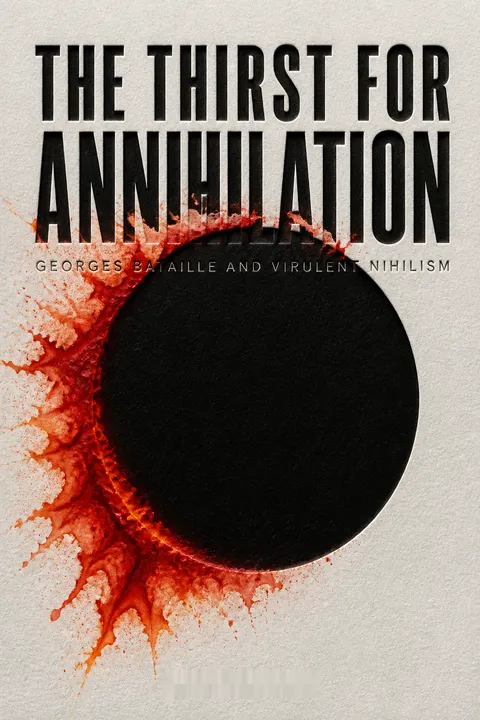

Key Takeaways
1. Bataille's Virulent Horror: A Communion Beyond Academia
In no way, though, is Nick Land’s book an attempt to appropriate Bataille’s writings to a secular intelligibility or to compromise with the aridity of academic discourse—rather, it is written as a communion.
Beyond academic discourse. This book is not a detached academic analysis of Georges Bataille, but a visceral engagement, a "communion" with his thought. It rejects the sterile "aridity of academic discourse" and the attempt to reduce Bataille's radical ideas to secular intelligibility. Instead, it aims to spread the "virulent horror" inherent in Bataille's writings, embracing their unsettling power.
Textual sacrifice. Land's approach is a "textual sacrifice," where words transcend their conventional meaning to touch the "broken voice of death." This involves discussing theoretical issues across philosophy, sociology, and psychodynamics, but only as "stepping stones into the deep water." The goal is not to clarify or appropriate, but to participate in the violent, non-utilitarian essence of Bataille's work.
Radical engagement. To truly engage Bataille is to accept an abnormal excitement and an appalling lack of refuge. It means abandoning the pursuit of "sound books" or comfortable digestion by "capital’s cultural machine." Only in the "twisted interstitial spaces of failure" can genuine contact and "anegoic intimacy" occur, resisting the impoverishment that comes from seeking education or comfort.
2. The Thirst for Annihilation: Humanity's Violent Impulse
Bataille’s writings cut violently across this tightly disciplined reading to reveal the strong underlying currents that bear us towards chaos and dissolution—the violent impulse to escape, the thirst for annihilation.
Underlying currents. Beneath the disciplined surface of cultural modernity, Bataille's work exposes a profound, violent impulse towards chaos and dissolution. This "thirst for annihilation" is not a mere desire for destruction but a fundamental drive that cuts across the Kantian bedrock of transcendental philosophy and its object-oriented reason.
Beyond utility. This impulse is non-utilitarian, escaping the logic of production and survival that defines human endeavors. It is a "violent impulse to escape" the confines of disciplined existence, pushing towards a radical undoing of self and order. This thirst is an ulceration, a compulsion to abstract, tearing negation from its logical function.
Ferocious investment. The thirst for annihilation is a "ferocious investment" in liquidation, where logical dissection reveals its terrible materiality as an excitation. It's a primitive craving for the abolition of reality, a drive that accomplishes itself through philosophy, twisting like a rusted nail into sensitive flesh. It is a love for death, without parsimony.
3. Solar Economy: The Primacy of Useless Expenditure
The radiation of the sun is distinguished by its unilateral character: it loses itself without reckoning, without counterpart. Solar economy is founded upon this principle.
Unilateral discharge. The universe operates on a "general economy" rooted in the sun's unilateral, unreckoning discharge of energy. This energy is squandered without return, making "utter waste" the inherent fate of all energy. Life itself is merely a "precarious stabilization and complication of solar decay," a temporary pause in this inexorable flow.
Excess precedes production. From this perspective, production is an illusion, a "digression in consumption." The sum of energy produced always exceeds what is necessary for its production, meaning "the world...is sick with wealth." The primordial task of life is not to produce or survive, but to consume this "clogging floods of riches."
Sacrificial consumption. Expenditure, or dépense, is the uninhibited wastage that returns energy to its solar trajectory, releasing it from the temporary arrests of terrestrial systems. This "voluptuary destruction" is the only true end of energy, a process of liquidation that accumulated efforts can only suspend for a while.
4. Libidinal Materialism: Philosophy as an Offence Against Anthropocentrism
Libidinal materialism is the name for such a philosophy, although it is perhaps less a philosophy than an offence.
Anti-anthropocentric stance. Libidinal materialism is a philosophy that vehemently rejects anthropomorphism, viewing it as a "vulgarity" that sides with "cages." It demands a thorough dehumanization of nature, an "uttermost impersonalism" in explaining natural forces, and a "vigorously atheological cosmology."
Pessimistic and diagnostic. This "offence" is historically pessimistic, drawing from Nietzsche, Freud, and Schopenhauer. It is "psychoanalytical" (without believing in the psyche) and "thermodynamic-energeticist" (without being physicalistic). Its methodology is genealogical, diagnostic, and aims for an "anegoic delirium" through the accentuation of intensity.
Beyond propositions. Such thinking is less concerned with propositions than with "punctures," hacking at the flood-gates protecting civilization from impersonal energy. It is a "writing against reservation," massively irresponsible, and without ultimate ancestor, representing "the textual return of that which is most intolerable to mankind."
5. Atheism as a Crime: The Violent Death of God
An atheism that does not hunger for God’s blood is an inanity, and the anaemic feebleness of secular rationalism has so little appeal that it approximates to an argument for his existence.
God's death as a religious event. Nietzsche's announcement of the death of God is not a mere epistemic conviction but a profound religious event, the "positive end of religion." For Bataille, this atheology is specifically Christian, rooted in the "sense" of the crucifixion as a divine suicide, deformed by theology into redemption.
Beyond secular rationalism. True atheism is not the "anaemic feebleness of secular rationalism" but a passionate hatred for God, a hunger for his blood. It is a "crime" no less worthy of cathedrals than the tyrant it abolished, an act of desecration that unleashes humanity from itself back into the "blind infernal extravagance of the sun."
Zero as the true absolute. The "a-" of atheism is not merely privative but affirms the "true absolute" of the nihil, the "undifferentiable cosmic zero." This is a religion of the zero, where "God remains dead," and his non-being provokes cynical laughter, revealing him as a "pathological insecurity" longing for release from his "ignoble inexistence."
6. Transgression: The Sacred Violation of Law and Utility
We have no true pleasure except in expending uselessly, as if a wound opens in us.
Law as preservation. Law, in Bataille's view, is an imperative for the preservation of discrete being, a "servility of a legal existence" that subordinates consumption to reproduction. Transgression, conversely, is the flagrant violation of all human utility, accumulative reason, stability, and sense, threatening mankind with outlawed adventures.
Evil as non-utilitarian. The criteria of "good" (self-identity, permanence, benevolence) are rooted in the "preservative impulses of a peculiarly sordid, inert, and cowardly species." To defy God in a "celebration of evil" is to embrace processes that are "immoderate, epidemic," and "irreducibly ruinous," such as eroticism, base religion, inutile criminality, and war.
Sacred communication. Transgression is not mere criminality but the "effective genealogy of law," operating at a more basic level of community. It is a "solar barbarism," a "violent liberation from servility," where the collapse of transcendence allows for a "communication more basic than the pseudo-communication of instrumental discourse."
7. The Labyrinth: Reality as Undifferentiated, Complex Immanence
The labyrinth is a complexity that cannot be determined as an extrinsic predicate of substance; one that returns the pretension of substantiality to the uncircumscribed recession of detailing which undoes it.
Beyond discrete being. The labyrinth is not an intervention into being but an "infestation or irresolvably complex collapse," replacing being with "illimitable corrosion." It represents the "positive impossibility of privileged scales," where irreducible detail and diversity recur across and between strata, meaning "being is nowhere."
Unconceptualizable implosion. Within the labyrinth, all substantiality succumbs to an "unconceptualizable implosion," becoming a mere cipher for the "unresolved precision of porosity." There is only "relative simplicity," never achieved totality or simplicity, but always a compact of integration and complexity that cannot be grasped by traditional logic.
Sponge-space. This "labyrinthine construction" is akin to "sponge-space," a geometry without inaccessible recesses, where space and time are constructed within it, not external to it. It is a "headless axis of recession," where profundity is a complication of the shallows, and "one" is nowhere, dissolving volumes into endless intrication.
8. Unilateral Difference: The Delirious Flow Beyond Binary Logic
A unilateral difference is the simultaneity of a tendency to separation and a persistence of continuity, which is a thought that cannot be grasped, but only succumbed to in delirium.
Beyond reciprocal relations. Base materialism introduces "unilateral difference," which operates only from the undifferentiated, flagrantly inconsistent with the principle of identity. Unlike bilateral or reciprocal relations, unilateral difference means that something can be differentiated from matter while remaining materially undifferentiated from it.
Delirium as truth. This concept cannot be grasped by conventional thought but must be "succumbed to in delirium." It explains how aberrant phenomena like "spirit" are spiritually distinct from matter yet materially continuous. Culture is only culturally different from nature, leaving nature uninterrupted by its most strenuous deviations.
Hybrid existence. The human animal is a hybrid spawned by unilateral difference, a blend of sentience and pathology. Mankind valorizes autonomy while cursing the tidal desires that pull it towards "fusional dissolution." Morality becomes the imperative to autonomous integrity, branding skinless contact and merging bodies as evil.
9. Eroticism and Literature: Catastrophic Diseases of Communication
Literature is like love in that both are catastrophic diseases.
Expenditure as essence. Literature, like love, is a "catastrophic disease" that wantonly exploits physiological resources, derailing lives and undoing methodical projects. It is primordially "expenditure," a "pathological extravagance" whose natural companions are poverty, ill-health, and mental instability, rather than a productive act.
Love's destructive core. Love is driven by a "thirst for disaster," fostering self-abasement and leading to ruinous poverty, madness, and suicide. It is the "ultimate illness and crime," incompatible with human welfare, because "evil is love," a need to deny an order with which one cannot live.
Communication through death. Eroticism, as the "fusion of sexuality and death," is the "extreme emotion" that opposes human to animal. It is the "little death" of orgasm, a provisional substitute for terminal oblivion that infiltrates death into vitality's core. Both eroticism and literature are "communication" opened by death alone, defiling those they unite.
10. Aborting the Human Race: Overman as Intensive Regression
The devaluation of the highest values, the convulsion at the zenith of nihilism, that aborts the human race.
Humanity's self-deception. Humanity, trapped in the Kantian practical postulate of immortality, seeks two ends: telos and terminus, blessing the former and cursing the latter. This teleological self-deception, where history is comprehended as progressive, is a "slander against nature," masking a deeper, terminal reality.
Nihilism's zenith. The "devaluation of the highest values" marks the "zenith of nihilism," which "aborts the human race." Humanity, having polarized high and low, is plunged into its abjected values: animality, pathology, sensuality, and materiality. This is a regression driven by zero, a violent spasm of relapse into an "extinct telos."
Overman as redirection. Overman is not a new goal or a conceptual advance, but an "intensive foetus," a redirection of humanity's intensive potential. It is predominantly regressive, a "step back from extension in order to leap in intensity," like drawing back a bow-string. History is aborted by zero, and the world of work perishes with the One.
11. War as Unreason: The Sacred Drive to Dissolution
War is unreason, but what is reason? It is something like a pearl; the symptom of a protracted irritation.
Beyond political instrument. War, in its radical sense, is not an instrument of policy or acquisition, but "unreason" itself. It is a "luxuriance of chances," a "metamorphosis of forces" from strategic ensembles to tactical fragments, the "goalless polemos of Herakleitean flux." Its true nature is a "solar genealogy," not a productivist motivation.
Prisoner of production. While industry inhibits solar flow, war is its free movement across the earth, imbued with sacred characteristics: irrationality, horror, and "incendiary glory." War is the "prisoner of production," its repressed energy source and implicit catastrophe, a "base hydraulics" of Thanatos.
Intensive desire. War is not merely a desire for destruction but "desire itself," convulsive recurrence, "unilateral zero." It irrupts into civilizations as a loss of control, a "de-humanizing regression," where "man" is a circumscription. Its profound degradation makes it "truly base," yet it is also "beautiful" in its harsh, fluid, and untamed aspects.
12. The Impossible: Writing as Wreckage and Unattainable Truth
The impossible is the basis of being.
Untruth of theory. Theory, in Bataille's work, is a "constricted species of fiction," secondary to textual generativity. It is a "fiction" that only exists as a "unilateral deviation from solar howl," impotent even to terminate itself. The "impossible" is not a margin but an immensity, making the possible shrivel to nothing.
Literature as annihilation. Literature is writing for nothing, a "pathological extravagance" whose natural companions are poverty and mental instability. It is the "termination of sense," a "holocaust of words," where the annihilation of what is written is the only means of compensating for the "offence of writing."
Communication through wreckage. Bataille's writing is not a doctrine but a "convulsion of hazard," a "chaos of books and papers." Its fragmentation and incompletion are not mere technique but reflect death itself, which "dissipates, aborts, fragments." This "filthy death" is a violent communion, where "poetry is the impossible," and "the truth of eroticism is treason."
Review Summary
The Thirst for Annihilation receives polarized reactions. Readers praise Land's intense prose and engagement with Bataille's nihilism, calling it hypnotic and philosophically daring. Critics cite impenetrable jargon, deliberate misreadings of philosophers like Heidegger and Nietzsche, and overblown obscurantism. Many find the anti-religious sections tedious and adolescent. The book's "libidinal materialism" and treatment of death, excess, and transgression captivate some while exhausting others. Several reviewers note it requires extensive philosophy background. Land's later political trajectory taints retrospective readings. Overall, responses range from "badass" genius to performative, incomprehensible failure, with most acknowledging moments of brilliance amid dense, often frustrating prose.
People Also Read

About the Author

Download PDF
Download EPUB
.epub digital book format is ideal for reading ebooks on phones, tablets, and e-readers.








































