


Key Takeaways
Today's chaos isn't collapse; it's a new civilization being born
Three waves, not endless progress. Toffler's central claim is that humanity has been hit by three great waves of change. The First Wave was the agricultural revolution, which took thousands of years to spread from around 8000 BC. The Second Wave was industrialism, which remade Europe, America, and beyond in roughly three centuries after 1650. The Third Wave, an information-and-technology civilization, began surging around 1955 and may complete itself in mere decades.
The collision explains the headlines. Crumbling families, energy crises, political paralysis, and spreading cults look like random breakdown. Toffler argues they are interconnected symptoms of two civilizations grinding against each other. Once you sort Third Wave innovations from dying Second Wave institutions, the confusion resolves into a discernible pattern, and action becomes possible again.
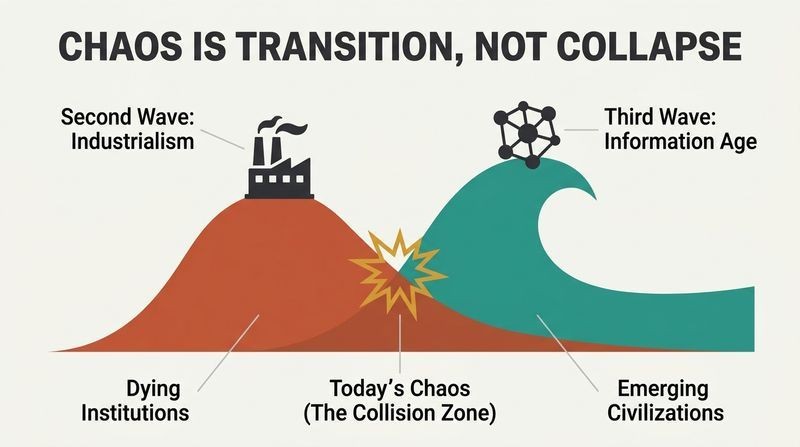
What's striking is how Toffler reframes anxiety as birth pangs rather than decay, a move that anticipates later complexity theory about systems reorganizing at higher levels. His wave metaphor borrows from Frederick Jackson Turner's frontier essay, and he admits it yields only partial truth. The tripartite scheme is admittedly gross: agrarian China and feudal Europe differ enormously, yet both count as First Wave. Critics note this flattening can hide as much as it reveals. Still, the framework's predictive hits (decentralization, customized production, remote work) are remarkable for 1980, predating the internet by more than a decade.
Industrialism split making from using, and the market rushed into the gap
The invisible wedge. Before industrialism, most people consumed what they produced: they were, in Toffler's coinage, prosumers. The Second Wave violently separated production from consumption, so almost no one, not even farmers, stayed self-sufficient. Everyone became dependent on goods made by strangers and sold through an exchange network.
The market became the vortex of life. Once producer and consumer were divorced, a switchboard was needed to reconnect them, and that switchboard, the market, moved from society's margins to its center. Toffler insists this happened under socialism too, since a planned economy still needs a mechanism to route goods. The wedge also split the human psyche: workers were trained to defer gratification while consumers were urged to indulge, producing a divided personality inside the same person.
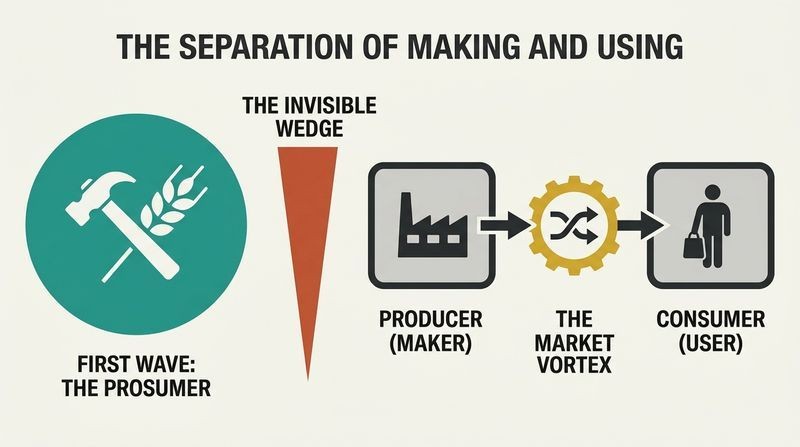
Toffler's insistence that the market is not inherently capitalist echoes economic anthropologist Karl Polanyi, whom he cites, and challenges both Marxist and free-market orthodoxies that treat markets as ideological property. The point that money-mindedness reflects industrialism rather than capitalism per se is genuinely provocative, supported by his examples of Soviet editors taking kickbacks. A modern reader might push further: behavioral economics now shows the producer-consumer psychological split he describes as a manufactured tension between self-control and impulse, which advertising deliberately exploits. The wedge concept also usefully prefigures debates about the informal economy and unpaid domestic labor's invisibility in GDP.
Six hidden rules programmed industrial life; recognize them dissolving
The code of the Second Wave. Toffler argues every industrial society, capitalist or communist, ran on six interlocking principles that grew out of the production-consumption split:
1. Standardization (identical products, tests, wages, and even time zones)
2. Specialization (the narrow expert replacing the jack-of-all-trades)
3. Synchronization (life paced to the machine and the clock)
4. Concentration (of energy, population, work, and capital)
5. Maximization (bigger equals better, the cult of scale)
6. Centralization (of power, money, and decision-making)
These rules are now under attack. Flextime breaks synchronization, customized products break standardization, small self-managed units break maximization, and decentralization movements break centralization. Much of the conflict in schools, businesses, and governments, Toffler says, is really a clash over which rulebook applies.
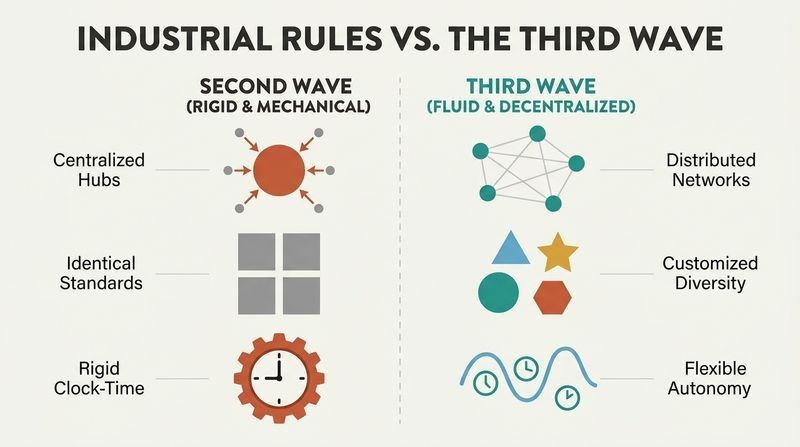
The genius here is treating disparate institutions (factories, schools, prisons, orchestras) as expressions of one underlying grammar. The symphony orchestra example, evolving departments and a conductor-manager to fill ever-larger concert halls, is a memorable illustration that culture mirrors production. Skeptics might argue Toffler overfits: standardization and scale economies remain very much alive in Amazon warehouses and global supply chains. Yet his deeper claim, that these are no longer the unquestioned default, holds. The framework resonates with Max Weber's analysis of bureaucratic rationalization and with James C. Scott's later work on how states impose legibility through standardization.
Mass society is shattering into diversity; stop expecting one-size-fits-all
De-massification is the master trend. Toffler's term de-massification means the breakup of uniform mass society into smaller, varied, faster-changing pieces. The mass market splinters into mini-markets: Bell once put the same black phone in every home, then began offering a thousand variations. Mass magazines like Life died while thousands of special-interest titles bloomed. A single black-and-white television consensus fractured into cable channels and cassettes.
Diversity spreads everywhere at once. Ethnic minorities reassert identity instead of melting in, occupations multiply, and values fragment. Toffler frames this not as selfish fragmentation but as a requirement of the new production system, which needs a more varied, open society to function. The practical lesson: policies, products, and messages designed for a uniform mass audience increasingly miss their target.
De-massification is arguably Toffler's most prescient concept, forecasting niche media, personalization algorithms, and identity politics decades early. The claim that diversity is functionally demanded by advanced production, not merely tolerated, is a strong structural argument that parallels Emile Durkheim's organic solidarity, where complex societies cohere through differentiation rather than sameness. A critical caveat: Toffler underestimated how digital platforms could re-massify attention around a few dominant networks even while fragmenting content, producing filter bubbles and viral monocultures. The tension between fragmentation and platform concentration is precisely the unresolved dynamic of the current information economy.
You are becoming a prosumer again, producing much of what you consume
The return of production for use. Toffler predicts the historic wedge between producer and consumer will partly heal, giving rise once more to the prosumer, someone who produces goods and services for their own use rather than for sale. His evidence in 1980: home pregnancy tests, self-service gas pumps, ATMs replacing tellers, and an explosion of do-it-yourself home improvement, where power-tool sales flipped from 70% professional to 70% consumer in a decade.
Two sectors, not one. He splits the economy into Sector A (unpaid production for self, family, community) and Sector B (production for exchange). Conventional economics ignores Sector A entirely, rendering housework and self-help invisible. As paid services grow costlier (the Law of Relative Inefficiency), doing it yourself becomes economically rational, shifting activity back to Sector A.
The prosumer concept has aged into a central pillar of the digital economy: YouTube creators, open-source coders, IKEA assemblers, and users who generate the content that platforms monetize. Toffler saw the outsourcing of labor to customers as both liberation and cost-shifting, a duality economists now call the externalization of labor. His critique that GDP ignores unpaid work anticipates feminist economics and the work of Marilyn Waring. One limitation: he treats prosumption as broadly empowering, whereas critics argue much of it is unpaid labor captured by corporations, from self-checkout to free data generation. The line between doing-it-yourself and being-made-to-do-it-yourself remains genuinely blurry.
Work is migrating back home to the electronic cottage
The home becomes a workplace again. Toffler coined electronic cottage to describe homes equipped with communications technology where people do paid work, reversing the Second Wave migration into factories and offices. He estimated that even with 1980 technology, a third to half of workers in advanced facilities could work largely from home, since telecommunications is far cheaper than transportation.
Ripple effects everywhere. He calculated that shifting even 12-14% of urban commuting to telecommuting could have eliminated America's gasoline imports. Beyond energy, home-based work could stabilize communities (less forced relocation), strengthen families through shared work, draw children into productive roles, and even revive the family as an economic unit. He acknowledged limits: some jobs need face-to-face contact, and motivation and management would have to be reinvented.
Written more than forty years before pandemic-era remote work became universal, this forecast is uncanny in outline and instructive in its errors. Toffler nailed the technological and energy logic but overestimated how quickly culture, management habits, and the human hunger for in-person contact would yield. The 2020s validated his core substitution of bandwidth for asphalt while also exposing what he underweighted: isolation, blurred work-life boundaries, and the surveillance potential of home monitoring. His hope that shared home-work would reweave family bonds sits in tension with evidence that remote work can intensify domestic strain, a nuance worth holding alongside his optimism.
The nuclear family is now a minority lifestyle, not the standard
The idealized model no longer fits. Toffler notes that the classic nuclear family (working father, homemaker mother, two children) described only about 7% of the American population by 1980. The family isn't dying, he argues, but losing its status as the single approved template, giving way to a proliferation of forms: singles living alone, unmarried couples, child-free couples, single parents, and what he calls aggregate families formed when divorced parents remarry and merge children.
Structure follows work. Just as the factory produced the streamlined nuclear family by stripping away relatives who couldn't move for jobs, the Third Wave de-massifies the family. He offers a mischievous test: to truly restore the nuclear family, you would have to smash the computer, force women back into kitchens, and re-massify society, because family form tracks the production system.
Toffler's satirical checklist for restoring the nuclear family is a sharp rhetorical device, exposing how nostalgic family-values politics ignores the economic substructure that made that family form dominant in the first place. Sociologists like Stephanie Coontz later documented exactly this: the 1950s nuclear family was a historical anomaly, not an eternal norm. The prediction that no single family form would dominate has largely held across the developed world. Where Toffler is weaker is on the emotional costs of this pluralism, the loneliness and instability that accompany expanded choice, a theme he treats more fully when discussing the psycho-sphere.
Tomorrow's corporation answers to many bottom lines, not just profit
From single purpose to multipurpose. Toffler argues the corporation, the defining Second Wave institution, is undergoing an identity crisis. Five converging pressures force it beyond pure profit-seeking: environmental limits, a densely organized society of activist groups, the rising role of information, complexified government, and heightened moral scrutiny. The result is a firm held responsible for ecological, social, informational, political, and ethical effects, not just economic output.
Multiple bottom lines. He points to early experiments: European companies publishing social reports, Deutsche Shell weighting five corporate goals equally, and firms tying executive bonuses to minority hiring. Managing this demands smarter executives capable of optimizing several variables at once, replacing the single-minded profit-maximizer. Toffler frames this as a genuine reconceptualization of what production even means.
This is essentially a blueprint for ESG, stakeholder capitalism, and triple-bottom-line accounting, articulated decades before those terms entered boardrooms. Toffler's structural argument, that new production conditions (not merely activist pressure) force the change, is stronger than most contemporary corporate-responsibility rhetoric, which tends to treat it as voluntary virtue. The skeptical counterpoint, which he half-anticipates, is greenwashing: much multiple-bottom-line reporting remains public relations camouflage, as the 2010s backlash against hollow ESG claims showed. The unresolved question he raises remains live today: how do you actually measure and enforce non-financial performance when the language of accountability barely exists?
The nation-state is being crushed from above and below at once
Squeezed from two directions. Toffler argues the nation-state, perfected by the Second Wave to match nation-sized economies, is losing power simultaneously to forces below it (regional separatists in Corsica, Scotland, Quebec, Alberta, the American Sun Belt) and forces above it (transnational corporations, currency flows, and global problems no single government can solve).
New global players. He highlights the transnational corporation as a rival to the state: by the early 1970s General Motors' sales exceeded the GNP of Belgium or Switzerland, and Exxon's tanker fleet dwarfed the Soviet Union's. Alongside them proliferate thousands of transnational associations and intergovernmental bodies. Toffler predicts not a single world government nor corporate dictatorship, but a messy matrix of overlapping institutions, an Oceans Matrix or Energy Matrix, meshing regions, cities, corporations, and interest groups.
The dual squeeze thesis illuminates phenomena Toffler could only glimpse: Brexit and Catalan independence from below, the EU, WTO, and multinational tech giants from above. His matrix model, networks of overlapping authority rather than neat hierarchies, anticipates political scientists' later concept of multi-level governance and neomedievalism. The prediction that regions might bond across borders more than with their own capitals resonates with today's city-state economics and networked global cities. A fair critique: Toffler somewhat underestimated the nation-state's resilience and its capacity to reassert itself through nationalism, border control, and digital sovereignty, all forces that surged in the 2010s against his globalizing current.
Our political institutions are obsolete; build a democracy of minorities
The machinery is broken. Toffler argues that representative government, designed when messages traveled by horse, cannot cope with Third Wave speed, complexity, and diversity. Decision-making suffers a logjam he calls decisional implosion: leaders make too many decisions too fast about problems too interconnected, producing paralysis and side effects. Blaming weak leaders misses the point; the institutions themselves are anachronistic.
Three design principles. He proposes a twenty-first-century democracy built on:
1. Minority power (majority rule is obsolete in a society with no majority; protect and combine diverse minorities)
2. Semi-direct democracy (citizens represent themselves on some issues via new technology, blended with elected representatives)
3. Decision division (push decisions to the right level, some up to transnational bodies, many down to regions and localities)
He even floats choosing some legislators by lottery, as with juries.
Toffler's diagnosis that governance capacity is overwhelmed by decision load prefigures debates about democratic backsliding and institutional sclerosis. His semi-direct democracy anticipates digital deliberation, citizens' assemblies, and liquid democracy experiments now trialed in Taiwan, Ireland, and elsewhere. The lottery idea revives sortition, an ancient Athenian practice enjoying serious academic revival through thinkers like Helene Landemore. The weakness: Toffler is thin on how minority-power systems avoid gridlock or capture, and technology-enabled direct democracy carries its own pathologies, manipulation, emotional volatility, and misinformation, which he acknowledges but underestimates. Still, his core insight, that institutional design, not leadership charisma, is the real variable, remains bracingly relevant.
People crave community, structure, and meaning; cults weaponize all three
A crisis in the psycho-sphere. Toffler argues that the collapse of Second Wave institutions breaks down three psychological necessities. Community offsets loneliness. Structure gives life comprehensible order (a job, a schedule, a role). Meaning connects us to a larger scheme. As families fracture, jobs turn transient, and the shared worldview dissolves, millions feel isolated, aimless, and adrift.
Why cults thrive. He explains the explosive rise of cults and quasi-religious movements as a direct response: they sell exactly these three products. New members get instant friendship, rigid rules that impose structure, and an all-encompassing worldview that organizes the chaos, all at the price of surrendering the self. His constructive alternative: deliberately design new community-builders, life-organizers, and semi-cults that provide structure without demanding total submission.
This framework, community plus structure plus meaning, is a compact and durable lens on the modern epidemic of loneliness, later quantified by researchers like Robert Putnam and surgeons general warning that isolation rivals smoking as a health risk. Toffler's insight that extremist and cultic movements are supplying unmet psychological needs anticipates analyses of radicalization, from gangs to online conspiracy communities, which recruit the structureless and disconnected. His proposed semi-cults, opt-in communities of moderate structure, feel underdeveloped and slightly utopian. Yet the diagnostic remains powerful: de-massification liberates the individual but atomizes them, and any humane future civilization must consciously rebuild belonging rather than assume it.
The clockwork worldview is dying; reality runs on feedback, not billiard balls
Indust-reality is crumbling. Toffler uses indust-reality to name the industrial era's super-ideology, its bedrock assumptions about nature, evolution, progress, time, space, matter, and causality. Second Wave thought pictured a universe of separate particles colliding in linear time like billiard balls, with simple causes producing predictable effects, and treated humanity's conquest of nature as inevitable progress.
A new synthesis emerges. The Third Wave replaces this with contextual, systems thinking. Toffler cites Nobel laureate Ilya Prigogine's work on how order arises out of chaos through fluctuation, and the distinction between negative feedback (which preserves stability) and positive feedback (which amplifies change). Causality becomes a web of mutual influences, sudden leaps, and chance fused with necessity. Time itself, after Einstein, bends and stretches. The lesson: expect discontinuity, amplification, and surprise, not smooth straight lines.
Toffler's move from mechanistic to systems thinking tracks a genuine paradigm shift across twentieth-century science, from cybernetics and chaos theory to complexity science at institutions like Santa Fe. His use of Prigogine's dissipative structures to argue that societies, like chemical systems, can leap to higher order through instability is intellectually ambitious and connects social change to thermodynamics. The risk is metaphor overreach: borrowing physics vocabulary to describe civilizations can illuminate or merely decorate. Still, the practical takeaway, that small kicks can trigger large consequences through positive feedback, is now standard in network theory, tipping-point epidemiology, and viral dynamics, vindicating Toffler's rejection of naive linear forecasting.
Analysis
The Third Wave (1980) is thesis-driven futurism, the ambitious middle panel of Toffler's triptych with Future Shock and Powershift. Its difficulty for a summarizer is scope: Toffler sweeps across energy, family, media, corporations, epistemology, and constitutional design, insisting all are facets of one civilizational shift. The unifying engine is de-massification: the Second Wave massified everything (production, media, education, politics, family), and the Third Wave reverses the process toward diversity, customization, and decentralization.
Read four decades on, the book is a study in asymmetric prophecy. Toffler's structural forecasts are astonishing: the customized short-run manufacturing that became mass customization and 3D printing; the de-massified media that became streaming and niche content; the electronic cottage that became remote work; the prosumer who became the platform-era user-creator. He grasped, before the microprocessor was ubiquitous, that information would become the central raw material and that this would decentralize both economics and culture.
His misses are equally instructive. He underestimated re-massification through digital platforms, the persistence of the nation-state, and the psychological toll of the very diversity he championed. His political prescriptions (semi-direct democracy, sortition, minority power) remain fringe experiments rather than mainstream reforms, and his optimism about a humane practopia now reads against a backdrop of surveillance, polarization, and platform monopoly he did not foresee.
The book's enduring value is methodological. Toffler models synthesis over specialization, urging readers to connect the energy crisis to the family crisis to the crisis of meaning. His wave framework, though admittedly crude, remains a usable mental model for locating any institution, technology, or conflict on the spectrum from dying industrialism to emerging information civilization. As a diagnostic lens for why change feels like breakdown, it has aged remarkably well.
Review Summary
The Third Wave receives mostly positive reviews for its prescient predictions about technology, society, and the future. Readers praise Toffler's insights into decentralization, personalization, and the information age. Many note the book's continued relevance despite being written in 1980. Critics appreciate Toffler's analysis of societal shifts but some find the length excessive. A few reviewers criticize Toffler's privileged perspective and dismissal of certain groups. Overall, readers find the book thought-provoking and valuable for understanding historical and future trends.
People Also Read





FAQ
What's The Third Wave about?
- Civilizational Shift: The Third Wave by Alvin Toffler explores the transition from an industrial society (Second Wave) to a new, information-based society (Third Wave).
- Interconnected Changes: It highlights how technological advancements and social dynamics are reshaping human interactions and institutions.
- Hopeful Perspective: Toffler presents a hopeful view that the new civilization can be more humane, sustainable, and democratic than any before.
Why should I read The Third Wave?
- Understanding Modern Challenges: The book provides insights into the complexities of contemporary life and the challenges posed by rapid technological change.
- Framework for Future Thinking: Toffler offers a framework for anticipating future developments, making it valuable for anyone interested in social science, economics, or political theory.
- Influential Perspective: As a seminal work in futurism, it has influenced thinkers, policymakers, and business leaders, enhancing understanding of the forces shaping our world today.
What are the key takeaways of The Third Wave?
- Three Waves of Civilization: Toffler identifies three waves: agricultural society, industrial society, and the emerging information-based society.
- Emergence of the Prosumer: The concept of the "prosumer" emerges, where consumers also become producers, reflecting a shift in economic roles and relationships.
- Crisis of Industrialism: The book highlights the crises faced by industrial societies and emphasizes the need for new solutions.
What are the best quotes from The Third Wave and what do they mean?
- "Despair is not only a sin... but that it is also unwarranted.": Emphasizes hope for a better future despite modern challenges.
- "We are the final generation of an old civilization and the first generation of a new one.": Reflects the pivotal moment in history as we transition from one way of life to another.
- "The world that is fast emerging... demands wholly new ideas and analogies.": Suggests the need for innovative thinking to address unique challenges of the new civilization.
How does Alvin Toffler define the three waves of civilization in The Third Wave?
- First Wave: Represents agricultural society, characterized by subsistence farming and small, self-sufficient communities.
- Second Wave: Industrial society, marked by mass production, urbanization, and bureaucratic institutions.
- Third Wave: The emerging information-based society, driven by technology, communication, and new forms of social organization.
What is the concept of the "prosumer" in The Third Wave?
- Definition of Prosumer: Refers to individuals who both produce and consume goods and services, blurring traditional economic roles.
- Shift in Economic Roles: Reflects a move from passive consumption to active participation in the economy.
- Implications for Society: Indicates a move towards more decentralized and participatory economic systems, leading to greater empowerment and creativity.
How does The Third Wave address the environmental crisis?
- Unsustainable Practices: Highlights the Second Wave's reliance on fossil fuels and industrial practices leading to environmental degradation.
- Call for New Solutions: Advocates for a shift towards sustainable practices and renewable energy sources.
- Interconnectedness of Issues: Emphasizes that environmental issues are linked with social, economic, and political challenges, requiring a holistic approach.
What role does technology play in The Third Wave?
- Driving Force of Change: Technology is a key driver of the transition from the Second Wave to the Third Wave.
- New Opportunities: Creates opportunities for innovation, creativity, and new forms of social organization.
- Challenges of Adaptation: While offering potential benefits, technology also necessitates thoughtful adaptation to avoid disruptions.
How does The Third Wave envision the future of work?
- Decentralization of Work: Predicts a future where work is increasingly decentralized, with more individuals working from home or in flexible teams.
- Integration of Work and Life: Suggests that as work moves into the home, boundaries between work and personal life will blur.
- Emergence of New Roles: Traditional job structures will change, allowing individuals to pursue diverse career paths and work arrangements.
What are the implications of the "inter-weave problem" in The Third Wave?
- Definition of the Inter-Weave Problem: Refers to the challenge of integrating various governmental and societal functions to create coherent policies.
- Consequences of Isolation: Solving problems in isolation leads to confusion and unintended consequences.
- Need for Holistic Solutions: Calls for governance that considers interdependencies of social, economic, and environmental factors.
How does The Third Wave address the collapse of consensus?
- Definition of Consensus Collapse: Describes the fragmentation of societal agreement on key issues due to increased diversity and complexity.
- Impact on Governance: Makes it difficult for political leaders to form stable coalitions or represent constituents effectively.
- Need for New Approaches: Traditional governance methods must evolve to accommodate a de-massified society, recognizing diverse minority voices.
How does The Third Wave suggest we build community in the future?
- Encouraging Local Connections: Advocates for fostering local connections and community engagement to combat loneliness and isolation.
- Utilizing Technology for Connection: Suggests technology can facilitate community building by enabling communication and collaboration.
- Promoting Inclusivity: Emphasizes creating environments where all individuals feel valued and included, fostering a sense of belonging.
About the Author


Download PDF
Download EPUB
.epub digital book format is ideal for reading ebooks on phones, tablets, and e-readers.








































