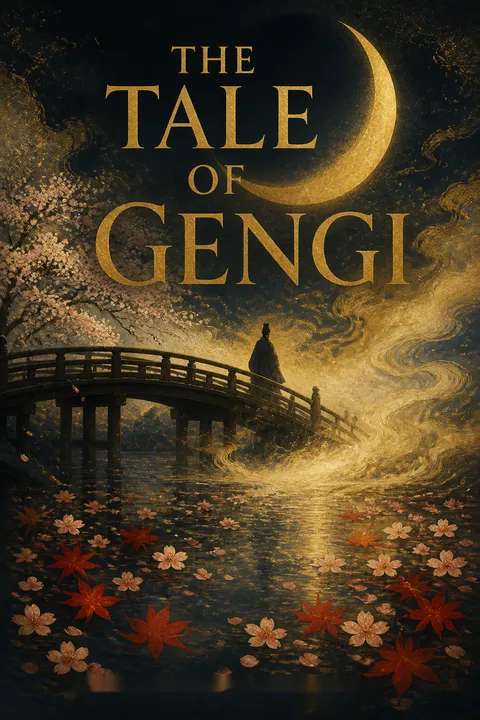

Plot Summary
Blossoms Amid Courtly Shadows
At the center of Heian court life, Genji—the Shining Prince—is born to both favor and peril, precocious in beauty and sensibility but shadowed from the start by maternal loss and shifting political tides. Amid rivalry between consorts and ministers, his fortunes rise and fall as easily as seasonal flowers. His early days are marked by subtle education, the arts of music and poetry, and an impetuous search for love and comfort, ever exiled from true belonging. Blossoms dazzle, but each tryst or attachment is tinged by the awareness of time's passing and the ephemeral joys court culture fosters. The underlying theme is that all human attachments, like springtime petals, are destined to scatter.
Storms of Exile and Return
Driven from the capital by political intrigue and fate's turn, Genji is exiled to Suma, where storms of nature and spirit test his inner resources. Torn from the pleasure and distraction of the capital, he confronts loneliness and the temporary frailty of honor, finding solace only in fleeting friendships and artistic creation. Yet exile is also purification: through loss and struggle, Genji touches the universal sadness at the heart of love and beauty. His return signals not triumph, but a chastened embrace of impermanence—old entanglements and new affections remain unresolved, and even the moments of reunion foretell further loss.
Sisters of the Autumn River
Uji's mist-shrouded rivers shelter Agemaki and Kozeri, sisters raised in isolation by their devout, melancholy father, Prince Hachi. He frets for their future, knowing the world values lineage over affection, and the sisters grow attuned to beauty, music, and melancholy. Their close bond is both a haven and a harbinger of sorrow. As suitors from the capital—Niou, Kaoru, and Kurodo—pursue them, the river's autumn song becomes an echo of passing time and the dangers of entering worldliness too soon. Their innocence and mutual devotion make them tragically vulnerable to the tides of love, rumor, and shifting fortune.
Rivalries of Heart and Duty
Romantic and filial responsibilities tangle as the promising young courtiers—Niou, the fiery prince; Kaoru, the somber enigma—compete for love and meaning. Agemaki counsels Kaoru to turn his devotion to Kozeri, who herself becomes the object of both Niou's impulsive desire and Kaoru's lingering regret. Their dilemmas—whether to yield or withhold, follow protocol or feeling—unfold beneath the scrutiny of family, servants, and the wider world. With every letter, glance, and clandestine visit, the truth becomes harder to discern, and the cost of indecision rises. The narrative shows that sincere intentions cannot always overcome social constraints or emotional confusion.
Masks Behind Monastic Walls
After the climactic losses—Agemaki through heartbreak and Kozeri's uneasy place as Niou's consort—Ukifune, the lost-third sister, surfaces in the story. She is swept up by both princes in a contest of devotion, then ultimately vanishes beneath the Uji waters. Fished out and revived by nuns and priests, she awakens to a world of old women, perpetually chanting monks, and monastic seclusion. Disguised by vows and veils, she battles the urge to forget all worldly suffering, yet is beset by dreams and requests from her past. Monasteries offer sanctuary but not erasure; behind every religious gesture, longing and unresolved ties persist.
Dream's End Along the Bridge
The title "Bridge of Dreams" becomes the text's central metaphor—ambition, memory, and desire are revealed as shifting illusions, unable to hold what the heart most craves. Ukifune, poised between lives, is visited by Kaoru, her brother, and compassionate nuns, each seeking connection or redemption. Yet the story closes with none of the expected resolutions: Kaoru's obsession, Niou's regret, and the family's hope all dissolve into uncertainty. The bridge leads to ambiguity, not certainty, and the dreamlike existence of all the characters gives way to awakening—the world's beauty and pain are alike a passing vision, impossible to change or keep.
Shells and Fragments of Memory
After Ukifune's disappearance and presumed death, Kozeri and Kaoru struggle with grief, guilt, and missed opportunities. Letters and gifts—tokens of affection, evidence of longing—become only brittle fragments, unable to bridge the gap between the living and the lost. The attempt to reconstruct meaning from memories, handwritings, or keepsakes only accentuates absence; mourning settles into the texture of days. Kaoru's quest for closure remains unfulfilled: every new revelation destabilizes the story further, and the attempt to gather meaning from debris yields only the awareness that all things, like shells on the shore, are fragile and unsatisfying.
Gossamer of the Vanished Self
The aftermath of Ukifune's vanishing—her family's distress, the search, and the rumors—enfolds the tale in an atmosphere of mystery and haunting. Was she rescued, possessed, or simply erased? To those left behind, her absence raises questions about love's substance and the self's durability. Kaoru and Niou, both in their different ways longing for her, are forced to accept that some losses cannot be recovered, or even explained. The story is threaded with images of gossamer, mist, and dreams—signifiers of a self that slips free from old identities into something ungraspable, perhaps even liberating.
Letters to the Living and Dead
Mourning and missed love manifest through relentless letter-writing and messages from mother to daughter, from suitor to beloved, from the living to the presumed dead. Each attempt to reach Ukifune is frustrated by misunderstanding, interception, or the vastness of death itself. Kaoru tries to learn if she lives, while the mother lingers in hope, unable to accept the finality of absence. The act of writing—so central to Heian emotional and courtly life—reveals both the longing for connection and its ultimate futility when fate intervenes. "Letters to the dead," the narrative makes clear, serve only the needs of those who write them.
Fragrance of Unanswered Prayers
Niou and Kaoru—rivals and friends—live in the world's perfumed sadness: gifts of flowers and silk, incense wafting from sleeves, ceremonies that mix devotion with yearning. Beauty becomes a kind of mourning for what can never last. Both men are haunted by the memories of fragrant encounters with lost women; even when surrounded by new loves and the distractions of court, they remain dissatisfied, seeking in rituals and longing a deliverance that never comes. The world's answer to longing, the text suggests, is silence and transience. Prayers return as fragrance, not fulfillment.
Ashes Under Passing Clouds
Ukifune's presumed funeral—a makeshift, hurried affair—exposes the vulnerability of human rituals to loss, miscommunication, and social misunderstanding. Her mother's grief, the household's confusion, and the clergy's attempts at posthumous salvation cannot penetrate the ambiguity of her fate. Ashes are scattered and the smoke drifts away, leaving those who survived only with rumors, vague hopes, and the unanswerable question: did she seek oblivion, or transformation? Even the most elaborate prayers and dedications are fleeting against the clouded, fickle sky of fortune.
The World's Unseen Farewell
Both Kaoru and Niou contend with the knowledge that those most precious to them have left no lasting trace. In a society that prizes outward form—poem, ceremony, rank—their most profound experiences disappear without commemoration, and the world itself offers no guarantee of recognition. Ukifune's absence is an example: to many, she remains a nameless ghost or rumor; to her loved ones, her story is an open wound. The novel's final turn is to ask whether any human life can ever be truly witnessed or understood before it is swallowed by the dreamlike world.
The Cloister's Compassionate Refuge
Ukifune's survival—rescued by priests and nuns, tended with care—offers a fleeting image of peace and compassion. The monastery at Ono becomes a place where the noise and dangers of the capital momentarily recede and one is welcomed for one's suffering. Here women who have lost families, beauty, and hope find in prayer and company a respite from uncertainty. Yet even in the cloister, the world presses in: visits, letters, memories, and possible recognition by nobility mean that the sanctuary is never absolute. Compassion, the reader learns, is a frail bridge across sorrow, not an escape.
Echoes Beyond the Withered Gate
As time passes, individuals from Ukifune's old life—her mother, old retainers, the faithful Colonel—draw near her new existence. Unrecognized or misrecognized, she watches them from behind blinds and convent walls, torn between gratitude for their devotion and horror at being recognized after her transformation. Imoto, the nun who shelters her, wants her to resume her place in the world, yet Ukifune remains resolute. Each reunion, each recollection, brings not the comfort of retrieval but the shock of strangeness—strong emotions persist, but identity is shown to be mutable, and return is impossible.
Lost Beneath the Plum Moon
Seasonal cycles continue at Ono—plum trees bloom, moonlight fills the garden—while Ukifune exists at the margin. Her commitment to religious life grows, even as nuns and visitors try to draw her back into the world. The moon's changing face, birds in migration, and the play of shifting light become metaphors for her own estrangement. Sought out by the Colonel, she responds with increasing detachment, her poetry and evasions revealing a heart set on dissolution rather than renewal. She writes of longing, but the object of desire is gone; what remains is the gentle acceptance of impermanence.
Shadows Cross the Misty Bridge
As Kaoru learns that Ukifune is not dead but living as a nun, he struggles to reach her, sending her brother as messenger. The meeting awakens memories and longing, but Ukifune holds fast, refusing to step back into worldly attachments or answer questions that would beckon her from the other shore. The narrative reveals the futility of seeking permanence in a dreamlike world—communication, recognition, even presence itself are lost in the mists of misunderstanding, self-erasure, and the irrevocable passage of time.
Ghostly Songs of Autumn Grass
Public rituals—lotus ceremonies, poetry contests, elegant diversions—briefly restore the energy of court life and bring the living together. Yet these celebrations are permeated by absence: Kaoru's gaze is haunted by longing, and his relationship with the Second Princess pales beside memories of the First. Even new prospects and attractions are colored by autumn's melancholy. Music and social brilliance cannot bring back dreams; they only accentuate the losses each must bear. The autumn grasses tremble, but the ghosts can neither be summoned nor dismissed.
Writing and Erasing in the Dark
The story closes with the image of Ukifune as nun—writing poems in her copybooks, refusing contact with Kaoru or Niou, and choosing silence as the ultimate response to the world's importunity. Her act is not so much disappearance as self-erasure: a willful act of autonomy, renunciation, and compassion. The last bridge, between the dream-world and awakening, is one that each must cross alone, and those left behind can only speculate about the shape and meaning of her choice. To write, to remember, to send messages—these are the world's answer to loss, yet the answer from the other side is silence, a bridge suspended in dreams.
Analysis
In its conclusion, The Tale of Genji reveals its deepest purpose: to map, with unrivaled delicacy, the landscape of human longing and the cost of beauty's impermanence. Through the stories of the court—of Genji, Kaoru, Niou, Agemaki, Kozeri, Ukifune, and their friends—Murasaki Shikibu evokes a universe in which love, art, ritual, and devotion are all responses to the world's sorrow and instability. The most precious bonds produce the greatest anguish, while solitude and renunciation offer refuge only at the price of loss.
The repeated images of drifting, vanishing, writing and erasing, underscore the novel's suggestion that meaning as well as desire is contingent: "mono no aware" is both a call to feel more, and a warning that feeling cannot forestall loss. The complex psychology of the characters—oscillating between passion, guilt, restraint, and withdrawal—complicates the patterns of rivalry, misunderstanding, and incomplete communication that drive the story forward as a series of missed crossings, failed recognitions, and false returns.
Ultimately, the story becomes a demonstration of Buddhist insight: all things are dreamlike, subject to change, and interdependent; even art and memory cannot grant what the heart most desires. Ukifune's final act—her writing-practice, refusal of Kaoru, and retreat into silence—becomes the model for awakening: it is not in seizing or reliving the dream that one finds peace, but in letting its bridge fall away. The lesson, for Murasaki Shikibu as for her readers, is to cultivate both sensitivity and detachment: to inhabit with grace the sorrow and beauty of the world, knowing always that their embrace—and our own—will pass like dew upon the grass.
Review Summary
Reviews of The Tale of Genji reflect deep admiration for its psychological depth, poetic beauty, and vivid portrayal of Heian court life, with many praising it as a timeless masterpiece and the world's first novel. Readers marvel at its complex characters and emotional resonance, though some struggle with its length, repetitive seduction storylines, and the protagonist's troubling behavior toward women. Translation choices significantly shape the experience, with Tyler and Seidensticker versions frequently recommended alongside supplementary texts for historical context.
People Also Read

Characters
Genji (Hikaru Genji)
Idolized for his unmatched beauty and sensibility, Genji is the restless soul at the center of the tale, seeking solace in love, art, and fleeting beauty but forever haunted by loss. Marked by the sadness of his mother's death and the insecurity of his rank, he devotes himself to romance and aesthetic pursuits, yet every embrace accentuates the world's transience. He is both a master of pleasure and a prey to melancholy, his relationships—whether courtly, intimate, or spiritual—falling victim to fate, political intrigue, or his own divided nature. His psychological complexity is revealed in his oscillation between seeking happiness and practicing detachment—a pattern mirrored in those who follow him.
Kaoru
Kaoru, Genji's supposed son (actually Kashiwagi's), embodies longing and the incapacity to act. Sincere and steadfast, haunted by his own illegitimacy, he often stands apart, observing, analyzing, and commemorating rather than fully living. Anxious for meaning and virtue, he channels love into caretaking and mourning, yet finds no satisfaction in either. Kaoru's relationships—with Kozeri, Ukifune, and his wife—reveal him as a man paralyzed by conscience and uncertainty, never quite able to seize his own happiness. His psychological wounds—confusion about origins, obsessive retrospection—impose a tragic restraint on his pursuit of connection.
Niou
Niou, Genji's grandson, stands as Kaoru's antithesis: daring, impulsive, sensual, and subject to the whims of his heart's attraction. He continually initiates affairs with enthusiasm and extravagance, but is also quickly afflicted by jealousy and remorse. Niou's temperament draws people to him, and yet his loves are often marred by impatience, restlessness, and a need for conquest. Where Kaoru mourns and speculates, Niou acts and suffers. His relationships with Kozeri and Ukifune typify the unpredictability of desire—he ignites love, but is unable to sustain or possess it; the price is ultimately the loss of the beloved and a permanent void.
Agemaki and Kozeri
Raised in sheltered obscurity, Agemaki (the elder) and Kozeri (the younger) reflect each other's hopes and fates, their intimacy both a defense and a tragic trap. Agemaki's wisdom and self-sacrifice protect Kozeri but leave her open to heartbreak; Kozeri's beauty and sweetness attract ardent suitors but also endanger her autonomy. Both suffer, and the narrative turns on their choices—a fatal hesitation, a misdirected sacrifice—culminating in loss and spiritual crisis. Their stories expose the perils of female vulnerability in a world where virtue, reputation, and happiness are perpetually at odds.
Ukifune
Ukifune is the enigmatic figure who—caught between the ardor of Niou and the caretaking of Kaoru—ultimately chooses to disappear: a gesture at once of despair and autonomy. Spiritually sensitive and emotionally fragile, she experiences the world's desires as both a temptation and a trap, culminating in an attempted suicide and subsequent rescue by nuns. Her transformation from object of love to Buddhist novice is the story's final word on detachment. Suffering becomes her bridge to liberation; she refuses to be defined by others' longing, instead erasing herself in a tender, ambiguous, and haunting gesture.
The Empress (Akashi Princess)
The Empress, Genji's daughter and Niou's mother, is a figure whose charm, intelligence, and composure anchor the court even as events conspire to challenge her happiness. She witnesses the loss of loved ones, the shifting affections of her son, and the slow fading of old glories, yet retains a dignity and inner poise emblematic of Heian ideals. Her relationships—with daughters, stepchildren, and consorts—expose the insecurities underlying even the highest station. Inwardly, she carries grief and longing, but outwardly maintains the ceremonies and elegance society demands.
Kashiwagi
Kashiwagi, Kaoru's true father, is a tragic presence whose secret act with Genji's wife initiates the cycle of guilt, secrecy, and spiritual anxiety pervading later chapters. Delicate, introspective, and ill-suited to the competitive court world, he dies consumed by remorse. His career and death exemplify the peril of unchecked passion in a society governed by form, and his legacy—Kaoru—bears the psychological scars of parentage, inheritance, and ambiguity.
Kosaisho
One of the rare self-aware and self-protective women, Kosaisho distinguishes herself through literary talent, lively conversation, and a sardonic view of men's foibles. She navigates courtly attempts at seduction and rivalry with wry humor, occasionally attracting both Kaoru and Niou. Yet ultimately, even such resourceful women are limited by the social order—they are admired, ignored, or discarded at the whim of powerful men, and seldom attain lasting happiness or security.
Imoto
The nun Imoto represents the compassionate, nurturing impulse that attempts to rescue and redeem lost children, especially Ukifune. Bereaved of her own daughter, she channels her grief into care for others, sheltering strays and wayfarers within her household. Her faith is practical but tinged with nostalgia—she cannot protect her charges from sorrow or the pull of the world, but offers kindness and stability in an uncertain universe.
Colonel (Unnamed)
The Colonel, connected to many leading families, is both an object of female hope and a representative of worldly ambition. He persistently pursues Ukifune after hearing rumor of her beauty, but ultimately is defeated by her refusal to return to secular life. His courtship, at once gallant and ineffectual, reveals the limits of male agency in the face of spiritual longing. His presence accentuates the contrast between transient desire and renunciation.
Plot Devices
Ephemerality and Mono no Aware
At the heart of the novel is "mono no aware"—the awareness of impermanence and the melancholy aroused by witnessing beauty's inevitable passing. The plot exploits the tension between passionate attachment and the certainty of loss: every encounter, every relationship is imbued with awareness that it cannot last. This sensibility shapes courtly rituals, romantic overtures, and scenes of mourning, such that the reader is brought to savor both the exquisite and the sorrowful. The text's circularity—echoes, dreams, recurring events—reinforces the impression that happiness, like the plum-blossom, is always on the verge of falling.
Letters and Poetic Exchanges
Heian society's emotional life flows through poems and letters—vehicles of longing, seduction, reflection, and regret. Characters rarely speak directly; instead, they compose verses or exchange tokens, creating ambiguity and suspense. Misunderstandings, secrecy, and rivalry are propelled by intercepted or returned messages, folded paper and scent, and the rituals of writing practice. The epistolary structure makes the most private emotions public performances and reveals the chasm between intention and perception.
Rivalry and Doubling
Central triangles—Genji and his rivals, Kaoru and Niou, Agemaki and Kozeri, Kozeri and Ukifune—drive the plot and deepen its psychological resonance. Often, friends are also competitors; doubles and near-twins (in beauty, talent, or fate) confound identity and choice. Repetition and variation (letters, motifs, errors, escapes) produce the novel's spiral structure, suggesting that each generation and character is trapped in recurring patterns. Events do not resolve; rather, they return in new forms, each time a little sadder.
Spiritual Possession and Awakening
Supernatural episodes—illnesses, possessions, hauntings—represent both inner turmoil and societal anxiety. Characters' suffering is often described in Buddhist terms: karma, illusion, the intermediate state, vows, and renunciation. Spiritual realization (as in Ukifune's final act) becomes the only real escape, but is itself fraught with ambiguity—retreat from the world may mean liberation or oblivion. Dreams, visions, and the ambiguous boundary between life and death reinforce the instability of identity and the impossibility of resolution.
Foil Characters and Irony
Each main character is paired with a contrasting double or foil, exposing the limitations and psychological patterns of both. Men's rivalry reveals their own emptiness; women's self-sacrifice both dignifies and endangers them. Irony permeates the work, as well-intentioned plans lead to disaster, virtue is circumvented by circumstance, and beauty becomes an occasion for greater longing. Surprising reversals—abductions, suicides, mistaken identity—undermine any hope for predictable outcomes.
Ambiguous Endings and Open Structures
Instead of resolution, the novel unfolds as a series of bridges—temporal, psychological, and literal—that continually fail to deliver completion. The final episodes, with Ukifune's renunciation and absence, leave all the major characters in a state of yearning and incompletion. The last word is not return, but erasure: the self dissolves like a bridge of dreams. The narrative ends with unanswered messages, unwitnessed farewells, and the acceptance that the "real world"—love, knowledge, consolation—remains forever just beyond reach.
Download PDF
Download EPUB
.epub digital book format is ideal for reading ebooks on phones, tablets, and e-readers.








































