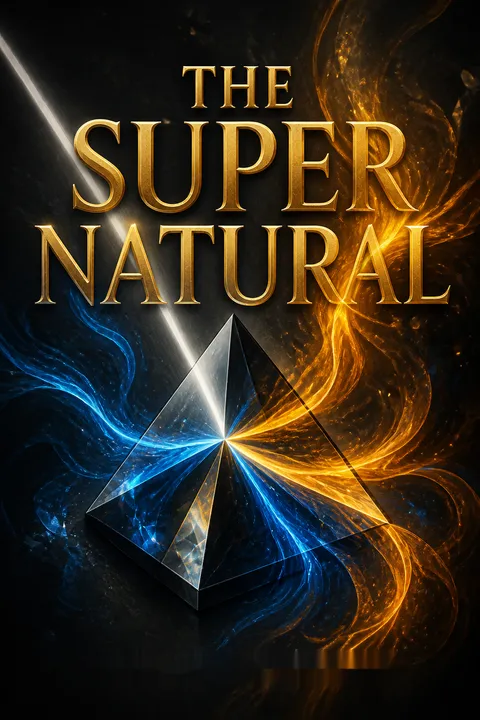

Key Takeaways
1. The "Super Natural" is an Already World, not a separate realm.
In a few words, this is a book about a new world, the next world that has already arrived, that has always been here, whether we have recognized its presence or not.
A larger reality. The authors propose that humanity is embedded in a fiercely alive and conscious reality, far grander than our current understanding. This "Already World" is not supernatural in the traditional sense, but "super natural"—an integral part of nature operating by rules we don't yet grasp. It's a call to recognize that the extraordinary is simply the natural, seen through a wider lens.
Beyond conventional views. This perspective challenges both rigid scientific materialism and conventional religious dogma. Religions have attempted to engage this reality, but often assume it's primarily concerned with us, which may not be true. The goal is to venture outside these "houses of faith" without abandoning the spiritual, and to embrace science with a more generous vision of human experience.
New understanding. Many things deemed impossible are not only possible but are "whispered secrets" of our existence. This book aims to shift the conversation, suggesting that we ourselves are "highly evolved prisms or mediums of this super nature coming into consciousness." The enigmatic presence of the human mind winks back from the dark, hinting at a profound, interconnected reality.
2. Embrace ambiguity: Beyond belief or dismissal, sit with the question.
The final hope and intended result of this book is not yet another set of pat answers or clear conclusions about strange things.
Resist easy answers. The authors advocate for a nuanced approach to unexplained phenomena, moving beyond the simplistic "either aliens are here or it's all rubbish" debate. This means resisting the temptation to prematurely categorize or interpret experiences, instead choosing to "sit with the question" and embrace ambiguity.
Flaws in current approaches. Both "reductive comparison" (reducing past religious phenomena to misinterpreted technology) and "religious comparison" (interpreting modern phenomena through ancient religious assumptions) are flawed. They make the mistake of assuming the truth and completeness of a particular worldview, projecting it onto all experiences.
- Reductive comparison: Ancient gods become astronauts, magic becomes advanced tech.
- Religious comparison: UFOs become demons, portents of the apocalypse.
A new conversation. The goal is to model a more evenhanded, careful, and intellectually generous conversation about experienced anomalies. This involves acknowledging the presence of military disinformation campaigns but moving beyond them to the deeper, older roots of these encounters in mystical and esoteric literature. The true meaning lies in the contactee, not just the craft.
3. Ancient folklore and modern encounters share deep, consistent patterns.
What we are seeing now is very much what our ancestors saw.
Timeless manifestations. Unexplained phenomena, from mysterious beings and strange lights to ghostly presences, have been part of human experience for millennia. St. Paul's vision on the road to Damascus or Moses' burning bush are ancient parallels to modern UFO and alien encounters. The only things new are the names and the visual grammar, which now fit our imagination directed toward aliens rather than angels or demons.
Cross-cultural consistency. Whitley's personal experiences, such as encounters with "little blue men" (kobolds), resonate with northern European folklore of mine-dwelling spirits. These figures, often described as small, dark blue, and carrying glowing orbs, have been observed across cultures and centuries, suggesting a universal pattern of perception.
- German, Welsh, Cornish, English miners reported kobolds.
- The metal cobalt was named after these blue entities.
- Modern "blue aliens" continue this tradition.
Beyond isolated anecdotes. The overwhelming response to Communion revealed that Whitley's experiences were not isolated. Hundreds of thousands of similar testimonies poured in, often describing consistent commonalities like the "gray alien" face. This vast body of witness suggests a widespread human experience, not mere individual delusion, demanding serious scientific and academic inquiry.
4. The Human as Two: Mind Beyond Brain.
I don’t mean that it’s entirely in the mind, but rather that the mind might not be entirely in us.
Consciousness beyond biology. The concept of "The Human as Two" posits that human beings possess a dual nature: the ego, confined to the body-brain, and a larger, cosmic mind that may exist independently of biology. This challenges the materialist assumption that mind is merely a product of brain activity.
Brain as a reducer. Instead of producing consciousness, the brain may act as a filter or reducer, shaping a vast, ancient, and intelligent cosmic mind into the limited, subjective experience of the ego. When this filter is compromised (e.g., through trauma or trance), other dimensions of consciousness or forms of life may "pop in."
- Mind is likely old, given the universe's age.
- Mind's lack of confinement suggests unknown limits.
- The Internet metaphor: Brain is a laptop, cosmic mind is the Internet.
Implications for death. If mind exists independently, then consciousness may not disappear with brain death. Experiences of seeing dead friends who were unknown to be deceased (Peak in Darien experiences) suggest post-mortem communication and survival of consciousness, further supporting the idea of a mind beyond the brain.
5. Trauma and trance can be catalysts for profound transcendent experiences.
The shattering of expectation that accompanies trauma doesn’t just cause transference, it opens a door.
Compromised filters. Experiences of the super natural often occur during or after trauma, illness, suffering, or death—situations where the brain's filtering mechanism is compromised. This "traumatic secret" suggests that deep suffering can breach the ego's boundaries, allowing access to other forms of mind or dimensions of consciousness.
Trance as a gateway. Trance induction, humanity's oldest technique for accessing altered states, is a safer way to "let a little more of mind in." Shamans, prophets, and mystics have historically used trance to gain secret truths, hear revelations, or "see" gods. Writing and reading themselves are forms of trance induction, shaping our perception of reality.
Beyond illusion. While trauma can lead to psychological transference (e.g., a brutal rape becoming an alien abduction), it can also open a door to genuine transcendence. Experiences like Whitley's childhood trauma at Randolph Air Force Base, or near-death experiences, suggest that profound suffering can "crack the cosmic egg," leading to a new understanding of self and reality.
6. Erotic encounters with the unknown reveal a repressed divine feminine.
One way to put it would be to say that I had a love affair with a goddess.
Sacred sexuality. Whitley's intensely personal and often erotic encounters with a feminine presence highlight a repressed aspect of Western spirituality. In monotheistic traditions, the divine is predominantly male, leaving no "Her" for men to commune with erotically. This leads to a spiritual world where male heterosexuality is often compromised or secularized.
The "flip" of sexuality. Whitley's experiences suggest that human sexuality is not merely a biological instinct but a conscious cosmic energy. He "flips" the reductionist view, raising sex to the level of the gods, implying that in rare moments, sexuality can reveal itself as "super natural"—a powerful, conscious force.
- Plato's Eros: Driving force of reproduction, culture, divine vision.
- Freud's Libido: Sexual energy sublimated into cultural works.
- Tantric traditions: Sexual fluids as potent power substances, union with deity.
Conjugal communion. Whitley's struggle with fidelity to his wife, Anne, during these erotic encounters underscores the profound connection between his personal relationships and his spiritual experiences. He wonders if Anne and the "goddess" are the same person in different forms, suggesting a "mandala-like existence" where conventional and unconventional relationships rotate around each other.
7. Physical traces, like implants, challenge materialist assumptions.
The implants exist. They are found encased in skin and embedded in deep tissue. Therefore, they are not accidental inclusions, but something put there intentionally.
Tangible evidence. Whitley's personal implant, a metallic object with motile cilia embedded in his ear, serves as a powerful physical trace of these phenomena. Despite initial medical dismissal as a cyst, its unique composition (meteoric iron) and behavior (slipping away during surgery, returning to its original position) defy conventional explanation.
Beyond simple explanations. The implants are unlikely to be tracking devices, given the sophistication of modern nanotechnology. Their importance lies not in their function as alien technology, but in their existence as "magical objects" that challenge our fundamental understanding of reality.
- Implants are found encased in skin but embedded in deep tissue, suggesting intentional placement.
- Similar objects removed from other contactees.
- One object reportedly emitted a low-power FM signal, then became X-ray invisible.
Mind-matter interaction. The phenomena also interact with technology, as seen in the inexplicable magnetic field disabling Whitley's alarm system and the electric sparks from his car's steering wheel. This suggests a blurring of the line between mental and material, hinting at a "one world" where physical events behave like mental events and vice versa.
8. Mythmaking as a conscious, interactive process, not mere fantasy.
We have always assumed that myth only came out of the mind, but, looking at this modern manifestation closely and objectively, it is clear that this is not true now, and perhaps has never been true.
Beyond imagination. The human mind is a mythmaker, creating stories to understand ourselves and the world. However, modern encounters suggest that these myths are not solely products of subjective imagination. They are "mythical objects"—materialized stories or meanings that appear physically, challenging the traditional separation of imagination and reality.
The "Super Story." The emergence of superhero narratives, like the X-Men, reflects a cultural hunger for empowerment and hints at "super nature." These stories, often born from societal helplessness, are not just fiction but "living graphic novels" that encode remembered experiences of contact and conscious cosmic evolution.
An external component. The UFO/alien narrative, from Kenneth Arnold's "flying saucers" to the Betty and Barney Hill abduction, demonstrates how strange experiences evolve into powerful myths. This modern myth is unique because it is underpinned by expert witness and physical evidence, making it "not entirely imaginary" and demanding objective study.
9. The soul is a conscious, plasmalike energy, a "UFO" within us.
I have been a plasma, and it was delightful.
Conscious light. The concept of the soul as a plasmalike energy is a radical idea, suggesting that life and intelligence may not require carbon-based forms. This resonates with ancient expressions of divinity as conscious light, such as Paul's "spiritual body" shining like stars or the Gnostic belief in a stellar soul.
Physics and mysticism converge. Quantum physics, with its mind-bending implications like entanglement and observer effect, offers parallels to mystical experiences. Founders of quantum physics, like Bohr and Schrödinger, saw resonances between their science and mysticism, hinting at a "realist mysticism" where the math and the mystical are expressions of the same fundamental reality.
- Quantum physics suggests consciousness and intention in reality.
- "Hippies who saved physics" explored quantum effects scaling to human experience.
- Jane English's experience of becoming light after reading about quantum paradoxes.
Energetics of being. Experiences of conscious plasmas and energy beings shift understanding from distant objects to immediate energy, vibration, and resonance. This "energetics" is a form of knowing through mutual "tuning" or "entrainment," where one becomes present with a presence, rather than merely observing it. The soul is a "UFO" that has landed in a body-brain, a "biological technology" for consciousness.
10. "Say Away" and "Say Again": Deconstruct beliefs to build new narratives.
What you see is not what you get. Seeing is not believing. Don’t believe what you believe. Don’t think what you think. Say away.
Deconstructing certainty. The "saying away" practice, rooted in apophatic mysticism, involves deconstructing all beliefs and assumptions—religious, scientific, and personal—to arrive at a deeper, dazzling truth beyond names and forms. This is not nihilism but a recognition that our cognitive hardware and cultural software constantly equate perception with reality, leading to mistakes.
The ultimate conspiracy. All conspiracy theories, at their core, express a fundamental truth: we are constantly being "duped" by our languages, cultures, religions, and brains. Every culture is a trance state, every ego a cultural production. Recognizing this "ultimate conspiracy" allows us to step back from rigid ideologies and acknowledge the fragile, fictional nature of our constructs.
A new story, a new way. After saying away, the task is to "say again"—to tell a new, better story about the unknown, one that is humbler, more paradoxical, and more honest. This new narrative should integrate modern cosmology, quantum physics, and evolutionary biology, placing "conscious cosmic evolution" at its center. It's a call to become conscious mythmakers, knowing our fictions encode real contact experiences.
- Resist exclusive reliance on machine readings.
- Recognize that "what looks like technology today is really magic."
- Embrace the "Super Story" of cosmic conscious evolution.
Shifting the conversation. The goal is to move beyond denial and ridicule, and also beyond naive belief, to foster objective, interdisciplinary study. This means acknowledging the reality of phenomena, the suffering of witnesses, and the limitations of current scientific and governmental approaches. The ultimate aim is to understand "who we are, what we are, where we are" by facing ourselves as part of a greater, super natural consciousness.
Review Summary
The Super Natural receives mixed reviews, with ratings ranging from 1 to 5 stars. Many readers find the book thought-provoking and appreciate its approach to unexplained phenomena. Some praise the authors' attempts to bridge belief and skepticism, while others find the content repetitive or unconvincing. The alternating chapter format between Strieber and Kripal is generally well-received. Critics argue the book lacks scientific rigor and relies too heavily on speculation. Overall, readers looking for definitive answers may be disappointed, but those open to exploring unconventional ideas may find value in the book.
People Also Read





Download PDF
Download EPUB
.epub digital book format is ideal for reading ebooks on phones, tablets, and e-readers.








































