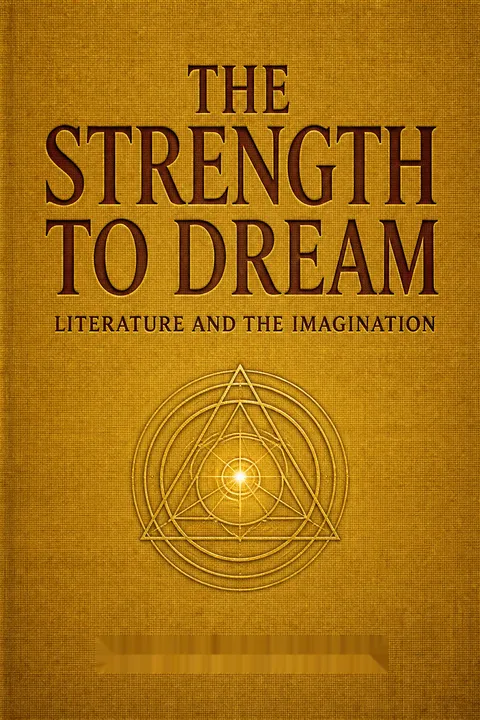

Key Takeaways
1. Imagination: The Core of Human Evolution and Freedom.
Imagination is man’s act of increasing his freedom. Its only enemy is the notion that man has no will. Its only limit is the conception of absolute freedom.
Beyond mere imagery. Imagination is more than just forming mental pictures of things not present; it's a fundamental faculty that drives human evolution and expands our consciousness. It acts as a "detonator of the will," enabling us to foresee the future and enlarge our present understanding, pushing beyond the immediate demands of survival. This vital force is crucial for breaking free from the "prison of the body" and the limitations of the present moment.
Fueling the will. The imagination operates like an engine, powered by various energies such as fear, love, lust, wonder, or ambition. A great artist learns to generate and harness these energies to intensify life itself. Unlike ordinary conscious thought, which fades without continuous effort, imagination, when deeply fueled, can create experiences that feel independent of the will, much like the vivid images experienced by desert ascetics or the compelling characters that seem to develop a life of their own for a writer.
A new dimension of consciousness. Humanity is evolving towards a "third dimension of imaginative consciousness," a luxury not for survival but for its own sake. This expanded awareness, akin to a "power house" in the subconscious, allows us to access and correlate vast stores of potential knowledge, moving beyond mere observation and reflection. This pursuit of imaginative consciousness is synonymous with the quest for freedom, which, in turn, is inextricably linked to the concept of evolution.
2. Modern Literature's Impasse: A Retreat from Purpose and Readability.
No one can pretend that hundreds of fishes gasping on the strand amount to a satisfactory state of literature.
The crisis of form. Twentieth-century literature, particularly the avant-garde, has fallen into a crisis of form and purpose. The shift from impersonal storytelling (like Shakespeare) to intensely personal visions (like Joyce or Proust) has led to a preoccupation with "saying something" rather than telling a story. This often results in fragmented, unselective narratives that prioritize subjective experience over communicative clarity, leaving readers baffled and critics hesitant to call out meaninglessness.
The "experimental novel" fallacy. Writers like Joyce and Proust, despite their reputations, did not establish a new, universally applicable form for the "experimental novel." Their works are exceptions, often unreadable for the general public, and their influence has misled many modern authors into believing that obscurity and the abandonment of plot are signs of artistic depth. This has contributed to a literary landscape where many works are "gasping on the strand," failing to connect with readers or advance human understanding.
Pessimism disguised as detachment. Many contemporary novelists, while claiming artistic detachment, are driven by a pessimistic worldview that dictates their techniques. They often exaggerate the sordidness of the world, aiming to depress the reader into accepting their particular "solution" (e.g., Catholicism, stoicism). This approach, however, often sacrifices artistic integrity for sensationalism or thinly veiled proselytizing, further alienating readers who seek genuine insight rather than emotional manipulation.
3. The Static Fallacy: How Pessimism Paralyzes the Will to Perceive.
The Beckett school has lost not merely the strength to will; it has lost even the strength to dream.
Acceptance of limited perception. The "static fallacy" is the mistaken belief that human perceptions are fixed and unchangeable, leading to an acceptance of life's inherent meaninglessness and boredom. This viewpoint, exemplified by writers like Samuel Beckett, assumes that man's only task is to passively observe the universe, without recognizing his capacity to actively alter his perception or exercise his will to find purpose.
Boredom as a symptom. When the will to perceive is paralyzed, individuals become acutely susceptible to boredom and a sense of futility. Characters in pessimistic literature often feel abandoned and without agency, trapped in a "dentist's waiting room" of existence. This agony, however, can be reinterpreted not as an inherent flaw of life, but as a "frenzied demand for a new deal for human beings"—a call for a new type of individual capable of conscious will and choice.
The illusion of objective horror. Pessimistic writers often present their temperamental reactions to life as objective truths, as if they have carefully weighed the entire universe and found it wanting. This ignores the selective nature of human consciousness, which bases its state of mind on a tiny fraction of available "facts." True insight requires an active "looking-both-ways"—outwards at the world and inwards at one's own capacity for perception and will—to transcend the narrow, often negative, interpretations of reality.
4. Science: A Dynamic Catalyst for Imaginative Expansion.
Imagination is the herald of change.
Beyond mere method. Science, far from being a dry, two-dimensional method, is a fundamental human intellectual activity rooted in a faith in order and a belief that problems, however complex, are worth attempting to solve. It represents an aggressive, proactive policy towards nature, contrasting sharply with the animalistic acceptance of defeat. This spirit of enterprise and discovery acts as a powerful stimulus for the human imagination, pushing it towards new frontiers of understanding and possibility.
Utopian visions and expanded realities. From More's Utopia to Bacon's New Atlantis and Wells's Men Like Gods, science has inspired visions of ideal societies and human perfectibility. While some of these visions can be naive or authoritarian, they demonstrate science's capacity to liberate the imagination from anthropocentric and earthbound limitations. Science fiction, in particular, aims to evoke wonder and amazement, expanding the reader's consciousness by exploring vast vistas of time, space, and alternative realities.
Authentic wonder. The best science fiction, like E.T. Bell's Before the Dawn or Lovecraft's The Shadow out of Time (despite his usual horror focus), achieves an "authentic vision of science." It grounds its fantasies in plausible scientific frameworks, making the incredible seem real and evoking a sense of awe and mystery. This contrasts with mere arbitrary fantasy, demonstrating how scientific rigor can lend authority and depth to imaginative explorations, much like theology provided a framework for Dante.
5. The "Power of Darkness": Unmasking Evil as Inner Conflict or Projection.
Imagination is man’s act of increasing his freedom. Its only enemy is the notion that man has no will. Its only limit is the conception of absolute freedom.
Evil as a psychological construct. For many writers, the concept of "evil" is not a profound metaphysical force but a projection of personal neuroses, sexual repression, or a reaction against perceived societal constraints. Dostoevsky's characters, for instance, often engage in "emotional onanism," their tragedies stemming from self-made madness rather than genuine external evil. This suggests that the fascination with "dark powers" often arises from internal conflicts and a starved capacity for affection, which can turn into malice.
The Gothic tradition and sadism. The Gothic novel, from Lewis's The Monk to Stoker's Dracula, often revels in gruesome and inhuman fantasies, frequently intertwining sadism with sex. This tendency, particularly evident in male writers of the genre, contrasts with female authors like Mrs. Radcliffe or Mary Shelley, whose works, even when dealing with the supernatural, remain rooted in human emotions and often offer rational explanations for seemingly supernatural events. This highlights how the portrayal of evil can reflect the author's own psychological landscape.
De Sade: The ultimate exposure. The Marquis de Sade, with his 120 Days of Sodom, pushes the "power of darkness" to its absurd extreme. His work, driven by resentment and a desire to shock, exposes the bankruptcy of a simplistic good-and-evil dualism. De Sade's "evil" is a reaction against lost freedom, an attempt to objectify oppression. While failing as literature due to its pathological nature, his work inadvertently reveals that the pursuit of evil, when devoid of genuine moral or spiritual depth, ultimately leads to self-sickness and absurdity, rather than profound insight.
6. Sex: A Misunderstood Force for Visionary Insight and Life Affirmation.
The power of the sexual impulse can be utilised like the cordite in a bullet, to drive the projectile of the imagination towards new insights.
Imagination's role in sexuality. Human sexuality is deeply intertwined with imagination, far beyond mere physical instinct. It relies on the perception of "strangeness" and the instantaneous "grasping" that transcends pedestrian attention. This imaginative component is what makes sex a powerful fuel, capable of magnifying the imagination's strength and driving it towards new insights, much like a spark flying upward to describe visionary experience.
Beyond puritanism and hedonism. Historically, many religious traditions have either suppressed or ritualized sex, often viewing it as an ally of the Devil. However, writers like William Blake, Maupassant, Wedekind, Artsybashev, and Lawrence have sought to restore sex to its place as a fuel for visionary experience and life affirmation. They challenge the notion that sex is solely for procreation or mere pleasure, instead seeing it as a profound expression of life's elemental force and a source of immense, untapped power for the human spirit.
The challenge of integration. While sex can be a potent imaginative fuel, its effective integration into a coherent artistic vision is rare. Many writers, like Maupassant, succumb to its raw power without intellectual analysis, leading to eventual artistic and personal breakdown. Others, like Lawrence, struggle with personal neuroses and disgust that taint their sexual mysticism. The ideal lies in understanding sex not as an end in itself, but as a dynamic force that, when channeled with conscious will and purpose, can lead to deeper self-knowledge and a more profound affirmation of life.
7. The Power of Polarities: Imagination's Fuel for Expanding Consciousness.
The imagination works on this basis of polarities.
Tension as a creative engine. Imagination thrives on the tension between opposing forces, or "polarities." This clash between the known and the unknown, the familiar and the alien, the mundane and the profound, is what activates and expands human consciousness. When these polarities are too narrow or ill-defined, as in some modern literature, the imagination stagnates, leading to a "crisis of imagination" and a lack of inventive power.
Beyond limited perspectives. Great literature, even when seemingly humanistic, implicitly engages with fundamental polarities like human misery and the invisible strength of life's "power house." This engagement allows the artist to communicate the inexpressible value of life, often by deliberately evoking a "soul sickness" that forces the reader to confront their own values. This process is analogous to how a near-death experience can reveal the profound value of existence.
Art as a counter-force. The human consciousness is often "hypnotized" and "jammed" by the aggressive immediacy of nature. Art, like science, serves as a primitive human device to retaliate, to "thrust nature to arm's length." It does this by suggesting general theorems about life—hypotheses about the nature of reality and human destiny—and then demonstrating them through artistic creation. This active engagement with polarities is essential for the imagination to function as a tool for understanding and shaping our world.
8. Existential Criticism: Judging Art by its Contribution to the "Science of Living."
Existential criticism is therefore the attempt to judge works of art by the contribution they make to the science of living, to judge them by standards of meaning as well as impact.
Beyond aesthetic impact. Traditional literary criticism, focused solely on artistic quality and aesthetic impact, is insufficient for evaluating much of modern literature. When works become obscure, unreadable, or seemingly meaningless, a purely aesthetic approach fails to provide meaningful commentary. Existential criticism, in contrast, proposes to judge art by its contribution to the "science of living"—its insights into human destiny, suffering, freedom, and the fundamental questions of existence.
A framework for meaning. This new critical approach, born from an age of spiritual flux, scrutinizes the underlying "values" and "meaning" of a work, rather than just its form or style. It asks: "What kind of a world would this be if the events of this book were completely typical of it?" This allows for an evaluation of the artist's implicit or explicit "value-judgements" on life and human destiny, recognizing that all literature, no matter how detached it pretends to be, is inherently concerned with "how men should live."
Unmasking artistic contradictions. Existential criticism can identify contradictions or failures in an artist's worldview that literary criticism might overlook. For example, it can highlight how a writer's later work might decline in quality due to a failure to develop their early philosophical concerns, or how a shift in fundamental beliefs (e.g., from evolutionism to a static view of human nature) can lead to inconclusive or self-contradictory artistic output. It seeks to understand the reasons behind artistic choices and their implications for human understanding.
9. The Artist's Evolutionary Mandate: To Will Dreams into Creation.
"Every dream can be willed into creation by those strong enough to believe in it."
Active engagement with destiny. The artist is not merely a passive observer of the world but an active participant in shaping human destiny. This involves a belief that both the artist and their times can be changed, combining the metaphysician's quest for understanding with the social reformer's drive for improvement. This "evolutionary preoccupation" is crucial for artistic development, as it demands continuous self-knowledge and a deep concern with the meaning of human life.
Beyond static observation. The Flaubert-Joyce ideal of the artist as a detached observer, relying solely on an "appetite for life" without direction, ultimately leads to artistic bankruptcy. True creative power, as exemplified by figures like Kazantzakis, arises from a commitment to a "supra-personal purpose" and an "evolutionary drive." Such artists dare to create grand, unifying visions, even in an age of perceived chaos, by actively willing their dreams into existence.
Profane perfection of mankind. The ultimate aim of imaginative creation is to teach humanity "what life is" and to inspire a striving for "profane perfection." This vision, shared by thinkers from Blake and Wells to Shaw, sees the artist, scientist, and religious person as embodiments of imagination, all working towards the same goal: to liberate man from his limitations and enable him to achieve a god-like potential. It is a direct counter to the "nothing to be done" mentality, asserting that there is always something to be done, always a dream to be willed into creation.
Review Summary
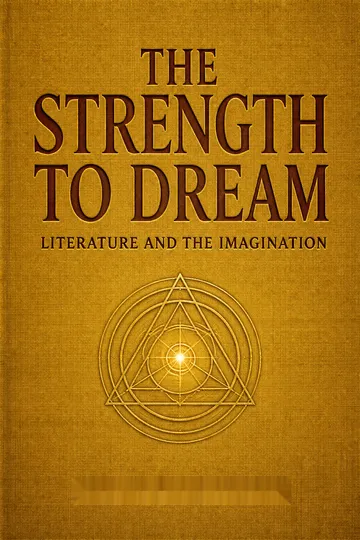
Reviews for The Strength to Dream are mixed, averaging 3.93/5. Many readers appreciate Wilson's ambitious scope in examining imagination through literary analysis, praising his deep engagement with numerous authors. However, common criticisms include his overly subjective approach, psychological judgments of authors rather than their texts, and inconsistent groupings of writers. Arabic-language reviewers note the book requires strong familiarity with European literature. Some felt the central question about imagination remained unanswered, while fans of Wilson found it characteristically brilliant and inspiring for further reading.
People Also Read



The Outsider Cycle Series
About the Author
Other books by Colin Wilson


Download PDF
Download EPUB
.epub digital book format is ideal for reading ebooks on phones, tablets, and e-readers.








































