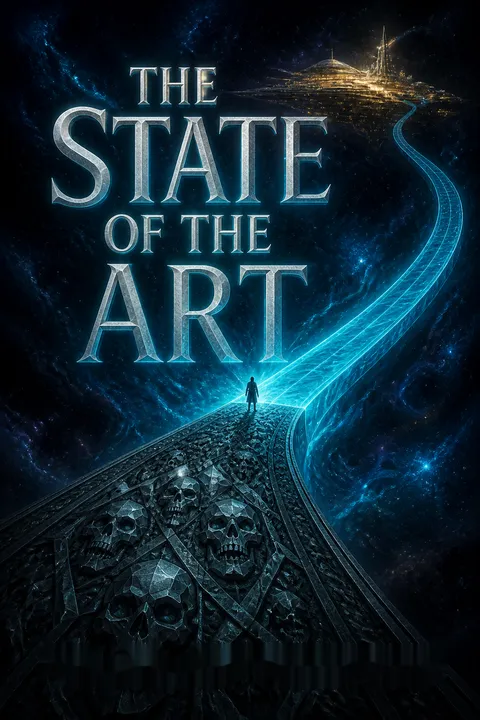

Summary Unavailable
This book is not suitable for a summary (it may be a textbook, workbook, cookbook, reference book, or collection). However, you can still explore the FAQs, about author, and other metadata below!
Plot Summary
Road of Skulls
On a cart rattling along the legendary Road of Skulls, two companions—Mc9 and his unnamed friend—travel toward a distant, shimmering City. The road is literally paved with the skulls of the Empire's enemies, a macabre testament to conquest and retribution. Their journey is marked by discomfort, idle conversation, and the promise of stories that never quite materialize. The landscape is both bleak and oddly beautiful, with the City always just out of reach, moving away as fast as they approach. The cart's driver sleeps, the beast of burden struggles, and the companions bicker and bond over wine and the meaning of "retribution." The journey becomes a metaphor for the endless, cyclical nature of history and the futility of seeking meaning in a world built on the bones of the past.
Gifts and Temptations
Wrobik Sennkil, a former Culture citizen now living as a man in the gritty city of Vreccis, is coerced by local criminals into accepting a Culture-made weapon. The gun, which only works for those with Culture genetics, is meant for an assassination: to shoot down a starship carrying political and military leaders. Wrobik is torn between the threat of violence, the lure of money, and the weight of his own past. The gun's sentient, chatty nature only deepens his alienation, reminding him of the utopia he left behind. As he contemplates the act, Wrobik's relationship with his lover Maust is strained by secrets and fear. The chapter explores the seductive dangers of power, the cost of exile, and the impossibility of escaping one's origins.
Exiles and Renegades
Wrobik's internal struggle intensifies as he weighs the consequences of his actions. His longing for Maust and the life they share is set against the backdrop of a society that is both vibrant and cruel. The Culture's legacy—biological enhancements, moral ambiguity, and a deep sense of otherness—haunts him. Wrobik's decision to flee rather than commit murder is complicated by betrayal and the realization that he can never fully belong to either world. The chapter delves into the psychology of exile, the allure of suffering, and the search for meaning in a universe that offers both abundance and emptiness.
The Culture's Dilemma
Aboard the General Contact Unit Arbitrary, the Culture's agents debate whether to make contact with Earth. The ship, Diziet Sma, and others immerse themselves in human culture, gathering data and experiencing the planet's beauty and brutality. The Culture's ethos of non-interference is tested by the planet's self-destructive tendencies—war, poverty, environmental devastation. The ship's eccentricities and the crew's personal biases color their observations. The dilemma is not just technological or political, but deeply ethical: can a utopian society justify imposing its values on a world that is both fascinating and flawed? The chapter captures the tension between curiosity, responsibility, and the limits of understanding.
Love and Alienation
Dervley Linter, a Culture agent, becomes enamored with Earth—not just its people, but its chaos, suffering, and vitality. He chooses to stay, undergoing physical and psychological changes to become more human. His conversations with Sma reveal the depth of his alienation from the Culture and his longing for authenticity, risk, and mortality. Linter's love is not for a person, but for the entire messy, tragic, and beautiful human condition. His decision is both a personal rebellion and a philosophical statement about the value of imperfection. The chapter explores the seductive power of the "other" and the cost of abandoning one's roots.
The Human Condition
Sma's travels through Europe—Paris, Berlin, Oslo—become a meditation on history, memory, and the scars of violence. Monuments to atrocity, the ruins of war, and the everyday struggles of ordinary people force her to confront the limits of Culture's utopian ideals. The contrast between the Culture's sanitized perfection and Earth's raw, unresolved pain is stark. Sma is both repelled and fascinated, drawn to the intensity of human experience even as she recognizes its destructiveness. The chapter asks whether true beauty can exist without suffering, and whether progress always comes at the cost of innocence.
The Lure of Earth
Linter's transformation is complete: he abandons his Culture enhancements, embraces human frailty, and seeks meaning in religion and community. His relationship with Sma becomes a microcosm of the larger conflict between intervention and observation. Sma, frustrated by the Culture's passivity, argues for action, while Linter insists on the necessity of choice, risk, and even failure. Their dialogue is a philosophical duel, each representing a different vision of what it means to be alive. The chapter highlights the paradox of longing for what one cannot have, and the dangers of idealizing the "other."
The Price of Freedom
Linter's request to be made more human is granted by the ship, despite Sma's objections. The process is both physical and existential, stripping away the safety nets of Culture life and exposing him to pain, disease, and mortality. Sma grapples with guilt and responsibility, questioning whether true freedom is possible or even desirable. The ship's rationale—respect for individual choice—clashes with the reality of suffering and loss. The chapter examines the cost of autonomy, the ethics of intervention, and the ways in which freedom can become its own form of bondage.
The Limits of Intervention
As the Culture prepares to leave Earth, the debate over intervention reaches its climax. Sma pleads for action to prevent catastrophe, but the ship insists on the value of observation and the dangers of unintended consequences. The decision to use Earth as a "control group" is both pragmatic and tragic, reflecting the Culture's ambivalence about its own power. The chapter explores the moral hazards of utopianism, the inevitability of suffering, and the impossibility of perfect solutions. The Culture's refusal to act becomes an act in itself, shaping the fate of a world it claims to respect.
The Choice to Stay
Linter's final act is to fully embrace his new identity, finding solace in religion and the rhythms of human life. His conversations with Sma in New York are poignant and unsettling, revealing the depth of his transformation and the irreconcilable gap between their worlds. Linter's death—violent, senseless, and preventable—becomes a symbol of the risks and rewards of choosing to be human. Sma's complicity, the ship's inaction, and the randomness of fate converge in a moment of loss that is both personal and universal. The chapter is a meditation on the meaning of sacrifice, the allure of faith, and the inevitability of death.
The Catastrophe Within
In a parallel narrative, a survivor and his smart suit struggle across a barren planet after a crash. Their journey is a test of endurance, sanity, and the limits of companionship. The suit, both protector and jailer, becomes a mirror for the survivor's fears and desires. As the days pass, the line between self and machine blurs, culminating in a revelation about the nature of consciousness and the price of survival. The chapter is an allegory for the broader themes of the book: isolation, dependence, and the search for meaning in a hostile universe.
The End of Innocence
The Culture's presence on Earth leaves subtle but profound marks—technological gifts, cultural contamination, and the lingering question of what might have been. The narrative shifts to a satirical account of alien "gifts" accidentally delivered to Earth, triggering chaos, competition, and unintended consequences. The farce of human ambition and the folly of power are laid bare, as the true nature of the "gifts" is revealed: they are, in fact, cosmic rubbish. The chapter is a darkly comic reflection on the dangers of progress, the unpredictability of history, and the loss of innocence that comes with knowledge.
The State of the Art
Sma's retrospective account, framed as a letter to a fellow scholar, is both confession and analysis. She recounts the events, debates, and emotions that shaped the Culture's encounter with Earth, acknowledging the ambiguities and failures of their mission. The ship's eccentricities, the crew's passions, and the planet's contradictions are woven into a tapestry of longing, regret, and unresolved questions. The chapter is a meditation on the limits of understanding, the dangers of certainty, and the enduring power of stories to shape reality.
The Drone's Perspective
The narrative closes with a coda from Skaffen-Amtiskaw, the ship's drone, who offers a wry, self-aware commentary on the events and their retelling. The drone's perspective highlights the challenges of translation—between languages, cultures, and even forms of consciousness. Its voice is both comic and poignant, underscoring the book's central themes: the impossibility of perfect understanding, the necessity of interpretation, and the enduring mystery of what it means to be human.
Analysis
A meditation on utopia, intervention, and the human conditionThe State of the Art is Iain M. Banks's most incisive exploration of the Culture's central paradox: how can a society built on freedom, abundance, and non-interference engage meaningfully with a world defined by suffering, conflict, and scarcity? Through interwoven narratives—ranging from the tragic to the satirical—Banks interrogates the limits of empathy, the dangers of certainty, and the seductive power of the "other." The book refuses easy answers, instead offering a nuanced meditation on the costs and consequences of both action and inaction. Its characters—exiles, lovers, machines, and survivors—embody the tensions between autonomy and dependence, idealism and pragmatism, belonging and alienation. The Culture's dilemma is ultimately our own: how to live ethically in a world that resists perfection, and how to find meaning in the face of uncertainty, loss, and the irreducible complexity of existence. The State of the Art remains a powerful, unsettling, and deeply human work, as relevant today as when it was written.
Last updated:
Report IssueReview Summary
The State of the Art is a collection of short stories and a novella by Iain M. Banks, receiving mixed reviews averaging 3.83 out of 5. The titular novella, featuring Diziet Sma and set on 1977 Earth, is generally considered the strongest piece, offering philosophical exploration of Culture values versus human society. Most reviewers found the collection uneven, with "Descendant" (about a man and his sentient spacesuit) frequently praised. Other stories received lukewarm reception, with "Scratch" often criticized as experimental and difficult. Several reviewers noted Banks excels more at novels than short fiction, though Culture fans appreciated the additional series content.
People Also Read
Characters
Diziet Sma
Diziet Sma is a Special Circumstances agent of the Culture, tasked with observing and evaluating Earth. Her role is both analytical and deeply personal; she is the lens through which the reader experiences the Culture's dilemma. Sma is intelligent, compassionate, and restless, struggling with the contradictions of her own society and the allure of the human condition. Her relationships—with Linter, the ship, and the people she encounters—reveal her capacity for empathy and her frustration with passivity. Sma's journey is one of self-discovery, as she confronts the limits of intervention, the cost of freedom, and the meaning of belonging. Her psychological complexity anchors the narrative, making her both a guide and a participant in the unfolding drama.
Dervley Linter
Linter is a Culture agent who becomes obsessed with Earth, ultimately choosing to abandon his enhancements and live as a human. His transformation is both physical and existential, driven by a longing for authenticity, risk, and connection. Linter's love for Earth is passionate and tragic, marked by a willingness to embrace suffering and mortality. His decision to stay is a form of rebellion against the Culture's perfection, a search for meaning in imperfection. Linter's psychological journey is one of alienation, faith, and sacrifice, culminating in a death that is both senseless and deeply symbolic. His relationship with Sma is fraught with tension, admiration, and unresolved longing.
The Arbitrary (Ship)
The General Contact Unit Arbitrary is a sentient starship, both host and observer in the Culture's mission to Earth. The ship is characterized by its wit, curiosity, and occasional capriciousness. It embodies the Culture's values—freedom, non-interference, and respect for autonomy—while also struggling with the ethical dilemmas posed by contact. The Arbitrary's interactions with its crew are marked by humor, exasperation, and a deep sense of responsibility. Its decision-making process is both rational and emotional, reflecting the complexities of machine consciousness. The ship's perspective is essential to the narrative, providing both a macro and micro view of the events and their significance.
Skaffen-Amtiskaw (The Drone)
Skaffen-Amtiskaw is an Offensive drone assigned to Sma, serving as both bodyguard and interlocutor. The drone's personality is sharp, sardonic, and occasionally self-important. It offers a unique perspective on the events, often highlighting the absurdities and contradictions of both human and Culture behavior. Skaffen-Amtiskaw's loyalty to Sma is tempered by a sense of independence and a penchant for mischief. Its role as translator and commentator underscores the challenges of communication and the limits of understanding. The drone's voice adds a layer of irony and self-awareness to the narrative, reminding the reader of the constructed nature of all stories.
Wrobik Sennkil
Wrobik is a former Culture citizen living as a man in a harsh, alien society. His journey is one of survival, compromise, and longing. Wrobik's relationship with Maust and his entanglement with local criminals force him to confront the violence and moral ambiguity of his adopted world. The sentient gun he is given becomes a symbol of his divided loyalties and the impossibility of escape. Wrobik's psychological landscape is marked by regret, fear, and a desperate search for meaning. His story is a meditation on exile, identity, and the cost of freedom.
Maust
Maust is Wrobik's partner, a dancer whose presence offers solace and connection in an otherwise hostile world. Their relationship is tender but fraught with secrets and the threat of violence. Maust's refusal to flee with Wrobik highlights the limits of love and the power of ambition. He represents both the possibility of happiness and the inevitability of loss. Maust's character is defined by resilience, vulnerability, and a quiet strength that anchors Wrobik in moments of crisis.
Li'ndane
Li'ndane is a member of the Culture crew, known for his irreverence, eccentricity, and penchant for mischief. He serves as both foil and commentator, challenging the assumptions of his peers and the reader. Li's antics—campaigning to become captain, staging elaborate dinners, and offering outrageous solutions—mask a deeper engagement with the book's themes. His humor and audacity provide a counterpoint to the seriousness of the narrative, while his insights often cut to the heart of the Culture's contradictions.
The Suit
In the "Descendant" narrative, the smart suit is both companion and antagonist to its human wearer. Its intelligence, loyalty, and limitations reflect the broader themes of dependence, autonomy, and the boundaries of consciousness. The suit's relationship with its wearer is marked by tension, cooperation, and eventual estrangement. As the journey progresses, the suit becomes a symbol of the blurred line between self and other, machine and human, survival and madness.
The Survivor
The unnamed survivor in "Descendant" is a figure of endurance and vulnerability. Stranded on a hostile planet, he is forced to confront his own limitations, fears, and desires. His relationship with the suit becomes a microcosm of the broader human condition: the struggle for connection, the fear of abandonment, and the search for purpose in the face of overwhelming odds. The survivor's psychological journey is one of fragmentation and resilience, culminating in a revelation about the nature of self and the cost of survival.
Professor Feldman
In the satirical "Cleaning Up" narrative, Professor Feldman represents the well-meaning but ultimately powerless intellectual. His efforts to promote alternative resources and improve the world are thwarted by bureaucracy, greed, and the chaos unleashed by alien "gifts." Feldman's character is both comic and tragic, embodying the futility of good intentions in a world driven by self-interest and misunderstanding.
Plot Devices
Dual Narratives and Framing
The book employs multiple narrative threads—ranging from the Culture's mission to Earth, to the personal struggles of exiles, to satirical vignettes of alien contact. These stories are framed by letters, reports, and commentaries, creating a layered structure that invites the reader to question the reliability of any single perspective. The use of framing devices—such as Sma's letter and the drone's coda—underscores the challenges of translation, interpretation, and understanding across cultures and consciousnesses.
Satire and Irony
Satirical elements, particularly in "Cleaning Up," lampoon human ambition, bureaucracy, and the unintended consequences of technological advancement. The arrival of alien "gifts"—which turn out to be cosmic rubbish—serves as a darkly comic critique of the arms race, consumerism, and the folly of seeking salvation through external means. Irony permeates the narrative, highlighting the gap between intention and outcome, and the dangers of certainty.
Psychological Realism
The book's strength lies in its nuanced portrayal of psychological conflict—exile, longing, guilt, and the search for meaning. Characters are driven by complex motivations, often at odds with their societies and themselves. The interplay between autonomy and dependence, freedom and responsibility, is explored through intimate dialogue, internal monologue, and the dynamics of relationships.
Foreshadowing and Parallels
Events in one narrative often echo or foreshadow those in another: the journey along the Road of Skulls prefigures the endless search for meaning; the survivor's struggle with the suit mirrors Linter's battle with identity; the Culture's debates about intervention are reflected in Wrobik's moral quandaries. These parallels reinforce the book's central questions about agency, belonging, and the limits of understanding.
Metafiction and Self-Reference
The narrative is self-aware, frequently drawing attention to its own construction, the act of translation, and the impossibility of perfect representation. The drone's commentary, Sma's confessions, and the satirical asides all serve to remind the reader that stories are always mediated, partial, and provisional. This metafictional approach invites the reader to engage critically with the text and its themes.
Culture Series


About the Author
Iain M. Banks was the science fiction pseudonym of Scottish author Iain Banks. He studied English Literature, Philosophy and Psychology at the University of Stirling and used the 'M' to distinguish his SF work from mainstream novels. A left-wing political activist, he protested the Iraq War by cutting up his passport. Banks was known for his Culture series, exploring post-scarcity anarchist societies. He demonstrated strong awareness of politics and economics in his writing, creating technically sophisticated social science fiction alongside friend Ken MacLeod. Banks announced he had terminal cancer in April 2013 and died that June, with The Hydrogen Sonata being his final Culture novel.
Other books by Iain M. Banks


Download PDF
Download EPUB
.epub digital book format is ideal for reading ebooks on phones, tablets, and e-readers.








































