
Key Takeaways
1. The Universal Quest for Immortality
Ever since that expulsion from Paradise, heroes have gone to the ends of Earth in search of Immortality; a selected few were given a glimpse of it; and simple folk claimed to have chanced upon it.
Eternal yearning. Across ancient cultures, from biblical narratives to Greek myths and Muslim tales, humanity has relentlessly pursued eternal life, a longing sparked by the expulsion from a mythical Garden of Eden where the Tree of Life offered everlasting youth. This quest was not merely individual but became a national enterprise, as seen with Ferdinand and Isabel's sponsorship of Ponce de Leon's search for the Fountain of Eternal Youth in the New World. Legends of rejuvenating waters and life-giving fruits, guarded by divine beings, fueled these expeditions, suggesting a universal memory of a time when immortality was within mankind's grasp.
Legendary figures. Heroes like Herakles, Tantalus, and Glaukos, along with biblical figures such as Enoch and Elijah, were believed to have achieved or been offered immortality, either through divine intervention, partaking of sacred substances, or by transforming into deities. These stories, often intertwined across cultures—like the Greek legend of Glaukos and the Koranic tale of Moses and the Fish of Life—reinforced the conviction that such a state was attainable. The consistency of these narratives, despite their diverse origins, suggested a shared, ancient truth rather than mere fairy tales.
Alexander's pursuit. Alexander the Great, tutored by Aristotle in ancient wisdom, was deeply influenced by these legends, believing that immortality was a right for those of divine lineage. His expeditions, often mirroring the quests of earlier heroes, sought not just conquest but the very Waters of Life, leading him to places like Ethiopia, where long-lived inhabitants drank from a miraculous fountain, and to encounters with figures like Enoch and Elijah, who were said to have escaped death. This historical pursuit underscores the profound impact of these ancient beliefs on even the most powerful rulers.
2. Ancient Gods as Extraterrestrial Astronauts
The Sumerians called them DIN.GIR, "the Righteous Ones of the Rocketships."
Celestial visitors. Ancient Sumerian texts, the foundational source for many later mythologies, describe "gods" not as supernatural beings but as "Lofty Ones" (Ilu) or "Righteous Ones of the Rocketships" (DIN.GIR) who came to Earth from a twelfth planet in our solar system, Nibiru (Marduk). These beings, called Anunnaki ("Those of Heaven Who Are on Earth"), arrived approximately 450,000 years ago, not for worship, but in search of gold for their home planet's survival. Their advanced technology, including multi-stage rockets (GIR) and detachable "Sky Chambers" (MU) or command modules (Ben-Ben), was interpreted by early humans as divine power.
Technological marvels. The descriptions of these "gods" and their craft are strikingly similar to modern concepts of space travel:
- GIR: Conical-pyramidal command modules fitting into multi-stage rockets.
- MU: "Sky Chambers" or UFOs, capable of independent flight in Earth's skies.
- Ben-Ben: A "Celestial Chamber" in which Ra landed, resembling modern command modules.
- "Chariots of Fire": Vehicles that snatched individuals heavenward, like Elijah.
- "Stones that Whisper": Communication devices capable of conversing with "Heaven" and "planets."
These ancient accounts suggest direct observation of advanced technology, not mere primitive fantasy.
The "Watchers." The term "Nefilim," traditionally translated as "giants" in biblical texts, literally means "Those Who Were Cast Upon" the Earth, referring to the "sons of the gods" who cohabited with human women. This aligns with the Sumerian "Anunnaki" and the Egyptian "Neter" ("One Who Watches"), suggesting a common understanding of these beings as extraterrestrial observers and participants in Earth's early history. Their presence and activities, including genetic manipulation and the establishment of sophisticated infrastructure, formed the basis of early human civilization and religion.
3. The Creation of Man and the Great Deluge
"Create a Lulu," a "primitive worker," he was told; "let him bear the yoke of the Anunnaki."
Genetic engineering. The Sumerian texts reveal that the Anunnaki, facing a mutiny among their ranks over arduous gold mining tasks in Africa, decided to create a "primitive worker" (Lulu) to take over the labor. This involved genetic manipulation by Ea (Enki), a brilliant scientist, and Ninhursag, the chief medical officer. They combined the egg of an Earth-evolved Apewoman with the sperm of a young astronaut, implanting the fertilized egg into a female astronaut to create the "Perfect Model" – Homo sapiens, Earth's first test-tube baby.
Man's proliferation. Initially, these hybrids could not procreate, requiring "birth goddesses" to carry subsequent generations. However, Ea later conducted further experiments, using his own sperm to create Adapa, a more intelligent Earthling capable of procreation, though not granted the Anunnaki's longevity. This act, paralleling the biblical story of Adam and Eve gaining "knowing" (procreation), angered Enlil, who feared humanity might also achieve eternal life. The subsequent interbreeding between young Anunnaki and human women, leading to "mighty ones" or "demi-gods," further fueled divine apprehension.
The global flood. The Deluge, a catastrophic event described in both Sumerian and biblical accounts, was not a divine punishment but a calculated consequence of Earth entering a new ice age and the gravitational pull of the returning Twelfth Planet (Nibiru). The Anunnaki, aware of the impending slippage of the Antarctic ice cap and the resulting immense tidal wave, swore to secrecy and prepared to evacuate Earth. Ea, however, secretly instructed Ziusudra (the Sumerian Noah) to build a submersible vessel, saving "the seed of all living things" and ensuring mankind's survival, much to Enlil's initial fury.
4. The Sinai Peninsula: Land of the Rocketships (Tilmun)
And the land where they hoped to find the Stairway to Heaven, we shall conclusively show, was the peninsula of Sinai.
Post-Diluvial Spaceport. After the Deluge destroyed their Mesopotamian space facilities, the Anunnaki established a new Spaceport in the Sinai peninsula, a "sacred zone" called TIL.MUN—"Land of the Missiles" or "Land of Living." This strategic location, at the "mouth of two bodies of water" (the Gulfs of Suez and Aqaba), was mountainous and rich in resources, making it ideal for their operations. Utu (Shamash), the "Bright One" and chief of the spacemen ("Eagles"), was placed in charge of this vital installation.
Geographical congruence. The Sinai's unique geography perfectly matches ancient descriptions of Tilmun:
- "Mouth of two bodies of water": The peninsula's inverted triangle shape at the Red Sea's bifurcation.
- "Mountainous Tilmun": The high granite peaks in the south and central plateau.
- "Sea of the Waters of Death": The Dead Sea, which Gilgamesh crossed to reach Tilmun.
- "Where Shamash ascends": The Spaceport's function, not a literal sunrise location.
The presence of subterranean "fossil water" in the central Sinai, accessible by a "missile fired from the skies" in Sumerian texts, parallels Moses striking a rock for water, suggesting advanced technology at play.
Resource-rich land. Tilmun was renowned for its copper, turquoise, and date palms. The Sinai was indeed a major source of these materials, with evidence of extensive mining operations dating back to before 4000 B.C., predating Egyptian civilization. The goddess Hathor, "Lady of Sinai" and "Falcon House," parallels the Sumerian Ninhursag, "The Cow" and Goddess of the Date Palm, further linking the Sinai to the Anunnaki's presence and their resource needs. The biblical "Moon City" of Jericho, near the Dead Sea, was likely the city of Sin, the Moon-god, who was Utu's father and thus connected to the Spaceport.
5. Baalbek: The Gods' Landing Place and Communication Hub
And there is no doubt left in our mind that in Baalbek we have found Ba'al's Crest of Zaphon, the target of the first journey of Gilgamesh.
Ancient airport. The colossal Roman temple ruins at Baalbek in Lebanon, built upon a massive, artificially created platform, are believed to be the "Landing Place" or "Airport of the Gods" – the "Crest of Zaphon" – which Gilgamesh first sought. This site, known as the "Crossroads of Ishtar," was a crucial hub for the gods' "Sky Chambers" (UFOs) and was guarded by a "Fiery Warrior" (Huwawa) with a "radiant beam" that "devoured trees and bushes." The platform's cyclopean stone blocks, including the 1,000-ton Trilithon, remain an engineering marvel beyond modern capabilities, suggesting non-human construction.
Communication center. Baalbek was also a sophisticated communication center, where Ba'al clandestinely installed a "Stone of Splendor" – "a contraption that launches words, a Stone that whispers." This device could communicate with "Heaven" (the home planet) and other locations on Earth, and also served as the source of oracular answers for mortals. The Ugaritic texts describe Ba'al's efforts to establish this "Fastness of Zaphon" with its "funnel-like window" and "raised platform," from which he could "discharge his godly sound" and "convulse the earth" as he soared skyward.
Oracle stones. The "Stone of Splendor" at Baalbek was one of a network of "oracle stones" or "omphalos" (meaning "navel" and "emanate forcefully") found at sacred sites across the ancient world, including Delphi, Siwa, and Heliopolis. These conical stones, often depicted with two eagles, were believed to be the source of divine pronouncements and were associated with the "Tree of Life" (date palm). Their dual function as communication devices and oracular sources highlights the technological and spiritual integration of the Anunnaki's presence.
6. The Giza Pyramids: Celestial Beacons, Not Royal Tombs
The Old Kingdom pyramids never held a Pharaoh's body because they were never meant to hold a king's body.
Guidance beacons. The Great Pyramids of Giza, far from being mere tombs for Pharaohs, were monumental guidance beacons for the Anunnaki's space vehicles. Their precise location on the 30th parallel, perfect alignment to cardinal points, and sides inclined at a specific 52° angle (where height to circumference ratio matches a circle's radius to its circumference) demonstrate advanced scientific knowledge. The smooth, white limestone casing created clear light and shadow patterns, serving as unmistakable direction pointers for aerial observers.
Pre-Pharaonic construction. Evidence suggests the Giza pyramids predated the Pharaohs attributed to them. The "Inventory Stela" of Khufu explicitly states that the Great Pyramid and the Sphinx were already standing when he reigned, and he merely restored the temple of Isis nearby. The lack of inscriptions within the pyramids themselves, in contrast to later Pharaonic tombs, further supports their non-Egyptian origin. Subsequent Pharaohs, like Zoser and Sneferu, attempted to emulate these existing structures, often with inferior results, indicating they were copying an already perfected technology.
Internal functions. The intricate internal structures of the Great Pyramid—including ascending and descending passages, the "Queen's Chamber," and the "King's Chamber" with its empty granite coffer—were not designed for burial. Instead, they likely housed sophisticated guidance and communication equipment. The "King's Chamber," maintaining a constant 68°F, and the coffer, emitting a deep, bell-like sound when struck, suggest functions related to precise measurement, environmental stability, and perhaps sound-based signaling for approaching spacecraft.
7. Jerusalem: The Mission Control Center and Earth's Navel
Jerusalem, we find, also lies precisely where the Baalbek-Katherine line intersects the flight path's central line based on Ararat.
Divine hub. Jerusalem, revered across Abrahamic faiths, was not merely a sacred city but the Anunnaki's post-Diluvial Mission Control Center, known as Ur-Shalem ("City of the Completed Cycle"). Its three peaks—Mount Zophim ("Mount of Observers"), Mount Moriah ("Mount of Directing"), and Mount Zion ("The Mount of the Signal")—indicate a sophisticated functional layout for monitoring and directing space operations. This parallels Nippur, the pre-Diluvial Mission Control, with its "heavenward tall pillar" (DUR.AN.KI) and "dark, crown-like chamber" (DIRGA) housing orbital data.
The Sacred Rock. Atop Mount Moriah lies the Sacred Rock, believed by Muslims to be the point from which Prophet Muhammed ascended to Heaven via a "Ladder of Light." This rock, described as a huge, artificially cut cube whose corners faced the cardinal points, was the site of Solomon's Temple, with its innermost chamber (the Dvir, "The Speaker") built directly over it. This chamber, completely gilded and housing the Ark of the Testament, was designed for communication, suggesting the Sacred Rock itself was a "Stone of Splendor" or "probing stone" for beaming the "Voice of the Lord."
Geodesic precision. Jerusalem's location is not arbitrary; it lies precisely on the central flight line bisecting the Landing Corridor, anchored on Mount Ararat. Furthermore, it is equidistant from Baalbek and Mount Umm Shumar, forming a perfect 45° right angle with these two sites. This geometric precision, along with the city's ancient name and the functions of its mounts, strongly indicates its role as a central command and communication hub within the Anunnaki's global grid.
8. The Divine Grid: Anunnaki's Global Landing Network
This, let us add at once, is only part of the amazing grid which—as we shall show—was laid out by the Anunnaki in connection with their post-Diluvial Spaceport.
Post-Diluvial reconstruction. After the Deluge, the Anunnaki meticulously re-established their global infrastructure, creating a vast "Divine Grid" for space operations. This network connected natural landmarks with artificial structures, forming a precise landing and communication system. The peaks of Mount Ararat served as the primary focal point, from which a central flight path and two flanking lines were triangulated across the Near East.
Key anchor points. The Landing Corridor was anchored by:
- Mount Ararat: The primary focal point in the north.
- Baalbek (Crest of Zaphon): The Landing Platform and communication hub in Lebanon.
- Mount Umm Shumar: The highest distinct peak in southern Sinai, serving as a southeastern beacon.
- The Giza Pyramids: A pair of artificial mountains acting as northwestern beacons, precisely equidistant from Baalbek and Umm Shumar, and aligned with Ararat.
This intricate arrangement ensured precise guidance for spacecraft approaching the Sinai Spaceport.
The Thirtieth Parallel. A crucial element of this grid was the 30th Parallel North, which served as a demarcation line between the domains of the rival Anunnaki brothers, Enlil and Ea. Sacred cities in each of the three regions allotted to Mankind—Eridu (Mesopotamia), Heliopolis (Egypt), and Harappa (Indus Valley)—were all situated precisely on this parallel. The Giza pyramids, too, were located on the 30th Parallel, and the Sphinx's eastward gaze along this line further emphasized its significance as a navigational and territorial marker within the Anunnaki's meticulously planned global network.
9. Unveiling Archaeological Forgeries: The Case of Khufu
If a forgery had taken place, it occurred not in ancient times but in the year A.D. 1837; and the forgers were not "some local priests," but two (or three) unscrupulous Englishmen.
The Khufu controversy. The long-held belief that Pharaoh Khufu built the Great Pyramid of Giza rests on dubious evidence: red-painted "quarry marks" discovered in sealed chambers above the King's Chamber in 1837 by Colonel Richard Howard Vyse. These markings, including Khufu's cartouche, were deemed authentic proof of his authorship. However, the "Inventory Stela," discovered earlier, explicitly states that the pyramids and Sphinx predated Khufu, who merely restored nearby temples. This contradiction led scholars to dismiss the stela as a forgery, unwilling to challenge established pyramidology.
Vyse's desperate quest. Colonel Vyse, a treasure hunter desperate for a significant discovery, dismissed his lead archaeologist, Caviglia, and used explosives to blast into previously unknown chambers. His chronicles reveal a frantic race against time and money, culminating in the "discovery" of the red-painted cartouches. A meticulous re-examination of Vyse's own records, combined with expert analysis of the hieroglyphs, strongly suggests that the inscriptions were not ancient masons' marks but a deliberate forgery perpetrated by Vyse and his aide, Mr. Hill.
Evidence of fraud. The "quarry marks" exhibited several inconsistencies:
- Script: Used semi-hieratic and hieratic scripts, which appeared centuries after Khufu's reign.
- Literacy: Contained unclear, incomplete, and erroneously employed hieroglyphs, inconceivable for an ancient Egyptian scribe.
- Placement: Inscriptions were upside down or vertical, suggesting they were painted by someone crouching in low compartments after the pyramid was built.
- The "Ra" mistake: The most damning error was the substitution of the hieroglyph for "Ra" (the sun god) for "Kh" (the first consonant in Khufu's name), a blasphemous and impossible mistake for an Egyptian scribe, but consistent with errors found in contemporary European sourcebooks used by the forgers.
This evidence shatters the traditional attribution of the Great Pyramid to Khufu, opening the door to its true, much older, and non-human origins.
Review Summary
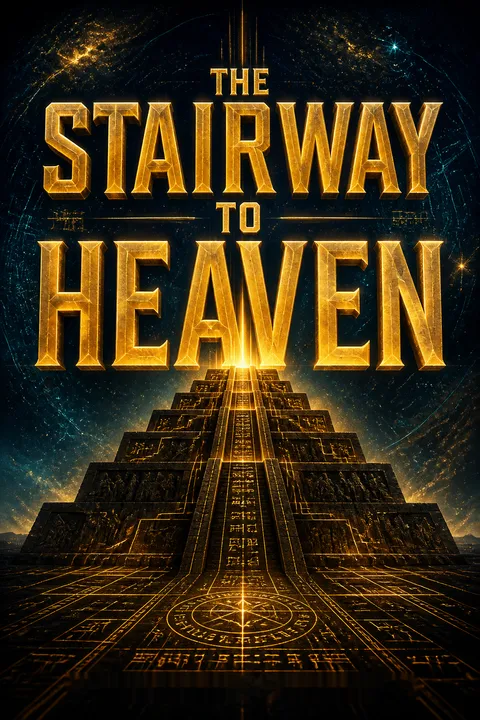
The Stairway to Heaven is the second book in Sitchin's Earth Chronicles series, following The 12th Planet. Reviews are mixed, with an overall 4.03/5 rating. Readers appreciate Sitchin's theories connecting ancient civilizations, particularly Egyptian and Sumerian cultures, to extraterrestrial Anunnaki visitors. Many find the detailed analysis of pyramids, hieroglyphics, and ancient texts fascinating, though some criticize the repetitive content and slow pacing. Several reviewers note the book drags compared to its predecessor, with data-heavy passages that are difficult to read. Common themes include the search for immortality, ancient spaceports, and connections between different mythologies. Opinions range from calling it groundbreaking to dismissing it as conspiracy theory.
People Also Read



Earth Chronicles Series
About the Author
Other books by Zecharia Sitchin
Download PDF
Download EPUB
.epub digital book format is ideal for reading ebooks on phones, tablets, and e-readers.








































