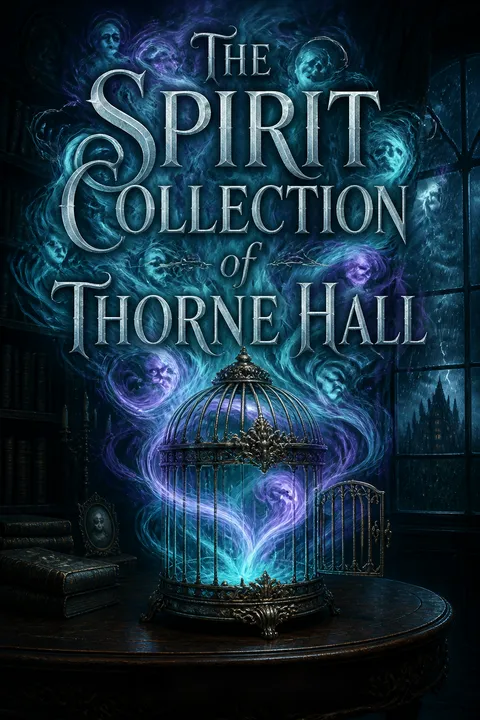

Plot Summary
Samhain Night Summoning
On a cold Samhain night in 1902, Jasper Thorne hosts a lavish party at Thorne Hall, culminating in a secret occult ritual. A true medium, Sparrow, and her kin perform a blood-soaked summoning, binding the first of fifteen spirits—Gideon Constant—to the house and the Thorne bloodline. The guests, both skeptical and desperate, witness the impossible as the dead are called forth. The ritual's cost is high, and the spirits are not easily contained. This night marks the beginning of a legacy of haunting, as the manor becomes home to a collection of restless, vengeful, and tragic ghosts, forever entwined with the fate of the Thorne family.
Spirits of Thorne Hall
In the present day, Thorne Hall is alive with the dead. Elegy Thorne, the current heir, manages a household where the spirits bicker, play, and sometimes wreak havoc. Each ghost has a distinct personality and tragic backstory, from the quarrelsome Eugenia and Mabel to the sorrowful Calliope and the terrifying Amos. Elegy's life is a constant negotiation between the living and the dead, her nights filled with soothing, singing, and containing the Collection. The ghosts are both family and burden, their presence shaping every aspect of Elegy's existence and the rhythms of the ancient house.
Elegy's Haunted Inheritance
Elegy's father, Thaddeus, is dying, and the responsibility of the Spirit Collection looms over her. The rules of the house are strict, preserving the past and keeping the spirits' existence secret. Elegy's daily life is a balancing act—managing the staff, appeasing her stepmother Fletcher, and keeping the ghosts from causing too much damage. The weight of inheritance is heavy, as Elegy is tested by her father and haunted by her own inadequacies. The Collection's mischief escalates, and Elegy's sense of isolation deepens, her future bound to the house and its restless dead.
Friends, Secrets, and Ghosts
Elegy's world expands when her childhood friends, Floss and Hugo, re-enter her life. She reveals the truth of the Collection to them, forging a bond of trust and shared secrets. Their friendship is a lifeline, offering glimpses of normalcy and longing for freedom. Yet, the ghosts' presence complicates everything—visits are rare, and the risk of exposure is ever-present. The trio's loyalty is tested as they navigate adolescence, love, and the peculiar dangers of Thorne Hall. Elegy's yearning for connection and escape grows, even as the house tightens its grip.
The Living and the Dead
As Elegy matures, her relationships with both the living and the dead deepen. Fletcher's tragic history and Hugo's secret love story mirror Elegy's own struggles with duty and desire. The ghosts become both confidants and tormentors, their stories echoing Elegy's fears of loss and longing for love. The boundaries between past and present blur, and the house becomes a crucible for grief, memory, and hope. Elegy's identity is shaped by those she loves and those she has lost, her fate inextricably linked to the spirits she must one day command.
Atticus Arrives
The arrival of Atticus Hart, the contractor's son, brings new energy and possibility to Thorne Hall. Atticus is drawn to Elegy's strangeness and the mysteries of the house. Their connection is immediate and electric, challenging Elegy's isolation and stirring desires she has long suppressed. Atticus's presence unsettles the ghosts and threatens the fragile equilibrium of the household. As he and Elegy grow closer, the possibility of a life beyond Thorne Hall flickers into view, even as the dangers of the Collection—and Thaddeus's control—intensify.
Love Amid Shadows
Elegy and Atticus's relationship deepens, offering both solace and risk. Their stolen moments are charged with longing and fear, as the ghosts watch and the house itself seems to conspire against them. Atticus's love gives Elegy hope for freedom, but also exposes her vulnerabilities. The Collection's jealousy and Thaddeus's suspicion threaten to destroy what they have found. Elegy is forced to confront the limits of her power and the cost of loving in a house ruled by the dead. Their love becomes both sanctuary and battleground.
The Test of Mastery
Thaddeus, sensing his end, subjects Elegy to a brutal test: she must control the Collection alone, night after night, or risk being deemed unworthy. The spirits, led by the cunning Gideon, push her to the brink, exploiting her fears and weaknesses. Elegy's only weapons are her will and her songs, which have a mysterious power over the ghosts. The ordeal leaves her physically and emotionally shattered, but also awakens a latent strength. The test is not just of mastery over the dead, but of Elegy's own identity and resolve.
Canny Bloodlines Revealed
As the crisis deepens, Elegy learns of her canny heritage—a lineage of magical women whose craft is rooted in blood, bone, earth, and song. The medium Dorian, who once taught Elegy the runes of protection, reveals himself as her true father. The Collection's origins are traced to Sparrow, Dorian's ancestor, whose grief and craft bound her kin to Thorne Hall. Elegy's power is not just inherited, but chosen, and her fate is entwined with the unfinished business of generations. The revelation transforms her understanding of herself and the Collection.
The Escape Plot
With Thaddeus's control tightening and the Collection growing more dangerous, Elegy and her allies plot an escape. Fletcher, her stepmother, aids her with secret passages and distractions. Elegy braves the haunted corridors, evades the spirits, and flees into the stormy night to seek help from Atticus and the canny community. The escape is fraught with peril, as the ghosts and Thaddeus's will pursue her. Elegy's courage and resourcefulness are tested, and the bonds of friendship and love are forged in adversity. The stage is set for a final confrontation.
The Banishing Circle
With the help of Dorian, Atticus, Floss, Hugo, and other canny practitioners, Elegy prepares a banishing ritual to free the Collection. The ritual requires blood, song, and the tenets of craft—earth, bone, and stone—anchored by those she loves. The ghosts are drawn to the circle, their hunger and fear palpable. As Elegy sings the ancient ballads, the power of her canny blood and the strength of her chosen family converge. The ritual is a battle of wills, with the fate of the spirits—and Elegy's own future—hanging in the balance.
Sparrow's Legacy Unearthed
The missing journal of Willie Abner is found, revealing the tragic story of Sparrow and her son Reed. Sparrow's grief over her lost child led her to create the Collection, binding her kin to the house in a desperate attempt to bring him back. The promise made to Jasper Thorne was born of love and sorrow, not malice. Elegy learns that only a sacrifice equal to Sparrow's can break the curse. The legacy of pain and longing is laid bare, and Elegy must decide what she is willing to give for freedom.
The Last Samhain
On the final Samhain, the ritual begins. Thaddeus, possessed by Gideon, tries to stop them, but is ultimately undone by his own despair and the weight of the promise. Dorian sacrifices himself, shedding his blood to anchor the craft and allow Elegy to live. The Collection, one by one, is released—some with relief, others with regret. The ghosts' stories are honored, their pain acknowledged, and their spirits finally set free. Elegy's grief is profound, but so is her relief. The house is cleansed, and the cycle of haunting is broken.
The Price of Freedom
The aftermath of the banishing is bittersweet. Elegy mourns the loss of the spirits who shaped her life, especially Hester, her Night Mother, and the children she loved. The house is transformed, its beauty restored, but it is no longer home. Elegy must reckon with her own identity, her canny heritage, and the choices that led to this moment. The cost of freedom is high—sacrifice, sorrow, and the end of an era. Yet, in the emptiness left behind, the possibility of a new life emerges.
The Spirits' Farewell
Elegy and her friends leave Thorne Hall behind, each finding their own path. The house becomes a museum, its secrets hidden from the world. Fletcher finds her own happiness, Hugo and Sebastian embrace love without fear, and Floss pursues her dreams. Elegy and Atticus build a life together far from the haunted halls, honoring the memory of those they lost. The spirits are remembered not as monsters, but as family—loved, mourned, and finally at peace. The past is not forgotten, but it no longer holds them captive.
A New Life Begins
Years later, Elegy lives by the ocean with Atticus and their daughter, Dorian. She tends a thriving garden, sings to her child, and fills her home with laughter and light. The scars of the past remain, but they are woven into a tapestry of joy and resilience. Elegy's story is one of survival, transformation, and the power of love to break even the oldest curses. The ghosts of Thorne Hall are gone, but their lessons endure: grief can bind, but it can also be healed; the living must choose life, again and again.
Analysis
A modern gothic about grief, agency, and the power of chosen familyThe Spirit Collection of Thorne Hall is a masterful reimagining of the haunted house novel, blending gothic atmosphere with psychological depth and a contemporary sensibility. At its heart, the book is about the ways we are bound by the past—by family, by trauma, by promises made in love and regret—and the possibility of breaking free. Elegy's journey from passive caretaker to active liberator is both a supernatural adventure and a coming-of-age story, exploring how we inherit not just property but pain, and how healing requires both mourning and letting go. The novel's use of song, ritual, and friendship as tools of survival and transformation offers a hopeful vision: that even the oldest curses can be broken, and that life—messy, joyful, and unpredictable—awaits those brave enough to choose it.
People Also Read
Characters
Elegy Thorne
Elegy is the last in a long line of Thornes, burdened with the care of the Spirit Collection. Sensitive, intelligent, and deeply lonely, she is shaped by a childhood spent negotiating with ghosts and a father who values control above love. Elegy's psychoanalytic core is her struggle between duty and desire, isolation and connection. Her relationships—with her friends, her stepmother, and especially Atticus—awaken her longing for freedom and self-determination. As she uncovers her canny heritage and the truth of her parentage, Elegy transforms from a passive caretaker to an active liberator, choosing love and life over fear and tradition.
Atticus Hart
Atticus is the son of the local contractor, worldly, compassionate, and drawn to the mysteries of Thorne Hall. His arrival disrupts the stagnant rhythms of the house and offers Elegy a vision of a different future. Atticus's grounded pragmatism and open-heartedness contrast with the house's insularity. He is both a romantic partner and a partner in battle, helping Elegy confront the ghosts—literal and figurative—that bind her. His love is patient and empowering, refusing to dictate Elegy's choices, and his presence is the key that unlocks her courage to seek freedom.
Thaddeus Thorne
Thaddeus is Elegy's father, the current master of the Collection, and a man consumed by duty and bitterness. His devotion to the promise made by his ancestors has corroded his capacity for love, leaving him emotionally distant and often cruel. Thaddeus's psychoanalytic profile is one of repression and projection—he cannot escape the ghosts of his own making, nor forgive himself for his failures. His final acts are both destructive and, in a twisted way, protective, as he tries to ensure the Collection's survival at any cost. His death is both a release and a reckoning.
Fletcher Thorne
Fletcher is a vibrant, wounded woman who finds herself trapped in Thorne Hall's web of grief and tradition. Her flamboyance and wit mask deep pain, and her relationship with Elegy is complex—part adversary, part ally, ultimately a source of unexpected support. Fletcher's psychoanalytic arc is one of resistance and adaptation; she refuses to be broken by the house or its ghosts, and ultimately finds her own path to freedom and self-expression.
Hugo Prescott
Hugo is Elegy's childhood friend and arranged fiancé, a man torn between familial expectation and personal truth. His queerness and longing for love are at odds with the role he is expected to play. Hugo's psychoanalytic struggle is with shame and self-worth; he fears being nothing without his inheritance, yet ultimately chooses authenticity and love over tradition. His journey mirrors Elegy's, and their friendship is a testament to chosen family and mutual rescue.
Floss Carmichael
Floss is Elegy's anchor to the world outside Thorne Hall, bold, irreverent, and fiercely protective. She is the first to believe Elegy's secrets and the first to fight for her freedom. Floss's psychoanalytic role is that of the supportive superego—she challenges Elegy's self-doubt and pushes her toward agency. Her own struggles with love and family echo the novel's themes of inheritance and self-determination.
Dorian Everwood
Dorian is the canny medium who taught Elegy the runes and is later revealed to be her biological father. Wise, gentle, and burdened by regret, Dorian's psychoanalytic arc is one of atonement—he seeks to protect Elegy from the fate that claimed Sparrow and so many others. His ultimate sacrifice is an act of love and liberation, breaking the cycle of grief and binding that has haunted his family for generations.
Gideon Constant
Gideon is the most powerful and dangerous of the Collection, a spirit whose cunning and malice drive much of the novel's conflict. He is both a symbol of the past's grip and a personification of the house's darkest impulses. Gideon's psychoanalytic profile is that of the id run amok—he feeds on fear, shame, and desire, and seeks to perpetuate the cycle of suffering. His defeat is necessary for Elegy's liberation.
Sparrow
Sparrow is the medium whose grief over her lost son led to the creation of the Collection. Her psychoanalytic essence is the destructive power of unresolved mourning—her love and guilt bind not only her kin but generations to come. Sparrow's story is a warning and a mirror for Elegy, showing both the dangers of clinging to the dead and the possibility of redemption through sacrifice.
The Spirit Collection
Each spirit in the Collection represents a facet of human suffering—regret, rage, loneliness, betrayal, and unfulfilled desire. They are both literal characters and psychological symbols, haunting not just the house but the minds of those who live within it. Their relationships with Elegy are complex—some are nurturing, others predatory, all are bound by the same curse. Their release is both an act of mercy and a necessary step in Elegy's individuation.
Plot Devices
Blood, Bone, Earth, and Song
The novel's central plot device is the canny craft—magic rooted in blood, bone, earth, and song. This device weaves together the supernatural and psychological, making the haunting both literal and metaphorical. The rituals of summoning and banishing are not just magical acts but expressions of grief, love, and the longing for connection. The use of song as a means of control and liberation is especially potent, linking Elegy's personal power to her emotional truth. The inheritance of craft and curse is explored through family secrets, hidden journals, and the gradual revelation of ancestry.
The Haunted House as Psyche
The house is both setting and character, its decaying rooms and secret passages mirroring the inner lives of its inhabitants. The ghosts are projections of trauma, memory, and desire, and the rituals of maintenance and containment reflect the struggle to manage the unconscious. The house's rules, its resistance to change, and its eventual transformation into a museum all serve as metaphors for the process of mourning, letting go, and moving forward.
Foreshadowing and Ballads
The recurring use of Child ballads and other folk songs foreshadows key events and themes. Each ballad is carefully chosen to reflect the emotional arc of the characters and the unfolding of the plot—songs of mourning, visitation, and farewell. The ballads serve as both literal spells and symbolic commentary, anchoring the supernatural in the deeply human.
Inheritance and the Breaking of Cycles
The plot is driven by the tension between inherited duty and the desire for freedom. The promise made by Sparrow and Jasper Thorne is both a curse and a contract, binding generations in a cycle of grief and control. The breaking of this cycle requires sacrifice, self-knowledge, and the courage to choose differently. The novel uses the structure of the family saga and the haunted house to explore how trauma is passed down—and how it can be healed.
Download PDF
Download EPUB
.epub digital book format is ideal for reading ebooks on phones, tablets, and e-readers.








































