
Key Takeaways
1. The Architect Elevator: Connect Penthouse to Engine Room
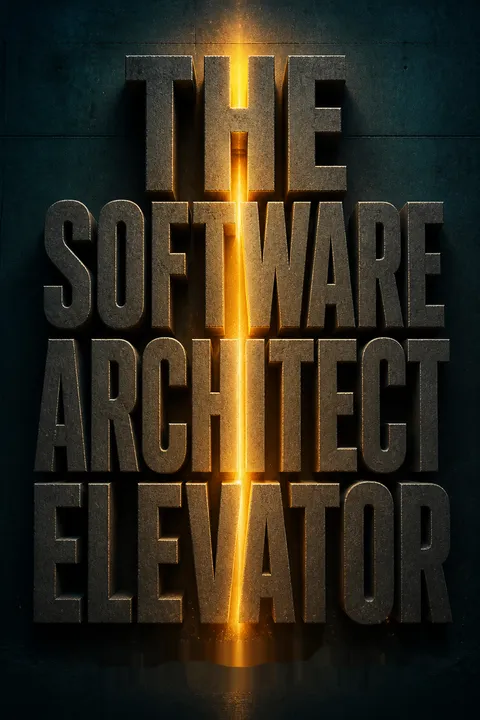
If you picture the levels of an organization as the floors in a building, architects can ride what I call the architect elevator: they ride the elevator up and down to move between a large enterprise’s board room and the engine room where software is being built.
Bridging the gap. Modern architects are crucial connectors in large enterprises, linking strategic business decisions (the penthouse) with technical implementation realities (the engine room). This direct linkage is vital in an era of rapid IT evolution and digital disruption, where technology is a core business driver, not just a cost center. Without this connection, critical information and decision-making power become dangerously siloed.
Two-way street. The "Architect Elevator" isn't a one-way trip. Architects must travel both up to understand business strategy and down to grasp technical realities and implementation challenges. This continuous movement ensures decisions are informed by both strategic intent and practical feasibility, preventing "Architect's Dream, Developer's Nightmare" scenarios and combating the "authority without responsibility" anti-pattern.
Organizational resistance. This vital role often faces resistance from both top management, who might prefer an illusion of control, and middle management, who feel bypassed. Successful architects must be prepared to navigate these political landscapes, carefully linking levels, demonstrating value, and gradually flattening the organizational "skyscraper" by fostering transparency and faster feedback loops.
2. Architects Live in the First Derivative: Embrace Constant Change
If I had to name one primary factor that influences architecture, I’d put rate of change at the top of my list, based on reasoning about the inverse question: when does a system not need any architecture at all?
Change defines architecture. The value and design of any system's architecture are fundamentally driven by its anticipated rate of change. A system that never changes needs minimal architecture, but in today's dynamic digital landscape, such systems are rare. Architects must therefore operate in the "first derivative" – focusing on how quickly a system needs to adapt and evolve.
Beyond functional requirements. Change isn't just about new features; it encompasses shifts in traffic volume, runtime environments (like cloud migration), and evolving business contexts. Traditional IT often views change as an intermittent, unusual state, packaging it into projects that aim for a return to "business as usual." This mindset, reflected in slogans like "never touch a running system," actively resists the constant evolution required for digital competitiveness.
Designing for velocity. To increase a system's rate of change, architects must address factors like excessive dependencies, friction in delivery processes, poor quality, and fear of making changes. A software system's "first derivative" is its build and deployment toolchain; optimizing this through Continuous Integration/Deployment (CI/CD) and automation is paramount. Confidence, fostered by robust automated testing, is key to accelerating change.
3. Architecture is Selling Options: Defer Irreversible Decisions
One of an architect’s most important tasks is to eliminate irreversibility in software designs.
Value in flexibility. Instead of making early, irreversible decisions based on incomplete information, good architecture creates "options" – the right, but not the obligation, to execute a technical decision at a later, more informed time. This approach, borrowed from financial markets, acknowledges that deferring decisions has inherent value, especially in uncertain environments.
Options have a price. Architectural options, like horizontal scalability or vendor abstraction, are rarely free. They come with costs, such as increased complexity or the trade-off of other options (e.g., cloud elasticity might mean vendor lock-in). Architects must articulate these costs and "strike prices" to the business, enabling informed decisions on which options are worth buying based on the level of future uncertainty.
Agile alignment. This "selling options" mindset aligns perfectly with Agile principles, where embracing change and adapting to new information is paramount. It shifts the architect's role from an all-knowing master planner to a facilitator who designs systems for adaptability, allowing the business to respond effectively to market shifts and evolving customer needs.
4. Think in Systems: Understand Behavior, Not Just Structure
A system’s structure is simply a means to achieve a desired behavior.
Beyond components. While traditional architecture definitions focus on components and their interrelationships, systems thinking emphasizes the overall behavior a system is designed to achieve. Architects should view structure as a tool to enable desired behaviors, rather than an end in itself. This perspective helps in reasoning about complex interactions and emergent properties.
Feedback loops. Systems thinking highlights the importance of feedback loops. Negative feedback loops stabilize a system (like a thermostat maintaining room temperature), while positive feedback loops can lead to exponential growth or collapse (like hyperinflation). Understanding these dynamics is crucial for predicting and influencing system behavior, whether in technical systems or organizational structures.
Influencing behavior. Many system problems arise from misunderstanding the relationship between structure, behavior, and observed events. Users often try to fix symptoms without addressing underlying systemic issues. Architects, by applying systems thinking, can identify recurring patterns like "bounded rationality" or "tragedy of the commons" to devise more effective interventions and drive lasting change.
5. Automate Everything, Self-Service the Rest: Never Send a Human to Do a Machine's Job
Automate everything and make those parts that can’t be automated a self-service.
Efficiency and resilience. Automation isn't just about cutting costs; it's primarily about achieving repeatability, resilience, and speed. Manual tasks, especially infrequent ones, are prone to human error and slow down processes. Digital leaders like Amazon have revolutionized IT by automating infrastructure provisioning and making it self-service, attracting top talent and enabling rapid innovation.
Self-service empowerment. Once tasks are automated, they can be exposed through self-service portals or APIs, empowering users to provision resources quickly and accurately. This approach provides better control, traceability, and reduces input errors compared to manual processes. It also democratizes access to resources, starving the "black markets" that often arise from high-friction, manual systems.
Beyond self-service. The ultimate goal is to manage infrastructure and configuration like software, using version control systems (GitOps) for approvals, change tracking, and automated deployment. This leverages decades of software development best practices, ensuring that even configuration changes are robust, testable, and integrated into a rapid delivery pipeline.
6. Software Eats the World: Adopt a Software Development Mindset for Infrastructure
If software does indeed eat the world, it will have IT infrastructure for breakfast.
Infrastructure as code. The virtualization of IT infrastructure, from virtual machines to serverless architectures, transforms hardware provisioning into a software problem. This "software-defined anything" (SDX) trend is essential for meeting the scalability and evolution demands of digital applications, but it requires a fundamental shift in mindset for operations teams.
Re-create, don't undo. Software developers think differently about change: they don't "undo" errors; they revert to a known good version and "re-create" the system from scratch. This "immutable infrastructure" mindset, where servers are "cattle" not "pets," allows for rapid recovery and consistent environments, leveraging version control, automated testing, and continuous integration for infrastructure.
Professional discipline. Operating in a software-defined world demands the same rigorous development lifecycle as application code. This includes well-defined languages (not just configuration files), automated quality checks, and integrated tooling. Embracing this discipline allows IT to move quickly while maintaining quality, turning hardware problems into software problems that can be solved with software.
7. Communicate with Emphasis, Not Just Completeness: Build Ramps, Show Pirate Ships
Every interaction with senior management is also a teaching opportunity. Use it!
Build a ramp, not a cliff. Technical communication often fails by presenting information as a "cliff" of jargon and acronyms, rather than a gradual "ramp" that allows the audience to build a mental model and draw conclusions. Architects must translate complex technical concepts into understandable terms, defining relevant properties within context and omitting irrelevant details.
Show the pirate ship. Instead of listing individual components (the LEGO bricks), architects should first present the exciting, fully assembled vision (the pirate ship) and its purpose. This grabs attention, builds excitement, and helps the audience understand the overall value proposition before diving into the technical details. A "product box" approach, focusing on tangible benefits, is highly effective.
Emphasis over completeness. Diagrams and presentations should prioritize a clear message and emphasis over exhaustive detail. The "five-second test" ensures a slide's core message is immediately apparent. Using storytelling headings, anchor diagrams, and sidebars allows diverse audiences to consume information at different levels of detail, making communication more impactful and less likely to be ignored.
8. Control is an Illusion: Foster Autonomy with Strategy and Feedback
You feel that you have control when people tell you exactly what you want to hear.
The semblance of control. Traditional "command-and-control" structures often create an illusion of control, where top-down directives are assumed to be followed, and status reports are taken as reality. This disconnect, highlighted by "watermelon status" (green outside, red inside), means leaders are flying blind, making decisions based on distorted information.
Closing the gaps. Drawing on military strategy, organizations face three gaps: knowledge (what you know vs. what you need to know), alignment (plans vs. actions), and effects (expected vs. actual outcomes). Instead of trying to eliminate these gaps with thick documents and micromanagement, effective leadership accepts them and empowers teams with "mission command" (Auftragstaktik).
Autonomy, not anarchy. True control comes from fostering autonomy, which requires a balance of:
- Enablement: Providing tools and a low-friction environment.
- Feedback: Ensuring teams have short, direct loops to learn from their decisions.
- Strategy: Clear, overarching goals that guide decision-making without dictating every step.
This framework prevents autonomy from devolving into chaos and strengthens the organization's ability to adapt.
9. No Pain, No Change: Transformation Requires Unlearning Old Beliefs
Learning new things isn’t easy, but unlearning old habits, especially ones that served us well many times, is much more difficult.
The cost of no change. Organizations, like individuals, resist change unless there's sufficient pain or a compelling vision. Deeply ingrained beliefs, often proven useful in the past (e.g., "change is risky," "quality can be added later"), become obstacles to transformation. These beliefs are often unstated and require "reverse engineering" to identify and challenge.
Unlearning is key. Simply telling people their beliefs are outdated is ineffective. Transformation requires helping the organization "unlearn" old habits and assumptions. This involves demonstrating new approaches with tangible results, explaining the changing context, and patiently establishing new, more effective beliefs.
Beyond snake oil. Many organizations fall prey to "panacea peddlers" selling quick-fix solutions or "digital showcases" that offer an illusion of progress without fundamental change. True transformation means tuning the organizational "engine" – changing people's mindsets, processes, and culture – rather than just applying superficial fixes. This is a burdensome but ultimately effective path.
10. Prioritize Economies of Speed Over Efficiency: Flow Trumps Utilization
If the rate of change on the outside exceeds the rate of change on the inside, the end is near.
Speed over efficiency. Traditional organizations prioritize "economies of scale" and resource efficiency, leading to large batch sizes and high utilization rates. However, digital competitors operate orders of magnitude faster, driven by "economies of speed." This fundamental shift means that optimizing individual tasks or resource utilization often comes at the expense of overall flow and time-to-market.
The cost of delay. Flow-based thinking emphasizes the "cost of delay" – the revenue lost by delivering a product or feature later. This cost can far outweigh development costs but is often ignored by organizations focused on budget predictability. Sandbagging and lengthy approval processes, designed for predictability, further exacerbate delays and stifle innovation.
Queues are the enemy. In the pursuit of speed, architects must look not at activities, but between them, where "inactivity" and queues reside. Queuing theory demonstrates that high utilization rates lead to extreme queue sizes and wait times. Making these invisible queues visible and actively reducing them (e.g., by automating processes, reducing synchronization points) is crucial for accelerating organizational throughput.
11. Embrace the Infinite Loop: Build-Measure-Learn for Continuous Adaptation
The critical KPI for most digital companies is how much they can learn per dollar or time-unit spent, i.e., how many revolutions through the Build-Measure-Learn cycle they can make.
Continuous learning. Digital companies thrive on rapid feedback and continuous learning. The "Build-Measure-Learn" cycle, where minimum viable products are launched, user behavior is measured, and insights drive product refinement, is their core operating model. The key metric is not just output, but the speed and effectiveness of this learning loop.
Pivoting the layer cake. Traditional hierarchical organizations, with their layered structures and slow decision-making processes, are ill-suited for rapid learning cycles. To accelerate, organizations must "pivot the layer cake" by forming cross-functional teams (tribes, feature teams, DevOps) with full responsibility from concept to operations. This creates direct feedback loops and removes unnecessary synchronization points.
Internal transformation. For corporate IT, this means becoming a "digital business" itself, offering services rapidly and at high quality, and engaging with internal customers (business units) in a continuous feedback loop. "Dogfooding" – using their own products – provides rapid learning in a safe environment. Ultimately, digital transformation requires changing HR, recruiting, and fostering a "maker mindset" where employees are empowered to build solutions, not just follow rules.
Review Summary
The Software Architect Elevator receives overwhelmingly positive reviews, praised for its fresh perspective on the architect's role in digital transformation. Readers appreciate Hohpe's insights on bridging business and technology, communicating across organizational levels, and driving change. The book is commended for its practical advice, entertaining writing style, and wealth of real-world examples. While some find certain chapters less relevant, most consider it a must-read for aspiring and experienced architects alike. Critics note its broad focus and occasional lack of cohesion, but overall, it's highly recommended for technical leaders and those interested in organizational change.
People Also Read





Download PDF
Download EPUB
.epub digital book format is ideal for reading ebooks on phones, tablets, and e-readers.








































