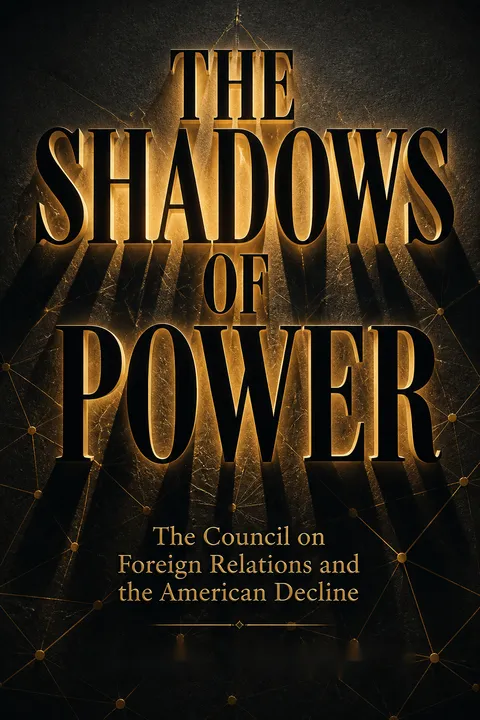

Key Takeaways
1. The Invisible Hand of Power: A powerful, unelected "Establishment" secretly guides U.S. policy.
"The real rulers in Washington are invisible, and exercise power from behind the scenes."
Hidden governance. For decades, prominent figures have hinted at an "invisible government" or "power behind the throne" that operates beyond public scrutiny. This shadowy entity, termed "the Establishment," is described as an exclusive group of powerful individuals from international finance, business, professions, and government, primarily from the Northeast, who wield significant influence regardless of who occupies the White House. Their decisions and agreements often shape national policies.
Elite network. This Establishment cultivates its members through a traditional career path, starting with elite private schools like Groton, progressing to Ivy League universities such as Harvard, Yale, Princeton, or Columbia, and often including graduate work as Rhodes Scholars at Oxford. From academia, they typically move into Wall Street, joining international investment banks, prominent law firms, or brokerage houses. Some gravitate towards influential think tanks like the Brookings Institution and the Rand Corporation, eventually serving on the boards of vast foundations such as Rockefeller, Ford, and Carnegie.
Public service facade. Ultimately, a select few advance into high positions within the federal government, often after a prerequisite membership in the Council on Foreign Relations (CFR). This intricate network ensures that key decision-making roles are filled by individuals who share the Establishment's worldview and agenda. The public remains largely unaware of this coordinated influence, believing that government is solely "of the people at large."
2. CFR: The Establishment's Nexus: The Council on Foreign Relations serves as the primary conduit for the Establishment's influence on government and policy.
Pulitzer Prize winner Theodore White said that the Council's "roster of members has for a generation, under Republican and Democratic administrations alike, been the chief recruiting ground for cabinet-level officials in Washington."
Recruiting ground. The Council on Foreign Relations (CFR), headquartered in New York City's Harold Pratt House, is depicted as the Establishment's central link to the U.S. government. Since its founding in 1921, it has consistently supplied personnel for upper-echelon government jobs, with nearly half of its members having served in official government positions or as consultants. This consistent flow of members into powerful roles ensures that the Establishment's perspectives are deeply embedded within the federal bureaucracy.
Policy formulation. Beyond staffing, the CFR significantly influences policy by formulating and marketing recommendations through its study groups and publications, particularly its journal, Foreign Affairs. While the Council claims to take "no institutional position on issues of foreign policy," its books and articles consistently push specific ideas, often shaping future government actions. Admiral Chester Ward, a former CFR member, noted that once a policy is decided, the CFR's research facilities develop arguments to support it and discredit opposition.
Homogeneous outlook. Despite claims of "broad hospitality to divergent ideas," the CFR's invitation-only membership tends to maintain a homogeneous viewpoint. Early members were predominantly bankers and lawyers with ties to J.P. Morgan, and this pattern largely continued. This uniformity ensures that officials drawn from the Council's ranks bring a consistent, predetermined perspective to Washington, effectively making the CFR a "school for statesmen" that guides national destiny.
3. The Globalist Imperative: The CFR consistently pushes for world government and the erosion of national sovereignty.
"The real problem today is that of world government."
Eroding sovereignty. A core accusation against the CFR is its advocacy for a world government, aiming to centralize power in a single global authority and eliminate national identities and boundaries. This agenda is subtly advanced through proposals that serve as "stepping stones" toward this ultimate goal. Foreign Affairs has published hundreds of articles promoting globalism, while conspicuously lacking any opposing viewpoints, undermining its claim of impartiality.
Strategic approach. The Council's publications reveal a long-term strategy to achieve world order. For instance, a 1944 publication noted that "the sovereignty fetish is still so strong in the public mind, that there would appear to be little chance of winning popular assent to American membership in anything approaching a super-state organization. Much will depend on the kind of approach which is used in further popular education." This suggests a deliberate, gradual approach to overcome public resistance.
Incremental steps. Richard N. Gardner, a CFR member, articulated this strategy in a 1974 Foreign Affairs article, calling for "an end run around national sovereignty, eroding it piece by piece," rather than a "frontal assault." This incremental approach involves strengthening international systems and organizations, such as:
- Gradually increasing the authority of the United Nations.
- Making more effective use of the International Court of Justice.
- Promoting regional organizations as building blocks for wider political units.
This persistent push for global governance raises critical questions about the future of American freedoms and self-determination.
4. The Unholy Alliance: Wall Street and Communism: Powerful financial interests have historically aided and aligned with Communist movements.
"The real truth of the matter is, as you and I know, that a financial element in the large centers has owned the government ever since the days of Andrew Jackson . . ."
Contradictory alliances. A controversial claim against the CFR is its historical "softness" on Communism, often exerting influence on behalf of the international Communist movement. This appears counterintuitive, given Wall Street's conventional image as the antithesis of the radical left. However, Foreign Affairs has featured numerous Marxists and socialists, including Leon Trotsky and Nikita Khrushchev, and even eulogized Trotsky, while rarely publishing staunch anti-Communists.
Financial backing. The Russian Revolution, like other major undertakings, required significant financing. Beyond German aid to Lenin, U.S. banking interests, notably Jacob Schiff of Kuhn, Loeb and Co., heavily bankrolled the Bolsheviks. Early CFR members, such as William Boyce Thompson, a Federal Reserve director, openly contributed millions to spread Bolshevik doctrine. This financial support continued for decades, with Rockefeller family interests providing trade and credit to Communist nations, including the construction of key industrial facilities like the Kama River truck factory in the Soviet Union.
Monopoly's allure. The apparent paradox of "capitalists" aiding Communists becomes clearer when Communism is understood as a form of total government control, essentially a state-run monopoly. Wealthy monopolists, who seek to eliminate competition, find common ground with systems that centralize power. As Frederick C. Howe explained, "the best of all business is politics, for a legislative grant, franchise, subsidy or tax exemption is worth more than a Kimberley or Comstock lode, since it does not require any labor, either mental or physical, for its exploitation." By influencing governments, these financial elites can leverage state monopolies for their own profit and control, blurring the lines between traditional capitalism and state socialism.
5. Crises as Catalysts for Control: Major historical events are often exploited or orchestrated to advance the Establishment's agenda.
"From now on, depressions will be scientifically created."
Engineered crises. The book posits that significant historical events, often presented as accidents, were either deliberately triggered or exploited by the Establishment to advance its agenda. The Panic of 1907, for instance, was allegedly "artificially triggered" by J.P. Morgan to create public demand for a central bank, leading to the Federal Reserve Act of 1913. This pattern suggests a calculated use of chaos to introduce desired systemic changes.
War as opportunity. World War I, too, is framed as an opportunity for globalist aims. U.S. entry into the war, despite public reluctance, was facilitated by incidents like the sinking of the Lusitania, which the book claims was deliberately exposed to danger to provoke anti-German sentiment. The war then served as a pretext for Woodrow Wilson's push for the League of Nations, the first major step towards world government, a concept long desired by internationalist forces.
Economic manipulation. The 1929 stock market crash and subsequent Great Depression are also attributed to deliberate manipulation by the Federal Reserve, which expanded the money supply to fuel speculation before suddenly contracting it. This "calculated 'shearing' of the public" allowed insiders to exit the market before the collapse and later buy up assets at rock-bottom prices. The resulting economic despair then justified the New Deal's expansion of government power and debt, further benefiting the international bankers who loaned money for recovery.
6. Presidents as Pawns: U.S. Presidents are frequently selected and manipulated to implement the Establishment's predetermined policies.
"Most of his thoughts, his political 'ammunition,' as it were, were carefully manufactured for him in advance by the CFR-One World Money group."
Careful selection. The Establishment, through its financial backing and media influence, actively selects and promotes presidential candidates who align with its agenda, regardless of party affiliation. Woodrow Wilson, for example, was propelled from academia to the presidency with the backing of international bankers like Jacob Schiff and Bernard Baruch, after agreeing to support the Federal Reserve and income tax. Similarly, Dwight D. Eisenhower, a political newcomer, was chosen over conservative favorite Robert Taft to ensure an internationalist agenda.
Guided administrations. Once in office, presidents are often guided by Establishment figures. Colonel Edward M. House, a key figure in the CFR's origins, served as Woodrow Wilson's "second personality," shaping his cabinet and policies. Franklin D. Roosevelt's son-in-law, Curtis Dall, claimed that FDR's political ideas were "carefully manufactured for him in advance by the CFR-One World Money group." This pattern suggests that the presidency, while appearing democratic, often serves as an executive arm for a pre-determined agenda.
Bipartisan control. The Establishment's influence extends across both major parties, ensuring that its core objectives are pursued regardless of election outcomes. This was evident in 1960 when Nelson Rockefeller, a quintessential globalist, influenced Richard Nixon's Republican platform, making it a "carbon copy" of the Democratic one. Later, Nixon, despite his conservative rhetoric, implemented policies that aligned with the Establishment's goals, including opening relations with Communist China and expanding federal spending, demonstrating that the "rivalry" between candidates often masks a shared underlying agenda.
7. Media as a Tool of Deception: The mass media is controlled by Establishment interests to shape public opinion and suppress dissenting information.
"There is no such thing as an independent press in America, if we except that of little country towns."
Orchestrated narratives. The mass media, far from being independent, is largely controlled by the same Establishment interests that influence government. This control, dating back to J.P. Morgan's alleged acquisition of influence over 25 major newspapers in 1915, ensures that public opinion is shaped to support the Establishment's agenda. This includes promoting specific policies, suppressing opposing viewpoints, and discrediting critics.
Historical blackout. After World War II, the Establishment actively worked to prevent critical examination of official propaganda, unlike the "debunking journalistic campaign" that followed WWI. Foundations like Rockefeller granted funds to the CFR to commission "authorized" histories, while historians challenging the official narrative were blacklisted by publishers and smeared in the media. This systematic suppression ensures that alternative perspectives on critical historical events remain largely unknown to the public.
Pervasive bias. Today, major media outlets like The New York Times, The Washington Post, Newsweek, and Time are deeply interlocked with the CFR, with numerous members holding key editorial and executive positions. Studies reveal a strong liberal bias in the media, which translates into selective coverage:
- Overwhelming support for reducing national defenses.
- Extensive reporting on human rights abuses in anti-Communist nations, while largely ignoring similar or worse violations in Marxist countries (e.g., Cambodia, Afghanistan).
This disproportionate reporting distorts public perception and influences policy by shaping what Americans believe about global events.
8. Trilateralism: Expanding the Globalist Reach: The Trilateral Commission emerged to broaden the globalist agenda, particularly influencing the Carter administration.
"The Trilateral Commission is, in reality, a group of concerned citizens interested in fostering greater understanding and cooperation among international allies."
New globalist front. With increased scrutiny on the CFR, David Rockefeller initiated the Trilateral Commission (TC) in 1973, expanding the globalist objective beyond a bilateral Atlantic Union to include Japan. Co-founded with Zbigniew Brzezinski, the TC brought together leaders from North America, Western Europe, and Japan in business, banking, government, and media. Brzezinski, a staunch globalist, articulated the need for this "community of the developed nations" to tackle global concerns, asserting that "National sovereignty is no longer a viable concept."
Carter's ascent. The TC played a pivotal role in propelling Jimmy Carter to the presidency in 1976. Despite his image as a Washington outsider, Carter was a founding member of the Commission, having been identified and cultivated by Rockefeller and Brzezinski. His rapid rise from obscurity to presidential candidate, supported by significant media attention, mirrored the patterns seen with Willkie and Eisenhower, suggesting a deliberate effort by the Establishment to install a Trilateralist in the White House.
Trilateralist regime. Once elected, Carter's administration was heavily staffed by TC members, fulfilling Brzezinski's vision that "all the key foreign policy decision makers of the Carter Administration had previously served in the Trilateral Commission." This ensured that Carter's foreign policy, despite his "human rights" rhetoric, aligned with the globalist agenda, leading to actions such as:
- Undermining U.S. allies like Anastasio Somoza in Nicaragua and the Shah of Iran.
- Unilaterally terminating the defense treaty with Taiwan and recognizing Communist China.
- Handing over the Panama Canal Zone.
These policies, often detrimental to U.S. interests and the Free World, consistently advanced the Trilateral-CFR game plan, strengthening Communist regimes and international bodies.
9. The Looming Constitutional Threat: A movement exists to drastically revise the U.S. Constitution, potentially leading to a totalitarian "new world order."
"The change will require major surgery. One cannot stop short of bold and decisive departures- And yet a guiding principle should be to write the new Constitution in a way that permits considerable leeway."
Constitutional overhaul. Amidst the bicentennial celebrations, a serious movement for constitutional revision is underway, spearheaded by groups like the Committee on the Constitutional System (CCS), co-chaired by CFR members. These groups propose drastic changes, including:
- Emulating European parliamentary systems, eliminating individual candidate votes.
- Expanding Congress with appointed members, diminishing voter power.
- Lowering the requirement for Senate treaty ratification.
These measures aim to streamline policy-making but would fundamentally alter the balance of power and increase the potential for authoritarian rule.
Crisis as pretext. The proponents of constitutional reform acknowledge that such "radical and 'alien' constitutional changes" would likely only be accepted "during and following a stupendous national crisis and political failure." CFR Chairman Peter G. Peterson has even forecast an economic crunch. This raises concerns that a manufactured or exploited crisis could be used to push through a new constitution, potentially incorporating elements of a "modern" constitution drafted in 1970, which called for a presidentially appointed Senate, transfer of state powers to the federal government, and nationalization of communications.
Global merger. The ultimate goal of this constitutional restructuring, combined with the globalist agenda, is a "new world order" that includes a "comfortable merger with the Soviet Union." This vision, revealed by Ford Foundation president H. Rowan Gaither to a Congressional investigator, explains the CFR's historical pro-Communist leanings. Recent events, such as CFR delegations visiting Gorbachev and the media's promotion of "glasnost," suggest a deliberate effort to prepare the American public for such a convergence, despite the totalitarian nature of the Soviet system.
10. A Call for Vigilance and Action: Americans must recognize the pattern of subversion and actively resist the globalist agenda to preserve national sovereignty.
"If that process continues unimpeded, we can anticipate a national crisis, a constitutional convention, and a new world order binding the Free World to the countries of the Iron and Bamboo Curtains."
Pattern of subversion. Americans must recognize the recurring pattern of Establishment manipulation in foreign policy. This typically involves:
- Communist insurgents initiating terror campaigns.
- The targeted government cracking down, leading to media denunciation for "human rights violations."
- U.S. intervention, demanding concessions, coalition governments, and imposing embargoes.
- The eventual collapse of the government and Marxist takeover, followed by a media blackout on subsequent atrocities.
This scenario has played out in China, Cuba, Vietnam, Iran, Nicaragua, and Rhodesia, and is currently being applied to other nations, demonstrating a consistent strategy to advance Communist influence globally.
Active resistance. To avert a totalitarian "new world order," Americans must exercise their rights to free speech and vote, demanding leaders who represent national interests, not international banking or world government. This involves:
- Opposing a constitutional convention and supporting the existing U.S. Constitution.
- Advocating for a strong U.S. defense and rejecting treaties that align the U.S. with the Soviet Union.
- Supporting effective aid to anti-Communist freedom fighters and opposing trade with Marxist regimes.
- Resisting the strengthening of the UN and other international agencies.
- Demanding reductions in federal spending, taxation, and bureaucracy.
Informed choice. The choice between liberty and a "new world order" is stark. The "best brains" of the Establishment have led to staggering debt, no-win wars, and the collapse of allies, demonstrating a lack of character despite their intellect. Americans must be vigilant against the allure of a global panacea during crises, understanding that centralizing power in a single international authority risks unprecedented tyranny. The decentralization of power enshrined in the U.S. Constitution is the safeguard against oppression, a principle worth fighting to preserve.
People Also Read
Download PDF
Download EPUB
.epub digital book format is ideal for reading ebooks on phones, tablets, and e-readers.








































