


Key Takeaways
Feeling like a fraud is nearly universal, not a personal defect
The impostor syndrome is a club, not a diagnosis. Valerie Young defines it as a persistent belief that you lack the intelligence or skills others credit you with, coupled with a conviction that any moment now you'll be exposed. In one study of successful people, 70 percent reported experiencing these feelings. Members range from CEOs to Oscar winners to Supreme Court justices.
Success paradoxically makes it worse. Jodie Foster feared someone would knock on her door to reclaim her Oscar, insisting it was meant for Meryl Streep. Streep herself confesses cold feet before every film. Because impostors treat each achievement as unrelated to the next, more success means only a bigger reputation to defend and further to fall, not the relief you would expect.
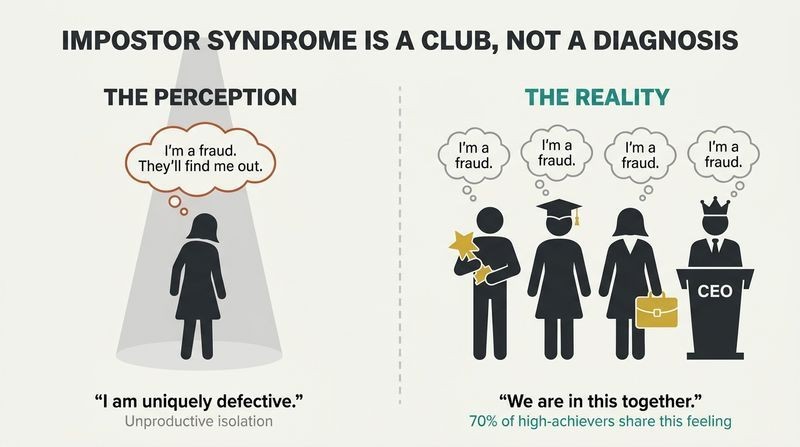
What's striking is how the syndrome inverts the logic of evidence: the more proof of competence accumulates, the more anxious the sufferer becomes. This resembles what psychologists call a disconfirmation-resistant belief, where contrary data gets reinterpreted to preserve the original conviction. It also connects to the Dunning-Kruger effect's mirror image: the genuinely skilled systematically underrate themselves while the incompetent overrate. Young's reframing from private shame to shared experience is itself therapeutic, echoing how support groups reduce suffering simply by breaking isolation. The naming of the phenomenon, she argues, is half the cure.
Master your excuse arsenal for explaining away every success
Impostors are virtuosos of self-disqualification. Young catalogs the standard deflections: I got lucky, I was in the right place at the right time, they only liked me, if I can do it anyone can, they must let anybody in, someone made a clerical mistake. A Cal Tech astrophysics PhD genuinely believed her doctorate proved the field was easy. Two strangers with common names each assumed the admissions office had confused their application with someone else's.
The cost is disconnection from your own competence. When you can never claim an accomplishment on a gut level, you feel oddly severed from achievements that clearly came from you. The only explanation left is that you fooled everyone. Recognizing these scripts is the first step to disarming them.
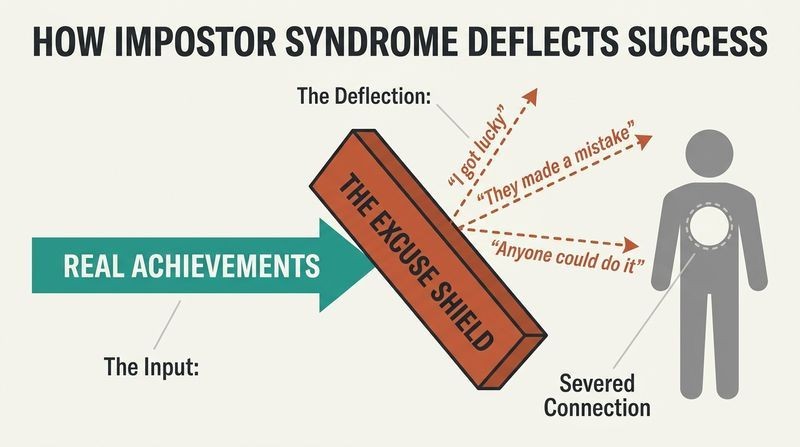
These deflections map neatly onto attribution theory: impostors habitually attribute success to unstable, external causes (luck, charm) and failure to stable, internal ones (lack of ability). Healthy attribution runs the opposite direction. What Young captures well is the creativity involved, which is itself a marker of intelligence being wasted on self-sabotage. There is a subtle arrogance embedded here too, as she notes elsewhere: waving off praise implies the admirers are too dim to see through you. Cognitive behavioral therapy targets exactly these automatic attributions, suggesting the pattern is learnable and therefore unlearnable.
Blame the situation, not yourself, for impostor feelings
There are seven legitimate triggers, most of them situational. Young lists them: being raised by humans (family messages about achievement), being a student (graded daily), working in a self-doubt-feeding culture, working alone, working in a creative field, being a stranger in a strange land, and representing your entire social group. A striking 85.7 percent of foreign-trained medical residents in Canada scored high for impostor feelings. British students from private schools scored low, suggesting belonging buffers self-doubt.
Shifting from personal to situational lowers anxiety fast. Instead of thinking what an incompetent fraud I am, you learn to think under these circumstances, who wouldn't feel this way? A student is supposed to feel stupid because learning requires it. Sonia Sotomayor described arriving at Princeton feeling like a visitor in an alien country.
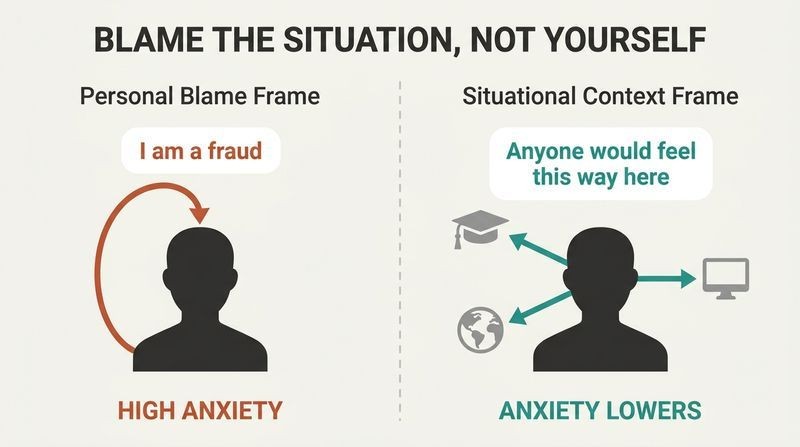
This situational reframing anticipates the modern critique that impostor syndrome has been over-individualized, treating a structural problem as a personal flaw. Recent scholarship argues that labeling women's responses to biased environments a syndrome pathologizes a rational reaction. Young is ahead of her time in locating causes outside the psyche. The medical-resident and private-school data support a belonging hypothesis consistent with Walton and Cohen's research showing that brief belonging interventions improve minority student outcomes for years. The practical lever is clear: change the context or your interpretation of it before trying to fix yourself.
Society really does judge women's competence by a harder yardstick
The bias is measurable, not imagined. When orchestras audition musicians behind a screen, women advance at roughly twice the rate. Swedish researchers Wenneras and Wold found women scientists had to produce 2.5 times more published work to earn the same competence score as men on grant reviews. Reviewers preferred fictitious candidate Brian over identically credentialed Karen two to one, and were four times likelier to demand supporting evidence from a woman.
Anger and self-promotion carry gendered penalties. In mock interviews, angry men were judged as deserving higher status while angry women were rated less competent. A freelance writer doubled her income simply by adopting a male pseudonym. Young's point: your self-doubt is partly a rational echo of external skepticism you did not invent.
These studies remain touchstones in gender research, and their durability is sobering. The pseudonym anecdote foreshadows later natural experiments, like transgender academics reporting sharply different reception under male versus female identities. Young's move is intellectually careful: she refuses to reduce impostor feelings purely to internal psychology or purely to sexism, instead showing how external bias and internal doubt reinforce each other in a feedback loop. One nuance worth adding: because women also penalized other women in these studies, the mechanism is cultural conditioning absorbed by everyone, not simple male malice. That makes it harder to fix but also depersonalizes the sting.
Spot the seven hiding strategies you use to dodge exposure
Impostors unconsciously protect themselves in predictable ways. Building on Clance and Imes, Young names seven coping mechanisms: overpreparation and workaholism, holding back, maintaining a low or ever-changing profile, using charm to win approval, procrastination, never finishing, and outright self-sabotage. A hospital president relocated every three years, figuring that was how long it took a board to discover he was a fraud.
These behaviors soothe anxiety but never cure it. Beneath each lies what psychologist Gerald Weinstein calls the crusher, a core negative belief such as I really am stupid or I am unworthy. The protective pattern exists to keep you from ever facing that crusher. Young insists every crusher is a lie. The work is to name the pattern, name the crusher, and count what the protection actually costs you.
The framework's strength is treating self-defeating habits as intelligent adaptations rather than character flaws, which reduces shame and invites change. This aligns with modern schema therapy, where maladaptive patterns are understood as once-protective strategies that outlived their usefulness. The procrastination insight is especially sharp: delaying provides a built-in excuse so a poor result reflects effort, not ability, preserving the fragile self-image. Interestingly, defensive pessimism research by Julie Norem suggests some of this anticipatory worry is genuinely adaptive for certain personalities, so the goal is not to eliminate the strategies wholesale but to strip out the shame fueling them.
Luck, timing, and connections aid everyone's success, including yours
External factors are real but never the whole story. Young concedes that serendipity matters. Christiane Amanpour got her start by claiming her dropout sister's tuition slot. Bill Gates had rare early computer access. But she flips the impostor's logic: successful people manufacture their luck by showing up, staying curious, and following through. Gates's whole class had the same terminal; only he built Microsoft.
Personality is competence, not an excuse. Women dismiss being liked as if it disqualified their achievement, saying they just like me. Men read likability correctly, as a skill. At Bell Labs, engineers named their most productive colleagues based on social intelligence, not IQ. The reframe: luck opened a door, but you walked through it and delivered, so log the win in the I did it column.
This is a shrewd rhetorical judo, granting the impostor's premise (yes, luck exists) then dismantling the conclusion (therefore I deserve nothing). It echoes the sociology of Robert Merton's Matthew effect and Gladwell's Outliers thesis that opportunity structures matter enormously. Yet Young avoids the fatalist trap by emphasizing agency at the margin. The likability point deserves emphasis in an era obsessed with credentials: emotional and social intelligence predict career success robustly, a finding Goleman popularized. One caution: the advice to simply claim credit can misfire in genuinely biased settings where women who self-promote face backlash, a tension the book itself acknowledges elsewhere.
Your private definition of competence is impossibly rigged against you
Five competence types set unwinnable standards. Young's core diagnostic identifies how impostors distort what competent means:
1. The Perfectionist demands flawless output every time.
2. The Natural Genius expects mastery to come fast and effortlessly.
3. The Expert believes she must know everything before acting.
4. The Rugged Individualist thinks needing help disqualifies the achievement.
5. The Superwoman/Man/Student measures worth by how many roles she juggles.
Swap the rules for mere mortals. Software engineers ship products with known bugs under a paradigm called good enough quality. Competence, Young redefines, is not doing everything yourself but knowing how to marshal the resources to get it done. There are many paths to expertise, effort beats innate talent, and shipping an imperfect version one beats endless polishing that never launches.
This typology is the book's most transferable tool because it converts a vague feeling into a specific, fixable belief. It dovetails with Carol Dweck's fixed versus growth mindset: the Natural Genius embodies the fixed mindset that treats struggle as proof of inadequacy rather than the mechanism of learning. The Expert type illuminates why women disqualify themselves from jobs when missing one listed requirement, a documented driver of the hiring gap. The good-enough-quality import from software culture is a genuinely useful cross-domain borrowing. The deeper lesson is metacognitive: examining the hidden rulebook itself, rather than trying harder to satisfy it, is what breaks the cycle.
Treat failure like a batting average, not a verdict on your worth
Women internalize failure; men externalize it. Young cites self-regarding attribution bias: women blame a bad outcome on lack of ability, men blame the test, the ref, or faulty equipment. Facing a failing grade, female engineering students tend to leave the program while male peers retake the course. Soccer coach Tony DiCicco observed that women hear criticism of the team as criticism of themselves individually.
Reframe the numbers and the meaning. A .333 batting average is stellar, meaning a great hitter fails seven times out of ten. Edison called his dead ends discovered ways that don't work. Young recommends treating criticism like Olympic judging, discarding the extreme high and low scores, and adopting the acronym Q-tip: Quit Taking It Personally. Failure is a curve in the road, not the end of it.
The attribution asymmetry is one of the most replicated findings in gender and achievement psychology, and its consequences compound over a career through what economists call differential persistence. Young's baseball framing is more than a pep talk; it reframes competence as a probabilistic distribution rather than a binary, which is statistically literate advice. The observation that criticism triggers shame in women and defensiveness in men connects to Shelley Taylor's tend-and-befriend versus fight-or-flight stress models. A useful extension: research on psychological safety by Amy Edmondson shows that teams which normalize error reporting outperform, suggesting the impostor's fear of mistakes also sabotages collective learning, not just individual confidence.
The female drive to connect can masquerade as fear of success
Care and connection reshape achievement choices. Drawing on Carol Gilligan, Young argues women weigh how success affects relationships. She maps seven success scenarios, from if I win, someone else loses to if I'm too successful it could cost me a relationship to if I act too smart or bossy, people won't like me. A twelve-year-old spelling champion apologized to her best friend for beating her.
Distinguish confidence issues from connection issues. The research is real: women who negotiate salary are judged less nice and less hireable, and women penalize female negotiators too. So holding back may be a shrewd reading of social consequences, not mere insecurity. Young's prescription is not to stop caring but to ask each time whether the hesitation is genuine self-doubt or a legitimate relational concern, then decide deliberately.
Gilligan's ethic of care remains contested, criticized for essentializing gender differences that may be culturally produced rather than innate. Young sidesteps the biology debate by framing these as socialized tendencies and statistical averages. The negotiation research by Bowles, Babcock, and Lai is robust and reveals a genuine double bind: the same behavior that advances men penalizes women, so telling women to just ask ignores the backlash. The generative move is diagnostic separation: naming whether a hesitation stems from capability doubt or relational calculus lets a woman address the actual variable. Peggy McIntosh's radical suggestion, that feeling fraudulent may reflect wise skepticism toward hierarchies of individual merit, adds philosophical depth.
Act confident before you feel it, because behavior drives feeling
Fake it till you make it is neurologically sound. When Wake Forest students acted like extroverts for fifteen minutes, they reported feeling happier regardless of their true temperament. James Taylor pretended to be a songwriter until he discovered he actually was one. The premise: you become what you do, and doing generates the confidence that feelings alone never will.
Women resist this harder, and it costs them. Young identifies male answer syndrome (answering regardless of knowledge) and irrational self-confidence syndrome (unearned certainty), and understands why women recoil from imitating them. But she distinguishes toxic bluster from healthy improvising. Ted Koppel admitted going into interviews knowing next to nothing, confident he could pick up enough to hold his own. Reframe bullshitting as winging it, holding your own, or trusting you'll figure it out.
The act-first principle aligns with William James's century-old insight that emotion often follows action, and with modern embodied-cognition and behavioral-activation research where changing behavior shifts mood more reliably than changing thoughts. Amy Cuddy's power-posing work made similar claims, though it later faced replication challenges, so the effect sizes are debated even if the direction holds. Young's most valuable contribution is decoupling healthy improvisation from arrogant fakery, addressing the moral objection many capable people feel toward self-promotion. Rebecca Solnit's mansplaining essay, cited here before the term existed, grounds the gendered asymmetry: the confidently ignorant crowd out the quietly competent, so learning to hold one's own is defensive necessity, not vanity.
You already take risks; expand what counts and add chutzpah
Women take unrecognized risks daily. Society defines risk narrowly around money, power, and status, the historically male arenas. Yet emotional vulnerability, career interruptions to raise children, and speaking an unpopular opinion are real risks. In four of five risk categories women are more cautious, but they lead in social risk-taking. Neuroscientist John Coates linked traders' testosterone surges to reckless overconfidence, and female-managed hedge funds fell only half as much during the 2008 crisis.
Cultivate chutzpah, gutsy audacity with flair. A teenage Spielberg wore a suit, waved past the guard, and squatted in an empty Universal office all summer, even adding his name to the building directory. Clare Boothe Luce sat down at an empty Vogue desk and started working until she was on the payroll. Their competence was real; the boldness just opened the door.
The testosterone and hedge-fund data offer a provocative counter-narrative to the deficit framing that women simply lack confidence. Sometimes measured caution is superior judgment, a point Buffett's patient style illustrates. This reframe is empowering because it revalues traits already present rather than demanding wholesale personality change. The chutzpah stories risk survivorship bias, since we hear about Spielberg's gambit precisely because it worked, and countless similar stunts surely flopped anonymously. Still, the underlying research that women underestimate and men overestimate ability suggests most women have upside room to take more calculated risks. Perls's insight that fear and excitement share identical physiology offers a concrete reappraisal tactic backed by emotion-regulation science.
Your deepest fear is not inadequacy but your own power
Impostorism is the flip side of giftedness. Young's final reframe, borrowing Marianne Williamson's observation, is that beneath the fear of being exposed as incompetent lies a buried certainty that you are capable beyond measure, and that is what truly frightens you. Leadership scholar Manfred Kets de Vries calls the impostor syndrome the flip side of giftedness. Playing small feels safe but costs the world your contribution.
Reframe the question and serve others. Instead of asking who do you think you are to go for it, ask who am I not to. Research shows women negotiate more assertively for others than themselves, outperforming men when advocating on someone else's behalf. So link your ambition to a cause, a team, or the next generation of girls. Young admits impostor feelings may never vanish completely, only shrink from a roar to a whisper.
Ending on power rather than self-acceptance is a bolder note than most confidence books strike, and it reframes ambition as generosity rather than ego. The finding that women negotiate harder for others is genuinely actionable, offering a workaround to the self-advocacy backlash: recast personal goals as service. This resembles self-determination theory's insight that prosocial motivation is often more durable than self-interested motivation. Young's honest concession that the syndrome persists, that even Pauline Clance, who named it, still felt it, is refreshingly anti-utopian. The goal is not permanent cure but faster recovery, a maintenance model closer to how we treat chronic conditions than acute ones.
Analysis
Valerie Young's 2011 book occupies an unusual niche: a self-help volume built on genuine doctoral research and a quarter-century of workshops with over 50,000 people, yet written with the warmth of a friend confessing her own dissertation-era paralysis. Its structure is diagnostic rather than prescriptive-first, moving from what impostor feelings are, through why they arise (family, gender bias, situation), to the internal mechanics (coping strategies, distorted competence rules), and finally to remedies (reframing failure, faking confidence, taking risks). The genius of the book is its refusal to locate the problem entirely inside the sufferer's head. Young braids two explanatory strands that most treatments keep separate: the cognitive-psychological (attribution biases, fixed mindsets, the crusher belief) and the sociological (measurable gender bias in hiring, grant review, and negotiation backlash). This dual causation makes her account more intellectually honest than the individualistic willpower narratives dominating the genre.
Her most enduring contribution is the five competence types, a taxonomy that converts an amorphous dread into a specific, editable belief. It anticipates by years the mainstream adoption of Dweck's mindset research and pairs naturally with it. The framework's diagnostic precision is what makes the book actionable where lesser treatments merely reassure.
The book shows its age and its moment. The heavy gender binary, defended as statistical shorthand, sits uneasily with contemporary understandings of gender as spectrum, and the essentialist echoes of Gilligan invite critique. More significantly, recent scholarship (Tulshyan and Burey) argues that framing a rational response to biased systems as a personal syndrome shifts the repair burden onto individuals rather than institutions. Young partly preempts this by devoting entire chapters to structural bias, but her remedies still land mostly on the individual: reframe, fake it, ask anyway.
What wears well is the psychological realism. Young never promises cure, only management, and she models it by narrating her own relapses during the book's own writing. That candor, plus the taxonomies that give readers language for a wordless shame, explains why the book remains a reference point in confidence literature.
Review Summary
The Secret Thoughts of Successful Women explores impostor syndrome, particularly among women. Readers found it insightful, practical, and relatable, appreciating the author's research, examples, and actionable advice. Many felt validated by learning about successful women's experiences with self-doubt. Some criticism focused on the book's length and occasional dated references. Overall, reviewers recommend it for anyone struggling with impostor feelings, noting its potential to boost confidence and provide valuable perspective, though some found the content familiar if they had previous exposure to the topic.
FAQ
What's The Secret Thoughts of Successful Women about?
- Focus on Impostor Syndrome: The book delves into the impostor syndrome, a psychological pattern where successful individuals doubt their accomplishments and fear being exposed as frauds.
- Empowerment and Understanding: Valerie Young aims to empower readers by helping them understand the roots of their self-doubt and providing strategies to overcome these feelings.
- Practical Tools Provided: It offers practical tools and insights to help readers reframe their thinking about competence, success, and failure.
Why should I read The Secret Thoughts of Successful Women?
- Relatable Experiences: If you’ve ever felt like a fraud in your professional or academic life, this book provides validation and understanding.
- Actionable Advice: The book is filled with actionable advice and exercises that can help you combat impostor feelings.
- Broader Context: It places personal experiences within a broader societal context, helping readers understand how cultural expectations and gender roles contribute to impostor feelings.
What are the key takeaways of The Secret Thoughts of Successful Women?
- Impostor Syndrome Defined: The book defines the impostor syndrome and explains its prevalence among successful individuals.
- Coping Mechanisms: Young outlines various coping mechanisms that people use to manage impostor feelings, such as overpreparing and procrastination.
- Redefining Success: The author encourages readers to redefine their understanding of success and competence, moving away from perfectionism.
What are the best quotes from The Secret Thoughts of Successful Women and what do they mean?
- “If we knew each other’s secrets, what comforts we should find.”: Highlights the importance of sharing experiences and vulnerabilities.
- “You may not know what you’re doing, but you’re doing it anyway.”: Encourages readers to take action despite fears and uncertainties.
- “Perfectionism has nothing to do with getting it right.”: Challenges the notion that perfection is necessary for success.
How does The Secret Thoughts of Successful Women explain the impostor syndrome?
- Psychological Pattern: Described as a persistent belief in one’s lack of intelligence or competence, despite evidence to the contrary.
- Common Experience: Many high-achieving individuals, regardless of gender, experience these feelings, normalizing the experience.
- Impact on Success: Impostor feelings can hinder personal and professional growth, leading individuals to avoid challenges.
What coping mechanisms do people use to manage impostor feelings according to The Secret Thoughts of Successful Women?
- Overpreparing and Hard Work: Compensating for feelings of inadequacy by working excessively hard or overpreparing for tasks.
- Procrastination: Delaying tasks to avoid the fear of failure, creating a built-in excuse for not succeeding.
- Self-Sabotage: Engaging in behaviors like not finishing projects to avoid the risk of being exposed as a fraud.
How can I overcome the impostor syndrome according to The Secret Thoughts of Successful Women?
- Reframe Your Thinking: Challenge negative self-talk and reframe your understanding of success and competence.
- Acknowledge Your Achievements: Keep a record of accomplishments to help internalize success.
- Seek Support: Connect with others who share similar experiences for validation and encouragement.
What are the competence types described in The Secret Thoughts of Successful Women?
- Perfectionist: Sets unrealistically high standards and feels inadequate when falling short.
- Natural Genius: Believes competence should come easily and struggles when faced with challenges.
- Rugged Individualist: Believes true competence means doing everything alone, often avoiding asking for help.
How does societal context influence impostor feelings according to The Secret Thoughts of Successful Women?
- Cultural Expectations: Societal norms and expectations, particularly regarding gender, contribute to impostor feelings.
- Stereotypes and Bias: Stereotypes about female competence can lead to self-doubt and reinforce impostor feelings.
- Support Systems: Building supportive networks can combat the negative effects of societal expectations.
What practical exercises does The Secret Thoughts of Successful Women suggest for building confidence?
- Achievement List: Create a list of accomplishments without qualifiers to recognize successes.
- Reframing Self-Talk: Practice positive self-talk and reframe negative thoughts about competence.
- Setting Realistic Goals: Establish attainable goals and celebrate small successes to feel more competent.
How does The Secret Thoughts of Successful Women address the impact of socialization on women’s self-perception?
- Cultural Expectations: Discusses how girls are socialized to prioritize others' feelings, leading to self-doubt.
- Comparison with Men: Contrasts with how boys are encouraged to be competitive, creating a confidence disparity.
- Changing the Narrative: Advocates for women to challenge ingrained beliefs and redefine self-worth.
What role does failure play in the context of The Secret Thoughts of Successful Women?
- Natural Part of Growth: Failure is an inevitable part of the learning process and should be embraced.
- Learning Opportunities: Encourages analyzing failures to extract valuable lessons.
- Shift in Mindset: Changing the perception of failure from a negative outcome to a stepping stone for growth.
Download PDF
Download EPUB
.epub digital book format is ideal for reading ebooks on phones, tablets, and e-readers.








































