

Key Takeaways
Your consciousness can leave your body, and doing so previews death
The core thesis. William Buhlman argues that out-of-body experiences (OBEs), where awareness separates from the physical body, are humanity's most common paranormal event and a direct doorway to understanding the soul. Drawing on over 16,000 survey responses from 32 countries, he presents the OBE not as fantasy but as a natural, trainable capacity.
Why it matters. Buhlman frames every spiritual tradition as ultimately pointing to one thing: consciousness transcending flesh. He contends that death is simply the transition into the same nonphysical state OBE explorers already visit. Ninety-eight percent of his respondents reported a jolt awake, 85% heard buzzing or roaring sounds, and 82% felt floating or spinning. These recurring patterns, he claims, prove OBEs describe a real shared territory rather than random dreams.
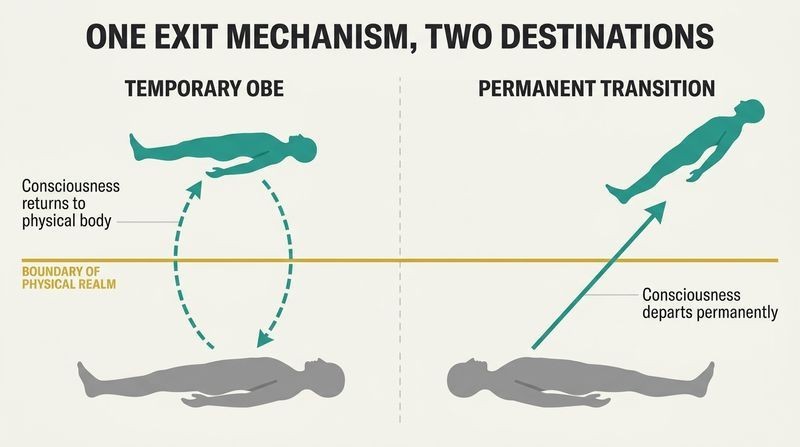
What's striking is how Buhlman reframes a fringe topic as universal human birthright rather than occult specialty. His survey-driven approach borrows the language of social science, though it lacks controls, verification, or peer review, so the data documents belief and reported experience, not objective travel. Neuroscience offers a sober counterpoint: Olaf Blanke's work stimulating the temporoparietal junction reliably induces OBE sensations, suggesting a brain-based mechanism. Yet even skeptics acknowledge the phenomenology is consistent and worth studying. The honest reader can hold both: the experiences are real as experiences, whatever their ultimate cause. Buhlman's contribution is normalizing and destigmatizing them.
Treat the buzzing, vibrations, and paralysis as a launchpad, not a seizure
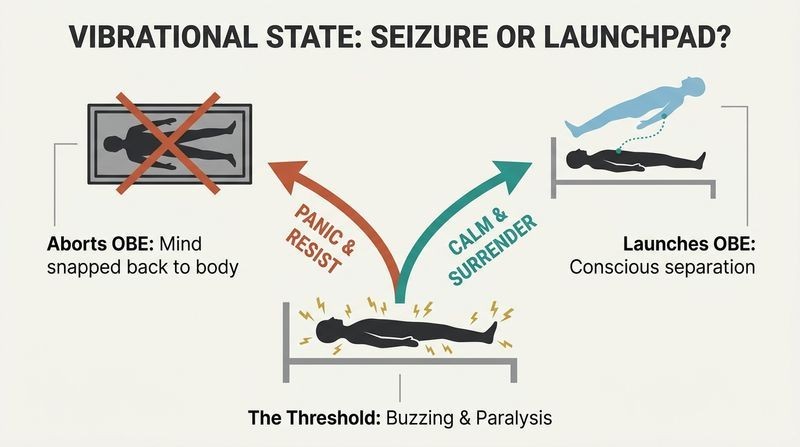
The vibrational state. Buhlman's central practical concept is what he calls the vibrational state: the buzzing, humming, roaring, electrical surges, and temporary paralysis that arrive just before separation. Seventy-two percent of respondents reported paralysis, 56% felt intense vibrations. Most people panic, snap their attention back to the body, and abort the experience.
The counterintuitive move. The correct response, he argues, is surrender. Let the vibrations spread through your whole body, stay calm, and direct your attention away from the physical (toward a door, the ceiling, floating upward). He notes children and even war veterans often mistake these sensations for seizures or medical crises. He reinterprets biblical passages, like Ezekiel's rumbling and John's trumpet-loud voice, as ancient descriptions of this same vibrational threshold.
This maps almost exactly onto sleep paralysis, a well-documented state where the body's REM atonia persists into wakefulness, often accompanied by buzzing, a felt presence, and terror. Where sleep researchers see a glitch in the sleep-wake boundary, Buhlman sees a spiritual gateway, and crucially, he offers a reframe that reduces fear. That reframe has genuine therapeutic value: studies show that psychoeducation about sleep paralysis lowers distress. His instruction to relax into rather than fight the state echoes exposure therapy. Whether or not one accepts the metaphysics, teaching frightened people that a terrifying nightly event is harmless and even usable is a real gift.
In the inner dimensions, thought instantly sculpts reality
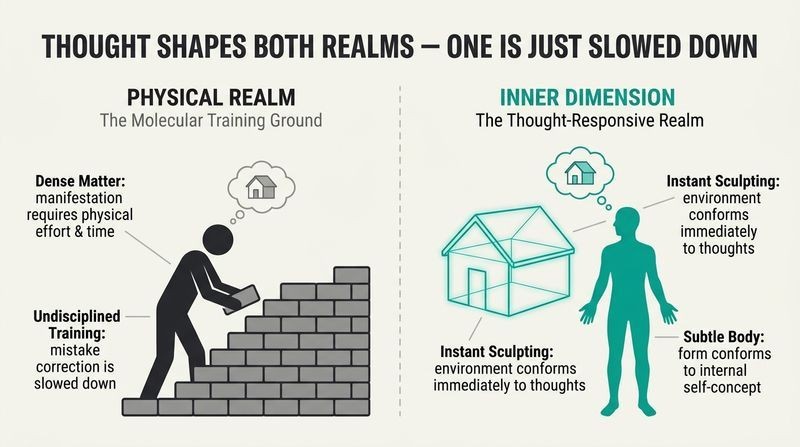
The thought-responsive universe. Buhlman's most consequential idea is that the nonphysical realms are thought-responsive: whatever you focus on instantly molds your form and surroundings. During OBEs, the blind report seeing, the paralyzed report walking, and the elderly appear young because the subtle body conforms to self-concept, not biology.
Practical consequence. He advises demanding results aloud and in present tense: a wimpy request yields a wimpy result. Physical reality follows the same rules, he claims, just slowed down by the density of matter. This is why he calls the material world a slowed-down molecular training ground: a school where undisciplined minds learn to wield creative thought without wrecking the pristine higher realms. Your fears, too, manifest instantly, which is why calm neutrality is essential.
The thought-responsive premise is Buhlman's boldest and least falsifiable claim, conveniently explaining away contradictions (couldn't see? your subconscious blocked it). It resonates with lucid dreaming, where expectation demonstrably shapes the dreamscape, lending experiential plausibility without requiring literal metaphysics. It also rhymes with the placebo effect and with cognitive-behavioral insight that interpretation shapes felt experience. The danger, familiar from The Secret and law-of-attraction culture, is victim-blaming: if thought creates reality, suffering becomes the sufferer's fault. Buhlman mostly avoids the crass wealth-manifestation version, aiming at spiritual growth. Still, readers should notice the unfalsifiability. The framework's real utility may be as a discipline for attention rather than a physics.
Rehearse dying now so it becomes an adventure, not a terror
Death as a skill. Buhlman's most original argument is that death is a learnable transition you can prepare for. Most people, he says, die untrained and settle into the astral plane, a comfortable, physical-like reflection of Earth, mistaking it for their true home and thereby locking themselves into reincarnation.
Being spiritually proactive. He draws on the Tibetan Book of the Dead, which is read aloud to the dying to steer consciousness toward the clear light beyond all form. His prescription: at your last breath, don't just go to the light or reunite with relatives. Instead demand to experience your higher self, your formless spiritual essence, bypassing the astral reflection entirely. He reports hospice nurses seeing patients slip in and out of OBE-like states as death nears, which he calls the thinning veil.
Here Buhlman converges with serious end-of-life research. Deathbed visions are well-documented across cultures, and contemporary work on psychedelic-assisted therapy shows that mystical-type experiences dramatically reduce death anxiety in terminal patients. His core claim, that familiarity with ego-dissolution states removes the fear of dying, is echoed by Roland Griffiths's psilocybin studies at Johns Hopkins. The framing of death as a trainable event, rather than a passive catastrophe, is genuinely empowering and aligns with the death-positive movement and hospice philosophy. The reincarnation-trap cosmology is unverifiable, but the practical counsel, cultivate equanimity with formlessness while alive, needs no metaphysics to be valuable.
Extreme trauma can eject consciousness, from combat to childbirth
Trauma as trigger. Buhlman collects accounts of OBEs forced by crisis: soldiers watching their bodies from above during firefights, victims of assault and abuse floating to the ceiling, women in painful labor observing themselves, marathon runners seeing a double beside them. He cites Hemingway's WWI shrapnel wound (fictionalized in A Farewell to Arms) and fighter pilots blacking out under G-force, a state the military dubbed G-lock.
The mechanism. He proposes that overwhelming pain, fear, or physical shock loosens the connection between physical and subtle bodies, and that a survival instinct ejects consciousness to protect it. Abuse survivors describe retreating to a safe corner of the room, sometimes into a lightbulb, escaping unbearable pain without any sensation of it.
This is where Buhlman's spiritual frame overlaps most productively with clinical psychology. What he calls trauma-induced OBE, psychiatry calls peritraumatic dissociation and depersonalization, recognized responses to overwhelming threat and strongly predictive of later PTSD. The felt escape from pain is real and adaptive in the moment. Buhlman's contribution is destigmatizing it and offering survivors a non-pathologizing narrative. The tension: interpreting a trauma response as spiritual proof of the soul could discourage some from seeking treatment for dissociation that has become chronic and disabling. Ideally the two frames coexist, one honoring the meaning, the other addressing the wound.
Children float out of their bodies routinely, then get taught it away
Childhood as peak permeability. Buhlman reports the first OBE typically occurs between ages four and twelve, then drops sharply in the teen years, which he attributes to cultural conditioning that trains kids to identify totally with the body. Young children describe flying, walking through walls, attending heaven school with a nice teacher, and meeting deceased relatives, only to be told it was just a dream.
The parenting prescription. He urges parents to validate rather than dismiss these experiences. For frightened children he offers the Golden Blanket Technique: guiding the child to imagine a warm blanket of golden protective light. To stop an episode, a child focuses on a finger or toe, snapping back to the body. He reinterprets many night terrors as misread vibrational-state phenomena.
The developmental claim is intriguing and partly corroborated from an unexpected direction: children report imaginary companions, vivid hypnagogia, and past-life memories (studied by Ian Stevenson and Jim Tucker at the University of Virginia) at rates that decline with age and socialization. Whether this reflects genuine permeability or simply an immature reality-testing faculty that culture later hardens is the open question. Buhlman's parenting advice is sound regardless of mechanism: dismissing a child's frightening nocturnal experience as nonsense tends to amplify fear, while calm validation and a concrete coping ritual reduce it. The Golden Blanket is essentially guided imagery, a technique clinicians use for pediatric anxiety.
Many alien abductions are OBEs wearing a sci-fi costume
A provocative reinterpretation. After receiving over 200 abduction letters that were nearly indistinguishable from OBE reports, Buhlman argues most abduction experiences are actually misinterpreted OBEs. Swap the words and the accounts match: paralysis, buzzing sounds, vibrations, floating up a beam of light, telepathic contact, missing time, and a felt presence appear in both.
The perception principle. His deeper claim is that we perceive the nonphysical with the mind, not eyes, so the mind clothes formless intelligences in culturally available imagery. Someone expecting robed monks sees monks; someone steeped in UFO lore sees grays. He suggests angels throughout history, appearing from nowhere and vanishing, may be the same multidimensional contact interpreted through each era's beliefs. Advanced beings, he speculates, would travel by focused consciousness, not metal starships.
This is a genuinely clever synthesis, and it aligns with mainstream sleep science: abduction narratives correlate strongly with sleep paralysis episodes, as Harvard's Richard McNally and Susan Clancy documented. The felt presence, paralysis, and levitation are textbook paralysis phenomenology, and the specific content (aliens versus demons versus dead relatives) tracks cultural expectation. Buhlman arrives at a similar conclusion from the opposite premise: rather than debunking the experiences as brain glitches, he validates them as real contact filtered through belief. Both camps agree the imagery is culturally constructed. The disagreement is only whether anything objective lies behind it, which neither survey nor lab can currently settle.
Pick a motion you can feel vividly and ride it out of your body
The inner-motion toolkit. Buhlman's signature induction method exploits imagined motion to loosen the energy body. As you drift toward sleep, vividly feel (not just picture) a continuous movement and hold it as your last conscious thought. Options include:
1. Climbing a rope hand over hand (ideal for poor visualizers and the blind)
2. Rising in a hot-air balloon or elevator counting floors
3. Rocking, rolling, or spinning around your axis
4. Swinging higher and higher like a child
5. A surfer imagining the perfect wave, whatever motion you personally resonate with
Practice discipline. He recommends practicing daily for at least 30 days, not in bed (too conditioned for sleep), and warns against starting too early and mentally exhausting yourself: five minutes of focused intention beats an hour of vague effort.
These techniques closely parallel established lucid-dreaming and hypnagogia induction methods. The emphasis on kinesthetic imagery over visual is smart and inclusive: mental imagery ability varies enormously across people (some have aphantasia and cannot picture anything), so offering a felt-motion route widens access. The insistence on holding an image as the final pre-sleep thought is essentially leveraging the hypnagogic transition, the fertile borderland between waking and sleep that artists and inventors have long mined. Buhlman's practical humility here is refreshing: he repeatedly says the right technique is whichever one you enjoy and can sustain, prioritizing consistency and emotional engagement over doctrinal correctness. That is sound behavior-change advice.
Fear is the only real barrier, and it must be faced head-on
The master obstacle. Across thousands of accounts, Buhlman identifies fear as the single greatest challenge, and 46% of respondents reported a panic attack during an OBE. Fear manifests as the impulse to flee the vibrations, terror of not returning to the body, and dread of nonphysical entities. Because the inner realm is thought-responsive, fear literally generates frightening manifestations.
Confronting it. His solution is to become a dispassionate, objective observer and, when a fearful form appears, to stand your ground and project love, which dissolves it. He recounts being crushed by a giant ornate mirror early in his practice until he screamed that he had the power and instantly lifted it, unlocking new freedom. He offers protection tools: the globe of white light, imagined armor, and demanding a shift to a higher vibrational level.
The psychology here is quietly sophisticated. Buhlman's fear-manifestation loop is a vivid dramatization of a real cognitive dynamic: anxious attention amplifies threat perception, creating a self-fulfilling spiral, exactly what happens in panic disorder. His prescription, face the fear rather than flee, mirrors the core mechanism of exposure therapy, the gold-standard treatment for phobia and panic. Projecting love onto a threatening figure resembles techniques in nightmare rescripting and Tibetan chöd practice, where practitioners deliberately confront terrifying forms. The mirror anecdote is a neat metaphor for how a felt sense of agency (I have the power) can collapse a paralyzing obstacle. The through-line, courage dissolves the barrier, transcends the book's metaphysics.
Every major religion was seeded by out-of-body explorers, not just believers
A radical reading of scripture. Buhlman argues the founders of the world's religions were not primarily believers but firsthand explorers of consciousness. He reads Paul's man caught up to the third heaven, John's Revelation, Ezekiel's rumbling ascents, Muhammad's ride through the seven heavens, and Swedenborg's documented spirit-world travels as literal OBE reports, each described through its era's cultural vocabulary.
Belief versus experience. His pointed critique: doctrine-immersed theologians memorize words and mistake them for wisdom, while the actual mystics transcended the body to experience God directly. He notes anthropologist Erika Bourguignon found some form of dissociative or OBE state in 89% of 488 surveyed societies. Jesus's born again, he suggests, precisely describes waking inside a new subtle body during separation.
This experiential reading of religion places Buhlman in a respectable lineage. William James in The Varieties of Religious Experience argued that direct mystical experience, not doctrine, is religion's living root, and Aldous Huxley's perennial philosophy made the same case for a common core beneath traditions. Bourguignon's cross-cultural data on institutionalized altered states is genuine and widely cited in anthropology. The vulnerability is interpretive overreach: reading every scriptural vision as specifically an OBE flattens rich, varied texts into one template and ignores literary, political, and theological dimensions. Still, the central provocation, that lived transformation matters more than professed belief, is a serious challenge to purely intellectual or tribal religiosity, and hard to dismiss.
Analysis
The Secret of the Soul is best understood as spiritual anthropology dressed as self-help. Its engine is not argument but accumulation: Buhlman marshals over 16,000 survey responses and hundreds of testimonies to establish, through sheer repetition, that out-of-body experiences follow consistent patterns across cultures, ages, and triggers. This is the book's rhetorical strength and its epistemological weakness. The consistency is real and genuinely interesting; the leap from consistent phenomenology to literal metaphysical travel is asserted, not demonstrated.
The book sits at a fascinating crossroads that Buhlman himself does not fully acknowledge. Nearly every phenomenon he documents has a robust materialist explanation: sleep paralysis, REM intrusion, hypnagogia, temporoparietal-junction disruption (Blanke), peritraumatic dissociation, and culturally-scripted abduction narratives (McNally, Clancy). A rigorous reader can accept all his descriptive data while rejecting his interpretation. What makes the book valuable regardless of one's metaphysics is its practical and therapeutic payload: reframing terrifying nocturnal experiences as harmless and usable, normalizing childhood and trauma dissociation, offering concrete anxiety-reduction rituals, and, most substantially, treating death-preparation as a learnable skill that reduces mortal terror. This last theme converges strikingly with contemporary psychedelic and palliative research showing that mystical-type ego-dissolution experiences durably lower death anxiety.
Buhlman's weakest move is the thought-responsive universe, an unfalsifiable premise that explains every failure as subconscious interference and flirts with law-of-attraction victim-blaming, though he keeps it aimed at spiritual growth rather than material gain. His strongest is the experiential critique of religion: the insistence that direct transformation outranks inherited doctrine, echoing William James and the perennialists.
Ultimately the book asks readers to become explorers rather than believers, and that stance, courage over comfort, experience over dogma, is worth taking seriously even by those who never leave their bodies. Its enduring utility is psychological: fear management, meaning-making, and equanimity before death.
Review Summary
The Secret of the Soul is highly regarded for its comprehensive exploration of out-of-body experiences (OBEs). Readers praise Buhlman's approach, which combines personal accounts, survey results, and practical techniques. The book is seen as valuable for beginners and experienced practitioners alike, offering insights into the spiritual aspects of OBEs and their potential for personal growth. Some reviewers note the book's organization could be improved, but overall it's considered an essential read for those interested in exploring consciousness beyond the physical body.
Glossary
Out-of-Body Experience (OBE)
Awareness separating from physical bodyThe experience in which a person's center of awareness appears to separate from and exist independently of the physical body, often perceiving the body from outside it. Buhlman treats it as a natural, common, trainable state and the foundation of authentic spiritual experience, distinct from ordinary dreaming because participants report full conscious clarity.
Vibrational state
Buzzing, paralysis before separationThe threshold phenomena that precede an OBE: internal vibrations, buzzing or roaring sounds, electrical sensations, and temporary paralysis. Buhlman attributes it to the opening of one or more chakras flooding the subtle body with energy. He teaches that surrendering to rather than resisting this state is the key to initiating full separation.
Thought-responsive universe
Reality molded instantly by thoughtBuhlman's principle that the nonphysical dimensions instantly reshape themselves according to the observer's focused thoughts, both conscious and subconscious. Your form, abilities, and surroundings conform to your self-concept. The physical world follows the same rule, only slowed by the density of matter, which is why he calls it a training ground for developing creative consciousness.
Astral plane / Bardo body
Form-based realm nearest physicalThe nonphysical dimension closest to the physical in density, an ethereal reflection of earthly reality. The Bardo body (a Tibetan term Buhlman equates with the astral or etheric body) is the subtle energy duplicate experienced there. He warns that mistaking this form-based reflection for one's true spiritual home perpetuates reincarnation.
Higher-Self Technique
Demanding union with spiritual essenceA method used during an OBE or at death: after separating, one firmly demands Now I experience my higher self, triggering rapid inward or upward motion through layers of light toward formless pure consciousness. Buhlman presents it as the most direct route to God-realization and the ideal final thought at the moment of death.
Golden Blanket Technique
Child's protective light visualizationA guided-imagery ritual Buhlman teaches parents to give frightened children. The child imagines lying under a warm blanket radiating golden protective light that keeps anything unwanted away and keeps guardian angels close. It is a fear-management tool for children experiencing vibrational-state phenomena or night terrors.
Inner-motion techniques
Imagined movement to induce separationA family of OBE induction methods that use vividly felt imagined motion (climbing a rope, rising in an elevator or balloon, rocking, rolling, spinning, swinging) held as the last conscious thought before sleep. The sustained sensation of movement is meant to loosen the subtle energy body and initiate the vibrational state.
FAQ
What's The Secret of the Soul about?
- Exploration of OBEs: The Secret of the Soul by William Buhlman explores out-of-body experiences (OBEs) as a tool for understanding our spiritual nature. It includes personal testimonies and insights from a global survey on OBEs.
- Spiritual Evolution: The book emphasizes the importance of transcending the physical body for spiritual growth, encouraging readers to explore their spiritual essence.
- Practical Guidance: It offers techniques and guidance for inducing OBEs, making it accessible for both beginners and experienced practitioners.
Why should I read The Secret of the Soul?
- Personal Empowerment: The book provides insights for personal and spiritual empowerment, encouraging readers to take control of their spiritual journeys.
- Understanding Life and Death: It offers a new perspective on death, viewing it as a natural transition, which can alleviate fears surrounding mortality.
- Universal Relevance: OBEs are presented as a common experience across cultures and religions, making the content relatable for anyone interested in spirituality.
What are the key takeaways of The Secret of the Soul?
- Innate Ability for OBEs: Everyone has the natural ability to experience OBEs, which can lead to profound spiritual insights.
- Vibrational State: Understanding the vibrational state is crucial for initiating OBEs and serves as a bridge to higher consciousness.
- Techniques for Exploration: The book provides various techniques, such as visualization and affirmations, to enhance spiritual growth and self-awareness.
What are the best quotes from The Secret of the Soul and what do they mean?
- Transcending Physical Limits: "There is simply no escaping the fact that our consciousness must transcend the limits of the body." This highlights the necessity of exploring beyond physical existence for spiritual growth.
- Vibrational State Key: "The key to understanding some of these mysteries may be the vibrational state." This emphasizes the importance of recognizing the vibrational state as a precursor to OBEs.
- Collective Consciousness Shift: "The increasing number of people around the world who are beginning to explore and cultivate this ability represents a major leap in the development and evolution of human consciousness." This reflects the growing acceptance of OBEs as a legitimate spiritual practice.
What techniques does William Buhlman recommend for inducing OBEs?
- Vibrational State Focus: Recognizing and embracing the vibrational state is essential for initiating an OBE. It can be self-initiated through practice.
- Visualization and Affirmations: Techniques like visualizing a desired outcome or using affirmations can facilitate the experience and empower the individual.
- Relaxation and Mindfulness: Practicing deep relaxation and mindfulness before sleep can enhance the likelihood of experiencing an OBE.
How does The Secret of the Soul redefine death and dying?
- Death as Transition: Buhlman presents death as a transition to another state of existence, encouraging readers to view it as a natural part of the spiritual journey.
- Empowerment Through Knowledge: Understanding the process of dying can empower individuals to face it without fear, seeing it as a wondrous transition of consciousness.
- Spiritual Guidance: The book offers methods for assisting loved ones during their transition, emphasizing the importance of spiritual support.
What is the vibrational state, and why is it important in The Secret of the Soul?
- Precursor to OBEs: The vibrational state is a universal prelude to out-of-body experiences and spiritual exploration.
- Energy Shifts: It involves sensations of energy, buzzing, or vibrations, indicating a shift in consciousness and preparing for separation from the physical body.
- Facilitates Growth: Engaging with the vibrational state can lead to personal empowerment and deeper spiritual insights.
How do childhood experiences relate to OBEs according to William Buhlman?
- Common in Children: Many children experience OBEs between ages four and twelve, often without fear or understanding.
- Influence on Spirituality: These experiences can significantly influence a child's spiritual outlook and openness to exploring consciousness.
- Parental Support: Parental understanding and support are crucial in helping children navigate their experiences and foster spiritual growth.
What similarities exist between OBEs and alien abduction experiences in The Secret of the Soul?
- Shared Phenomena: Many elements of OBEs overlap with reports of alien abductions, such as paralysis and buzzing sounds.
- Consciousness Exploration: Both involve a shift in consciousness and exploration of nonphysical dimensions, suggesting multidimensional experiences.
- Impact on Perception: These encounters can lead to significant shifts in personal perception and understanding of reality.
How can I assist someone who is dying, according to The Secret of the Soul?
- Spiritual Guidance: Provide clear spiritual guidance to help the dying person transition smoothly, using affirmations and reminders of their spiritual essence.
- Supportive Environment: Create a peaceful atmosphere where the individual feels safe to explore their spiritual journey.
- Affirmations: Encourage the person to focus on affirmations to help them connect with their spiritual essence.
How does William Buhlman address the fear of death in The Secret of the Soul?
- Reframing Death: Buhlman encourages viewing death as a natural transition rather than something to fear, promoting joy in the continuation of life.
- Preparation for Transition: Insights on preparing for death through conscious spiritual action and exploration are provided.
- Assisting Others: The importance of assisting lost souls during OBEs is discussed, which can also alleviate fears about death.
How does William Buhlman define the soul in The Secret of the Soul, and what is its significance?
- Essence of Consciousness: The soul is defined as "pure consciousness existing independent of all energy bodies, shapes, or forms."
- Multidimensional Nature: The soul can operate multiple energy bodies simultaneously, allowing exploration across different dimensions.
- Path to Self-Realization: Exploring the soul is key to achieving self-realization and spiritual growth, encouraging readers to embrace their spiritual essence.
About the Author
Other books by William Buhlman
Download PDF
Download EPUB
.epub digital book format is ideal for reading ebooks on phones, tablets, and e-readers.








































