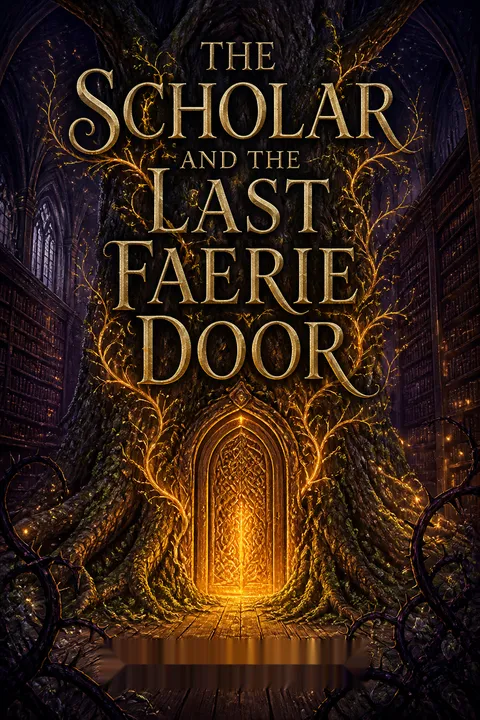

Plot Summary
Four Words in Camford
Clover Hill, a scholarship student from a nonmagical family, finds herself isolated at Camford, the secret university of magic. Her world changes when Alden Lennox-Fontaine, the golden heir of a powerful Family, asks her, "What are you reading?" in the library. This simple question forges a connection that will alter the course of her life. The library, a labyrinthine refuge, becomes the backdrop for Clover's first real conversation at Camford, and the spark of intellectual kinship with Alden. Their discussion of forbidden magical texts hints at deeper mysteries and ambitions. Clover's longing for belonging and her outsider status are palpable, setting the emotional stakes for her journey. The moment is charged with possibility, loneliness, and the first glimmer of hope that she might find her place in this world of privilege and secrets.
War's Shadow on Home
Clover's childhood is shaped by the Great War, which takes her beloved brother Matthew to the front and leaves her family reeling. When Matthew returns, he is cursed by faerie magic—a wound that will not heal, a midnight madness that threatens his life. The war's devastation is compounded by the Spanish flu, which claims Clover's father. The family's struggle is both material and magical, as they learn to bind Matthew during the dangerous nights when the curse takes hold. Clover's determination to save her brother becomes her driving force, and the first seeds of her ambition to study magic are sown. The chapter is suffused with grief, guilt, and the desperate hope that magic might offer a way to heal what war has broken.
The Secret World Revealed
A visit from Sam Truelove Wells, a mage who served with Matthew, reveals the existence of the magical world and its strict codes. Clover learns that magic is real, but tightly controlled by ancient Families who fear exposure and faerie power. The incident at Amiens, where a faerie broke free and cursed hundreds, has led to a ban on faerie magic and the sealing of the doors between worlds. Clover's world expands and contracts at once: she is offered a glimpse of possibility, but also the weight of secrecy and exclusion. Her resolve to help Matthew hardens, and she begins to study magic in secret, guided by Lady Winter, a formidable local witch. The chapter pulses with the thrill of discovery and the ache of being on the outside looking in.
The Scholar's Ambition Ignites
Determined to save her brother and escape the confines of her rural life, Clover sets her sights on Camford. She earns a scholarship through relentless study and the help of Lady Winter, who tutors her in the basics of magic. Arriving at Camford, Clover is awed by its wild, overgrown beauty and the sense of history in its stones. Yet she is quickly reminded of her outsider status—ignored, pitied, and dismissed by her privileged peers. Her friendship with Alden, Hero, and Eddie begins to blossom, offering her a fragile foothold in this new world. The emotional core is Clover's hunger for knowledge, her longing to belong, and the first stirrings of the ambition that will drive her into dangerous territory.
The Four Bound Together
Clover, Alden, Hero, and Eddie become an inseparable group, united by their outsider status and intellectual curiosity. Their bond is cemented through late-night study sessions, rooftop adventures, and the shared pursuit of forbidden knowledge—especially the mysteries of faerie magic. Each brings something unique: Hero's brilliance and defiance, Eddie's gentle wisdom, Alden's charisma and restlessness, Clover's determination and empathy. Together, they begin to question the rules that bind their world, and to dream of changing it. The emotional arc is one of belonging, hope, and the intoxicating sense of possibility that comes from finding one's people.
Forbidden Knowledge Sought
The group's research into faerie magic leads them to break into the Camford archives, risking expulsion and worse. They discover that the true danger lies not just in the magic itself, but in the secrets the Families have buried—secrets about the nature of faerie doors, the failure of binding circles, and the true events at Amiens. Tensions rise as Clover realizes Alden and Hero have their own agendas, and that their friendship is built on both genuine affection and mutual need. The emotional tone is one of exhilaration, fear, and the first cracks in the group's unity as ambition and loyalty collide.
The Midnight Curse Returns
Clover returns home for the holidays, only to find her family struggling and Matthew's curse worsening. Her attempts to heal him with new magic fail, deepening her guilt and sense of helplessness. A bitter argument with her mother exposes the rift between Clover's ambitions and her family's needs. When Matthew's life hangs in the balance, Clover is forced to confront the limits of her power and the price of her choices. The chapter is heavy with regret, love, and the realization that magic cannot fix everything—at least, not without terrible cost.
The Door Opens Wide
Back at Camford, the group's research culminates in a reckless experiment: opening a faerie door using a new, untested method. Their hope is to find a safe way to bargain with the fae and lift the ban on faerie magic. Instead, they unleash a force they cannot control. The faerie they summon is the same one from Amiens, filled with rage and grief over a sister trapped at the heart of Camford. The experiment goes wrong—binding circles fail, the door nearly breaks open, and only Clover's desperate intervention prevents catastrophe. The group is shattered by guilt, betrayal, and the knowledge that they have set something terrible in motion.
Ashfield's Golden Summer
The four retreat to Ashfield, Alden's ancestral home, for a summer that is both idyllic and haunted. Old wounds resurface: Alden's guilt over his brother's disappearance, Hero's struggle for independence, Eddie's quiet suffering, Clover's longing for love and belonging. The bonds between them are tested as secrets come to light and the consequences of their actions close in. The summer is a brief, golden interlude before the world changes forever—a time of laughter, love, and the bittersweet knowledge that nothing can last.
The Faerie's Bargain
Haunted by the faerie's demands and the knowledge of what lies beneath Camford, the group is torn apart by conflicting loyalties. Alden's obsession with saving his brother drives him to dangerous extremes; Clover is forced to choose between her love for her friends and her sense of right and wrong. Hero, possessed by the faerie, becomes both victim and threat. Eddie, caught in the crossfire, tries to hold the group together. The emotional climax is a tangle of love, betrayal, and the realization that some wounds cannot be healed by magic alone.
The Library's Heart Exposed
The final confrontation takes place in the Camford Library, where the group discovers the living faerie bound at the heart of the great oak—a sacrifice made centuries ago to power the Families' magic. The faerie's rage is justified; the world of privilege and power Clover has fought to join is built on theft and cruelty. To free Hero and right the ancient wrong, Clover must become the new ward of the library and make an impossible choice: preserve the world she loves, or break it to set things right. The emotional stakes are at their highest—love, guilt, and the weight of history press in from all sides.
The World Shatters
Clover chooses to free the faerie, shattering the foundation of Camford and the Families' power. The university collapses, magic drains from the blood of the privileged, and the old order falls. In the chaos, Hero is freed, but the cost is immense—Clover's home, her magic, and the world she fought to belong to are gone. Alden, broken by guilt and loss, chooses to remain behind and close the last door from the faerie side, sacrificing himself to ensure the worlds remain separate. The chapter is a maelstrom of grief, relief, and the uncertain hope that something new can grow from the ruins.
The Reckoning at Camford
In the aftermath, the survivors pick through the wreckage—literal and emotional. Hero, Eddie, and Clover are exonerated, but the world they knew is gone. The truth about Camford and the Families comes to light, sparking upheaval and reform. Clover grieves for Alden, for the library, for the magic that once made her special. Yet she finds solace in her friends, her family, and the knowledge that she did what was right, even when it broke her heart. The emotional arc is one of mourning, acceptance, and the first tentative steps toward healing.
The Price of Magic
The collapse of Camford forces a reckoning with the past and a reimagining of the future. Magic is no longer the birthright of the privileged few; new universities spring up, open to all who wish to learn. Clover, Hero, and Eddie dedicate themselves to teaching, research, and the slow work of building a more just world. The scars of the past remain—personal and collective—but so does the hope that things can be better. The emotional tone is bittersweet, a blend of loss and possibility.
The Last Door Closes
The last faerie door is closed forever, sealing the worlds apart and ending the cycle of theft and violence. Ashfield burns, a final sacrifice to ensure the past cannot return. The friends say goodbye to Alden, to the world they once knew, and to the illusions that sustained them. In the ashes, something new begins to grow—a promise that the future can be different, if they have the courage to make it so. The chapter is suffused with grief, love, and the quiet triumph of choosing what is right over what is easy.
Aftermath and New Beginnings
Years later, Clover reflects on all that has been lost and gained. She teaches at new universities, raises her daughter Rose, and keeps the memory of Camford alive in dreams. The world is still broken, still dangerous, but it is also more open, more just, and more full of possibility than ever before. The bonds of friendship endure, even as the past recedes. The story ends not with closure, but with the promise that the work of healing and building never truly ends—and that even in the ruins, new life can take root.
Analysis
A modern fantasy reckoning with privilege, power, and the cost of belongingThe Scholar and the Last Faerie Door is a profound meditation on the dangers of exclusion, the seduction of power, and the necessity of breaking with the past to build a more just future. Through the lens of a magical university and its hidden sins, H.G. Parry explores how institutions perpetuate privilege by hoarding knowledge and gatekeeping access. The story's emotional core is the journey of Clover Hill, whose longing to belong leads her to both great achievement and terrible mistakes. The friendships at the heart of the novel are both a source of strength and a crucible for betrayal, mirroring the larger societal conflicts between tradition and change. The book's ultimate message is that true healing requires sacrifice, honesty, and the courage to let go of what no longer serves. By breaking the last faerie door, Clover and her friends do not simply destroy the old world—they make space for something new to grow, rooted in justice, openness, and the hard-won wisdom of those who have suffered and survived. The novel is a call to question the foundations of our own institutions, to reckon with the costs of our privileges, and to imagine a future where knowledge and magic are the birthright of all.
Review Summary
The Scholar and the Last Faerie Door is a captivating dark academia fantasy set in 1920s England. Readers praise Parry's intricate worldbuilding, complex characters, and exploration of themes like class, gender, and colonialism. The story follows Clover Hill as she navigates a secret magical university and dangerous faerie magic. While some found the pacing slow, many appreciated the atmospheric writing and emotional depth. The book's blend of historical fantasy and academic intrigue resonated with fans of similar works, earning mostly positive reviews.
People Also Read



Characters
Clover Hill
Clover is the heart of the story—a determined, fiercely intelligent young woman from a nonmagical family who wins a scholarship to Camford. Haunted by her brother's faerie curse and her family's struggles, she is driven by love, guilt, and an insatiable hunger for knowledge and belonging. Clover's journey is one of transformation: from outsider to scholar, from follower to leader, from someone desperate to fit in to someone willing to break the world to set things right. Her relationships—with Alden, Hero, Eddie, and her family—are complex, marked by love, betrayal, and forgiveness. Psychologically, Clover is defined by her empathy, her need to fix what is broken, and her willingness to bear the cost of doing what is right, even when it means losing everything she thought she wanted.
Alden Lennox-Fontaine
Alden is the charismatic, brilliant scion of a powerful magical Family, but beneath his charm lies a deep well of pain and obsession. Haunted by the disappearance of his brother Thomas and his own role in opening the faerie door, Alden is driven by a need to undo the past and prove himself worthy. His relationship with Clover is fraught with longing, rivalry, and mutual recognition—they are mirrors of each other's ambition and loneliness. Alden's psychological arc is one of self-destruction: his inability to let go of the past leads him to betray his friends and, ultimately, to sacrifice himself to close the last door. He is both villain and victim, a tragic figure whose brilliance is matched only by his capacity for self-delusion and regret.
Hero Hartley
Hero is a dazzling intellect, a woman ahead of her time, determined to break the barriers of gender and class that confine her. Her friendship with Clover is a lifeline for both—an alliance of outsiders who refuse to be defined by others' expectations. Hero's possession by the faerie is both literal and symbolic: she becomes the battleground for the story's deepest conflicts, her will pitted against an ancient rage. Her arc is one of survival, resilience, and the struggle to reclaim her own agency. Hero's wit, courage, and vulnerability make her both a leader and a casualty of the world's injustices.
Edmund "Eddie" Gaskell
Eddie is the quiet soul of the group, a botanist whose connection to the natural world gives him a unique perspective on magic and life. Often overlooked, even by his friends, Eddie's kindness and loyalty are his greatest strengths. He is the first to see the dangers in their research, the first to forgive, and the last to give up hope. Eddie's psychological journey is one of self-acceptance: learning to value his own voice, to stand up to those he loves, and to find happiness outside the structures that have always excluded him. His relationship with Richard, his partner, is a quiet triumph of love over fear.
Matthew Hill
Matthew is Clover's beloved older brother, a casualty of war and faerie magic. His struggle with the curse is the catalyst for Clover's journey, and his resilience in the face of suffering is a touchstone for the story's moral questions. Matthew's relationship with Clover is marked by love, guilt, and the unspoken wounds of war. He represents the cost of secrets, the pain of survival, and the possibility of healing—even when scars remain.
Sam Truelove Wells
Sam is the bridge between worlds: a mage who fought alongside Matthew, a member of the Board, and a man haunted by the compromises of power. His loyalty to Clover's family is genuine, but he is also complicit in the system that oppresses them. Sam's psychological arc is one of regret and atonement—he tries to do what is right, but is often constrained by fear and duty. His relationship with Matthew is a shadow of what might have been, marked by love, loss, and the impossibility of going back.
Lady Anjali Winter
Lady Winter is Clover's first magical teacher, a woman of color and outsider in the magical world. Her wisdom, strength, and generosity shape Clover's path, and her own story is a testament to the costs of exclusion and the power of resilience. Lady Winter's psychological depth lies in her ability to see the world's injustices clearly, to fight for change, and to nurture those who come after her. She is both a survivor and a builder of new worlds.
The Faerie Dryad
The faerie at the heart of the story is both monster and martyr—a dryad whose sister was imprisoned to power Camford's magic. Her rage is justified, her violence terrible, her grief bottomless. Possessing Hero, she becomes the story's antagonist, but also its conscience: a reminder of the cost of power, the pain of loss, and the impossibility of justice without sacrifice. Her psychological complexity lies in her duality—destroyer and liberator, villain and victim.
Grimoire (Henry Grimsby-Lennox)
Grimoire is the enigmatic, ageless librarian of Camford, a living embodiment of the university's history and its buried sins. His death at the hands of the faerie marks the end of an era and the vulnerability of even the most powerful institutions. Grimoire's role is to guard knowledge, but also to keep it from those who need it most—a symbol of the dangers of hoarding power.
Rose Hill
Rose is Clover's daughter, raised by Matthew and Jemima, a child of both worlds—magical and mundane, privileged and excluded. Her existence is a secret, a promise, and a challenge to the old order. Rose represents the possibility of a new world, one where magic is not the birthright of the few, but the inheritance of all who seek it. Her psychological role is that of the future: unburdened by the past, yet shaped by its consequences.
Plot Devices
Dual Worlds and Hidden Doors
The narrative is structured around the existence of two worlds: the mundane and the magical, separated by hidden doors that can be opened only by those with the right knowledge or blood. The doors are both literal and symbolic—gateways to power, belonging, and danger. The act of opening a door is always fraught with risk, and the consequences ripple outward, affecting not just individuals but entire societies. The motif of the door recurs throughout the story, marking moments of transformation, betrayal, and revelation.
The Scholar's Quest and Forbidden Knowledge
The story is driven by the characters' pursuit of knowledge—about magic, about themselves, about the world's hidden history. This quest is both noble and dangerous: it leads to breakthroughs and healing, but also to hubris, disaster, and the unearthing of buried sins. The tension between what should be known and what must remain secret is a constant source of conflict, both personal and political. The narrative structure mirrors this, with revelations coming in layers, each deeper and more unsettling than the last.
Cycles of Betrayal and Forgiveness
The emotional heart of the story is the bond between Clover, Alden, Hero, and Eddie—a bond forged in shared struggle and shattered by betrayal. The cycles of trust, deception, and forgiveness play out on both personal and societal levels, echoing the larger themes of exclusion, privilege, and the cost of power. Foreshadowing is used to hint at the group's eventual rupture, while the narrative's return to moments of connection and reconciliation underscores the possibility of healing, even after terrible harm.
The Price of Magic and the Weight of History
Magic in the story is never free—it is always bought at a price, whether in blood, memory, or the suffering of others. The revelation that the Families' power is built on the imprisonment of a faerie and the theft of her land forces a reckoning with history. The narrative structure uses flashbacks, confessions, and the gradual unearthing of secrets to build a sense of inevitability and tragedy. The final act of breaking the faerie's chains is both a liberation and a destruction, a necessary shattering that makes possible the building of something new.
Download PDF
Download EPUB
.epub digital book format is ideal for reading ebooks on phones, tablets, and e-readers.








































