
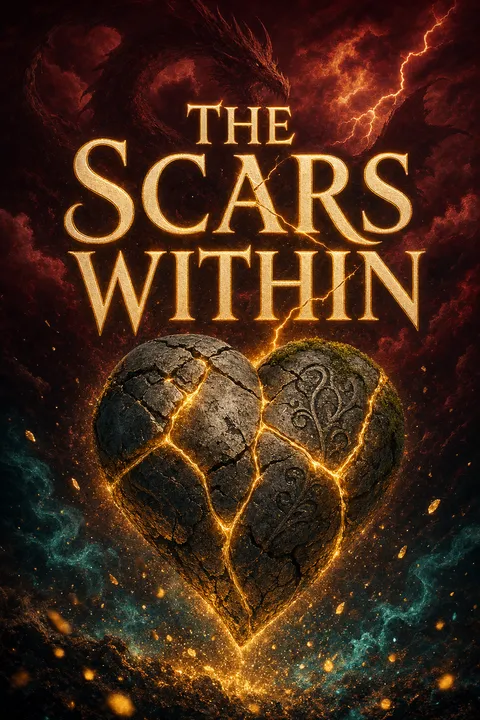


Plot Summary
Prologue
For two years Scarlet1 has rotted in a dark shed, beaten by captors who keep her breathing but never let her leave. Her fellow prisoner Jaelyn was dragged away long ago and never returned. Numb past feeling, Scarlet1 presses her arm against a rusty nail she calls her beacon, cutting herself just to feel something other than the ache inside.
One day strange hands unlock her shackles and a raspy voice tells her the rest is up to her. She crawls free and discovers her prison sat beside a horse-racing stadium, crowds cheering while she starved. Staggering onto the track, she screams at the riders to trample her, begging to be hit, certain no one will miss her.
The opening refuses euphemism, rendering suicidal despair as lived sensation rather than metaphor. The rusty nail, reframed from beacon of hope to instrument of self-harm, encodes the book's central psychology: a survivor turning inward the violence done to her, mistaking self-destruction for agency. The racetrack detail is brutally ironic, ordinary leisure unfolding feet away from unwitnessed torture, dramatizing how invisible suffering can be. By giving Scarlet a voice that narrates her own surrender, the author establishes an unreliable relationship with hope itself. The reader meets a protagonist at absolute zero, so that every later flicker of connection registers as hard-won, and the mantra to come carries genuine weight.
A New Start at Mageia
A year after the racetrack, recovered in a women's shelter, Scarlet1 receives an anonymous package: the elemental documentation of the father who abandoned her,8 her only ticket into Mageia War College. She returns home to find the cottage burned to ash and resolves to rebuild from nothing, clinging to a whispered promise that she is meant for more.
Sorted into a quad with chatty Delaney,4 brash Tatum,5 and shy Cleo,6 she meets her team leaders, identical twins Rhodes2 and Shayde Wylder,3 fire wielders bonded to dragons. Having never channeled magic, Scarlet1 hopes to disappear into the crowd. She claims a coffee-brewing work assignment, discovers a quiet rooftop, and silently vows she will not surrender to her darkness again.
The inciting structure inverts the usual fantasy-school dream: Scarlet enters not seeking glory but refuge, weaponizing a deadbeat father's identity as survival currency. The anonymous package functions as a narrative hook and a thematic one, an unseen benefactor implying she was always watched, always wanted by someone. Her instinct to vanish marks trauma's social signature, hypervigilant invisibility. Yet the coffee station and rooftop establish small rituals of self-soothing, the protagonist building scaffolding for a self she does not yet believe deserves to exist. The quad introduces found family as the counterforce to abandonment, the relational wager the entire novel will test.
The Brothers and the Bully
Saddled with Rhodes2 as her espresso-station trainer, Scarlet1 trades barbs with him over a handmade clay mug that quickly becomes her one daily joy. His brother Shayde3 is the opposite: easy, flirtatious, quick to shield her from Pehper,13 a redheaded bully who turns out to be his ex.
When a cafeteria food fight spirals out of control, Scarlet1 and Shayde3 are hauled before War Chief Kalluri,11 who visibly startles at her surname. Rhodes2 scolds her for embarrassing him, then later softens, hiding her favorite mug under the machine with a kind note. Caught between the guarded twin2 who lets her be herself and the warm twin3 who makes her feel safe, Scarlet1 begins, against every instinct, to let people in.
The mirrored twins externalize Scarlet's relational dilemma: safety versus authenticity. Shayde offers the performance of normalcy she has rehearsed for strangers; Rhodes, prickly and unreadable, paradoxically permits her real self, sarcasm and all. The mug operates as an attachment object, a transferable locus of joy for someone who distrusts joy. Kalluri's flinch at her name plants narrative suspicion early, rewarding attentive readers. Pehper supplies a low-stakes antagonist whose cruelty rehearses the larger theme of being judged by lineage, a status anxiety Scarlet, the bastard outsider, internalizes. The food fight, frivolous on its surface, is the first time she risks unguarded play.
Her Father Wears the Uniform
Hiding in the rooftop shadows, Scarlet1 overhears Rhodes2 arguing with officers about a secret mission, then comes face to face with the man issuing commands: Captain Thorne.8 The rare surname confirms what she dreaded. This is the father who walked out8 when she was an infant, now a respected war captain who looks straight through her.
She has rehearsed this reunion a thousand ways, rage, grief, indifference, but all of it dissolves. He demands to know how much she overheard, warns her to keep quiet, and brushes past as though she is a stranger. He does not recognize the daughter he abandoned. She is, to him, nothing, and the old wound reopens raw.
The encounter stages the cruelty of asymmetry: a defining trauma for the child is a forgotten footnote for the parent. Scarlet's collapse of every rehearsed script captures how anticipatory fantasy cannot survive contact with indifference, the absence of recognition more wounding than any confrontation. Thorne's failure to know her face literalizes emotional erasure. The overheard mission braids personal pain into political intrigue, suggesting her father's coldness and the college's secrets are entangled. Psychologically, this beat reactivates the abandonment schema that governs her every relationship, explaining why she keeps the Wylder brothers at arm's length even as she craves them.
History Written in Lies
In History of Warfare, the scruffy, defiant Professor Hogboom12 dismantles the official story of the Battle for Mareki. He claims the founding First Four channeled all four elements, that the recorded history was likely burned away on purpose, and that the mages who supposedly turned to ash may not have died at all.
The Mareki, he insists, did not merely fuel magic, it created it, far too powerful to be the simple weather-stone children are taught about. When Scarlet1 blurts a question about why the truth was erased, he meets her with approval rather than anger. Then Captain Thorne8 strides in, whispers in his ear, and the lecture ends abruptly, leaving the room thick with buried secrets.
Hogboom functions as the heretic-mentor archetype, the lone truth-teller whose knowledge marks him for danger. His lectures convert the worldbuilding into suspense, reframing institutional history as propaganda and inviting the reader to distrust the surface. Thorne's silencing interruption demonstrates how power polices memory, the recurrent theme that those who control the past control the present. Scarlet's instinctive question signals her unschooled intelligence and her hunger for hidden truths, qualities that will make her both target and key. The motif of buried history rhymes with her personal buried trauma: both demand excavation, and both, the novel argues, turn lethal when suppressed.
Two Suitors, Two Storms
Scarlet1 tastes two kinds of intimacy. Shayde3 flies her to a moonlit bonfire, introduces his dragon Drithan, teaches her the joy of a roasted sweet, kisses her, and asks her to the All Hallows Eve Ball. Days later Rhodes2 spirits her by horseback to a village tavern run by his old friend Walter, coaxes her onto the floor for a clumsy line dance, and quietly admits his father always favored Shayde3 and that their twin bond has been shut for years.
Riding home, a thunderstorm, her oldest terror, breaks; Rhodes2 carries her through a screaming panic attack, tucks her in safe, and leaves coffee brewed exactly as she likes it. With Shayde3 she performs the normal girl; with Rhodes2 she stops performing.
The love triangle is psychologically legible rather than decorative. Shayde represents the safe, sunlit relationship trauma survivors often gravitate toward, low-risk, low-revelation. Rhodes embodies the riskier intimacy of being truly seen, which is why she can be sarcastic and broken in his presence. The storm sequence is the chapter's emotional thesis: he meets her at her most dysregulated without recoiling, the corrective experience of safety she has never had. His confession about the blocked twin bond signals a parallel wound, two walled-off people recognizing each other. The coffee, brewed to her exact recipe, is care expressed through attention, the language her starved heart can finally read.
The Father's Cruelest Truth
Captain Thorne8 ambushes Scarlet1 on her rooftop sanctuary, calling her worthless and a fraud. He swears she is not his blood, that her mother betrayed him while he was deployed, and orders her to leave Mageia, surrender his name, and never cross his path again. He backs her toward the parapet's edge, daring her to jump.
Pushed past breaking, Scarlet1 hurls her fury outward and the heavy iron door slams shut on its own, then dents under his fist. She has channeled air. Rhodes2 bursts through as his black dragon shrieks overhead, and Thorne8 shoves past him and storms off. Humiliated, magic finally awakened by rage, Scarlet1 flees down the stairs feeling she is racing back toward rock bottom.
The scene fuses psychological catastrophe with magical awakening, a deliberate coupling: her power surfaces only when paternal cruelty pushes her to the edge, suggesting trauma and gift share a root. Thorne's verbal abuse weaponizes her deepest fear, unworthiness, while physically herding her toward suicide, externalizing the internalized death-wish of the prologue. That she channels air through fury rather than focus reframes magic as emotional overflow, not discipline. Rhodes's arrival positions him as protector against the very figure who scripted her self-loathing. The beat marks a turning of the abandonment wound from passive grief into combustible agency, even as she still reads survival as defeat.
The Baby in the Stables
Reeling, Scarlet1 runs to Aunt Cora,9 the herbology professor who raised her after her mother's death and whom she trusts above anyone. Cora9 confirms the harder truth: Scarlet's1 mother Lily found her as an infant one stormy night, wrapped in sheets in the stables, with a note pleading that someone keep her safe.
Lily was not her birth mother at all; she chose Scarlet,1 loved her, and intended to tell her the truth before a fever stole her life. Thorne's8 accusation of an affair was the lie he told himself to justify leaving. Scarlet1 absorbs the vertigo of learning she was given away at her very beginning by a mother she never knew, then taken in twice by women who chose her.
The revelation reframes Scarlet's entire abandonment narrative: the original wound predates memory, an infant left on a doorstep with a desperate note. Yet Cora reframes it as being chosen, twice, complicating the self-pity script with evidence of love freely given. This is the book's therapeutic logic at work, replacing the story of being discarded with the story of being wanted. Lily's intended honesty, thwarted by death, adds tragic incompleteness, the truths that arrive too late. Psychologically, the scene destabilizes identity at its foundation, forcing Scarlet to ask whether worth is inherited or built, the question her self-rescue arc will eventually answer.
Death Inside the Walls
War Chief Kalluri11 summons the college with grave news: a group of villagers has been found brutally murdered beyond the grounds, and Professor Hogboom12 is dead in his chambers, nightshade in the chalice at his bedside, the first murder in Mageia's history. A shadowy figure called the Grim is behind the terror. Curfew descends; cadets are forbidden to walk alone.
Scarlet1 and her quad swear to stay together and trade theories about who could move unseen through warded halls. Privately, a hidden pawn confesses to having brewed the very potion that killed the talkative professor,12 threatened into service by the Grim. Back in her dorm, Scarlet1 notices one stem of her herbology plant has turned black and rotten, a quiet, ominous sign.
The murders escalate the conspiracy from theory to body count, fulfilling the danger Hogboom's heresy invited and proving the institution's secrets are worth killing for. The Grim, an unseen blackmailer operating through a coerced insider, generates dread through proximity rather than spectacle, the threat lives among them. The hidden pawn's guilt-ridden confession humanizes complicity, refusing a tidy villain. The blackened plant stem is a masterful planted detail, a domestic omen whose significance is withheld, training the reader to trust that small wrongnesses matter. Structurally, this beat converts a romance-school setting into a thriller, raising the stakes for Scarlet's own anomalous nature.
Chosen by Crimson Fire
The Burn Trials arrive: cadets stand in the pit while unbonded dragons either choose them and burn away their clothes, or incinerate those who lack the fire element. Several cadets die screaming in ash. Tatum,5 refusing to be expelled as mundane, steps forward and survives, bonding a blue dragon named Echo.
When a dragon's flames engulf Tatum,5 Scarlet1 panics and sprints into the pit to save her, only for an enormous red dragon7 to descend and bathe her in fire. She does not burn. She emerges bonded, alive, her clothing gone but her body whole. The impossible has happened: already an air wielder, she has now channeled fire too. She is a mage, and her irises have turned scarlet red.
The Burn Trials literalize the novel's logic that survival demands walking into the fire. Scarlet's selfless charge inverts her death-wish, she risks annihilation not to end her life but to save a friend, the first proof her relational bonds have rewired her will to live. The dragon's choice rewards this, and the impossible double-channeling marks her as the prophesied anomaly. The scarlet eyes externalize transformation: the survivor visibly becomes the marvel. Crucially, the magic finds her in the act of love, reinforcing that her power and her healing are inseparable. The trial's lethal randomness underscores the brutal world that has always treated her life as expendable.
Mage on Trial
Hauled before Kalluri,11 Scarlet1 is accused of deliberately stealing two elements from the Mareki, threatened with exile to the Barren Watch, and stripped of permission to channel. He invokes a prophecy and a wraith. Professor Maksimov10 storms in to defend her, arguing no one can revoke what the Mareki chose to give, and wins her the right to learn and to fly under supervision.
Cora9 and Thorne8 argue bitterly over her parentage before the room. Afterward Rhodes2 defies orders to take her to meet her red dragon, Lakota,7 who speaks directly into her mind. He tells her she chose him, again and again, every time she clawed up from her darkness, and reveals a long scar on his neck mirroring the one on her arm.
The tribunal dramatizes institutional fear of the exceptional, treating Scarlet's gift as crime, a familiar dynamic for those whose difference reads as threat. Maksimov emerges as the protective mentor who reframes power as sacred consent rather than theft. The standout is Lakota, whose mind-bond makes literal what therapy seeks: an unconditional witness who insists her worth predates her achievements. His matching scar collapses the boundary between wounded self and rescuing other, suggesting the will to live can be externalized and made audible. His sardonic warmth gives Scarlet a relationship free of romantic complication, pure chosen belonging, the truest found-family bond in the book.
The Tomb Behind the Bookshelf
Scarlet1 recalls stumbling through an illusory bookcase into a hidden corridor she alone can enter, where a plaque bears a prophecy about scattered elements made whole and a Crimson Wraith whose flames guide the shadows. At its end waits a circular chamber with an obsidian pedestal of four runes that hums and seems to call to her.
Now openly mocked as the mage by a gleeful Pehper13 before a jeering courtyard, Scarlet1 leans on Laney,4 Tatum,5 and Cleo,6 who help her dig through Mageia's buried history. They theorize the Mareki was once a single gem split into shards. When she leads her friends to the secret barrier, only she can pass through it, and after channeling, two of the runes glow.
The inaccessible tomb individuates Scarlet as singular, her body a key, deepening the mystery of her origins while isolating her even among allies who literally cannot follow. The public humiliation scene weaponizes the very specialness that should be celebrated, dramatizing how exceptionality invites cruelty and how found family becomes the antidote to mob shame. The collaborative historical sleuthing models healthy interdependence after chapters of self-reliance. The prophecy's ambiguous wraith hangs over her, inviting the dread that she might be the foretold destroyer, an externalization of her fear that she carries darkness wherever she goes, the hero-and-villain duality she keeps naming.
Interrogated and Burned
Thorne's8 men drag Scarlet1 from herbology class to a stone hut, shackle her to a chair, and demand to know how she channeled two elements and where the Eternal Tomb lies. They burn her leg with a glowing poker and force black truth powder into her face. The shed surges back, but this time she fights.
Throwing up the mental gates Rhodes2 taught her, and aided by an unseen presence pressing beside her, she clamps the truth behind her teeth, realizing in the process that the hidden chamber she alone can enter is the Eternal Tomb itself. Maksimov10 and Kalluri11 burst in; Thorne,8 exposed for ordering the torture, is left to answer for it as Lakota7 rages overhead.
The interrogation re-stages the shed deliberately, then rewrites its ending: where once she surrendered, now she resists, the clearest measure of her arc from helplessness to defiance. The mental gates Rhodes drilled pay off, converting his earlier care into concrete survival tooling, intimacy as armor. The mysterious second presence shoring up her defenses seeds a buried connection she does not yet understand. Her realization about the tomb fuses external mystery with internal stakes: her body and the conspiracy share a secret. That her own father commissioned the torture confirms Thorne as antagonist beyond mere neglect, sharpening the novel's portrait of paternal violence.
Blood in the Mountains
During a weekend War Campaign, Scarlet's1 team, Shayde,3 Davis,14 Laney,4 and a sulking Pehper,13 find their elements mysteriously suppressed, traced to their spelled map. Camped in a cave, they venture deeper and are ambushed by Tyrian rogues lurking far below the Barrens. Shayde3 explodes into brutal, expert hand-to-hand combat, dropping armed men with a skill no cadet should possess.
The floor caves in, dropping Scarlet1 and Shayde3 into a freezing lower chamber where, magic faltering, they share body heat under his cloak while awaiting rescue. Rhodes2 leads the team that hauls them out. Scarlet1 escapes the ordeal without flashbacks, fueled by fury rather than helplessness, but Shayde's3 hidden training and the suppression leave her deeply uneasy.
The campaign converts pedagogy into peril, exposing how unprepared cadets are for real violence and quietly indicting an institution that teaches magic but not survival. Shayde's startling combat prowess fractures his sunny persona, planting doubt about who he really is and what he conceals. The suppressed elements, sabotage by someone with access, tighten the conspiracy's noose around the inner circle. Notably, Scarlet meets confinement and cold without dissociating, evidence her healing is structural, not cosmetic. The forced intimacy with Shayde, now affectively cooled, contrasts the earlier warmth and signals the romantic axis has shifted decisively toward Rhodes.
Daggers and a Confession
Rhodes2 flies Scarlet1 to a secret mountain plateau and drills her in self-defense, forbidding elements entirely. He explains the brutal stakes: a rider who loses their dragon loses all magic and is discarded as less than mundane, so she must be able to protect herself with nothing but her body.
Move by move she earns answers to her questions, learning he taught himself to fight under a father who shaped him into a weapon. He admits he has been in love, that the girl chose someone else, and that his favorite color is red, the shade of her eyes. When she finally disarms him, he gives her twin runed daggers to keep, and the tension between them burns barely restrained.
Rhodes's pedagogy is a love language: he is preparing her to outlive even the loss of the dragon that anchors her will to live, refusing to let her survival depend on anything fragile. The lesson reframes self-defense as self-worth, the body as a fortress one builds. His confession, oblique and aching, casts Scarlet herself as the unattainable beloved, dramatizing how two guarded people circle intimacy. The daggers, earned by disarming him, symbolize trust transferred and power shared. His self-disclosure about a father who carved him into a soldier mirrors Scarlet's paternal wound, deepening the recognition that draws them together as fellow survivors of being shaped by others.
Accused, Then the Ledge
The Grim's message is scrawled across a wall and Professor Reynoski is found dead. Jealous and frightened, Shayde3 storms Scarlet's1 room, accuses her of being the murderer and the prophesied wraith, and smashes her glued-together favorite mug. Gutted, she climbs the rooftop parapet to end everything.
Lakota7 soars above, vowing he will catch her and raze the castle before he lets her fall, talking her back from the edge by insisting she is her own reason to live. Rhodes2 arrives and holds her as she finally pours out the whole truth, the shed, the beacon, the scar she carved herself. He calls her a warrior who broke her chains. Later Laney4 embraces her too, and Scarlet1 chooses, at last, to take her life back.
This is the novel's emotional climax, the prologue's death-wish revisited and overturned. Where she once begged to be hit, she now lets herself be held. Lakota's intervention dramatizes the externalized voice of self-preservation, the part of her that refuses to quit speaking through a creature bonded to her soul. Telling her story aloud to Rhodes is the therapeutic turn the book has built toward: secrecy was the wound's incubator, and disclosure begins healing. Shayde's accusation weaponizes her oldest fear, that she contaminates everything, making her choice to live a refusal of that internalized verdict. The reframing of the scar from shame to proof of fight crystallizes the title's meaning.
The Ball and the Broken Mug
At the All Hallows Eve Ball, Scarlet1 descends the stairs in a crimson gown on Rhodes's2 arm, her dragon mark bared, daring the whispering crowd to stare. They lead the tavern line dance through the ballroom in joyful defiance, and Shayde3 offers a quiet apology and a request to stay friends.
Rhodes2 meets her afterward on the rooftop amid floating flames, holding her favorite mug painstakingly glued back together, telling her not everything that shatters must stay broken. They spend the night together. By morning, searching his jacket, she finds a torn note from the Grim ordering her delivered to a mountain. Panicking, certain he has betrayed her, she accuses him and flees, abandoning the one person fighting hardest to keep her.
The mended mug is the chapter's controlling symbol, repair without erasure of the cracks, a thesis on healing as integration rather than restoration to a flawless original. Scarlet's defiant entrance reclaims the gaze that once humiliated her, converting spectacle into self-possession. Their union represents the fullest lowering of her defenses. The discovered note then triggers her core abandonment script in reverse: terrified of betrayal, she becomes the one who flees, enacting the very abandonment she dreads, a poignant illustration of trauma sabotaging intimacy at its peak. The irony is sharp, she runs from her steadiest ally precisely when stability is finally within reach.
The Grim Unmasked on the Mountain
In the corridor, Shayde3 drugs Scarlet1 and Laney4 with befuddle powder and hauls them to a mountain altar. The Grim is revealed: Aunt Cora,9 a lifelong Tyrian spy who has been murdering professors to absorb their elements and become the first archmage, needing only Scarlet's1 fire and a recovered Mareki shard.
She confesses she engineered everything, severing a dragon bond at Scarlet's1 birth, sickening Lily with fever, ordering the shed. Scarlet1 battles her with air and fire.
Laney4 throws herself in front of Cora's9 deadly vines and dies in Scarlet's1 arms, begging her to keep writing her story. Cora9 escapes in smoke. As Lakota7 and Rhodes2 arrive and Scarlet1 collapses from a head wound, a woman with her own hazel eyes kneels and greets her as sister.
The betrayal lands hardest because Cora was the one safe attachment, transforming the maternal rescuer into the architect of every wound, the ultimate violation of trust. Her archmage scheme retroactively recasts Scarlet's whole life as engineered suffering, a chilling literalization of feeling that the universe conspires against you. Laney's sacrifice fulfills her symbolic role as Scarlet's externalized light, and her dying charge, keep writing, hands the survivor a reason to continue beyond grief. The twin's arrival detonates the parentage mystery and the unseen presence from earlier, reframing the anonymous package, the freed shackles, and the marekem aid as a sister's lifelong, hidden vigilance.
Epilogue
Two voices close the book. Rhodes2 confesses the depth of his love and guilt: shaped by his father into a ruthless weapon, he walled out everyone, even his twin,3 and fears the morally gray soldier he was built to be.
When the long-dead twin bond flared open, he raced to the mountains and now carries Scarlet1 on foot toward a hidden village for healing. Then Fallon speaks, the woman with Scarlet's1 hazel eyes. She is Scarlet's1 identical twin, raised at a concealed faction called the Hollow, sharing the marekem that let her feel every torment.
She was the hands that freed the shed, the sender of the documentation. She delivers Scarlet1 to healers, and a General watching over the recovery quietly asks whether Scarlet1 knows the truth. Fallon answers no, father.
The dual epilogue recontextualizes the entire novel as a story of secret guardianship. Rhodes's confession reframes his coldness as trauma armor identical to Scarlet's, completing the mirror and humanizing his morally gray dread. Fallon's revelation answers the prologue's deepest ache: someone always cared, always fought, always watched through an unbreakable bond, even when Scarlet believed herself utterly alone. Her tough, profane voice and her years of thwarted rescue attempts indict the same institutional failures the novel critiques, leadership too proud to save the expendable. The final paternal exchange opens the next mystery while delivering catharsis: the abandoned child was, in truth, never abandoned, only hidden from a family that knew her all along.
Analysis
The Scars Within wears the costume of dragon-rider romantasy but is, at its core, a survivor's interior war rendered in fantasy grammar. Its governing insight is that the deadliest antagonist can be the self: Scarlet1 repeatedly names herself both hero and villain, and her climbs out of rock bottom are sabotaged by the same voice that tells her she is unworthy. The author externalizes psychological forces into characters and creatures, Lakota7 as the audible will to live, Laney4 as embodied hope and light, the marekem as proof that love can persist invisibly, so that abstract therapeutic concepts become dramatized relationships. This is a book about disclosure as medicine: Scarlet's1 wounds fester precisely because she hoards them, and her turning point is not a battle won but a story finally told aloud to people who do not flee. Found family operates as the structural counterweight to a lifetime of abandonment; the quad and the dragon offer corrective attachments that slowly rewrite her schema that everyone leaves. The romance, too, is psychologically literate, contrasting the safety of performance with the riskier intimacy of being truly seen, and insisting that the mended thing, cracks visible, is more honest than an unbroken one. Politically, the novel critiques institutions that sacrifice the expendable, the war college that prizes power over people, leaders too proud to save a captive girl, mirroring how trauma survivors are often abandoned by the systems meant to protect them. The recurring imagery of storms reframes catastrophe as transformation: a wall battered and patched outlasts one never tested. If the book sometimes leans hard on its mantras, that earnestness is the point. It is written as a survival guide disguised as a story, arguing that choosing to live, again and again, is itself a kind of heroism worth dragons.
Characters
Scarlet Thorne
Traumatized survivor turned mageKnown as Scar, she enters Mageia hollowed out by two years of captivity and a lifetime of abandonment, determined to disappear rather than be hurt again. Fiercely sarcastic as a shield, she hides a tender longing to belong and a habit of treating silence about her pain as a kindness to others. Her psychology is governed by an abandonment schema: she expects everyone she loves to leave, so she leaves first or never lets them close. The mantra that she is meant for more is less belief than lifeline. Across the story she oscillates between being her own hero and her own villain, and her central battle is internal, learning that survival is a choice she must make again and again. Coffee, books, and rooftops are her small fortresses of joy.
Rhodes Wylder
Guarded storm-eyed twinOne of the fire-wielding Wylder twins and a team leader, Rhodes greets the world with cold sarcasm and unreadable mismatched gray-blue eyes, one flecked with blue as if at war with itself. Shaped under a demanding father into something untouchable, he keeps everyone at a distance, including his own brother3, with whom he has severed the twin bond. Beneath the armor lives a reader of fantasy novels, a maker of small kindnesses, and a man terrified of the weapon he was built to be. With Scarlet1 he finds someone strong enough to withstand his storm, and her presence cracks his fortress open. Their dynamic is two fortified people recognizing a fellow survivor and slowly, warily, lowering their walls.
Shayde Wylder
Warm, charming twin leaderRhodes's2 identical twin, distinguished by lighter hair and a dimpled, easy grin, Shayde is the approachable Wylder, quick with a joke, a wink, and a rescue. He befriends Scarlet1 early, defends her from his ex Pehper13, and seems to lay every card face up on the table. Yet his sunny openness conceals strain and secrets he refuses to explain, including a fighting skill no cadet should have. Driven by guilt and a need to protect those he loves, he carries burdens that gradually warp his behavior. He represents the safe, sunlit attachment Scarlet1 gravitates toward before she learns that ease is not the same as honesty.
Delaney Salvitto
Optimistic bookish best friendCalled Laney, she is Scarlet's1 irrepressibly chatty, fiercely loving roommate, a bookworm who dreams of opening a bookstore-plant-coffee shop. Her relentless optimism and talent for happy places make her Scarlet's1 emotional anchor and the embodiment of hope and belonging. She refuses to let Scarlet1 face darkness alone, insisting they lift each other up, and she is the one who first calls a stranger family.
Tatum Sinclair
Brash, big-hearted roommateYoungest of six brothers, Tatum is loud, confident, and quick to toughen others up, though she hides her own fear of being a late-blooming mundane beneath the bravado. Her swagger masks the same self-doubt Scarlet1 carries, and her vulnerability becomes a mirror that teaches Scarlet1 everyone fights private battles behind their armor.
Cleo
Shy, gifted earth wielderThe quiet fourth member of the quad, an only child who barely speaks at first but blossoms once she channels earth magic with natural ease. Loyal and observant, often armed with smuggled snacks, she steadily emerges from her shell, modeling the slow opening Scarlet1 herself undergoes among trusted friends.
Lakota
Sardonic bonded red dragonAn enormous, ancient red dragon with fragmented memories and a dry, teasing voice that lives in Scarlet's1 mind once they bond. Beneath his arrogance and constant ribbing about her caffeine habits is fierce, protective devotion. He functions as the externalized voice of Scarlet's1 will to live, insisting she chose him every time she rose from her darkness, and he becomes the truest unconditional bond in her life.
Captain Thorne
Cold absent fatherA respected war captain whose surname is Scarlet's1 only inheritance, he abandoned his family when she was an infant and does not recognize the grown daughter before him. Cruel, proud, and entangled in secret military missions, he reactivates Scarlet's1 deepest wounds, embodying paternal rejection and the violence of being treated as nothing by the one meant to protect you.
Aunt Cora
Beloved aunt and mentorKnown at Mageia as Professor Reyes, the whimsical herbology teacher who took Scarlet1 in after Lily's death and taught her to survive. Warm, theatrical, and gifted with plants and potions, she is the maternal anchor Scarlet1 trusts above all others, the one family member who chose her and never seemed to let go.
Professor Maksimov
Fierce fire mentorCalled Allie, the formidable fire-wielding professor who rides a red dragon named Roux. Unafraid to defy even the War Chief, she champions Scarlet's1 right to learn and fly, then secretly trains her hard for war. She is the protective mentor who insists power chosen by the Mareki cannot be revoked by any man.
War Chief Kalluri
Suspicious college leaderThe aging, increasingly frayed head of Mageia, keeper of its doctrine and its secrets. Haunted by a prophecy and the murders within his walls, he treats Scarlet's1 anomalous power as a threat to be contained, threatening exile and suspending her magic, embodying institutional fear of the exceptional.
Professor Hogboom
Heretic history teacherThe scruffy, blunt History of Warfare professor who insists the official account of the Battle for Mareki is a lie and that the truth could mean life or death. His dangerous candor marks him as the conspiracy's first casualty.
Pehper
Spoiled rival bullyA wealthy, attention-hungry redhead and Shayde's3 ex who torments Scarlet1 from the first day, weaponizing class status and public ridicule. Her petty cruelty rehearses the larger theme of being judged unworthy by lineage.
Davis
Loyal joking cadetA sandy-haired second-year and friend of the Wylders, quick with jokes and ale, who steadily becomes one of Scarlet's1 reliable allies in training and on the field.
Plot Devices
The beacon and the scar
Trauma symbol of self-harmIn the shed, Scarlet1 fixates on a rusty nail she names her beacon, first as a symbol of hope, then as the blade she uses to cut herself when numbness becomes unbearable. The resulting scar on her left arm becomes the wound she lies about, the proof of her lowest moment, and eventually the emblem the story reinterprets. The motif recurs whenever she dissociates or panics, and the language of beacons, light in darkness, and rock bottom threads through her inner monologue. By the end the scar is recast not as evidence of failure but as proof of the fight in her, with the deeper truth being the scars within. It is the book's most direct engagement with mental health and self-rescue.
The favorite coffee mug
Symbol of fragile joyOn her first night Scarlet1 chooses a handmade, pastel-flecked clay mug that becomes her daily ritual of joy, a small, defendable pleasure no one can take. Rhodes2 learns her exact coffee recipe and quietly sets the mug out for her, an early act of unspoken care. The mug travels through the story as a barometer of her wellbeing, and its eventual shattering and careful repair become a thesis on healing: not everything that breaks must stay broken, and the visible cracks are part of the mended whole. It externalizes the question at the heart of the novel, whether a person broken by trauma can be put back together without erasing what happened.
The marekem twin bond
Hidden link of guardianshipTwins in this world share a marekem, a soul-deep bond letting them feel and sense one another. The Wylder twins' severed bond explains their estrangement and seeds questions about what drove them apart. More secretly, the device underlies the unseen presence that aids Scarlet1 during torture and the mysterious benefactor who freed her and sent her documentation. Used as both worldbuilding mechanic and emotional engine, the marekem ultimately reveals that Scarlet1 was never as alone as she believed, that an invisible thread of love and vigilance ran through her darkest years. It transforms the prologue's despair, no one came for her, into the opposite truth.
The Crimson Wraith prophecy
Looming destiny mysteryA prophecy hidden on a plaque in a warded corridor speaks of scattered elements made whole, a forgotten realm coming due, and a Crimson Wraith whose flames guide the shadows. Paired with the lore of the Mareki essences and a rune pedestal that responds only to Scarlet1, it drives the central conspiracy: who the wraith is, whether it heralds salvation or destruction, and how Scarlet's1 impossible dual magic fits. The device generates dread by suggesting Scarlet1 herself might be the foretold danger, weaponizing her fear that she carries darkness. It also recodes the history Hogboom12 warned about, framing the murders and the hunt for the Eternal Tomb.
The Grim's blackmail notes
Coercion driving the espionageThroughout the book, short italic interludes reveal a coerced insider receiving threatening notes left under a pillow by a masked figure called the Grim, demanding errands, potions, and ultimately the delivery of Scarlet1. The notes blackmail the pawn with exposure of a forbidden secret, forcing complicity in murder and abduction. The device sustains a parallel hidden narrative running beneath the main plot, drip-feeding dread and misdirection about who serves the Grim and why. A torn note discovered at a crucial moment detonates Scarlet's1 trust and triggers the climax, making these slips of parchment the quiet mechanism that turns intimacy into betrayal and lures her toward the mountain.
Download PDF
Download EPUB
.epub digital book format is ideal for reading ebooks on phones, tablets, and e-readers.








































