

Key Takeaways
Contented people quietly follow learnable rules; wealth was never the point
Success means sleeping well, not cashing out. Templar built the book by people-watching, a habit born as a boy hidden under his grandmother's department-store desk. He noticed that some people glide through life while others struggle, and the difference is a set of small, repeatable choices he calls the Rules. Crucially, he defines success the way his hardworking grandparents would: content, healthy, kind, useful, not rich or famous.
First rule: keep it under your hat. A "Rules Player" never preaches or announces the project. Like a reformed smoker nagging friends, evangelizing repels people. You simply change your behavior, let others notice the warm glow, and say nothing. The Rules are not secret wisdom, just common sense most people forget to practice.
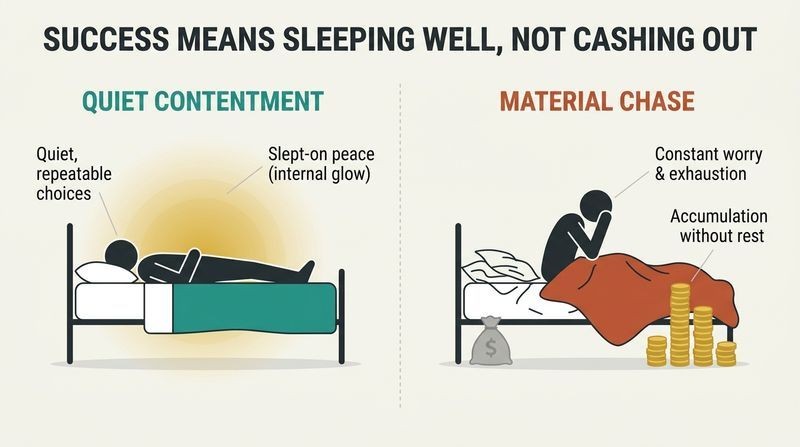
What's striking is Templar's deliberate divorce of success from money, a stance that anticipates the positive-psychology finding that beyond a modest income, wealth barely moves life satisfaction. His "keep quiet" rule aligns with research by Peter Gollwitzer suggesting that announcing identity goals can prematurely satisfy the ego and reduce follow-through. The weakness is methodological: this is one man's observation, not controlled study, and survivorship bias lurks (we notice serene people and assume their calm caused their contentment). Still, framing virtue as a private practice rather than public performance is a useful corrective in an age of curated self-improvement broadcasts.
Accept yourself and your past instead of grinding for perfection
What is done is done. Templar had what he calls a dysfunctional childhood, and for years he stewed in resentment. The shift came when he realized that even if he lined up everyone who had wronged him, there would be nothing they could do to fix it. So he chose to treat the bad things as fuel rather than damage. One sibling never made that choice and was overwhelmed by bitterness.
Accept before you improve. He rejects the New Age command to love yourself as too ambitious. Start smaller: simply accept the warts, weaknesses, and mistakes. You get older but not wiser, just equipped to make fresh mistakes, so be forgiving. Guilt is fine only if it drives action; otherwise dump it, because only good people feel it anyway.
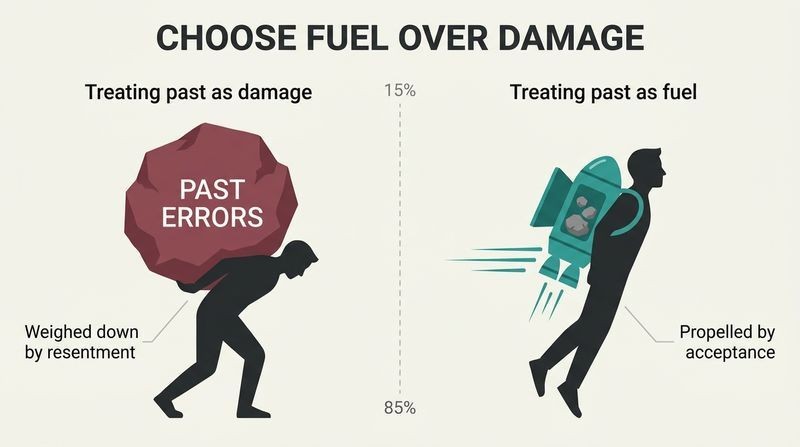
This maps neatly onto Carl Rogers's paradox: "when I accept myself just as I am, then I can change." Self-acceptance as a precondition for growth is now backed by self-compassion research (Kristin Neff), which finds that people who treat themselves kindly after failure recover faster and try harder than self-critics. Templar's reframe of a painful past as identity-forming echoes post-traumatic growth literature. One caveat worth flagging: radical acceptance can shade into complacency without the companion rule of aiming high, and the line between "accept my flaws" and "excuse my flaws" is thin. Templar handles this by pairing acceptance with striving, not replacing one with the other.
You carried the feeling in with you; happiness is generated internally
No object holds the joy. Templar's sharpest thought experiment: when you buy a car that thrills you, where did the maker install that thrill? When you fall in love and light up on seeing your partner, they could fly to the other side of the planet and you would still own the feeling. When you get fired and feel like nothing, that feeling was not printed on the dismissal letter. You brought all of it. People become addicted to buying and infatuation because they mistake the trigger for the source.
Stop mortgaging today to the future. Don't dwell in the past (a room you can visit but no longer live in) or postpone happiness to when you are thinner, richer, or more in love. There is always a next condition. Appreciate the real, present you.
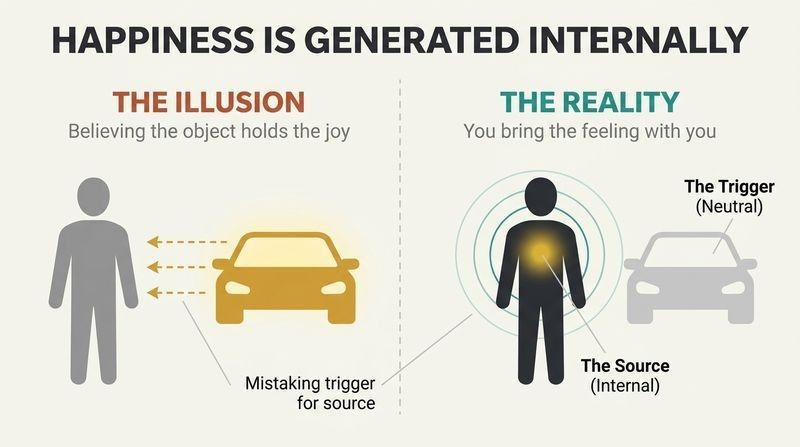
Templar independently arrives at the hedonic-treadmill principle from psychology: humans adapt to gains and losses and drift back to a baseline, which is why lottery winners and accident victims converge over time. His "you brought the feeling with you" framing prefigures cognitive appraisal theory, where events are neutral until we interpret them. The Stoics said it plainly: we are disturbed not by things but by our judgments about them. Where the claim overreaches is in implying circumstances barely matter; chronic poverty, pain, and loneliness genuinely depress wellbeing. The honest version is that within a wide band of ordinary life, interpretation dominates, but the band has real edges.
Be the last to raise your voice; retaliation only escalates
Shouting signals you have lost the argument. Templar confesses he inherited a shouting gene from a loud family, and every time he yells he regrets it, including a proud-then-ashamed tantrum over a broken DVD player. His workaround is simple: walk away rather than slide into a shouting match, and treat "I don't do shouting" as a fixed benchmark. Calm people get trusted, relied on, and promoted.
Buy time with a pause. Count to ten silently, or recite a nursery rhyme, to let the surge of rage subside before you respond. He once faced down a wall of youths threatening to steal his fish and chips by slowly counting to ten and walking straight at them; they turned away. Retaliation, whether against a neighbor's tree or a colleague's theft, provokes counter-retaliation, the whole grim logic of war in miniature.
Neuroscience gives Templar's stopwatch a mechanism. The amygdala hijack described by Daniel Goleman floods the body with adrenaline, and the prefrontal cortex needs a few seconds to reassert control, so a literal ten-count is not folk superstition but physiology. His escalation warning echoes game theory: tit-for-tat only stays productive if someone occasionally forgives, otherwise defection spirals. The children-squabble analogy is apt because sibling conflict compresses the escalation curve into minutes. The subtle point often missed: choosing silence is not weakness or defeat but a power move that keeps the moral high ground and denies the provocateur the reaction they wanted.
Struggle is the design, not a defect; you are not in charge
Only dead fish swim with the stream. Templar argues life is meant to be a series of struggles and lulls, and we should be grateful for the difficulty because it forges strength, growth, and the joy of relief when rain finally stops. He cites the grim statistic that many men die soon after retirement, having stopped swimming against the current.
Life is a pizza with everything on it. You cannot have the pepperoni without the occasional olive you hate; pick it off and enjoy the rest. His children learned they could not reject a whole pizza over one disliked topping. Likewise, accepting that you are not the driver of the runaway train is liberating: stop banging your head against unchangeable walls, focus only on what you can actually change (usually just yourself), and enjoy the show.
Templar fuses Stoic dichotomy of control (Epictetus) with something close to Nietzsche's amor fati, loving your fate rather than merely tolerating it. The retirement mortality claim has real epidemiological support: loss of purpose, routine, and social role correlates with decline, which is why "ikigai" and continued engagement feature in longevity research. The pizza metaphor is a homely version of acceptance in ACT (Acceptance and Commitment Therapy), which teaches that fighting unavoidable discomfort amplifies it. A fair challenge: "you are not in charge" risks fatalism if taken alone, but Templar quarantines it by pairing surrender over outcomes with fierce ownership of your own conduct.
Dedicate your life to something and turn dreams into plans
Write a private mission statement. Templar says the people who know what counts first know what they are dedicating their life to. His own north star came from a line that lodged in him: if your spirit is the only thing you take with you when you die, it should be the best thing you own. He does not broadcast it; a quiet internal yardstick like Disney's "make people happy" is enough to measure how you are doing.
Dreams are unlimited; plans are the machinery. Dream as wildly as you like, since wishes cost nothing, but recognize that a plan is a map with logical steps. Working in casinos, he watched gamblers limit their winnings while refusing to limit their losses. Aim to be the very best at whatever you do, judged by your own standard, because aiming for second best is genuinely sad.
Templar's distinction between boundless dreams and bounded plans dovetails with implementation-intention research: vague aspirations rarely produce action, but specifying when-where-how steps roughly doubles follow-through. His "be your own judge of best" sidesteps the comparison trap while smuggling in accountability, since honest self-assessment tends to be harsher than external grading. The casino anecdote is a vivid illustration of loss aversion and the sunk-cost fallacy operating in real time. One tension: an internally defined standard of "best" could rationalize mediocrity for the self-deceiving, so the rule leans heavily on the intellectual honesty he assumes his reader possesses, arguably the scarcest ingredient in the whole system.
Live the samurai's code: no fear, no surprise, no hesitation, no doubt
Four words from a seventeenth-century swordsman. Templar dedicates the book to Miyamoto Musashi and distills a way of moving through life. No fear means facing what scares you head-on (he white-knuckled across a three-story roof repeating the mantra). No surprise means staying awake, since most shocks left clues we slept through. No hesitation means deciding and moving before the opportunity passes. No doubt means, once committed, you stop rehashing and trust your judgment.
Carry yourself with dignity and stay young. The most content person he met lived frugally yet radiated peace; genuinely successful people have quiet self-esteem and do not need to brag. Dress as if today matters, step outside your comfort zone with small acts of bravery, and keep trying new tastes and places, because staying young is a state of mind, not a birthday.
The Musashi frame gives an aphorism book a spine of martial clarity, and modern performance psychology would recognize each element: exposure therapy for fear, situational awareness for surprise, bias-for-action for hesitation, and commitment-with-confidence for doubt. "Dress like today is important" finds unexpected support in enclothed-cognition studies, where wearing a lab coat measurably improved attention. The comfort-zone rule maps to the concept of eustress, the productive stress that drives growth. The main caution: "no doubt" can curdle into stubbornness, and genuine expertise often requires updating beliefs, so the samurai's certainty is best read as commitment to a chosen path rather than refusal to ever reconsider evidence.
Race your partner to say sorry and aim for contentment over fireworks
Apologize first, for arguing at all. Templar's marriage rule is to be the first to say sorry, not for the specific offense but for having descended into an argument in the first place. Saying sorry costs no dignity; it defuses tension and usually humbles the other into apologizing too. The view from the moral high ground, he notes, beats revenge.
Give space and lower the target. We fall for someone independent, then try to clip their wings out of jealousy; healthy couples stay strong together and strong apart. He also warns against chasing happiness, an unsustainable extreme like the honeymoon rush of chemistry. Contentment is the worthier aim because it lasts. Treat your partner better than your best friend, keep talking, and remember you signed up to dedicate yourself to another person's happiness.
The apology reframe is quietly radical: it decouples "sorry" from admitting factual fault, which is exactly why couples deadlock, each waiting for the other to concede the point. Gottman's marriage research supports the mechanics here, finding that successful couples make and accept "repair attempts" quickly, and that contempt and stonewalling predict divorce. Templar's preference for contentment over ecstatic happiness matches the hedonic-adaptation reality that passionate love neurochemically cannot persist and matures into companionate love. The space-to-be-themselves rule prefigures self-expansion theory, which finds that partners who support each other's independent growth report higher long-term satisfaction than those who fuse identities.
Let your kids fail; there are no bad children, only bad behavior
Freedom to mess up is the curriculum. Templar was given room to screw up spectacularly as a youth and learned fast; a cousin who was over-protected imploded later in life with no resilience built. A parent's job is to stand by with the antiseptic and a kiss, not to prevent every fall, though leading questions ("have you thought this through?") are allowed.
Separate the child from the act. He initially loathed the phrase "a good child who did a bad thing," then adopted the sentiment. Labeling a child bad sets something they cannot change; naming the behavior naughty gives them something they can. He adds that teenagers must fall out with you to leave home, since a child who loved you too much could never break free, and that forgiving imperfect parents (his own mother struggled, his father was absent) frees you to move on.
Developmental psychology strongly backs the fail-forward stance: overparenting, or "snowplow" parenting, correlates with higher anxiety and lower self-efficacy in young adults, because mastery requires struggling through manageable difficulty. The label distinction is essentially Carol Dweck's growth mindset applied to character; praising or condemning fixed traits ("you are bad," even "you are clever") backfires, while targeting behavior keeps identity open to change. The teenage-rupture insight aligns with attachment and individuation theory, where secure separation is a developmental achievement, not a betrayal. The forgiveness rule is generous but has limits worth naming: understanding a parent's constraints does not obligate reconciliation with genuine abuse, a nuance the compact rule cannot fully carry.
Ask "what's in it for them?" and put more back than you take
Win-win beats zero-sum. Templar urges you to step back in any negotiation, at work or over a family holiday, and identify the other person's bottom line, so you get what you want while they feel they gained too. Beneath the surface we are all closer than we think; he cites the claim that huge numbers of Europeans trace back to Genghis Khan, and tells of a man who ranted about immigration until discovering his own father was foreign.
Reinvest in the world quietly. Be for the glory, not the degradation; be part of the solution, using Easter Island (a people who ate through their wildlife and felled every tree) as a warning. Hang out with people who lift you and prune the chronic moaners. Put something back through time and talent, and ask whether history would record that you left the place better than you found it.
The win-win framing is textbook Fisher and Ury (Getting to Yes): shift from positional bargaining to underlying interests and the pie can grow. Templar's "we are all closer than you think" is genetically literal; coalescent theory shows the most recent common ancestor of all living humans is startlingly recent, only a few thousand years back. The advice to curate your social circle has real teeth: the Framingham studies found happiness, obesity, and even loneliness spread through social networks like contagions, so choosing who surrounds you is a legitimate wellbeing intervention. Easter Island as ecological parable is contested by some historians, but its rhetorical force as a lesson in finite resources remains intact.
Happiness is a trainable habit; every barrier to it lives inside you
Judge your life by the long view. Permanent elation is impossible and boring; the real question is not "am I happy right now" but "am I happy overall." A bad day can sit inside a fundamentally good life. Two techniques recur: look from the other direction (a teenage swimmer who came third but felt proud because he "nearly came second"), and spin it by rehearsing the day's good moments each night before sleep, ignoring the negatives.
Stop blaming the job or the partner. Templar insists the obstacles to contentment are internal, so changing your circumstances without changing your outlook just makes you less unhappy, not happy. Do things you are genuinely good at to enter a therapeutic flow state (Csikszentmihalyi's total absorption), keep a support network you actively value, and remember that people who feel in control of their choices are reliably happier.
Templar's nightly gratitude rehearsal is now one of the most empirically validated interventions in positive psychology; Seligman's "three good things" exercise measurably raised happiness and lowered depression for months in controlled trials. "Look from the other direction" is cognitive reappraisal, the reframing skill at the core of CBT and among the most durable predictors of emotional resilience. The internal-locus-of-control claim rests on decades of work since Julian Rotter, consistently linking perceived agency to wellbeing and persistence. The provocative overstatement is that all barriers are internal; systemic constraints are real, and telling someone in genuine hardship that their misery is purely an outlook problem can be both inaccurate and unkind. Read as emphasis rather than absolute, it holds.
Analysis
The Rules of Life belongs to a distinctly British lineage of pragmatic self-help: unpretentious, allergic to New Age uplift, and suspicious of anything it cannot actually do on a Tuesday morning. Templar's method is anthropological rather than clinical. He watched people, sorted the content from the struggling, and reverse-engineered the behaviors that separated them. This is both the book's charm and its epistemological soft spot, since observation without controls cannot distinguish cause from correlation, and the serene may simply have had easier lives. Readers should treat the 116 rules as hypotheses to test, not laws proven.
What elevates the book above a fortune-cookie collection is a coherent philosophy hiding beneath the aphorisms. Strip away the pizza and the fish, and you find a fusion of Stoicism (control what you can, accept the rest, judgments not events disturb us), Japanese martial discipline (the Musashi mantra), and an almost Buddhist emphasis on presence and non-attachment to outcome. The recurring engine is conscious choice: Templar's deepest claim is that most people sleepwalk, and that simply being awake and deliberate, about how you argue, dress, dream, forgive, and spend your attention, is most of the battle.
The framework's greatest strength is its psychological prescience. Written for a general audience, it independently arrives at findings later formalized in positive psychology, CBT, and behavioral economics: hedonic adaptation, cognitive reappraisal, internal locus of control, gratitude practice, loss aversion. Its greatest vulnerability is the individualism that ignores structural constraint; "all barriers are inside you" is empowering for the comfortable and potentially cruel to the genuinely trapped. The wise reading holds two truths at once: circumstances are real, and within them, interpretation and conduct remain the levers you actually control. That, ultimately, is the book's quiet, durable wager.
Review Summary
The Rules of Life by Richard Templar receives mixed reviews. Many readers find it a simple, common-sense guide to living better, with practical advice on personal growth, relationships, and social interactions. Some appreciate its easy-to-read format and inspirational tone, while others criticize it as basic and repetitive. The book is often described as a reminder of universal truths rather than groundbreaking insights. It resonates more with younger readers or those seeking quick, digestible life advice. Overall, reviewers tend to find at least a few useful takeaways, even if they don't agree with all 106 rules.
People Also Read






Glossary
Rules Player
Someone who quietly practices life's rulesTemplar's term for a person who deliberately follows the Rules of Life to become calmer, kinder, and more content. A defining trait is discretion: Rules Players never preach or announce what they are doing, they simply change their own behavior and let results speak. Success for them means contentment and good character, not wealth or status.
No fear, no surprise, no hesitation, no doubt
Samurai four-point code for livingA maxim Templar adapts from seventeenth-century swordsman Miyamoto Musashi as a strategy for life. No fear means confronting what scares you; no surprise means staying alert to the clues life gives; no hesitation means deciding and acting before opportunity passes; no doubt means committing fully and trusting your judgment once the choice is made.
Life is a pizza
Accept bad parts with goodTemplar's metaphor that everything worthwhile comes as a package of desirable and undesirable elements, like a pizza topped with both your favorites and things you dislike. You cannot enjoy the good bits (a job, a partner, a neighbor) without tolerating the bad bits; the mature response is to pick off the olives and relish the rest rather than reject the whole.
Only dead fish swim with the stream
Struggle strengthens; embrace resistanceTemplar's image for why life's difficulties are necessary rather than unfair. A living fish swims against the current and grows stronger for it; only a dead one drifts passively downstream. He frames existence as alternating struggles and lulls, arguing that setbacks forge resilience and that ceasing to strive, as after abrupt retirement, can be dangerous.
Side of the angels, not the beasts
Daily moral choice frameworkTemplar's way of describing the constant small choices between behavior that helps or harms others. Every action affects family, society, and world for better or worse, and being on the side of the angels means consciously choosing the constructive, considerate option. He insists each person must define angel and beast for themselves and never police others' definitions.
Flow
Absorbed, worry-free immersion in activityBorrowed from psychologist Mihaly Csikszentmihalyi, the state of being so fully immersed in a task that you become almost unaware of external events. Templar recommends it as both a happiness generator and a distraction from worry, achieved by doing something you are genuinely good at, where confidence and enjoyment flow naturally.
FAQ
What's "The Rules of Life" about?
- Guiding principles: "The Rules of Life" by Richard Templar is a guide to living a better, happier, and more successful life through a set of guiding principles.
- Personal code: It offers a personal code for navigating life's challenges and opportunities with grace and effectiveness.
- Practical advice: The book provides practical advice on how to improve personal well-being, relationships, and social interactions.
- Life improvement: It aims to help readers get more out of life, shrug off adversity more easily, and generally be a happier, calmer, more fulfilled person.
Why should I read "The Rules of Life"?
- Self-improvement: The book is ideal for anyone looking to improve their life by adopting simple yet effective rules.
- Universal appeal: Its principles are applicable to various aspects of life, including personal growth, relationships, and career.
- Practical guidance: It offers actionable advice that can be implemented immediately to see positive changes.
- Inspirational: The book is designed to inspire readers to live life to the fullest and make the most of every opportunity.
What are the key takeaways of "The Rules of Life"?
- Self-awareness: Understanding and accepting oneself is crucial for personal growth and happiness.
- Relationships: Building and maintaining strong relationships requires effort, understanding, and respect.
- Life balance: Achieving a balanced life involves setting priorities and making conscious choices.
- Continuous learning: Life is a journey of continuous learning and adaptation, and embracing this can lead to fulfillment.
How does Richard Templar define "The Rules of Life"?
- Guiding principles: Templar defines them as guiding principles that help individuals navigate life more effectively.
- Universal truths: They are based on universal truths observed in happy and successful people.
- Practical application: The rules are meant to be practical and applicable to everyday situations.
- Personal choice: They emphasize personal choice and responsibility in shaping one's life.
What are some of the best quotes from "The Rules of Life" and what do they mean?
- "No fear, no surprise, no hesitation, no doubt": This quote emphasizes the importance of confidence and decisiveness in life.
- "Life is a pizza": This metaphor suggests that life comes with both good and bad experiences, and one must learn to enjoy the good while managing the bad.
- "Be the last to raise your voice": This rule highlights the value of maintaining composure and calmness in conflicts.
- "Accept what is done is done": It encourages letting go of past mistakes and focusing on the present and future.
How can "The Rules of Life" help improve my relationships?
- Communication: The book emphasizes the importance of open and honest communication in relationships.
- Respect and understanding: It advocates for respecting differences and embracing commonalities with others.
- Support and encouragement: Encourages being supportive and encouraging to loved ones, fostering stronger bonds.
- Conflict resolution: Offers strategies for resolving conflicts amicably and maintaining harmony.
What does Richard Templar say about handling adversity in "The Rules of Life"?
- Acceptance: Accept what cannot be changed and focus on what can be improved.
- Resilience: Develop resilience by learning from past experiences and using them to grow stronger.
- Perspective: Maintain a positive perspective and see challenges as opportunities for growth.
- Support system: Rely on a support system of friends and family to help navigate tough times.
How does "The Rules of Life" suggest achieving personal happiness?
- Self-acceptance: Accept yourself with all your flaws and strengths.
- Pursue passions: Engage in activities that you are passionate about and that bring joy.
- Balance: Strive for a balanced life that includes work, relationships, and personal time.
- Mindfulness: Practice mindfulness and live in the present moment to fully appreciate life.
What role does self-awareness play in "The Rules of Life"?
- Foundation for growth: Self-awareness is the foundation for personal growth and improvement.
- Understanding emotions: It involves understanding and managing one's emotions effectively.
- Recognizing strengths and weaknesses: Helps in recognizing personal strengths and areas for improvement.
- Informed decisions: Leads to more informed and conscious decision-making in life.
How does "The Rules of Life" address the concept of success?
- Personal definition: Success is defined personally and is not solely about wealth or status.
- Happiness and fulfillment: True success involves happiness and fulfillment in various aspects of life.
- Continuous improvement: It is about continuous improvement and striving to be the best version of oneself.
- Balance and priorities: Success requires balancing different life priorities and making conscious choices.
What are some practical tips from "The Rules of Life" for everyday living?
- Daily reflection: Take time each day to reflect on your actions and thoughts.
- Set goals: Have clear goals and a plan to achieve them.
- Be present: Focus on the present moment and avoid dwelling on the past or future.
- Practice gratitude: Regularly express gratitude for the positive aspects of your life.
How can "The Rules of Life" influence my career?
- Professionalism: Emphasizes the importance of professionalism and dedication in the workplace.
- Continuous learning: Encourages continuous learning and skill development for career advancement.
- Networking: Highlights the value of building strong professional relationships and networks.
- Work-life balance: Stresses the importance of maintaining a healthy work-life balance for long-term success.
About the Author
Other books by Richard Templar





Download PDF
Download EPUB
.epub digital book format is ideal for reading ebooks on phones, tablets, and e-readers.








































