
Key Takeaways
1. The "Efflorescence" of Classical Greece: A Unique Historical Phenomenon
Hellas was great because of a cultural accomplishment that was supported by sustained economic growth.
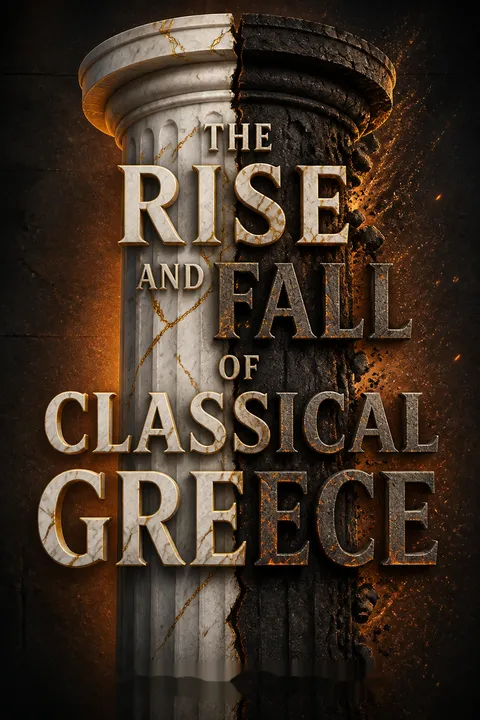
Beyond Byron's lament. Lord Byron, in 1812, mourned Greece as a "sad relic of departed worth," highlighting the stark contrast between its ancient glory and its then-impoverished state. This book explains the mystery of how ancient Greeks created a culture central to the modern world, why it eventually declined politically, and why its legacy endured. The answer lies in a concept called "efflorescence"—a period of increased economic growth accompanied by a sharp uptick in cultural achievement.
Defining efflorescence. Classical Greek efflorescence, peaking around 300 BCE, was characterized by demographic growth, higher levels of per capita welfare, and prolific cultural production. Unlike mere concentrations of state capital or monumental architecture, this efflorescence reflected a broad societal uplift. It was exceptional in premodern history for its duration, intensity, and profound long-term impact on world culture, setting it apart from earlier or later periods of Greek history.
A precocious modernity. This era saw a unique cultural accomplishment supported by sustained economic growth, made possible by a distinctive approach to politics. The Greek world, a social ecology of hundreds of city-states, fostered a substantial middle class that consumed goods and services well above mere subsistence, driving economic expansion. Despite features unlike modernity, such as widespread slavery and limited political rights for women, the most developed Greek states exhibited aspects of a "modernity before the fact."
2. A World of Small, Peer City-States Fostered Competition and Growth
Hellas was a strikingly extensive and long-lived small-state, dispersed authority culture—and it was by far the largest and the longest lived city-state culture in documented world history.
Ants around a pond. Plato's analogy of Greeks living "like ants or frogs around a pond" aptly describes the unique social ecology of ancient Hellas. By the late fourth century BCE, this world comprised approximately 1,100 city-states (poleis) stretching across the Mediterranean and Black Seas, from Spain to North Africa and Western Asia. These states, though varying greatly in size from tiny Koresia (15 km²) to vast Syracuse (12,000 km²), interacted as peer polities, fostering a dynamic environment.
Geographic advantages. The mountainous, coastal geography of Greece, with its diverse microclimates and unevenly distributed resources, naturally encouraged specialization and trade. This fragmented landscape made large-scale imperial consolidation difficult, unlike the great river systems of Mesopotamia or Egypt. The ease of sea travel further facilitated exchange, weaving a complex network of cultural communication and economic interdependence among the poleis.
A shared, yet diverse, culture. Despite regional differences, Greek poleis shared a common language, religion, architectural styles, and military practices (like hoplite warfare and triremes). This shared cultural foundation lowered transaction costs for interstate exchange and learning, while local variations created opportunities for specialized production. This unique combination of extensive small-state culture and shared identity was a critical backdrop for the efflorescence.
3. Decentralized Cooperation: The Puzzle of How Greece Thrived Without Central Authority
How can a system in which authority is dispersed create adequate opportunities for cooperation at scale, redistribute the fruits of cooperation in ways that promote stability, and thereby accumulate resources sufficient to preserve itself over time?
Hobbes' challenge. The persistence and flourishing of the Greek city-state system posed a fundamental challenge to theories of social order, particularly Thomas Hobbes' assertion that cooperation at scale is impossible without a centralized, coercive authority. Unlike empires like Persia or Rome, Hellas lacked a single ruler or unified command structure, yet it avoided a "war of all against all" and achieved remarkable collective goods.
Aristotle's "political animals." Aristotle, building on Plato's analogy, saw humans as the most "political animals" due to their unique capacity for reason and complex language, enabling them to produce public goods through cooperative social action. He argued that human flourishing (eudaimonia) required living in a well-functioning polis, where individuals acted for the common good, guided by justice in both production and distribution.
Beyond genetic kinship. While ants cooperate due to genetic kinship and simple information exchange, human cooperation in the polis was more complex. It relied on:
- Fictive kinship ideologies: Like Athens' myth of Earth-born ancestors.
- Small-group dynamics: Local monitoring in demes and tribes.
- "Altruistic punishment": Individuals willing to sanction free-riders.
- Existential threats: Constant inter-polis conflict incentivized internal cohesion.
This blend of motivations, coupled with sophisticated information exchange, allowed Greeks to achieve complex collective goals without a master.
4. Fair Rules and Open Competition Fueled Unprecedented Economic Growth
Fair rules (formal institutions and cultural norms) promoted capital investment (human, social, material) and lowered transaction costs.
The engine of efflorescence. The exceptional economic performance of classical Hellas stemmed from its distinctive political institutions and civic culture. These "fair rules" — formal institutions and social norms that ensured relatively equal standing for many within society — fostered capital investment and significantly lowered transaction costs, driving continuous innovation and learning. This was a limited form of opportunity egalitarianism, primarily for adult male citizens.
Incentives for investment. Rule egalitarianism, by protecting individuals' security, property, and dignity, reduced the fear of arbitrary expropriation by the powerful. This incentivized individuals to invest in specialized skills and knowledge, deferring short-term gains for long-term rewards. For example, Solon's reforms in Athens, by forbidding enslavement for debt and encouraging skill development, spurred Athenians to move beyond subsistence agriculture into more lucrative endeavors.
Lowering transaction costs. Fair rules also dramatically reduced the costs associated with economic exchanges. Standardized weights, measures, and coinage, along with impartial legal mechanisms for dispute resolution (like Athens' commercial courts), made trade more predictable and less risky. This environment, where information was more equally accessible and institutional support reliable, fostered a vibrant market-based economy and encouraged widespread specialization.
5. From Crisis to Citizen-Centered States: Early Reforms in Sparta and Athens
The Lycurgan reforms created a strong and unusually broad-based “natural state” ruled by an extensive and stable coalition of citizens.
Post-collapse innovation. The collapse of Mycenaean civilization (c. 1200 BCE) and the subsequent Early Iron Age created a vacuum, allowing for new forms of social organization. The widespread availability of cheap iron weaponry made it difficult for elites to monopolize violence, empowering ordinary men. This led to the emergence of citizen-centered states, where collective action and morale were crucial for survival in an era of endemic inter-community conflict.
Sparta's military specialization. Facing internal revolts and external threats, Sparta adopted the "Lycurgan reforms" (7th-6th century BCE), creating a unique system of citizen-soldiers. Spartans hyperspecialized in warfare, supported by the labor of state-owned helots. This system, enforced by terror and mutual monitoring, ensured a formidable army and allowed Sparta to dominate the Peloponnese for two centuries, albeit at the cost of economic diversification and openness.
Athens' path to openness. Athens, by contrast, faced a crisis of debt and social fragmentation in the early 6th century BCE. Solon's reforms (594 BCE) cancelled debts, forbade enslavement of Athenians, and established civic rights, laying the groundwork for a broad citizenry. Cleisthenes' reforms (508 BCE) further democratized Athens, creating a federalist deme-tribe system that fostered trust, widened social networks, and enabled collective decision-making, leading to Athens' rapid rise as a naval power.
6. Athens' Democratic Empire: A Golden Age of Innovation and Wealth
Political liberation resulted, in Herodotus’ assessment, not in a cascade of free riding, but in the coherent collective military action that defeated the Spartan coalition.
The democratic advantage. Herodotus observed that after deposing its tyrants, Athens' military capability surged, attributing this to "equality of public speech" and citizens' eagerness to achieve for themselves. This democratic dynamism was evident in Athens' victories against Persia at Marathon (490 BCE) and Salamis (480 BCE), fueled by a massive citizen-navy and a willingness to invest public funds in defense.
Empire as economic engine. The Delian League, initially an anti-Persian alliance, transformed into an Athenian empire, providing security against pirates and fostering a vast, integrated market. Athens imposed standardized weights, measures, and coinage, and invested heavily in infrastructure like the Piraeus harbor. This lowered transaction costs across the Aegean, benefiting both Athens and its subjects, and driving unprecedented economic growth and specialization.
Cultural and institutional flourishing. The wealth generated by the empire funded Athens' "Golden Age," producing iconic art, architecture (e.g., the Parthenon), literature, and philosophy. The democratic system, with its federalist structure, citizen councils, and accountability mechanisms like ostracism, fostered collective wisdom and effective policy-making. This era demonstrated how a citizen-centered state could leverage dispersed knowledge and competitive elites to achieve remarkable economic and cultural heights.
7. The Post-Imperial Paradox: Disorder and Continued Efflorescence
Indeed, there was even more confusion and disorder in Greece after the battle than before.
Beyond the Peloponnesian War. The defeat of Athens in the Peloponnesian War (404 BCE) and the subsequent century of shifting hegemonies (Sparta, Thebes) and endemic conflict might suggest decline. Yet, contrary to contemporary observers like Xenophon, the fourth century BCE marked the apex of classical Greek efflorescence. This period saw continued economic growth, cultural production, and institutional innovation, even amidst political fragmentation.
Athenian resilience and innovation. Athens, despite losing its empire, quickly recovered. It refined its democracy with new legal codes, distinguishing fundamental laws from assembly decrees, and establishing mechanisms to ensure accountability and prevent rash decisions. Crucially, Athens opened access to its legal and market institutions for non-citizens, attracting traders and boosting indirect tax revenues, demonstrating a flexible and adaptive approach to governance.
Federalism and Hellenization. Across Greece, federal leagues like those in Achaea and Aetolia matured, offering a balance between local autonomy and regional strength. These leagues fostered economic integration and security, promoting specialization. Simultaneously, the Greek cultural zone expanded, with non-Greek elites in regions like Anatolia and the Black Sea adopting Hellenic institutions and practices, creating new markets and further integrating the broader Greek world.
8. The Rise of Macedon: Greek Expertise Turned Against Itself
Philip took you over when you were helpless vagabonds, mostly clothed in skins, feeding a few animals on the mountains and engaged in their defense in unsuccessful fighting with Illyrians, Triballians, and the neighboring Thracians.
Philip, the ultimate opportunist. Philip II of Macedon, a "Hellenized dynast" from the fringes of the Greek world, emerged as the most successful of the "opportunists" who selectively borrowed from Greek culture and institutions. Unlike earlier Persian invaders, Philip's success stemmed from his ability to appropriate and enhance Greek military and administrative expertise, turning it against the very city-states that had pioneered it.
Military and financial genius. Philip transformed Macedon from a weak, feudal state into a formidable power by:
- Military reforms: Developing the sarissa (long pike) and integrating cavalry, light, and heavy infantry into a highly trained, disciplined army.
- Resource exploitation: Gaining control of rich gold and silver mines (Philippi), dramatically increasing state revenues.
- Financial sophistication: Minting high-quality coinage and employing Greek financial experts (like Callistratus) to optimize state income.
These innovations gave Macedon a decisive advantage over the Greek city-states, whose military and financial systems, while advanced, were not designed for the scale and centralized control Philip commanded.
The fall at Chaeronea. Philip's victory at Chaeronea in 338 BCE against a coalition of Athens and Thebes marked the end of the era of independent Greek city-state dominance. His subsequent formation of the League of Corinth, with himself as hegemon, effectively brought mainland Greece under Macedonian control. This political fall was not due to Greek decline, but to Philip's superior leadership, strategic vision, and masterful application of specialized knowledge, much of it derived from Greek innovations.
9. Immortality Through Creative Destruction: How Greek Culture Endured Beyond Political Fall
The political fall of classical Greece proved, in short, to be yet another example of creative destruction, rather than a ruinous destruction leading to quick economic and cultural collapse.
A partial fall, not total ruin. The political fall of classical Greece, marked by Macedonian conquest, was not an abrupt end to its efflorescence. Instead, it was a process of "creative destruction." While the major city-states lost full independence, many Hellenistic poleis retained significant autonomy, and the multi-state ecology persisted under the new Macedonian dynasts. This partial independence allowed Greek institutions and culture to adapt and continue flourishing.
Hellenistic efflorescence. The Hellenistic era (323 BCE - 2nd century BCE) saw continued economic growth and cultural production, building upon the classical heritage. New advances were made in historiography, drama, philosophy, science, and architecture, often in new cultural centers like Alexandria, Pergamum, and Antioch, which functioned as poleis with their own laws and citizens. This sustained efflorescence ensured that Greek achievements were not lost to history.
The path to immortality. The resilience of Greek cities, hardened by centuries of institutional and technical innovation (democracy, federalism, military architecture), allowed them to negotiate favorable terms with Hellenistic kings. This, combined with the Roman Empire's eventual embrace and dissemination of Greek culture, ensured its "immortality." Greek learning, preserved by Byzantines and Arabic scholars, was re-exported to the West during the Renaissance, cementing its enduring legacy.
Review Summary
The Rise and Fall of Classical Greece receives mixed reviews averaging 3.93/5 stars. Readers praise Ober's innovative use of economics, game theory, and quantitative data to explain Greek prosperity, with many appreciating his thesis that decentralized democracy and citizen-centered governance fostered unprecedented efflorescence. However, critics question his methodology, citing unreliable ancient statistics, neoliberal bias, and overly academic language. Some find the theoretical opening chapters difficult, preferring the historical narrative sections. Scholars debate whether his data supports causation claims and whether comparisons to modern democracies are appropriate. Most agree the interdisciplinary approach is ambitious and thought-provoking, though execution varies in convincingness.
People Also Read

About the Author
Download PDF
Download EPUB
.epub digital book format is ideal for reading ebooks on phones, tablets, and e-readers.








































