

Key Takeaways
Jung's most important work was hidden for nearly a century
A secret book behind all of Jung's ideas. Between 1913 and 1930, C.G. Jung conducted what he called his "confrontation with the unconscious" — deliberately evoking waking fantasies, entering them like dramas, and recording the results. He wrote these visions in private Black Books, then transcribed them in calligraphic script into a red leather folio he titled Liber Novus, adorning it with his own paintings. The work was not published until 2009, nearly fifty years after his death.
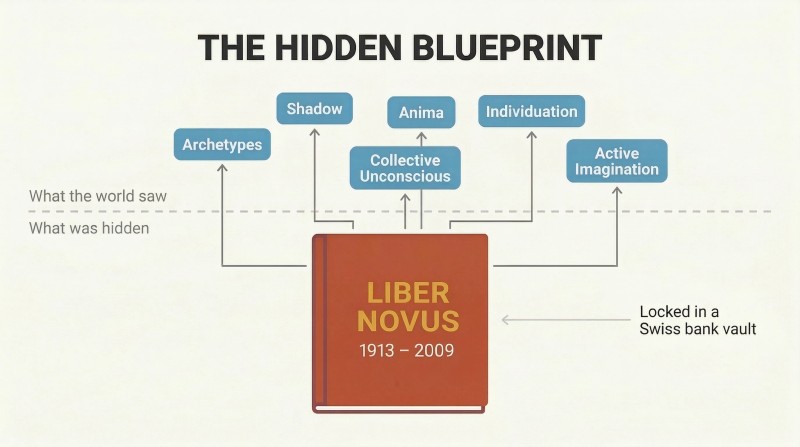
Every major Jungian concept originated here. The collective unconscious, archetypes, individuation, active imagination, the anima, the shadow — Jung traced all of these to what erupted from his psyche during these sixteen years. The Red Book is the molten core from which his entire psychology crystallized. Without it, scholars had been interpreting an edifice while the blueprint sat locked in a Swiss bank vault.
At forty with every success, Jung lost the only thing that mattered
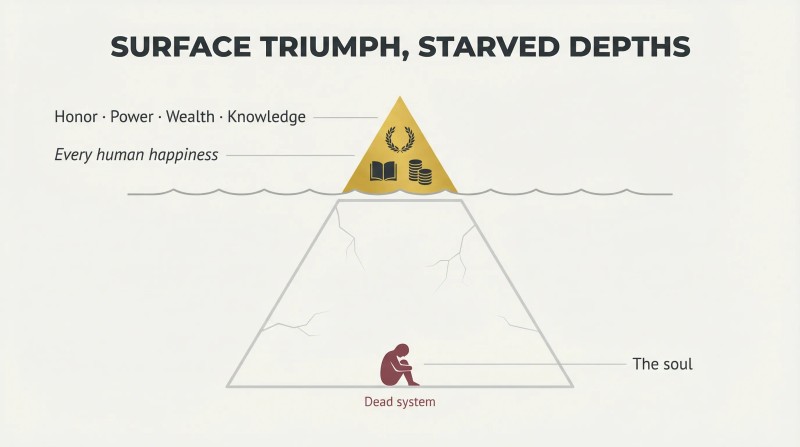
Worldly triumph became spiritual drought. In 1913, at age thirty-eight, Jung had achieved honor, power, wealth, knowledge, and "every human happiness." Then something collapsed. He realized he had spent years serving what he calls the spirit of the times — use, value, achievement — while neglecting his soul entirely. He had turned the soul into a "dead system," a scientific object. His ego had been fed; his depths had starved.
The descent began with dreams he couldn't interpret. Visions of Europe drowning in flood and blood haunted him. He feared psychosis. Only the outbreak of World War I in August 1914 convinced him these weren't signs of personal madness but precognitions of collective catastrophe. This realization gave him the courage to continue recording what the depths revealed — and to compile the Red Book itself.
Below your reason lives a spirit you cannot outthink or outrun
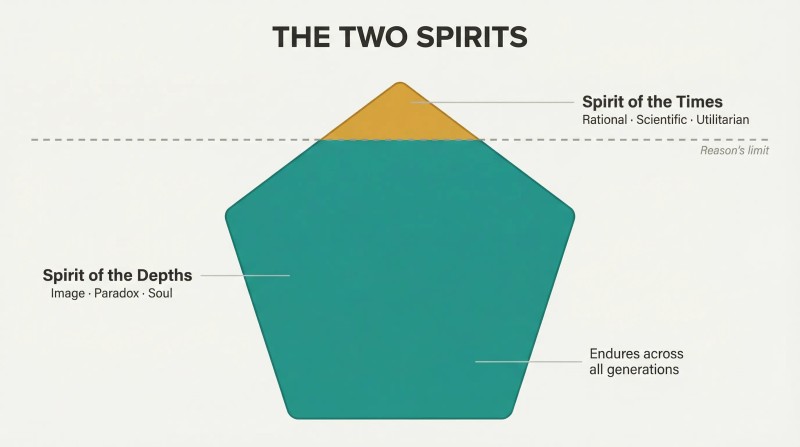
Two spirits compete for your allegiance. Jung distinguishes the spirit of the times — rational, utilitarian, scientific — from the spirit of the depths, which leads to "the things of the soul" and operates through image, paradox, and nonsense. The spirit of the times told Jung his visions were madness. The spirit of the depths told him they were reality. Jung discovered the deeper spirit possesses greater power, since it rules across all generations while the spirit of the times shifts with each era.
Reason alone kills what it touches. Jung found that scholarly explanation of his inner experiences destroyed their living quality — "like someone who tried to understand a Gothic cathedral under its mineralogical aspect." The spirit of the depths demanded he swallow what his intellect found revolting: the small, the banal, the inglorious. Only by accepting what reason hates most — simplemindedness, paradox, meaninglessness — could he access what reason cannot reach.
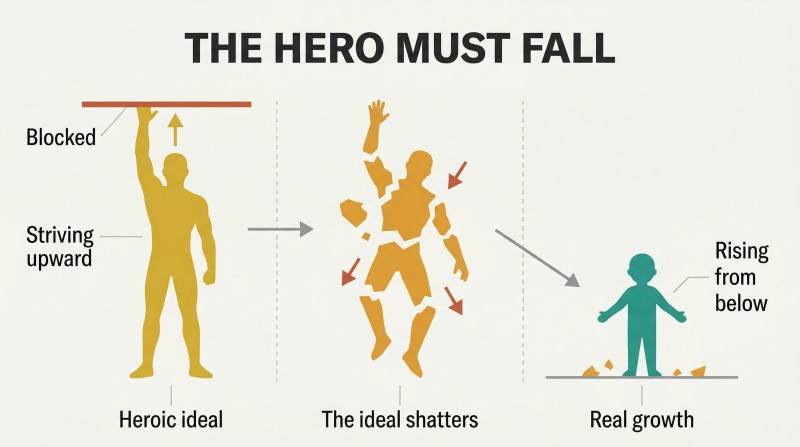
Your hero ideal must die before real growth can begin
Jung dreamed of assassinating Siegfried. In a pivotal vision, Jung and a companion ambushed the blond Germanic hero on a mountain pass and shot him dead. Jung woke in torment, feeling he must kill himself if he couldn't solve the riddle. The answer: Siegfried represented his own heroic ideal — efficiency, willpower, the drive toward solar heights. That ideal had to be murdered because it blocked access to the deeper self.
Perfection is the enemy of wholeness. The hero strives only upward, demanding imitation. But imitation prevents you from living your own life. Jung argues the time of hero-worship has passed: "The new God laughs at imitation and discipleship." When the hero falls, something terrifying happens — the sun of the depths rises, serpents swarm, and chaos erupts. But from this chaos, the divine child is born. Growth requires descending into your own incapacity, not ascending toward someone else's perfection.
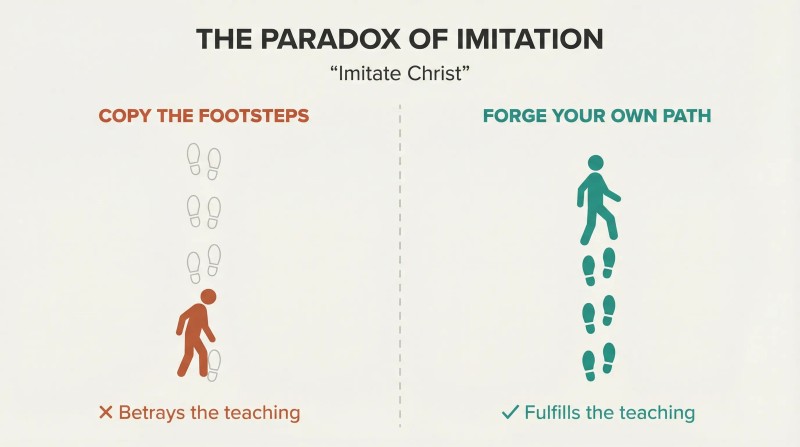
True imitation of Christ means refusing to imitate anyone
Christ lived his own life — that's the lesson. Jung takes Thomas à Kempis's Imitation of Christ and inverts it. Christ didn't follow a model. He lived his unique path to its end, including crucifixion. Therefore, genuinely imitating Christ means doing what he did: forging your own unprecedented way, not copying his. The moment you follow Christ's specific footsteps rather than his principle, you've betrayed the teaching.
No teacher, no law, no savior walks your road. Jung is explicit: "My path is not your path, therefore I cannot teach you." Giving laws, making things easier, preaching to others — all of this has "become wrong and evil." The signposts have fallen, unblazed trails lie ahead. Each person must find what grows from their own soil rather than harvesting from foreign fields. Living by example means the example lives, not you.
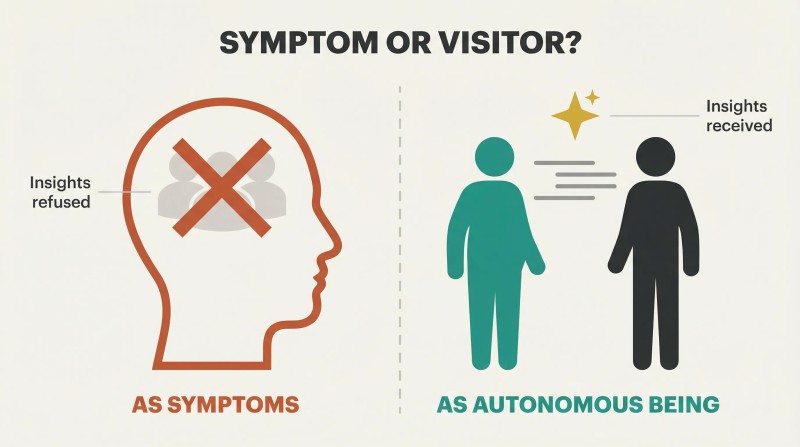
Engage your inner figures as autonomous beings, not symptoms
Jung developed a practice called active imagination. He would deliberately quiet his rational mind, allow fantasy images to emerge, then enter the scene as a participant — speaking with the figures, arguing, asking questions. The key: treat these characters not as projections of your ego but as independent visitors with their own knowledge and agenda. A figure named Philemon became Jung's inner teacher, conveying insights Jung's conscious mind could never have produced.
Philemon taught psychic objectivity. Through conversations with this wise old man in his garden, Jung learned the critical distinction: thoughts are not your possessions. They exist in you like trees exist in a forest — alive, independent, not manufactured by your will. Elijah, Salome, the Red One, Izdubar — each figure carried truths Jung needed. Dismissing them as hallucinations would have been, in his framework, like refusing mail because you don't recognize the handwriting.
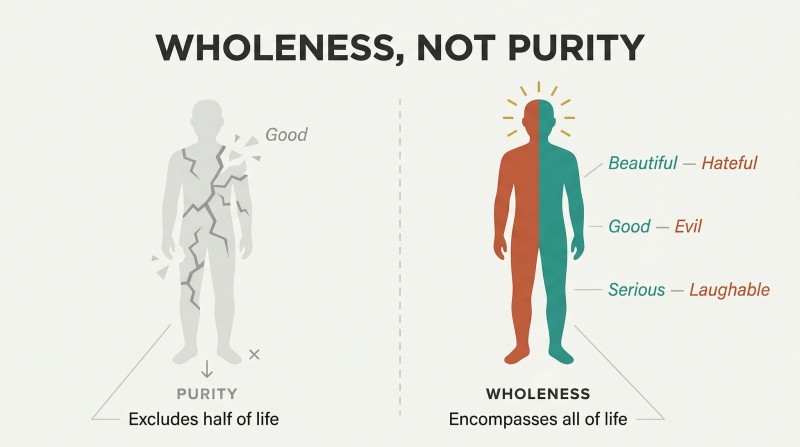
Your new God must be born from ambiguity, not from purity
Jung's visions birthed a God that horrified him. The divine child that emerged from his psyche was not pure light but "hateful-beautiful, evil-good, laughable-serious." In the Sermones to the dead, Philemon teaches about Abraxas — a God above the Christian God and the Devil, who encompasses both. Abraxas is "effect in general," the creative-destructive totality of life that no moral category can contain.
Unequivocalness leads to death. Jung insists that a one-sided God — purely loving, purely good — cannot sustain real life. Christ himself had to descend into Hell after the crucifixion. The new divine image unites opposites: "As day requires night and night requires day, so meaning requires absurdity and absurdity requires meaning." The goal isn't choosing good over evil but achieving the wholeness that holds both in tension, like walking — requiring both left foot and right.
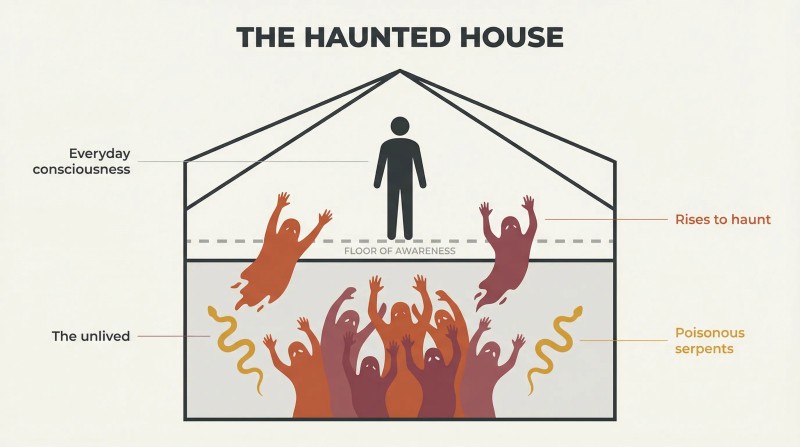
What you leave unlived becomes the ghost that haunts your house
The dead besieged Jung's home. In a striking 1916 episode, Jung's house filled with an eerie atmosphere — his children had nightmares, his doorbell rang with no one there. The dead appeared in his visions, crying: "We have come back from Jerusalem, where we did not find what we sought." These were souls who had died incomplete, their unlived potential still restless. Jung wrote the Seven Sermons to the Dead in three feverish evenings to answer their demands.
The unlived doesn't simply vanish — it festers. What you repress, avoid, or deny doesn't disappear but degenerates underground. Your unused capacities become "poisonous serpents." The dead — your own discarded possibilities and those of human history — crowd behind the everyday wall of your consciousness. Jung argued that every person carries unlived life that demands fulfillment, and that refusing this demand creates the very torment people project onto their neighbors and enemies.
Declare the sacred overwhelming — then carry it as living fantasy
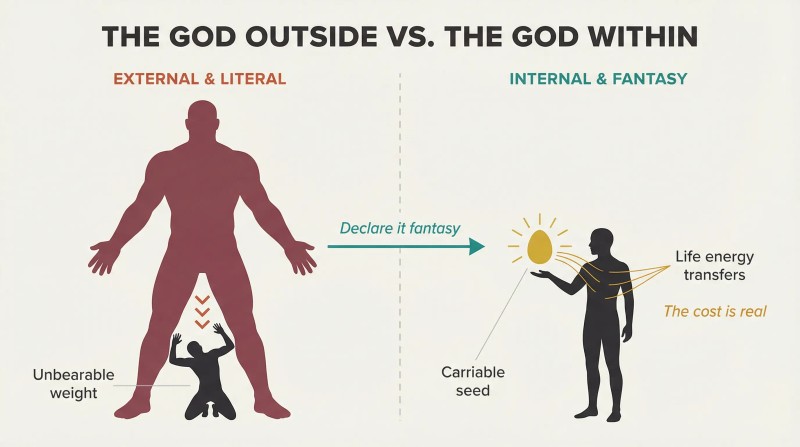
Jung healed a giant by shrinking him into an egg. When the ancient God-hero Izdubar was paralyzed by contact with modern scientific knowledge, Jung found an ingenious solution: he persuaded Izdubar to accept being called a fantasy. This made the giant lighter than air — Jung could carry him in his pocket. Rather than killing the God, declaring him "merely" a fantasy saved him, because fantasy is psychically real and workable.
The paradox reverses St. Christopher's burden. Christopher staggered under the Christ child's weight because the God remained external and literal. Jung discovered the opposite principle: internalize the divine as a living image, and what was crushing becomes light. The God then incubated within Jung like a seed in an egg, eventually bursting forth transformed — "completely sun." The cost was real: Jung felt drained, powerless, as if all his life force had passed into the reborn God. Birth is never free.
The real test of everything: bearing solitude with your naked self
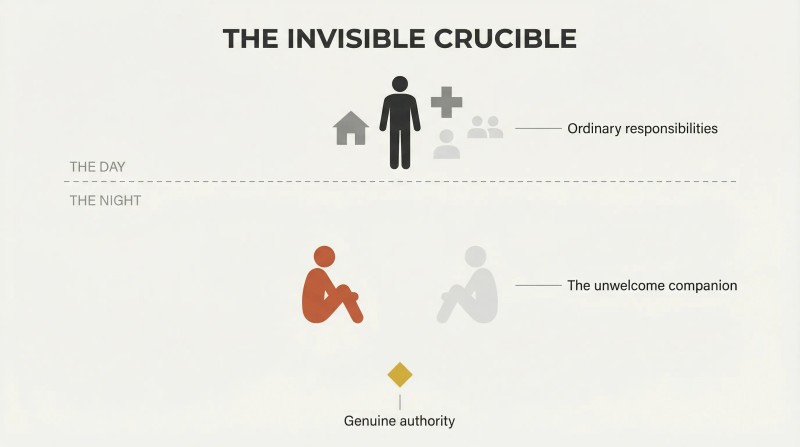
After the God ascended, Jung was left with his I. When the divine vision departed, Jung found himself alone with the most unwelcome companion imaginable: his ordinary, flawed, embarrassing human self. Not the grand visionary — just a barbarian requiring "barbaric means of education." He compares the process to medieval purgatory: cataloguing his own vanity, cowardice, resentment, and self-deception, then ruthlessly confronting each one.
Solitude is not retreat but crucible. Jung maintained his family life, his medical practice, and his military service throughout his years of inner turmoil. The descent happened at night; the day belonged to ordinary responsibilities. But the decisive work occurred alone — no teacher, no community, no external validation. As Philemon, his inner guide, taught through paradox and silence rather than doctrine: the magician's real power is invisible, and the only genuine authority comes from having endured your own depths without flinching.
Analysis
The Red Book's 2009 publication was arguably the most consequential event in Jung scholarship since his death in 1961. It revealed that analytical psychology — the collective unconscious, archetypes, individuation, active imagination — emerged not from clinical observation or scholarly synthesis but from a deliberate, terrifying plunge into psychosis-adjacent experience. The polished theoretical edifice of the Collected Works turns out to be a translation of molten, mythological material that Jung himself called 'fiery, molten basalt.'
This changes how we must read Jung. His concepts are not detached hypotheses but hard-won survival strategies. The anima is not an abstract construct; it is Salome, blind and dangerous, demanding love. The shadow is not a textbook category; it is the murdered child whose liver must be eaten. The theoretical coolness of Jung's published works now reads as an extraordinary act of containment — the scholarly equivalent of building a nuclear reactor around a meltdown.
The work occupies a position that remains genuinely unprecedented. It is neither literature nor philosophy nor psychology nor religion, but a deliberate fusion that challenges the post-Enlightenment segregation of these domains. Jung wrote it at the precise historical moment — between 1913 and 1930 — when such boundaries were still porous, when Kandinsky painted apocalyptic visions, Hugo Ball invented Dada, and Yeats composed cosmologies from automatic writing. The Red Book belongs to this modernist ferment, but unlike its contemporaries, it was withdrawn from public view before it could influence its own era.
Perhaps most striking is the central paradox: Jung documented a process he explicitly declares cannot be imitated, then spent forty-five years translating it into a teachable therapeutic system. The Red Book insists 'my path is not your path' — yet it became the hidden blueprint for millions of analysands' journeys. This tension between the radically singular and the universally applicable is the book's deepest gift and its most unresolved challenge.
Review Summary
The Red Book is a deeply personal and profound work by Jung, documenting his psychological journey and encounters with the unconscious. Readers find it both challenging and transformative, praising its artistic beauty and psychological insights. Many consider it Jung's most important work, offering a unique glimpse into his mind and the development of his theories. The book's publication after decades of secrecy has been hailed as a significant event in psychology and spirituality. Some readers struggle with its complex symbolism and unconventional format but appreciate its profound impact on their understanding of the psyche.
Glossary
Spirit of the depths
The irrational psychic layerJung's term for the ancient, mythopoeic dimension of the psyche that operates through images, paradox, and the inexplicable. It opposes the 'spirit of the times' (rational, utilitarian consciousness) and possesses greater power across generations. It demands acceptance of what reason finds repulsive—the small, the absurd, the banal—and leads to the soul's own knowledge.
Spirit of the times
Rational contemporary consciousnessJung's term for the prevailing rational, scientific, utilitarian mode of thinking that governs how people navigate everyday life. It values use, achievement, and logical explanation. While necessary, it blinds people to the deeper currents of the psyche and must be temporarily set aside to access the spirit of the depths.
Active imagination
Deliberate waking fantasy techniqueJung's method of deliberately quieting rational consciousness, allowing spontaneous fantasy images to arise, then entering the fantasy as a participant—holding dialogues with figures, observing scenes, and recording everything. Distinguished from passive daydreaming by its intentional quality and from dream analysis by occurring in a waking state. Jung considered it the core technique underlying the Red Book's creation.
Pleroma
Undifferentiated fullness and nothingnessA Gnostic term Jung adopts in the Seven Sermons to the Dead to designate the state of absolute totality where all opposites cancel out—neither existing nor not existing, containing all qualities and therefore none. It is both the beginning and end of creation. Humans are parts of the Pleroma yet distinct from it through differentiation. Striving toward nondifferentiation means dissolution into the Pleroma—the death of the creature.
Abraxas
God uniting all oppositesIn the Seven Sermons to the Dead, the God above both the Sun God (goodness) and the Devil (emptiness). Abraxas is 'effect in general'—the creative-destructive totality of life that encompasses both poles. He is neither good nor evil but the force of becoming itself. Jung adopted the term from Gnostic tradition, where Basilides used it for the supreme deity whose numerical value was 365.
Principium individuationis
Principle of becoming distinctBorrowed from Schopenhauer and applied by Jung to describe the essential nature of created beings: the drive toward differentiation from the undifferentiated Pleroma. In the Seven Sermons, it is declared the creature's very essence. Failure to differentiate means dissolution into nothingness. This concept evolved into Jung's mature theory of individuation—the process of becoming one's complete, unique self.
Philemon
Jung's inner wise guideA figure who appeared in Jung's active imaginations, initially as a winged old man with bull's horns and kingfisher's wings. Named after the mythological host of the Gods from Ovid's Metamorphoses. Philemon taught Jung 'psychic objectivity'—that inner figures possess autonomous reality independent of the ego. He delivered the Seven Sermons to the Dead and represented superior insight. Jung considered him a guru-like presence distinct from his own personality.
Supreme meaning
Bridge between meaning and absurdityJung's term for the path or bridge to what is to come—the 'God yet to come.' It is neither pure meaning nor pure absurdity but their fusion: 'image and force in one, magnificence and force together.' It is the beginning and end, the way across. When meaning becomes too rigid it dies; when absurdity overwhelms, chaos reigns. The supreme meaning rises from the collision of both, perpetually renewed.
FAQ
What's The Red Book: Liber Novus about?
- Exploration of the Unconscious: The Red Book is a detailed account of C.G. Jung's exploration of his unconscious mind through "active imagination," a method he developed to engage with inner images and fantasies.
- Personal Journey: It documents Jung's personal journey of self-discovery, where he confronts archetypal figures and themes such as the soul, God, and existence, reflecting his spiritual and psychological development over sixteen years.
- Cultural Context: Set against early 20th-century cultural upheaval, the book connects individual psychological experiences with broader existential questions and collective cultural phenomena.
Why should I read The Red Book: Liber Novus?
- Understanding Jung's Psychology: The book provides essential insights into Jungian psychology, including concepts like the collective unconscious and individuation, serving as a key to understanding his later theories.
- Literary and Artistic Value: It is not only a psychological text but also a work of art, featuring Jung's illustrations and calligraphy, offering a rich, immersive experience.
- Personal Growth: Engaging with Jung's inner journey can inspire readers to explore their own unconscious, fostering personal growth and self-discovery.
What are the key takeaways of The Red Book: Liber Novus?
- Individuation Process: Jung emphasizes the importance of integrating different aspects of the self to achieve wholeness, stating, "The self is the principle and archetype of orientation and meaning."
- Role of the Unconscious: The book illustrates how the unconscious influences thoughts, feelings, and actions, often in unrecognized ways, with dreams paving the way for life.
- Embracing Duality: Jung explores the necessity of embracing both light and dark aspects of the psyche, suggesting true understanding comes from acknowledging human complexity.
What are the best quotes from The Red Book: Liber Novus and what do they mean?
- "The supreme meaning is the path...": This highlights the idea that understanding one's purpose and direction in life is essential for personal growth and transformation.
- "You should all become Christs.": Jung challenges readers to embody Christ-like qualities, suggesting true spiritual development requires personal sacrifice and integration of divine potential.
- "The spirit of the depths is ungodly...": This emphasizes the need for balance between societal influences and deeper, often darker, aspects of the psyche.
How does Jung define the concept of the Self in The Red Book: Liber Novus?
- The Self as Wholeness: Jung describes the Self as the totality of the psyche, encompassing both conscious and unconscious elements, representing the integration of various personality aspects.
- Symbolic Representation: The Self often manifests through symbols and archetypes in dreams and visions, guiding individuals toward self-discovery.
- Path to Individuation: The Self is central to individuation, where individuals strive to become their true selves, allowing for personal growth and reconciliation of inner conflicts.
What is the method of "active imagination" described in The Red Book: Liber Novus?
- Engaging with Inner Images: Active imagination is a technique Jung developed to explore the unconscious by engaging with inner images and fantasies, allowing dialogue with the unconscious.
- Creative Expression: Jung encouraged creative expression, such as writing or painting, to facilitate this process, believing diverse images amplify one another.
- Integration of Experiences: The goal is to integrate insights from these dialogues into conscious awareness, fostering personal growth and self-understanding.
How does The Red Book: Liber Novus address the theme of duality?
- Embracing Opposites: Jung emphasizes the need to embrace both light and dark aspects of the psyche, illustrating the complexity of human nature.
- Integration for Wholeness: The integration of opposites is essential for achieving psychological wholeness, with the spirit of the depths teaching this mystery.
- Cultural Reflection: Jung's exploration of duality reflects broader cultural themes, suggesting societal values often overlook the unconscious's importance.
What role do archetypes play in The Red Book: Liber Novus?
- Universal Symbols: Archetypes are innate, universal symbols residing in the collective unconscious, influencing human behavior and experiences.
- Guiding Forces: They serve as guiding forces in the individuation process, helping individuals navigate their inner worlds and connect with the broader human experience.
- Transformation and Healing: Engaging with archetypes can lead to transformation and healing, representing unresolved issues or potential growth areas.
How does The Red Book: Liber Novus relate to Jung's later works?
- Foundation of Jungian Concepts: The book serves as the foundation for many of Jung's later theories, including the collective unconscious and archetypes, providing a narrative context for his ideas.
- Influence on Analytical Psychology: The themes and experiences documented directly influenced Jung's development of analytical psychology, particularly his understanding of individuation.
- Interconnectedness of Ideas: Jung's later writings often reference experiences and symbols from The Red Book, illustrating how early explorations shaped his scholarly contributions.
What is the significance of the "soul" in The Red Book: Liber Novus?
- Representation of the Inner Self: The soul symbolizes deeper aspects of the self often neglected or repressed, emphasizing the need to reconnect for wholeness and understanding.
- Dialogue with the Soul: Jung engages in dialogue with his soul, illustrating its importance in the individuation process and the necessity of nurturing this connection.
- Source of Wisdom: The soul is portrayed as a source of wisdom and guidance, offering insights that transcend rational thought, suggesting true understanding comes from within.
How does The Red Book: Liber Novus depict the relationship between the individual and society?
- Critique of Conformity: Jung critiques societal norms and the pressure to conform, suggesting true individuality requires breaking away from collective expectations.
- Importance of Personal Journey: The text emphasizes the significance of the personal journey in relation to societal values, highlighting the need for self-discovery.
- Collective Responsibility: Jung acknowledges the interconnectedness of individuals within society, suggesting personal growth contributes to collective well-being.
How does The Red Book: Liber Novus explore the relationship between humanity and the divine?
- Divine Presence in the Unconscious: Jung posits that the divine is present within the unconscious, influencing human behavior and experiences.
- Unity of Opposites: The book emphasizes the unity of opposites, where the divine encompasses both good and evil, suggesting a broader understanding of divinity.
- Personal Experience of the Divine: Jung encourages seeking personal experiences of the divine rather than relying solely on external religious structures, highlighting personal engagement's importance.
About the Author
Other books by C.G. Jung
Download PDF
Download EPUB
.epub digital book format is ideal for reading ebooks on phones, tablets, and e-readers.








































