
Key Takeaways
1. The Pyramid Structure is Essential for Clear Communication
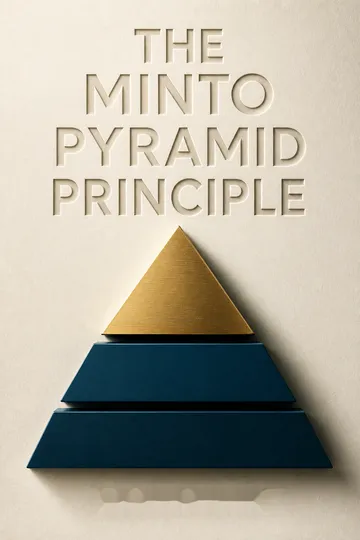
The key skill, then, is to be able to recognize which are your major and which your minor ideas, and to work out their relationships within the structure. The demands of logic and the limitations of a reader's ability to take in information dictate that this structure will always be pyramidal in shape — hence The Pyramid Principle.
Organize thoughts. Clear writing isn't just about good sentences; it's about the logical order of ideas. The human mind naturally sorts information into hierarchical, pyramidal groupings to comprehend it. Therefore, every written document should deliberately mirror this mental process, presenting ideas in a structured pyramid.
Reader's burden. Without a clear structure, readers are forced to expend mental energy trying to connect disparate points, often leading to confusion or disinterest. By pre-sorting your ideas into a pyramid, you reduce the reader's cognitive load, allowing them to grasp your message more easily and quickly. This is a courtesy to the reader, ensuring they follow your intended logic.
Foundation of clarity. The pyramid principle provides a comprehensive framework for identifying major and minor ideas and defining their relationships. This structured approach ensures that your communication is not only clear but also persuasive, as each point logically supports the overarching message.
2. Always Communicate from the Top Down
Controlling the sequence in which you present your ideas is the single most important act necessary to clear writing. The clearest sequence is always to give the summarizing idea before you give the individual ideas being summarized. I cannot emphasize this point too much.
Lead with the answer. Presenting the main idea first, followed by supporting details, is crucial for reader comprehension. The reader needs to know the framework within which to judge subsequent information. Without this upfront summary, they will try to infer relationships, often incorrectly, or simply give up.
Avoid confusion. Imagine being told a series of facts without context; your mind struggles to find a connection. This is what happens when you present details before the main point. By stating your conclusion or main point first, you provide the reader with a mental "bucket" into which they can logically place all subsequent information.
Enhance retention. Top-down communication ensures that the reader immediately grasps your core message. Even if they only read the first few sentences, they will understand your primary point. The rest of the document then serves to explain or defend that point, allowing for efficient scanning and deeper engagement for those who wish to delve further.
3. Respect the Mind's "Magical Number Seven" Limit
What he points out is that the mind cannot hold more than about seven items in its short-term memory at any one time.
Cognitive constraint. George A. Miller's "Magical Number Seven, Plus or Minus Two" highlights a fundamental limitation of human short-term memory. We can only effectively process and retain about five to nine items simultaneously. Exceeding this limit leads to mental overload and difficulty in comprehension.
Group for retention. When faced with more than a few items, the mind automatically attempts to group them into logical categories. This natural tendency should be leveraged in writing. Instead of presenting a long list of individual points, group them under a higher-level summary idea, effectively reducing the number of items the reader needs to hold in memory.
Simplify complexity. By organizing ideas into smaller, manageable groups, each summarized by a single overarching point, you make complex information digestible. This creates a series of mini-pyramids, where the reader only needs to remember the summary points at each level, making the entire document easier to follow and recall.
4. Ideas Must Be Logically Grouped and Ordered
Specifically, they must obey three rules: 1 Ideas at any level in the pyramid must always be summaries of the ideas grouped below them. 2 Ideas in each grouping must always be the same kind of idea. 3 Ideas in each grouping must always be logically ordered.
Three golden rules. For a pyramid structure to be effective, its ideas must adhere to strict logical rules. The first rule ensures that higher-level ideas are true abstractions of the points below, not just labels. This creates a clear hierarchy of thought.
Homogeneous groupings. The second rule, "same kind of idea," means that all points within a single grouping must belong to the same logical category. For example, if one point is a "reason," all others in that group must also be "reasons." This allows for a coherent summary and prevents logical leaps. A shortcut is to ensure you can label the grouping with a plural noun (e.g., "recommendations," "problems").
Structured sequence. The third rule dictates that ideas within a grouping must be logically ordered. There are only four possible logical orders:
- Deductively: Major premise, minor premise, conclusion.
- Chronologically: Steps in a process (first, second, third).
- Structurally: Parts of a whole (e.g., Boston, New York, Washington for a regional analysis).
- Comparatively/Ranking: Order of importance (most important first).
Adhering to these rules ensures that your thinking is sound and your message is instantly clear.
5. The Introduction: A Story to Engage the Reader
This classic pattern of story-telling — Situation, Complication, Question, Answer — permits you to make sure that you and the reader are ‘standing in the same place’ before you take him by the hand and lead him through your thinking.
The SCQA framework. A compelling introduction follows a narrative flow: Situation, Complication, Question, and Answer. This structure is designed to capture the reader's attention by presenting a story they already know or can easily relate to, thereby establishing the relevance of your document's main point.
Build relevance. The "Situation" sets the context, stating a non-controversial fact the reader accepts as true. The "Complication" introduces an alteration or problem within that situation, which naturally leads the reader to ask a "Question." Your document's main point then serves as the "Answer" to this question.
Psychological hook. This storytelling approach acts as a "lure of an unfinished story," making it easy for the reader to set aside other thoughts and focus on your message. It ensures you and the reader are on the same page before you delve into your detailed reasoning, making them more receptive to your ideas.
6. Vertical and Horizontal Logic Drive the Pyramid's Cohesion
Any point you make must raise a question in the reader’s mind, which you must answer horizontally on the line below.
Question-answer dialogue. The vertical relationship in a pyramid creates a dynamic question/answer dialogue with the reader. Every statement you make should implicitly raise a logical question (e.g., "Why?", "How?", "What do you mean?"), which you then answer with the ideas grouped directly below it. This continuous engagement pulls the reader through your reasoning.
Deductive or inductive. The horizontal relationship within a grouping dictates that ideas must present either a clear deductive or inductive argument.
- Deductive: Presents an argument in successive steps (e.g., general statement, specific observation, logical implication).
- Inductive: Groups similar ideas under a plural noun and draws an inference about their collective significance.
You must choose one, not both, for clarity within a single grouping.
Ensuring coherence. Understanding these two relationships is fundamental to building a robust pyramid. The vertical ensures relevance and engagement, while the horizontal guarantees logical consistency within each supporting group. This dual logic ensures that every idea contributes meaningfully to the overall message and is presented in the most comprehensible way.
7. Build Your Pyramid Top-Down or Bottom-Up
You can use this knowledge in building your pyramid either by starting at the top and working down, or by starting at the bottom and working up.
Two construction paths. While the ideal presentation is top-down, the process of building your pyramid can start from either end. The top-down approach is generally easier, beginning with your main subject, the reader's question, and your answer, then breaking it down into supporting points.
Top-down process:
- State your document's subject.
- Identify the reader's question about the subject.
- Formulate your answer (the main point).
- Develop the Situation and Complication for the introduction.
- Determine the "New Question" raised by your answer.
- Outline the key line points that answer this new question.
This method forces clarity from the outset, ensuring all subsequent points are relevant.
Bottom-up process: When your thinking isn't fully formed, start by listing all the points you want to make. Then, group similar points, summarize each group, and continue this process upward until you arrive at a single overarching message. This iterative process helps discover the logical relationships and refine your main point.
8. Master Deductive vs. Inductive Reasoning for Impact
Deduction presents a line of reasoning that leads to a ‘therefore’ conclusion, and the point above is a summary of that line of reasoning, resting heavily on the final point. Induction defines a group of facts or ideas to be the same kind of thing, and then makes a statement (or inference) about that sameness.
Distinct logical paths. Deductive reasoning moves from a general statement to a specific conclusion (e.g., "All men are mortal; Socrates is a man; therefore, Socrates is mortal"). Inductive reasoning observes specific facts or ideas, groups them by similarity, and then makes a generalized statement or inference about that group (e.g., "French, German, and Russian tanks are at the Polish border; therefore, Poland is about to be invaded by tanks").
When to use each. While deduction is a common way to think, it can be ponderous in writing, forcing the reader to follow a lengthy argument before reaching the conclusion. For higher-level summaries in business documents, induction is generally preferred because it presents the main point (the inference) upfront, making it easier for the reader to absorb.
Strategic application. Push deductive arguments to lower levels of the pyramid, where the steps are fewer and the connection is immediate. At the Key Line level, aim for inductive arguments that directly answer the reader's "Why?" question with a set of reasons or steps. This ensures your message is direct and impactful, rather than a mystery story.
9. Highlight Your Structure for Instant Comprehension
Whichever format you choose, remember that your objective is to make comprehension easier for the reader.
Visual cues are vital. Once your pyramid's logic is sound, its visual presentation on the page must reinforce that structure. Effective formatting helps the reader quickly grasp the hierarchy and flow of your ideas, even at a glance. This is not merely aesthetic; it's a functional necessity for clarity.
Common formatting tools:
- Headings: Use major section headings, subsections, and numbered paragraphs, indenting for subordinate ideas. Headings should reflect ideas, not just categories (e.g., "Increase Sales" not "Findings").
- Underlined points: Underlining entire statements of support points, especially at the Key Line level, allows readers to quickly scan and grasp the main arguments.
- Decimal numbering: Provides precise referencing for specific topics, often used in conjunction with headings for enhanced clarity.
- Indented display: For short documents or lists, indenting groups of points visually sets them apart, making their relationships easier to discern.
Rules for effective highlighting: Always use more than one element at each level (no single headings), ensure parallel ideas are in parallel grammatical form, limit wording to the essence of the thought, and introduce each group of headings to set context. The goal is to make the document readable even without the headings, while the headings themselves serve as a concise précis.
10. Problem-Solving Requires Structured Analysis
What this section has been saying is that before you can legitimately advise someone on how to change an undesirable result, you must have defined clearly five things: (1) the gap between where he is and where he wants to be, (2) the structure of the situation that gave rise to the gap, (3) the structure of its underlying processes, (4) the alternative ways the structure could be changed, and (5) the changes required to accommodate the alternative you choose.
Systematic approach. Effective problem-solving is a logical process that begins with precise problem definition. It involves understanding the current undesirable result, identifying the desired outcome, and clearly defining the gap between them. This initial clarity guides all subsequent analysis.
Uncover root causes. To understand why a problem exists, you must visualize and analyze the underlying structures and processes that produce the observed results. Tools like "logic trees" (financial, task, activity, choice, or sequential structures) help break down complex situations into mutually exclusive and collectively exhaustive causes.
Evaluate solutions. Once causes are identified, alternative solutions must be explored and tested against feasibility and likelihood of success. The final recommendation should clearly visualize the new situation with the proposed changes, including any additional adjustments needed. This structured approach ensures that recommendations are well-founded and comprehensive.
11. Craft Specific, Action-Oriented Summary Statements
I call these statements intellectually blank because they do not in fact summarize the essence of the ideas grouped below them. They simply state the kind of idea that will be discussed. As such they cannot serve as nuggets on which to focus future thinking.
Avoid vague summaries. "Intellectually blank assertions" like "There are three problems" or "We recommend five changes" fail to summarize the actual content or implications of the ideas below them. They merely categorize, offering no insight and making the document dull and difficult to follow.
State the effect or implication. For action ideas (steps, recommendations), the summary should state the effect of carrying out those actions. For situation ideas (reasons, problems, conclusions), the summary should state what is implied by their similarity. This forces precision and ensures the summary is a true abstraction, not just a label.
End-product orientation. When describing actions, ensure the wording implies a clear, tangible end product or cutoff point. For example, instead of "Strengthen regional effectiveness," say "Assign planning responsibility to the regions." This specificity allows you to judge if the steps below will achieve the stated effect and makes the writing more concrete and useful.
12. Write by Visualizing Images, Not Just Words
To compose clear sentences, then, you must begin by ‘seeing’ what you are talking about. Once you have the image, you simply copy it into words.
Think in images. All conceptual thinking occurs in images, not words. Images efficiently synthesize vast amounts of information into abstract configurations, allowing the mind to manipulate complex details. When writing, consciously recall or create these mental images to translate them into clear, concise prose.
Translate images to words. Good writing allows the reader to construct a "memory image" as they read, phrase by phrase. If your prose is vague or jargon-filled, the reader struggles to visualize, leading to confusion and poor retention. By starting with a clear mental image, you can "copy" it into words, enabling the reader to re-create that image and grasp your meaning effortlessly.
Clarity and pleasure. This technique not only enhances clarity but also makes the reading process more enjoyable. The goal is to present ideas in a way that transfers knowledge in large, vivid chunks, making it easier for the reader's mind to process and recall. As a commander filing out troops through a narrow gap, you owe the reader order and arrangement.
Review Summary
The Pyramid Principle receives praise for its structured approach to communicating complex ideas, with readers particularly valuing the first half's clear concepts and frameworks like MECE and SCQA. Many find it essential for business writing, consulting, and problem-solving, noting its immediate practical application. Common criticisms include dense second-half content, outdated examples, dry textbook-like prose, and occasional formatting issues. Despite mixed views on readability, most reviewers recommend it as foundational reading for professionals seeking clearer, more logical communication skills.
People Also Read


About the Author
Other books by Barbara Minto
Download PDF
Download EPUB
.epub digital book format is ideal for reading ebooks on phones, tablets, and e-readers.








































