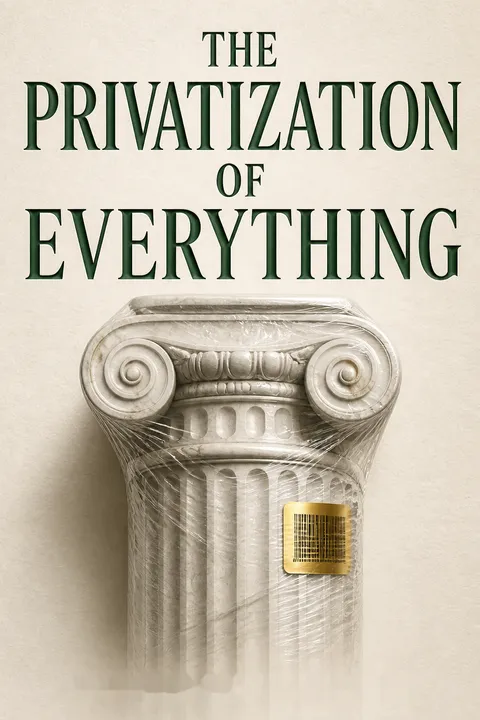

Key Takeaways
1. Privatization: A Stealthy Transfer of Public Control to Private Hands
Privatization is the transfer of control over public goods to private hands.
Beyond outsourcing. Privatization is far more expansive than simply outsourcing government services to private companies. It encompasses a broader strategy that includes austerity measures, where public funding for vital goods is reduced, forcing private options to fill the void. It also involves deregulation, which eliminates or weakens public control through essential safeguards for consumers, workers, and the environment. In essence, privatization represents a fundamental shift of power over our collective destiny to unelected and often unaccountable corporations.
A political strategy. This transfer of control is primarily a political strategy, often disguised by the myth of private-sector efficiency and the promise of "no new taxes." The COVID-19 pandemic starkly illustrated this, as the Trump administration's response was "centered fully on unleashing the power of the private sector." This approach led to:
- Private companies producing tests and selling them on the open market.
- Google supposedly providing online triage (which was largely aspirational).
- Retailers offering parking lots for testing without the necessary infrastructure.
The market's failure to coordinate or meet demand, coupled with price gouging, highlighted the dangers of this ideology.
Citizens to consumers. Privatization fundamentally transforms citizens into consumers, encouraging an individualistic mindset that prioritizes personal satisfaction over the common good. This shift is often rooted in historical efforts to denigrate public life by associating it with marginalized groups, making private alternatives seem superior. When public goods are treated as mere products, the market dictates access, leading to exclusion and rivalry, rather than collective decision-making about shared resources.
2. Market Failures: When Profit Motives Undermine Public Health and Essential Services
The market cannot and will not save us because market incentives are directly opposed to public health.
Profit over public health. The COVID-19 pandemic exposed how market incentives directly conflict with public health needs. While conservative commentators advocated for deregulation and a "free-for-all" in testing and treatment, the reality was chaos:
- Jacked-up prices for tests (e.g., $2,315 for a single test that normally cost $100).
- Inaccurate tests flooding the market due to relaxed FDA regulations.
- Public health departments overwhelmed by faxes from small labs with no incentive to modernize.
- Prioritizing market share for private companies over getting tests to those most in need (e.g., professional athletes tested routinely while nurses went untested).
This demonstrated that when public health is treated as a series of consumer products, the public's needs are not on the menu.
Erosion of safeguards. This pattern extends beyond pandemics to essential services like food safety. Historically, public demand and activism led to robust public health measures, such as the 1906 Food and Drugs Act, saving millions of lives annually. However, privatization efforts have eroded these safeguards:
- Private food auditors (e.g., AIB International) inspect only areas requested by their "clients" (the farms), missing critical health hazards like manure piles and maggots.
- Industry-led pilot programs allowed producers to use their own employees as inspectors, leading to high error rates and contaminated food.
- The goal shifted from public safety to speed and efficiency, with production lines humming at 175 birds per minute.
Public control is vital. These examples underscore that public health is not a mere product for an unregulated market. When food inspectors view producers as clients rather than the public, inspection becomes a service to protect the client's profits, not public well-being. Keeping our food safe and communities healthy requires the public to retain control, ensuring that vital services are not compromised by the pursuit of private gain.
3. Infrastructure as Economic Destiny: Public Control vs. Private Profit
Infrastructure is economic destiny, so we need to pay attention to who is calling the shots; typically it’s those who are putting up the money.
Shaping economic futures. Decisions about infrastructure profoundly shape a region's economic destiny. When private capital dictates these projects, investments are channeled to the most profitable areas, often neglecting rural communities and limiting diverse economic growth. Historically, this was evident in Iowa's railroad development:
- State constitutional debt restrictions led to private railroad construction.
- Eastern railroad companies built lines serving their own financial interests, not Iowa's diverse economic development.
- Iowa received five east-west lines, but no north-south connections, limiting its economy primarily to agriculture for decades.
In contrast, New York's publicly funded Erie Canal fostered diverse economies in western New York, demonstrating the power of public control.
The pitfalls of P3s. Public-Private Partnerships (P3s) are often touted as solutions to infrastructure funding gaps, but they frequently lead to private control over public assets. While governments can finance projects at low interest rates through bonds (2-4%), private companies seek much higher returns (10-20%). This financial leverage allows private entities to:
- Control operations and maintenance for decades, prioritizing profit over public good.
- Insert contract clauses that penalize governments for future policy changes (e.g., Chicago parking meters).
- Shift costs to the public through tolls and fees, even as the public loses control.
The Indiana Toll Road (ITR) serves as a stark example, leased for 75 years for an upfront payment that ultimately cost the state billions in lost revenue and control.
Limiting public freedom. Privatization of infrastructure, whether roads, air traffic control, or broadband, restricts public freedom and choice. The ITR deal included non-compete clauses that prevented Indiana from improving nearby roads, forcing truckers to pay higher tolls or use less suitable alternatives. Similarly, attempts to privatize air traffic control prioritize large commercial carriers, potentially raising fees for smaller airports and limiting economic opportunities in less-trafficked regions. Public broadband initiatives, vital for rural economic development, are often blocked by telecom giants through state legislation, demonstrating how private interests actively limit competition and public access to essential services.
4. Privatization's Assault on Democracy and Justice
Privatization, sold to us as a way to avoid intrusive government, in fact actively creates distant, unaccountable, and inscrutable centers of power.
Undermining rights. Privatization often serves as a "wormhole" to circumvent constitutional rights and democratic processes. In Kansas City, Missouri, the city council privatized public streets in the Westport district, allowing businesses to implement unconstitutional weapon searches by private security. This transforms citizens with rights into consumers subject to private contracts, eroding fundamental freedoms. Historically, the Gilded Age saw elites redefine freedom as property rights and contracts, limiting democracy and justifying actions like anti-union injunctions.
Secrecy and unaccountability. Transparency is a primary casualty of privatization, as private entities performing public functions often hide information as "trade secrets," even when public money is involved. Examples include:
- Maximus Inc. redacting expense breakdowns for a state healthcare exchange contract.
- Charter school management companies claiming "academic policies and strategies" as trade secrets to avoid public scrutiny.
- JobsOhio, a privatized economic development agency, being exempt from public records laws, obscuring how tax breaks and grants are awarded and creating conflicts of interest.
This opacity weakens legislative and judicial oversight, empowering an executive branch that operates through deals with unfettered private corporations, rather than through democratic accountability.
Justice for profit. The justice system itself is not immune. Private prisons, driven by profit, introduce "bed guarantees" that incentivize incarceration and undermine justice reforms. Studies show private prisons are:
- More expensive than public alternatives.
- Less safe, with higher rates of violence and assaults on staff.
- Worse at rehabilitation, with higher recidivism rates.
- Less secure, with higher escape rates.
These companies actively lobby for tough-on-crime legislation and target vulnerable populations, such as immigrants, to fill their beds. Similarly, for-profit probation companies turn minor infractions into "debtors' prisons," charging excessive fees and corrupting court proceedings by influencing judges' decisions based on their need for profit. Forced arbitration clauses in contracts further privatize civil law, stripping citizens of their constitutional right to public courts and subjecting them to biased, secretive proceedings.
5. The Social Safety Net: An Engine of Inequality Under Private Management
This is a blatant upward transfer of wealth, pennies at a time, from those living hand-to-mouth to those with the power and reach to turn those pennies into billions of dollars.
Profiting from poverty. Privatization transforms public assistance programs into mechanisms for wealth transfer, siphoning funds from the most vulnerable to wealthy corporations and investors. The Electronic Benefits Transfer (EBT) card system, intended for convenience, became an engine of inequality:
- Financial services companies (e.g., J.P. Morgan) charge fees for balance inquiries, customer service calls, and even withdrawing public money.
- These fees, often 25 cents to $3 per transaction, disproportionately impact beneficiaries with monthly packages in the low hundreds.
This system, often supported by lawmakers seeking to make public assistance difficult, ensures that the poor are punished while the rich get richer.
Moral crusades and denial of care. Conservative politicians often deny that public assistance is a public good, framing poverty as a result of personal choices rather than systemic issues. This moralistic stance fuels privatization schemes like the HOPE Act, which:
- Outsources Medicaid fraud investigation and enforcement to for-profit companies.
- Incentivizes these companies by tying payments to caseload reductions, effectively rewarding them for denying medical care.
- Imposes strict deadlines (e.g., 10 days) for paperwork, leading to removal from assistance for trivial reasons.
This echoes the 19th-century poorhouses, which, despite being expensive and inhumane, were promoted by reformers to instill a work ethic and "weed out fraud," often at the cost of family separation and increased suffering.
The cost of "efficiency." When public services are privatized, the promised "efficiencies" often materialize as inflated administrative costs and executive salaries, while services decline and workers' wages are slashed. Examples include:
- Texas's privatized Medical Transportation Program, which saw administrative costs quadruple and per-ride costs nearly triple, while serving fewer people.
- Iowa's privatized Medicaid system, where administrative costs rose by 50-200%, executive compensation soared, and patient care was drastically cut (e.g., reducing at-home visits for disabled patients).
- Food service contractors (e.g., Aramark) cutting cafeteria workers' pay and benefits, forcing them onto food stamps, while CEOs earn millions.
- Federal government contractors paying millions of workers less than $15 an hour, effectively making the government the largest low-wage employer.
These practices dismantle the safety net, devalue public service, and actively exacerbate economic inequality by channeling public funds upward.
6. Eroding Community: How Privatization Divides Us
When the people of a democracy have nothing held in common, “there is nothing to occasion the action in concert that is democracy’s defining trait.”
Dividing public spaces. Privatization drives a wedge into the very idea of community by creating tiered access to public spaces and services. Public state parks, starved for funds, introduce "glamping" options that cater to a wealthier clientele, reserving prime spots for those who can pay ten times more. This creates a luxury product out of a universal public good, fostering isolation and emphasizing differences, as seen in the McKinney, Texas, private pool incident where racial tensions erupted over access to a privatized recreational space. Such actions undermine the fundamental role of public spaces in fostering shared experiences and democratic engagement.
Privatizing history and memory. Even our shared history is vulnerable to privatization. While presidential libraries traditionally serve as public institutions run by the National Archives, the Barack Obama Presidential Center opted for a private foundation to curate its exhibits and documents. This decision, made without much public debate, means visitors will encounter Obama's version of his history, lacking the neutrality and critical perspective that public archivists and curators provide. This erosion of public control over historical narratives contributes to a loss of a "common baseline of facts" and hinders the difficult conversations necessary for a functioning democracy.
The tragedy of lost public goods. The sale of public assets for private gain often leads to the destruction of community resources and economic opportunities for local residents. Lake Texoma State Park in Oklahoma, a beloved public park, was sold to oil tycoons for a fraction of its value with promises of a luxury resort. Twelve years later, the resort never materialized, local businesses that relied on park visitors collapsed, and the community felt "ripped off." This "ultimate con job" not only deprived residents of access to shared land but also undermined their economic independence and sense of belonging, demonstrating how privatization can destroy the fabric of a community for the benefit of a few wealthy individuals.
7. The Corruption of Public Education and Knowledge
The most efficient way to generate knowledge is to share new ideas; the best way to generate profit is to prevent others from learning and selling your new ideas.
Competition stifles innovation. The notion that market competition inherently drives innovation in education is a myth. In reality, "running schools like a business" often stifles genuine innovation and leads to cynical strategies for market share. In Washington, DC, charter schools, by establishing programs for grades 5-12, siphon off fifth-grade students from traditional public elementary schools, not because their programs are superior, but to secure per-pupil funding earlier. This competitive pressure prevents public schools from investing in innovative programs like team teaching for upper grades, as funding is constantly diverted.
Locking down knowledge. Unlike the collaborative spirit of public education, private charter schools often treat educational practices as proprietary "trade secrets." They implement:
- Nondisclosure agreements for teachers, threatening legal action for sharing "curriculum systems, instructional programs, or research and development strategies."
- Non-compete clauses that prevent teachers from seeking employment at other schools.
- Extensive redactions in public applications, obscuring details about their educational programs and goals.
This secrecy, driven by the profit motive, directly contradicts the open sharing of knowledge and best practices essential for educational advancement, turning schools into competitive silos rather than collaborative learning environments.
The void in higher education. Decades of deep funding cuts to public higher education, often driven by tax breaks for the wealthy, have created a void filled by private interests. This has led to:
- Wealthy donors, like Charles Koch, influencing university curricula and faculty hiring decisions to advance ideological agendas, compromising academic freedom.
- The rise of for-profit colleges, which, despite high tuition and low quality, have thrived by targeting vulnerable students and siphoning federal student aid.
These "schools" often operate as "call centers" focused on recruiting students for loans, rather than providing genuine education, leading to massive student debt and little to no career advancement. The Trump administration, particularly Secretary Betsy DeVos, actively supported these fraudulent institutions, rolling back protections for defrauded students and funneling federal money into failing for-profit ventures.
8. Reclaiming Public Goods: A Path to a Pro-Public Future
The most important lesson of this book is that, because we gave private interests that power, we can take it back.
Reversing the power transfer. The pervasive privatization of public goods has concentrated immense, unaccountable power in private hands, affecting everything from healthcare to justice. However, this power was granted, not inherent, and can therefore be reclaimed. A pro-public future requires rejecting the notion of a "market society" and building one based on public values, ensuring universal access to essential goods. This involves pragmatic decisions about what remains under public control, driven by deliberation and debate, not expediency or profit motives.
Six steps to regain control:
- Define the Public: It’s All of Us. We must ensure universal inclusion, fight racism embedded in public systems, and reject consumerism as the template for government interaction. Recognizing our interdependence means fighting for everyone's right to public goods and the power over them.
- Let the Public Decide. Democracy, not the market, must determine what constitutes a public good. This requires ongoing public dialogue, creating mechanisms for deliberation, and empowering citizens to make decisions at the ballot box and in legislatures, adapting to evolving societal needs and crises.
- Pay for Things We Value. We must acknowledge that public goods always have a cost, and choose to pay for them as citizens through progressive taxation, rather than through regressive fees or deferred costs. Investing early in public goods like education and infrastructure yields long-term social and economic benefits, avoiding the far higher human and financial costs of austerity.
- Don’t Let the Free Market Limit Freedom. We must prevent private interests from blocking public alternatives and creating monopolies. This means challenging crony capitalism, stopping companies from profiting as middlemen for services the public could provide more efficiently, and empowering public servants to innovate without fear of private "competition."
- Create and Enforce Pro-Public Standards and Rules. Establishing and rigorously enforcing standards for public goods is crucial. This includes banning contract clauses that undermine democratic decision-making, ensuring profit incentives align with public interest (e.g., no private prisons profiting from high crime), and demanding "operational transparency" from all entities receiving public money.
- Surface the State: The Public Needs to See It. We must actively counter the belittling of public service and highlight government accomplishments. By telling accurate stories of public investment and its impact on daily life—from scientific breakthroughs to essential infrastructure—we can restore public trust, foster civic engagement, and build a virtuous cycle of solidarity and common purpose.
Review Summary
The Privatization of Everything receives high praise for its thorough examination of how privatization negatively impacts public goods and services. Readers appreciate the detailed examples and clear arguments against unchecked privatization in areas like education, healthcare, and infrastructure. Many find the book eye-opening and infuriating, highlighting the need for public ownership and transparency. While some criticize the one-sided approach and lack of concrete solutions, most reviewers consider it an important, must-read book that exposes the dangers of prioritizing profit over public welfare.
People Also Read






Download PDF
Download EPUB
.epub digital book format is ideal for reading ebooks on phones, tablets, and e-readers.








































