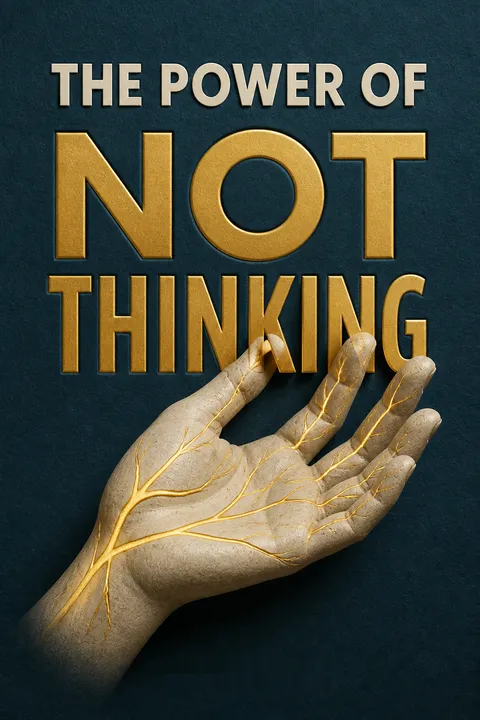

Key Takeaways
1. Our Intelligence Extends Beyond the Brain: The Body as a Source of Knowledge
Instead, our understanding of the world arises from our bodies’ interactions with and perceptions of the world—and it is through these interactions that our bodies acquire knowledge.
Challenging tradition. For centuries, Western thought, heavily influenced by René Descartes' "cogito ergo sum" ("I think therefore I am"), has positioned the mind as the sole seat of intelligence, relegating the body to a mere mechanical vessel. This dualistic view has led us to believe that intellect resides purely in abstract thought, separate from our physical being. However, this perspective overlooks the profound ways our bodies actively participate in shaping our understanding and intelligence.
Embodied intelligence. The book argues that intelligence is not just a product of our brains processing abstract information, but fundamentally emerges from our bodies' interactions with and perceptions of the world. Our bodies are not passive carriers for our brains; they are active participants in learning, sensing, and making sense of our surroundings. This "embodied knowledge" is practical, intuitive, and deeply ingrained, allowing us to act without consciously "thinking about thinking."
Beyond the brain. Consider the octopus, an evolutionary anomaly whose intelligence is distributed throughout its body, with two-thirds of its neurons in its arms. Its arms can act independently, demonstrating that intelligence isn't confined to a central brain. Similarly, philosopher Maurice Merleau-Ponty argued that the body is central to how we perceive and make sense of the world, suggesting that "I have a body, therefore I can know." Our bodies, equipped with chemical, mechanical, visual, and thermal sensors, are our primary instruments for experiencing and understanding reality.
2. Abstract Data and Models Fall Short: The Limits of Disembodied Understanding
The mind-first perspective is often a reductionist one that, while sometimes useful, can be, as the theologian Rowan Williams puts it, "A search for the least adorned, the most fundamental pattern or structure we can come up with ... When we have said that everything can be reduced to this or that equation, we have actually said nothing of any great substance; we have simply said there is a mathematical process without which this would not be what it is."
The allure of abstraction. From Descartes' coordinate geometry to modern GPS and big data analytics, there's a pervasive tendency to reduce the world to abstract, quantifiable models. These "intellectual technologies" promise objective, detached understanding, enabling efficiency and control. GPS, for instance, allows us to navigate without engaging with our surroundings, leading to a disembodied understanding of landscapes.
Missing human complexity. Big data, often hailed as the new oracle, aims to describe and predict social life through statistical laws, much like 17th-century "social physics." While useful for identifying patterns, this approach often makes human complexity invisible. It struggles to capture:
- Emotions and feelings
- Social relations
- Inner worlds and subjective experiences
- The "why" behind behaviors
The map is not the territory. Relying solely on abstract data creates a "view from nowhere," a detached perspective that can be misleading. As D.H. Lawrence noted, "The map appears to us more real than the land." This reductionist mindset, prevalent in business and education, prioritizes factual, explicit knowledge over the rich, nuanced understanding gained through direct, embodied experience, leading to a partial and often uncaring account of reality.
3. Multisensory Observation Unlocks Deeper Insights: The Power of Experiential Immersion
By using his body to observe the market up-close, Eisman was able to create a more rounded perspective on a highly complex, large-scale phenomenon.
Beyond mere looking. Western cultures often prioritize vision, but true observation involves all our senses. The body is equipped with a full range of sensory equipment that allows us to perceive the world in a holistic, multisensory way. This comprehensive engagement is crucial for acquiring deep, nuanced understanding.
The "view from somewhere." When financial analyst Steve Eisman and his team investigated the sub-prime mortgage crisis, they didn't just rely on data. Their trip to the "sand states" and Las Vegas provided a "view from somewhere," revealing critical, subtle clues that abstract data missed:
- The "cheap suits" of bond raters, signaling their undervalued role.
- Anecdotes like a stripper with five home equity loans, highlighting reckless lending.
- The sheer number and flamboyant antics of bond salesmen, indicating irrational exuberance.
These visceral observations cemented their conviction to bet against the market, proving the power of situated, embodied perception.
Embodying other worlds. Charles Foster (living as a badger, otter, fox) and Thomas Thwaites (living as a goat) exemplify extreme multisensory immersion. They sought to understand animal perspectives by physically inhabiting their environments and mimicking their behaviors, demonstrating that to truly understand others, whether human or animal, one must embody their world. This process, supported by "motor simulation theory," shows how observing actions primes our own bodies to perform them, facilitating learning without explicit instruction.
4. Mastery Through Practice: How Our Bodies Learn Without Conscious Thought
For the things we have to learn before we can do them, we learn by doing them, men become builders by building and lyre players by playing the lyre; so too we become just by doing just acts, temperate by doing temperate acts, brave by doing brave acts.
Learning by doing. Many skills, like riding a bicycle, are acquired through repeated action rather than explicit instruction or understanding of underlying principles. We learn by doing, absorbing feedback from our actions, and gradually embedding knowledge in our bodies. This "procedural memory" allows us to perform complex tasks automatically, without conscious thought.
The path to expertise. Hubert Dreyfus's model of skill acquisition outlines a progression from novice to expert, where the role of conscious thought diminishes.
- Novices follow explicit rules.
- Advanced beginners apply rules of thumb in context.
- Competents recognize patterns and focus on relevant features.
- Proficients develop intuitive reactions based on assimilated experiences.
- Experts act fluidly and instinctively, knowing what to do without thinking, often performing "as a whole" rather than breaking down tasks.
The paradox of overthinking. For experts, conscious reflection on individual steps can actually impair performance, a phenomenon known as "choking." Studies with golfers and footballers show that focusing on the mechanics of a well-learned skill degrades performance. This highlights that once knowledge is embodied, it's often best to let the body perform without the mind's intrusive commentary, as verbalization can "overshadow" non-linguistic perceptual memory.
5. Improvisation: The Body's Genius for Navigating Unpredictable Worlds
Improvisation embodies the power to create value freely from an instantaneous encounter.
Life's middle game. Like the "middle game" in chess, much of life is unpredictable, demanding improvisation rather than adherence to scripts or rules. While computers can master rule-based games like chess by brute-force calculation, human intelligence excels at navigating novel, ambiguous situations where perfect information is absent. This ability to improvise is deeply rooted in our embodied knowledge.
The challenge of autonomous systems. Developing autonomous vehicles (AVs) highlights the difficulty of replicating human improvisation. AVs struggle with:
- Environmental variability: Roads change constantly (weather, markings, parked cars).
- Human unpredictability: Interpreting and predicting the actions of other drivers, pedestrians, and cyclists.
- Infinite scenarios: It's impossible to pre-program responses for every unforeseen event (e.g., a piece of litter on the road).
Human drivers, by contrast, fluidly perceive, predict, and plan in milliseconds, drawing on years of embodied spatial understanding and social cognition.
Recognition-primed decision-making. Gary Klein's research on firefighters shows that in high-pressure, uncertain situations, experts make decisions instinctively through "recognition-primed" strategies. They rapidly identify patterns based on compiled experience, intuitively generating plausible responses without comparing multiple options. This perceptual skill, deeply tied to the body's ability to "read" subtle cues, is central to human improvisation and remains a significant hurdle for AI.
6. Empathy is Embodied: Feeling and Understanding Others Through Shared Experience
If empathy depends on shared experience, it does so because we can only truly sense what things feel like for others when we have experienced what they have.
Beyond cognitive understanding. Empathy is often framed as a mental exercise of perspective-taking, but it has a profound bodily dimension. William James argued that emotions originate in our bodies: "We are afraid because we run," not the other way around. Our physical responses to stimuli are integral to the emotions we feel, suggesting that disembodied emotion is a nonstarter.
Mirroring and resonance. The discovery of mirror neurons in the 1990s provided a neurological basis for embodied empathy. These neurons fire both when we perform an action and when we observe someone else performing it, creating a "direct experiential understanding." This mirroring mechanism allows us to literally "feel your pain" by activating similar emotional states in ourselves. Furthermore, "entrainment" describes how our bodies spontaneously synchronize with others, leading to shared moods and feelings, as seen in audiences at a concert.
Experiential empathy. Projects like architect David Dillard's "Sleepover Project" (where architects experienced old age conditions) and the Crossroads Foundation's "Refugee Simulation" demonstrate that true empathy for others' lives comes from direct, visceral experience. These simulations, by inducing physical discomfort and vulnerability, create bodily states congruent with the lives being understood, making participants more receptive to information and fostering a deeper, emotional connection that purely cognitive approaches cannot achieve.
7. Memory is Not Just Cerebral: Our Bodies and Environments Retain Knowledge
What has my body become? A memory in a landscape?
Beyond the brain's filing cabinet. The conventional view of memory as information "stored" in the brain, like a hard drive, is incomplete. The body itself is a powerful repository of knowledge and memory. "Muscle memory," or procedural memory, allows us to perform complex sensorimotor skills—like tying shoelaces or playing piano—automatically, without conscious recall. This "sedimented habit" is a combination of habituated muscles and neural networks.
Contextual and sensory recall. Memories are often deeply tied to our physical experiences and environments. Proust's madeleine moment illustrates how sensory cues (taste, smell) can trigger vivid, embodied memories. Our bodies form multidimensional maps of spaces, allowing us to navigate familiar supermarkets or recall where we left our spectacles by retracing our steps. This "proprioceptive" sense of our body's position in the world contributes to a deep, remembered feel for space.
The extended mind. The concept of the "extended mind" proposes that our cognitive processes are not confined to the brain but extend into our bodies and even our physical environment. Objects like notebooks, pens, or smartphones act as "outboard brains," scaffolding our thoughts and memories. This means that thinking is an embodied and situated activity, where brain, body, and environment work together to retain and recall information, challenging the notion of an isolated, disembodied mind.
8. Visceral Experience Drives Effective Business and Policy Decisions
Research has become a proxy for customers. Good inventors and designers deeply understand their customer. A remarkable customer experience starts with heart, intuition, curiosity. You won’t find any of it in a survey.
Beyond the boardroom. Business and policymaking often rely on abstract data, reports, and models, leading to a "distance, data, disembodiment" problem. Executives and policymakers can become disconnected from the realities of their customers or constituents. Brian Roberts (Comcast CEO) talking to Sky salesmen, or Dutch Ambassador Simon Smits hitching a ride with a hauler to understand Brexit trade, exemplify leaders seeking embodied knowledge.
Experiential learning in action:
- Duracell's camping trip: Executives experienced the outdoor market firsthand, shivering in tents and learning camp craft, leading to an award-winning advertising campaign that "just got" the outdoor community.
- Facebook's 2G Tuesdays: Engineers simulated slow network conditions, viscerally understanding the challenges faced by users in emerging markets, which drove the successful development of Facebook Lite.
- P&G's "mainstream green consumer" project: Teams lived green lifestyles, discovering practical insights into eco-conscious living that informed new detergent formulations.
Bridging the empathy gap. These embodied approaches generate "felt and emotional" knowledge that is practical and transferable. It allows leaders to toggle between customer needs and organizational constraints, using personal experience as a touchstone. Larry Summers' road trip through "Flyover States" revealed the disconnect between coastal elites and Middle America, highlighting the need for policymakers to "go there" to understand people's lives and feelings, which often trump facts in political discourse.
9. The Embodiment Paradox: Why "Easy" Human Skills Remain Hard for AI
Brains do not come as isolated entities as do computers. They come with bodies. Bodies are their interface with the world, and, some would argue, there cannot be thinking without embodiment.
AI's early assumptions. The field of Artificial Intelligence, born in 1956, initially pursued "Good Old-Fashioned AI" (GOFAI), assuming intelligence was purely about manipulating abstract symbols and following rules, akin to a disembodied computer program. This led to early successes in complex cognitive tasks like chess, but significant failures in seemingly simple real-world interactions.
The "embodiment turn." Roboticists like Rodney Brooks, inspired by insects, challenged GOFAI. His "nouvelle AI" argued that "the world is the best model of the world," meaning intelligent agents must learn from direct interaction with their environment, not pre-programmed symbolic representations. Robots like Herbert, designed with sensors to learn and respond to the messy reality of an office, demonstrated that intelligence emerges from bodily interaction.
Moravec's Paradox. This shift revealed a profound paradox: "It is comparatively easy to make computers exhibit adult-level performance on intelligence tests or playing checkers, and difficult or impossible to give them the skills of a one-year-old when it comes to perception and mobility." Humans effortlessly perform "low-level" sensorimotor tasks—like picking up a pencil with the right grip or recognizing a face in a crowd—due to billions of years of evolution. These embodied skills, which enable our adaptability, improvisation, and common-sense understanding of the world, are precisely what remain fiendishly hard for AI to replicate.
People Also Read




Download PDF
Download EPUB
.epub digital book format is ideal for reading ebooks on phones, tablets, and e-readers.








































