

Key Takeaways
Refusing to choose is itself a choice: the choice to fail
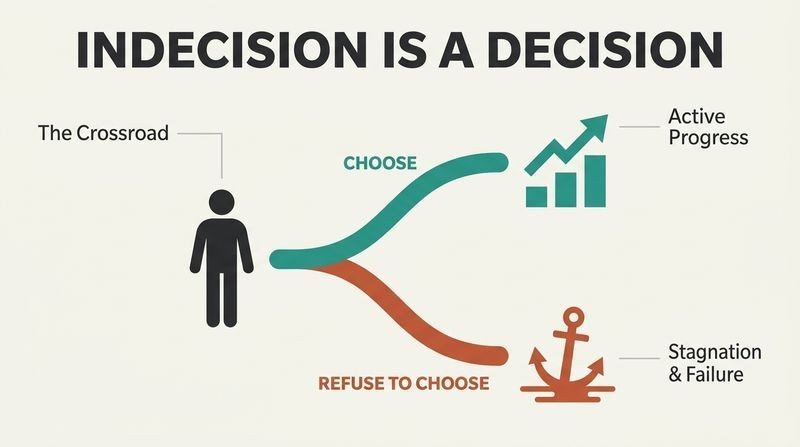
Indecision is a decision. Raymond Charles Barker, a New York minister who filled Lincoln Center every Sunday, builds his entire philosophy on one blunt claim: the person who cannot make up his mind has already decided, and what he has decided is failure. Drifting, waiting for clarity, and endlessly asking others what to do are not neutral pauses. They are active commitments to stagnation.
The pattern often starts early. Barker traces chronic indecision to the first six years of life, when a domineering parent never let the child pick anything. He describes a woman in her forties who could not buy her own clothes for twenty-five years, having unconsciously turned her husband into a substitute for her controlling mother. Naming the pattern began to break it.
The reframe is bracing because it removes the comfort of the fence. Modern decision science echoes it: Barry Schwartz's work on the paradox of choice shows that endless deliberation breeds regret and paralysis, and behavioral economists note that not deciding defaults you into whatever option inertia selects. Barker's insight predates this literature by decades. What's debatable is his monocausal origin story. Attributing lifelong indecision to childhood domination is tidy but ignores temperament, culture, and genuine uncertainty where caution is wise. Still, as a motivational lever, treating passivity as an accountable act is far more empowering than treating it as harmless waiting.
Whatever you plant in your subconscious must sprout in your life
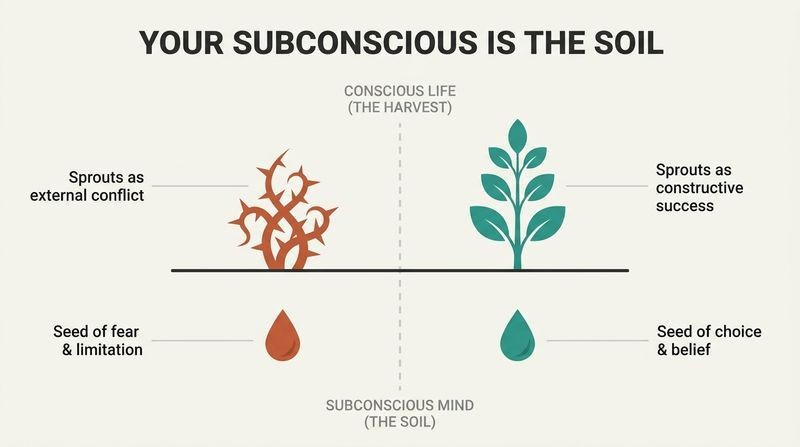
The one mental law. Barker's central mechanism is what he calls Mental Law: whatever thought you deposit in your subconscious mind, it must reproduce as your experience. He compares it to sowing and reaping, or gathering figs from thistles. The subconscious is impersonal and automatic. It does not judge, edit, or ask whether the seed is good for you. It simply grows what it receives.
You are cause, not victim. From this follows his hardest teaching: nothing happens to you that your own consciousness did not cause. He uses the image of a movie screen. Life is the neutral screen; your consciousness is the projector. A tragedy or comedy plays, but the screen stays unmarked. Blaming events, family, or luck misreads the projector for the screen.
This is New Thought metaphysics, and its literal reading (that thoughts alone rearrange external matter) sits uneasily with evidence. Cancer, poverty, and accidents are not simply projected by their sufferers, and such doctrine risks blaming victims for misfortune. Yet the psychological core is robust. Cognitive behavioral therapy rests on the same architecture: recurring automatic thoughts shape mood and behavior, which shape outcomes. Reticular activating system research shows attention primes what we notice and pursue. Read as a claim about the internal locus of control rather than magical causation, Barker's law aligns with decades of findings that agency beliefs predict resilience and achievement.
You are Intelligence itself, not a person who needs fixing
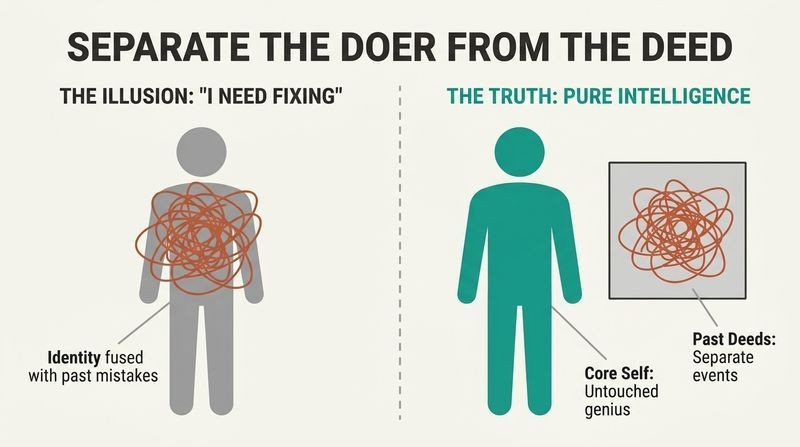
Redefine the self at the root. Barker asks the reader to say aloud, I am pure Intelligence, always acting intelligently, and to notice whether the mind rebels. That rebellion, he argues, is the whole problem. If you cannot accept yourself as capable, you cannot exceed your own self-image. Stupidity does not exist; it is merely Intelligence misused. Every person individualizes one Infinite Mind.
Separate the doer from the deed. He offers a clean analogy: a concert pianist who plays a round of golf is still a pianist. Onlookers see a golfer; his genius is untouched. Likewise, your past mistakes describe what you did, not what you are. Judge yourself by what you will do next, never by the wreckage behind you.
The pianist-golfer distinction is a compact piece of practical wisdom that survives translation out of its theological frame. It anticipates Carol Dweck's growth mindset (ability is not fixed by past performance) and the therapeutic move of separating identity from behavior (I did a bad thing versus I am bad). Self-compassion researcher Kristin Neff finds that decoupling worth from failure improves persistence more than self-criticism does. Where Barker overreaches is in denying that limitation is ever real; some constraints are genuine. But as an antidote to the corrosive habit of defining oneself by one's worst moments, the reframe is genuinely liberating.
Say no on purpose to evict what has outlived its usefulness
The power of deliberate no. Barker insists that welcoming new ideas matters less than consciously releasing dead ones. The subconscious treats the word no as a law of elimination. Name what no longer serves you, declare its dismissal final and irrevocable, picture yourself already free of it, then refuse to rethink it. Every time the old problem resurfaces in your mind, shift attention to the fact that it is gone.
New wine, old bottles. He borrows the biblical image: pour new wine into old bottles and the bottles break. You cannot walk forward while facing backward. He suggests literally listing the situations, grudges, and dead ambitions clogging your path, then thanking your subconscious at night for dissolving them, and never worrying them back into existence.
The mechanics here resemble modern habit-reversal and rumination research more than mysticism. Refusing to re-engage an intrusive thought is close to the acceptance-and-refocus techniques in ACT (Acceptance and Commitment Therapy), and the nightly gratitude framing prefigures well-documented gratitude-journaling effects on sleep and mood. The caution: suppression can backfire, as Daniel Wegner's ironic-process studies (try not to think of a white bear) demonstrate. Barker's method works better than raw suppression precisely because it substitutes a competing focus rather than fighting the thought head-on. The deeper wisdom is that letting go is an active decision requiring the same energy as pursuit, not a passive fading.
Chase ideas, not things, because ideas are what produce things
Cause over effect. Barker draws a sharp line between the metaphysician and the ordinary striver. Most people manipulate circumstances, objects, and events, which are effects. The wiser move is to control cause, which is the idea that precedes every result. He calls original ideas immaculate conceptions: they arise fresh from the Infinite Mind, unborrowed, and get adulterated only when we drag them into doubt about how, when, or whether.
Feed the mind like the body. New ideas, he argues, are as essential as food and water. Repeating the known is not progress. He points to inventions once dismissed as implausible (cars in 1900, radios in 1910, transatlantic flight in 1920) to show that progress always begins as an idea the crowd rejects before a decisive thinker acts on it.
The primacy of ideas over circumstances resonates with how innovation actually diffuses. Everett Rogers's diffusion-of-innovations research confirms that breakthroughs look absurd until early adopters validate them, matching Barker's implausibility list. His warning against adulterating an idea with premature how-questions parallels design-thinking guidance to separate ideation from evaluation, since judging too early kills fragile concepts. The friction point is his suggestion that ideas alone suffice; execution, capital, and timing clearly matter too. Barker partly concedes this by demanding decision and action after the idea. Read charitably, the claim is about sequence: cognition precedes and directs behavior, so guarding the quality of your thinking is upstream leverage.
Happiness is a decision you make, then declare in the present
Satisfaction beats circumstance. Barker defines happiness as genuine satisfaction with your present experience, and argues the modern abundance of gadgets, education, and therapies has not made people happier because happiness is a change of consciousness, not of possessions. People want to rearrange facts; the real work is rearranging ideas inside the mind.
Where attention goes, emotion follows. This is his operational rule. Deliberately place attention on constructive people and situations. Stop complaining, find things to praise, answer that you feel great even when facts say otherwise (a seeming lie that prepares the truth). His practical prescription includes concrete acts: try new restaurants, rearrange the pictures on your walls, expand your social circle, and wear your best clothes on ordinary occasions.
The behavioral prescriptions are more evidence-backed than Barker could have known. Behavioral activation, a frontline depression treatment, works exactly by scheduling novel and pleasant activity before the mood to do so arrives, reversing the wait-to-feel-motivated trap. Positive psychology's gratitude and savoring interventions echo his find-things-to-praise instruction. The attention-steers-emotion principle underlies mindfulness and attentional-bias-modification research. The dubious part is the fake-it declaration; toxic positivity can invalidate real distress, and forcing I feel great can deepen shame when it fails. Barker's better move is the action list, which changes inputs rather than merely asserting a feeling that isn't there yet.
There is no virtue in poverty or self-deprivation; wanting more is legitimate
Prosperity is a consciousness, not a bank balance. Barker defines prosperity as the ability to do what you want at the instant you want to do it, explicitly not money itself. Money is a means, God in circulation, never the goal, and he notes there are as many miserable rich people as poor ones. But he attacks the inherited religious idea that going without is holy, calling it nonsense.
Sound patterns before windfalls. He refuses to promise instant cash. People who demand money without building a prosperity consciousness stay broke, and unrealistic debt reveals a fantasy that money arrives without mental or physical work. He confesses that early ministry debts gave him a haunted unease until the day he owed no one. Integrity, order, and paying bills on time are the substrate of real abundance.
Barker threads a needle between prosperity-gospel excess and puritanical thrift. His demand for financial order and honesty as prerequisites is unusually grounded for the genre and matches behavioral-finance findings that money habits and self-control, not windfalls, predict lasting wealth (lottery winners frequently return to baseline). Defining prosperity as autonomy over one's time anticipates research showing time affluence correlates with wellbeing more strongly than income past a threshold. The weak spot is the residual magical thinking that consciousness generates money; structural factors like wages, discrimination, and luck are real. His practical counsel (order, integrity, common sense with credit) is what actually carries the load here.
Decide to be well before any healing can begin
Hope is not decision. After fifty years practicing spiritual mind healing, Barker reports he stopped trying to argue sick people into wellness because a healing borrowed from his authority is not their decision, and the subconscious will not reverse a disease pattern it spent months building until the conscious mind issues a clear, emotionally charged order to stop. Hope carries no such authority; he calls it a palliative, often a delusion.
Health is normal; sickness carries hidden payoffs. He observes that many patients unconsciously cling to illness for its fringe benefits: attention, flowers, get-well cards, a paid vacation from responsibility. Such people become petty tyrants ruling the household from the bedroom. He tells of Nona Brooks setting a farmer's wife's broken leg in 1897 through treatment alone, unfazed because she simply expected it to work.
The literal claims about mending bones by prayer sit far outside evidence, and treating serious disease with metaphysics instead of medicine is dangerous; Barker himself grants medicine its due. But the psychological observations are sharp and validated. The concept of secondary gain, where illness yields social rewards that unconsciously prolong it, is established in psychosomatic and rehabilitation medicine. Patient commitment and expectancy genuinely affect outcomes: the placebo effect, motivation in physical therapy, and adherence research all confirm that a decisive, expectant patient recovers better. Barker's insistence that the patient, not the healer, must own the decision anticipates modern patient-activation and self-efficacy models in chronic-disease management.
A closed, calcified mind manufactures its own loneliness and illness
Curiosity is survival. Barker treats mental rigidity as a genuine pathology he calls calcification: thinking twenty years out of date, recreating the past in the present, refusing new ideas. He tells of a prosperous relative who visited his church three Sundays, grew intrigued, then fled home saying he was too old to change churches and wanted to die in his own denomination, which he soon did. The man's curiosity was dead long before his body.
Balance work with genuine pleasure. He insists the work-obsessed person who takes labor home every weekend and calls his isolation virtuous is not admirable but unhealthy, feeding the ego rather than the mind. There is healing power in a hearty laugh. Watch a growing plant, take a fun hobby, and refuse the drab thinking that dead-ends a mind.
The link between openness and health is now empirically respectable. The Big Five trait of openness to experience correlates with cognitive resilience, and studies on lifelong learning and novelty-seeking associate them with slower cognitive decline and even longevity. Barker's calcified relative is a vivid case of what researchers call cognitive rigidity, a risk factor in depression and poor aging. His work-pleasure balance point prefigures burnout research and the recovery literature showing that psychological detachment from work restores performance. The one caveat: not all tradition is calcification, and constant novelty-seeking has its own costs. Discernment, which Barker gestures at via Emerson's call to examine what we call good, matters.
Treat yourself with spoken affirmations to reprogram the subconscious
Spiritual treatment defined. Throughout the book Barker prescribes what he calls spiritual treatment: a positive, present-tense self-statement spoken aloud and silently, repeated in varied phrasings, designed to impress a new belief on the subconscious until it acts on it. It is not begging a deity; it is changing the mind of the one praying. He supplies scripted treatments for guilt release, health, prosperity, decongesting a cluttered mind, and welcoming new ideas.
The hourglass image. He pictures consciousness as the narrow neck of an hourglass, with infinite ideas above and the material world below. Your mind is the filter. Fear and worry are silt that clogs the channel like a river silting up until navigation stops. Treatment dredges the channel so ideas can flow into form.
Spoken, present-tense self-statements are a real technique with mixed evidence. Research by Joanne Wood found that positive affirmations can backfire for people with low self-esteem, worsening mood when the statement clashes with self-belief, which is a genuine limit on Barker's method. Yet self-affirmation theory (Claude Steele) shows that affirming core values buffers stress and defensiveness, and self-talk research in sport psychology confirms instructional and motivational self-talk improves performance. The present-tense framing mirrors visualization used by elite athletes. The hourglass metaphor for cognitive clutter blocking insight aligns with incubation research: creative solutions surface when anxious rumination quiets. The tool works best when the affirmation is believable and value-based rather than grandiose.
Stop asking everyone what to do; the answer is already inside you
Advice-seeking as self-abdication. Barker calls the chronic advice seeker a sorry soul and names the inability to run your own mind the major sin of life. He offers the restaurant illustration: a diner picks up the menu, asks a companion what they are having, hears roast beef, and immediately says he will have that too, quietly surrendering a fragment of his individuality. Leaning on wiser, kinder people merely maintains the childhood pattern of dependency.
Cook in your own kitchen. His metaphor: eating three restaurant meals a day will never make you a cook. Only entering your own kitchen and using its equipment starts the skill, and the first results may be uninspiring. Making your own decisions, even wrong ones, is how you claim the self-determination that individuality requires.
The restaurant-mirroring example is a small masterpiece of behavioral observation, capturing social conformity that Solomon Asch's famous line-judgment experiments later quantified: people override their own accurate perception to match the group. Barker's cooking metaphor maps onto deliberate-practice research, where skill (including decision-making judgment) develops only through repeated first-hand attempts and error correction, never through vicarious consumption. The nuance he underplays is that good decisions often do require others' expertise; autonomy is not the same as isolation, and seeking counsel is different from surrendering the choice. His real target is the abdication of the final decision, not the gathering of input, and that distinction sharpens an otherwise sweeping claim.
Every decision alerts your subconscious to build the result
Decision starts the engine. Barker's culminating claim is that no creative process can begin until a decision is made. He could not write his own chapter until he decided to, resisting a summer day's temptations, after which every needed idea flowed in sequence. A firm decision signals the subconscious that a solid idea has been accepted, and the law of consciousness then goes to work drawing on resources the conscious mind could never marshal.
Decide, authorize, release. His success process has three beats, mirroring the Genesis Let there be: know what you want, decide it shall happen, and act on the decision. Then hand it to the subconscious without specifying how, refusing to investigate reasons it might fail. Doubt for even a fleeting moment robs the decision of authority and the subconscious cannot act on it.
The decide-then-let-go structure resembles the psychology of goal commitment. Peter Gollwitzer's research distinguishes the deliberative mindset (weighing options) from the implemental mindset (executing after commitment), showing that crossing the Rubicon of decision measurably boosts focus and follow-through, precisely Barker's point. The instruction not to prescribe how prefigures findings that over-planning every step can reduce adaptive flexibility, while trusting subconscious incubation aids complex problem-solving. The overstated element is that any doubt cancels results; real achievers proceed amid doubt, and Barker's zero-doubt demand can breed guilt when uncertainty inevitably intrudes. The durable insight is that commitment itself is the catalytic act that converts intention into momentum.
Analysis
The Power of Decision (1968) is a work of New Thought metaphysics, part of the Religious Science lineage founded by Ernest Holmes, whom Barker cites. It is thesis-driven rather than framework-driven: a single idea (indecision is a decision to fail, and directed thought reprograms an obedient subconscious) recurs through chapters applying it to happiness, wealth, health, and creativity, each capped with a scripted spiritual treatment. The prose is exhortatory and sermonic, reflecting Barker's decades filling Lincoln Center pulpits. The difficulty in summarizing lies in separating the durable psychology from the literal metaphysics, and in avoiding the repetitive incantatory treatments that pad the text.
Read critically, Barker sits at an interesting hinge in intellectual history. His causative-mind doctrine is scientifically indefensible if taken literally: thoughts do not knit broken bones or generate income independent of action and circumstance, and the doctrine's shadow side is victim-blaming, implying the sick and poor authored their suffering. Yet stripped of the theism, much of his applied psychology anticipates ideas now empirically supported: internal locus of control, cognitive behavioral restructuring, behavioral activation, growth mindset, goal-commitment theory, self-efficacy in healing, and the secondary-gain concept in psychosomatic medicine. Barker essentially intuited that belief, attention, and decisive commitment shape behavior and thus outcomes, then over-attributed the mechanism to a cosmic Mind.
What distinguishes the book from generic positive thinking is its unusual severity about personal responsibility and its refusal to romanticize suffering or poverty. Barker does not comfort; he indicts passivity, complacency, and the martyrdom of clinging to problems. His most transferable contributions are the reframe of non-choice as culpable choice, the emphasis on deliberate release (the power of no), and the decide-then-release sequence. For a modern reader, the value is best extracted by treating the metaphysics as metaphor and the psychology as method. The affirmations work when believable and value-anchored; they backfire when grandiose. Read as a manual for agency rather than magic, it remains sharp.
Review Summary
The Power of Decision received mostly positive reviews, with readers praising its life-changing impact and powerful message about decisive thinking. Many found it inspirational and transformative, highlighting its emphasis on taking control of one's life through decision-making. Some readers appreciated the author's bold, no-nonsense approach, while others found the writing style arrogant or repetitive. Critics noted an overreliance on religious references and pseudo-scientific claims. Despite mixed opinions on the delivery, many readers found valuable insights and practical advice for personal growth and success.
People Also Read



FAQ
1. What is "The Power of Decision" by Raymond Charles Barker about?
- Central Theme: The book explores how the act of making decisions shapes every aspect of our lives, from happiness and health to prosperity and creativity.
- Mental Science Foundation: It is rooted in the principles of Mental Science, emphasizing the power of the subconscious mind and the law of cause and effect.
- Practical Spirituality: Barker presents decision-making as a spiritual and practical tool for self-mastery and fulfillment.
- Step-by-Step Guidance: The book offers actionable steps, affirmations, and mental exercises to help readers overcome indecision and live more intentionally.
2. Why should I read "The Power of Decision" by Raymond Charles Barker?
- Overcome Indecision: The book provides a clear framework for breaking free from indecision, which Barker identifies as a root cause of failure and dissatisfaction.
- Empowerment: Readers learn to take responsibility for their lives, understanding that they are the creators of their experiences through their decisions.
- Holistic Benefits: The advice applies to all areas—work, relationships, health, finances, and personal growth—making it universally relevant.
- Spiritual and Practical: It bridges spiritual wisdom with practical action, making it suitable for readers of all backgrounds seeking real change.
3. What are the key takeaways from "The Power of Decision" by Raymond Charles Barker?
- Decision is Power: Every success or failure stems from a decision; indecision is itself a decision to fail.
- You Are Cause: Individuals are the cause of their experiences, not passive victims of circumstances.
- Change Starts Within: Lasting change requires a shift in consciousness, not just external adjustments.
- Affirmative Thinking: Using affirmations and spiritual treatments can reprogram the subconscious for positive outcomes.
- Continuous Growth: Life is an ongoing process of self-discovery and decision-making; complacency leads to stagnation.
4. How does Raymond Charles Barker define "decision" and why is it so important?
- Decision as Creative Act: Barker defines decision as the most important function of the individual mind, initiating the creative process.
- Authority Over Life: Making decisions is how individuals assert authority over their experiences and direct their subconscious mind.
- Indecision Equals Failure: He argues that indecision is a decision to fail, often rooted in fear, guilt, or dependency on others.
- Foundation for Change: No improvement or achievement is possible without first making a clear, committed decision.
5. What is the "Intelligence Factor" in "The Power of Decision" by Raymond Charles Barker?
- Intelligence as Source: Barker teaches that every person is an individualization of Infinite Intelligence, capable of right decisions.
- Problems as Misuse: Problems arise when unintelligent (negative) factors like worry or fear are introduced into the mind.
- Self-Image Shift: Recognizing oneself as pure Intelligence is key to making right decisions and overcoming self-doubt.
- Spiritual Affirmation: The book provides spiritual treatments to help readers internalize their identity as Intelligence in action.
6. How does "The Power of Decision" by Raymond Charles Barker address indecision and its consequences?
- Indecision as Failure: Barker asserts that indecision is a subconscious decision to fail, often established in early childhood.
- Dependency Patterns: Chronic indecision leads to reliance on others for answers, undermining individuality and self-determination.
- Breaking the Pattern: The book encourages readers to stop seeking advice for every issue and to trust their own inner guidance.
- Responsibility and Freedom: Accepting responsibility for decisions is essential for personal freedom and success.
7. What practical methods and exercises does "The Power of Decision" by Raymond Charles Barker recommend for making better decisions?
- Spiritual Treatments: The book offers affirmations and spiritual treatments to reprogram the subconscious and support new decisions.
- Visualization: Readers are encouraged to visualize desired outcomes and to mentally rehearse being free of problems.
- Attention Control: Barker emphasizes the importance of directing mental attention toward solutions and positive ideas.
- Daily Practices: Activities such as making lists of what to release, stating decisions aloud, and maintaining a gratitude mindset are recommended.
8. How does "The Power of Decision" by Raymond Charles Barker connect decision-making to happiness, prosperity, and health?
- Happiness: Deciding to be happy is presented as a prerequisite for satisfaction; happiness is an inside job, not dependent on external circumstances.
- Prosperity: Prosperity is defined as the ability to do what you want when you want; it starts with a decision and a prosperity consciousness, not just money.
- Health: Health is seen as the normal state, maintained or restored by deciding to be healthy and affirming this at the subconscious level.
- Unified Approach: In all areas, the process is the same: decide, affirm, and act as if the desired state is already true.
9. What role does the subconscious mind play in "The Power of Decision" by Raymond Charles Barker?
- Law of Mind: The subconscious mind acts as a law of cause and effect, manifesting whatever is consistently impressed upon it.
- Impersonal Mechanism: It does not judge or discriminate; it simply creates according to the dominant thoughts and decisions of the conscious mind.
- Reprogramming: By making new decisions and using affirmations, readers can overwrite old, limiting patterns in the subconscious.
- Continuous Creation: The subconscious is always at work, so conscious direction is necessary to ensure it produces desired results.
10. How does "The Power of Decision" by Raymond Charles Barker suggest overcoming guilt, fear, and negative patterns?
- Self-Understanding: Recognize that guilt and fear are self-created and can be released through rationalization and spiritual treatment.
- No Divine Judgment: The universe does not judge or punish; only self-judgment creates suffering.
- Affirmative Release: The book provides specific affirmations to neutralize guilt and fear, replacing them with self-acceptance and confidence.
- Focus on the Present: Emphasis is placed on judging oneself by what one will do, not by past mistakes.
11. What are the most important concepts and definitions in "The Power of Decision" by Raymond Charles Barker?
- Causative Mind/Creative Mind: The subconscious mind, which sets creation in motion and is the cause of life’s experiences.
- Creative Process: The mechanism by which thoughts, beliefs, and decisions become reality.
- Infinite Mind: The universal intelligence (Mind of God) from which all ideas and possibilities arise.
- Mental Law: The principle that what is placed in the subconscious must appear in experience.
- Spiritual Treatment: Positive self-statements or prayers designed to set the creative process in motion for desired outcomes.
12. What are the best quotes from "The Power of Decision" by Raymond Charles Barker and what do they mean?
- "Indecision is actually the individual’s decision to fail." This highlights that not choosing is itself a choice, usually leading to negative outcomes.
- "You are Intelligence, capable of knowing the right idea at the right time to make the right decision." This affirms the reader’s innate ability to access wisdom and make effective choices.
- "You are the right person, in the right place, to create a right world for yourself." This quote empowers readers to recognize their unique role and potential in shaping their lives.
- "What you place in your subconscious mind must appear as your experience." This underscores the central law of Mental Science: thoughts become things.
- "Never judge yourself by what you have done. Judge yourself in terms of what you will do." This encourages forward-thinking and self-forgiveness, focusing on potential rather than past errors.
Download PDF
Download EPUB
.epub digital book format is ideal for reading ebooks on phones, tablets, and e-readers.








































