

Key Takeaways
A gay teen followed his best friend into 1979 Marine boot camp
The premise is a dare made real. Greg Cope White, an eighteen-year-old gay, skinny, aimless junior-college dropout, impulsively decides to join his best friend Dale at thirteen weeks of Marine Corps boot camp at Parris Island. This is 1979, fifteen years before "Don't Ask, Don't Tell," when being gay in the military was flatly illegal and admission meant discharge, jail, or a beating.
He enters with two disqualifying secrets: he is fourteen pounds underweight and he is gay. His recruiter tapes a lead pipe to his crotch to sneak him past the scale. From that absurd, desperate start, White carries a burden no other recruit shares: he must complete every physical trial the others do while hiding who he is, every hour, for thirteen weeks.
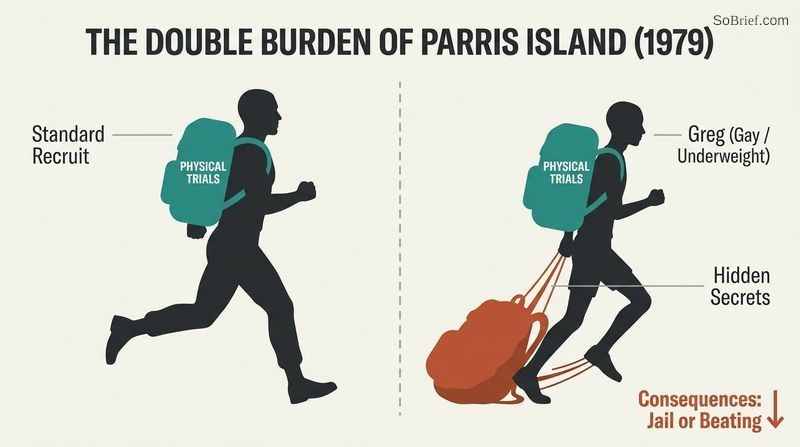
What's striking is the doubling of difficulty the memoir dramatizes. Every recruit fears failure; White fears exposure on top of it. Psychologists studying concealable stigma call this the cognitive load of "passing," the constant self-monitoring that drains mental resources others spend on the task itself. Studies of closeted employees show measurable declines in performance and wellbeing from this vigilance tax. White's estimate that he spent roughly a fifth of his energy managing fear rather than training is a vivid, lived illustration of research that would not be formalized for decades. The hook works because the stakes are genuinely mortal, not merely metaphorical.
Boot camp strips your identity down so it can rebuild you as one unit
Sameness is the method, not a side effect. The Corps systematically erases individuality. Recruits' heads are shaved in seconds, civilian clothes are bagged like trash, and everyone is issued identical camouflage, boots, and gear in a thirty-minute assembly-line rush through showers blasted by fire hoses. Recruits lose the pronoun "I" and must refer to themselves in the third person as "the Private."
Senior Drill Instructor McKinnon delivers the thesis directly: there is no black or white anymore, only shades of green (light green, dark green, and in-between green). The punishment structure reinforces it. When one recruit fails, the entire platoon drops for push-ups. You are blamed for your neighbor's mistakes until the group learns that survival is collective, not individual.
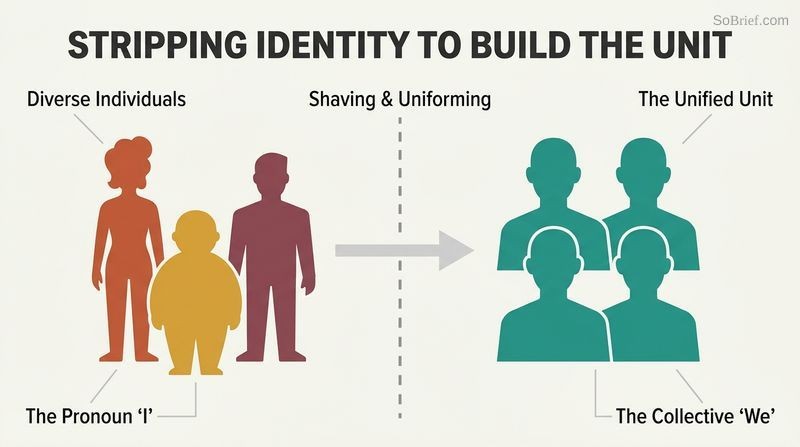
The technique mirrors what sociologist Erving Goffman termed the "total institution," where the self is mortified and reconstituted to serve the group. Militaries worldwide converge on the same tools: uniform dress, synchronized movement, collective punishment. Research on synchronized activity (marching, chanting, singing) shows it measurably increases cooperation and pain tolerance, which is why the drills feel arbitrary but produce cohesion. There is a shadow side White notes honestly: the same machinery that forges brotherhood also breeds resentment toward the weak link and demands the suppression of conscience. The method is powerful precisely because it overrides the individual, for better and worse.
Everyone arrives feeling like the misfit, not just you
Difference is the shared condition. White expected to be uniquely out of place. Instead he discovered a platoon full of people carrying visible or hidden marks of otherness: Bowman, the overweight kid whose family made him fat and who joined to lose fifty pounds; recruits pre-judged for skin color or poverty; men who chose boot camp over prison; Baker, who turns out to be unable to read or write because his recruiter filled out his forms.
White's insight is that the battle for acceptance is fought on many fronts at once. His gayness happened to be invisible, which he came to see as a strange privilege. The overweight and the Black recruits absorbed cheap, open hatred; his difference could at least be hidden.
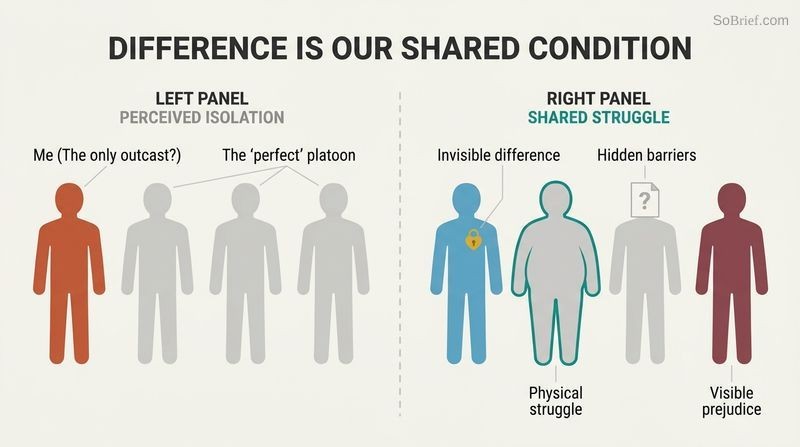
This is the memoir's most humane move: reframing personal shame as a universal human experience. The observation aligns with research on "pluralistic ignorance," the widespread error of believing you are the only one struggling while everyone else has it together. In reality most people are privately managing some version of not-enough. White's point about invisible versus visible stigma is sharp and worth extending. Visible difference invites immediate cruelty but also solidarity and accommodation. Invisible difference offers cover at the cost of chronic isolation and the exhausting labor of concealment. Neither is enviable. The recognition dissolves his sense of being categorically alone.
You can always take one more step, then another
Exhaustion is rarely the true limit. White arrives never having run a mile, done a pull-up, or broken a real sweat. He is convinced his body will betray him. The Corps teaches otherwise through relentless repetition. On his first run, Drill Instructor Santoro forces him to breathe in a five-count rhythm matched to his stride, and the self-consciousness that had paralyzed him dissolves into pure motion.
On the final three-day forced march, loaded with a pack that adds over fifty percent to his slight body weight, he hits mile ten certain he cannot continue. His legs keep moving anyway. The lesson the DIs drive home: the goal is not to make recruits tireless, but to show them they already are, that the ceiling they imagined was self-imposed.
Modern endurance science backs this up. The "central governor" theory proposes that fatigue is partly a protective signal generated by the brain well before muscles actually fail, meaning perceived limits sit below true physiological ones. Athletes trained to reinterpret discomfort routinely exceed prior bests. White's breathing-cadence trick is essentially a mindfulness intervention, narrowing attention to a controllable rhythm to quiet catastrophizing thought. The deeper transferable principle is that capability is often discovered rather than possessed. People who have never tested a limit tend to dramatically underestimate it, which is why structured, supported adversity can be genuinely revelatory rather than merely painful.
Play the room you're in, then slide your true self back when it's safe
A survival strategy learned young becomes armor. White moved thirteen times in eleven years before college, always the new kid on the outside of every inside joke. He learned early to read a room, be likable, and blend in. Being raised Mormon (a faith he privately disbelieved from age ten) taught him to publicly affirm what he did not believe, honing his ability to present a convincing false self.
In boot camp this becomes literal survival. He never tries clumsy hyper-masculinity, knowing he lacks the voice or build to pull it off. Instead he keeps his sexuality "under his helmet," catalogs feminine tells to avoid (limp wrists, hand-on-hip stances, eye-rolling), and zips his real self away, planning to unzip it only when appropriate.
This is code-switching under threat, and the memoir renders its cost without self-pity. Sociolinguists and identity researchers describe such strategic self-presentation as adaptive but taxing, especially when the stakes are safety rather than mere social smoothness. There is an uncomfortable tension the book leaves open: is concealment a betrayal of self or a legitimate act of survival? White frames it as the latter, and given 1979's legal reality, that is defensible. The nuance worth holding is that the same chameleon skill that protected him also reinforced his sense that his authentic self was fundamentally unwelcome, a wound that outlasts any single deception.
Watching Bowman fail, then return transformed, redefined what effort means
Failure need not be final. Early on, four recruits cannot manage even three pull-ups and are dropped, sent to a remedial "Physical Correction Platoon." Among them is Bowman, White's overweight friend who dreamed of walking into his parents' house thin and in uniform. His inability to complete a single pull-up, wept over on the quarterdeck, is one of the book's cruelest moments.
Months later, Bowman returns to the Phase III platoon, visibly thinner, and knocks out roughly thirty pull-ups before the DIs stop him. The whole platoon erupts in cheers. For White, Bowman is a mirror: someone with even longer odds who refused to stay defeated. The message lands harder than any lecture. "Bowman was me. I was Bowman."
The scene illustrates what psychologists call a "growth mindset," the belief that ability is developed through effort rather than fixed at birth. Bowman's arc is textbook: setback, targeted remediation, mastery. But the memoir is honest about the machinery behind it. Bowman did not simply will himself thinner; he was placed in a structured, supervised environment engineered for exactly that outcome. The transformation is inspiring precisely because it was scaffolded, which is a useful corrective to bootstrap mythology. Change of this magnitude rarely happens through solitary grit. It happens when someone is given both high expectations and a system designed to help them meet those expectations.
The Marine's toughest opponent isn't the enemy; it's your own self-doubt
The real war is internal. White's recurring antagonist is not a drill instructor but the voice in his head repeating that he is weak, feminine, and doesn't belong. Santoro, the hyper-masculine ideal DI White both fears and is drawn to, keeps puncturing this. During the rope climb White is sure he cannot do, Santoro's earlier coaching plays in his head and he reaches the top. Santoro's parting line: stop thinking you're average.
The sand-flea test crystallizes it. Locked at attention, a flea burrowing in his ear, White is told by Santoro he can swat it away, that nothing is stopping him. He refuses, holding the position on principle. Discipline, he learns, is choosing the order over the itch, mastering the impulse rather than obeying it.
The sand-flea episode is a small masterpiece of self-regulation training. It maps onto the classic marshmallow-test paradigm: the capacity to override an immediate urge in service of a chosen value predicts a striking range of life outcomes. What the DIs understood intuitively is that willpower strengthens through deliberate exercise under pressure, not through comfort. There is a counterpoint worth raising. Some of these tests blur discipline with domination, and blind obedience has an obvious dark history in military contexts. White's version is generous, reading Santoro's cruelty as tough-love investment. The honest reader can admire the self-mastery while remaining wary of authority that demands it be total.
The platoon beat the weak link so it wouldn't get them killed
Cohesion has a brutal underside. Private Webster is the platoon's persistent liability: lazy, selfish, unapologetic, breaking his leg by falling off his bunk out of sheer sloth, then refusing to help clean and getting the whole platoon punished. The resentment festers. One night, recruits smother him with a pillow and beat him with bars of soap stuffed in socks, a "soap party," while the DIs appear to quietly condone it.
White doesn't swing, but he doesn't stop it either. He supports it. Yet lying awake afterward, he recognizes his hypocrisy. He has feared exactly this his whole life, that whispered hatred would become fists, and knows that if his own secret were exposed, he might be the one under the pillow.
This is the memoir at its most morally uncomfortable, and it earns respect by not flinching. Group cohesion research consistently finds that in-groups punish free-riders, and militaries weaponize this to enforce the principle that one weak member endangers all. But the same dynamic is the engine of mob violence and scapegoating. White's self-indictment is the crucial move: he sees that the machinery producing his belonging is the same machinery that could destroy him. The chapter quietly interrogates whether the brotherhood he craved is worth the cruelty required to maintain it, refusing the easy triumphalism a lesser memoir would reach for.
Reframe cruel labels until they lose their power to wound you
Meaning is assigned, not inherent. The word "faggot" is hurled constantly at Parris Island, often not even aimed at White specifically but soaked up by him personally every time. Scrubbing a filthy chow-hall floor, a Marine calls him one, and White notes his mind is learning to apply salve to the wound.
His stated conclusion: today the word carries no weight for him because he chooses to assign it none. He wryly adds that calling him a bad dresser is what would actually start a fight. The reframe is deliberate cognitive work, deciding which insults get to define you and which are just noise from people who never bothered to know you.
This is essentially cognitive reappraisal, a cornerstone of modern therapy: the emotional charge of an event depends on the meaning you attach to it, and that attachment is at least partly under your control. Reclaiming or neutralizing slurs is a documented resilience strategy in marginalized communities. A caveat keeps it honest, though. Reframing is powerful for personal peace but should not be mistaken for the words being harmless in the world; slurs still signal danger and license violence. White's peace is hard-won and individual. The strategy protects the self without pretending the hostility that produced the slur has actually disappeared.
He hid to get in, then earned pride no one could take away
The lie was the door; the earning was the point. White enters on deception (the taped weight, the false answers about his sexuality) and spends thirteen weeks braced to be discovered. On the final night, McKinnon meritoriously promotes six of seventy-plus recruits to Private First Class. White's name is called. The DI hands him the chevron and says he isn't giving him anything, he earned it.
That single sentence resolves the book's core anxiety. White qualified as a Marksman, aced the hour-long swim float that even the gifted Dale failed, scored high on knowledge and fitness, and did it all while carrying his secret. He walks off Parris Island a Marine, having found, inside an institution that legally forbade his existence, the one thing he lacked: self-acceptance.
The irony anchoring the whole memoir is that authentic self-worth arrived through an organization designed to reject him. This complicates any simple narrative about institutions and belonging. Belonging, the book suggests, is not granted by an institution's official rules but forged through shared ordeal, which can quietly outrun and even contradict those rules. White's arc also reframes the "imposter" feeling: he was, technically, an imposter by the Corps' own standards, yet his competence was fully real. The takeaway is that earned mastery can silence self-doubt even when external validation is conditional or forbidden, because the proof lives in what you actually did, not in who was watching.
Analysis
The Pink Marine is a coming-of-age memoir structured as a chronological immersion, thirteen weeks at Parris Island in 1979, told with a comedian's timing and a survivor's candor. Its difficulty as a summary subject is that its value is atmospheric and cumulative rather than propositional. White is not selling a framework; he is transmitting an experience. The insights must be excavated from scenes, and the humor (essential to the book's texture) resists compression without flattening.
What elevates the book above standard boot-camp narrative is the second, hidden ordeal layered over the shared one. Every recruit endures the shaved heads, the communal toilets, the bends-and-thrusts. White endures all of that plus the unrelenting labor of concealment in an era when discovery meant discharge or violence. This dual structure gives the familiar genre a fresh moral and psychological charge. The memoir effectively becomes a case study in identity management under existential threat, decades before such dynamics were widely researched.
The book's central and somewhat paradoxical claim is that a total institution built to erase individuality and legally hostile to his existence gave White the self-acceptance a permissive civilian life never had. This deserves scrutiny. The Corps did not accept him; it never knew him. What it offered was a meritocracy of ordeal in which competence was measurable and belonging was earned through shared suffering, independent of the official rules. That distinction (between an institution's stated values and the culture forged in its trenches) is the book's most durable intellectual contribution.
The memoir is honest about the cost. The soap-party chapter refuses to sanitize how cohesion breeds cruelty. White implicates himself. That refusal to deliver clean triumph is what makes the eventual triumph credible. Published in 2016, well after the 2011 repeal of Don't Ask, Don't Tell, the book reads as both period document and argument: the man who hid was always fully capable of the title he had to lie to earn.
Review Summary
The Pink Marine chronicles Greg Cope White's experience as a closeted gay man in Marine Corps boot camp during the 1970s, before "Don't Ask, Don't Tell." Reviewers praise White's honest, humorous storytelling and his balanced portrayal of the grueling training that transformed him from directionless youth to confident Marine. Many found it inspiring and moving, appreciating the visceral depiction of boot camp life and the historical perspective on LGBTQ+ service members. Some wished for more coverage of his post-boot camp career. The memoir has been adapted into a Netflix series called "Boots."
People Also Read





Glossary
Snapping in
Locking rifle into firing positionThe technique of using the rifle's canvas strap, wound tightly around the arm, to bind the weapon securely against the shoulder for the steadiest possible firing position. Recruits practiced snapping in and out repeatedly before ever firing a live round, drilling the muscle memory so the rifle would not shift when they shot at targets five hundred yards away.
Bends and thrusts
Punishing repeated squat-thrust exerciseA grueling calisthenic used by drill instructors as "incentive" punishment: bend down, thrust the legs back into a plank, hold briefly, snap the feet back in, and stand at attention, repeated without pause until told to stop. White describes it as the exercise he most hated, performed on command whenever the platoon or an individual erred.
Incentive PT
Exercise used as punishmentPhysical training administered not to build fitness but to punish mistakes and burn lessons into recruits. Push-ups, bends and thrusts, and holding rifles at arm's length were inflicted whenever a recruit fouled up, often applied to the entire platoon collectively so the group would pressure and correct its weakest members.
Soap party
Collective nighttime beating of offenderAn informal, group-administered punishment in which recruits hold down a despised platoon member at night and beat him with bars of soap stuffed inside socks, which inflicts pain without leaving obvious marks. It sends a message to a recruit deemed a dangerous liability. White's platoon does this to Private Webster while the drill instructors seemingly condone it.
Green (light, dark, in-between)
Race-neutralizing unity metaphorSenior Drill Instructor McKinnon's insistence that recruits are no longer Black or white but only shades of Marine Corps green: light green, dark green, and in-between green. It is the Corps' doctrine of enforced sameness, dissolving individual and racial identity into a single unit whose members are responsible to and for one another.
Maggie's Drawers
Signal flag for a missThe solid white circular flag waved by target-pullers at the rifle range to signal that a recruit's shot completely missed the target. Named for a mythical Maggie's flapping underwear, it became the enduring symbol of a soldier's missed shot. Recruits pulling targets sometimes charitably faked hits to spare and encourage the shooter.
Blousing straps
Elastic bands gathering trouser legsElastic bands used to gather the bottoms of camouflage trousers tightly over the boot tops, producing the sharp "snap and pop" bloused look of an experienced Marine. Recruits were denied this privilege during Phase I, so loose trouser bottoms marked newcomers; earning the straps was a milestone signaling advancement toward full Marine status.
FAQ
What’s The Pink Marine by Greg Cope White about?
- Memoir of Marine boot camp: The book is a memoir chronicling Greg Cope White’s experience as a gay recruit in the U.S. Marine Corps boot camp at Parris Island in 1979, before “Don’t Ask, Don’t Tell.”
- Themes of identity and survival: It explores his struggle to hide his sexuality in a hyper-masculine, often hostile environment, while enduring the physical and emotional challenges of training.
- Transformation and growth: The narrative follows his journey from insecurity and fear to self-acceptance and pride as he becomes a Marine.
- Insight into military life: Readers get a vivid, detailed look at the routines, discipline, and camaraderie that define Marine Corps training.
Why should I read The Pink Marine by Greg Cope White?
- Unique LGBTQ+ perspective: The memoir offers a rare, honest look at military life from the viewpoint of a gay man, providing insight into the intersection of sexuality and military culture.
- Inspiring story of resilience: Greg’s journey from self-doubt to earning a meritorious promotion is motivating for anyone facing adversity or seeking self-acceptance.
- Humor and honesty: The book balances serious themes with wit and humor, making it engaging and relatable.
- Cultural and historical insight: It sheds light on the challenges faced by LGBT service members before policy changes and offers a snapshot of late 1970s military culture.
What are the key takeaways from The Pink Marine by Greg Cope White?
- Endurance through adversity: The memoir demonstrates that determination and support can help one survive and thrive in even the most hostile environments.
- Authenticity and self-acceptance: Greg’s story underscores the importance of being true to oneself, even when pressured to conform.
- Transformation through challenge: Boot camp is depicted as a crucible that forges discipline, teamwork, and mental toughness.
- Power of friendship: The bond with his friend Dale highlights the importance of support and solidarity in overcoming hardship.
What are the best quotes from The Pink Marine by Greg Cope White and what do they mean?
- “If I can make it through boot camp, anyone can.” — A message of hope and resilience for those facing adversity.
- “Stop thinking you’re fucking average.” — Drill instructor Santoro’s challenge to Greg, urging him to overcome self-doubt and strive for excellence.
- “Being gay can’t limit me in any way.” — Greg’s assertion that sexual orientation does not define one’s capabilities or worth.
- “Once a Marine, always a Marine.” — The closing line, signifying the lasting pride and identity forged through the Marine Corps experience.
What challenges did Greg Cope White face as a gay recruit in The Pink Marine?
- Constant fear of exposure: Greg lived with the anxiety of being discovered as gay in a military culture that was openly hostile to homosexuality.
- Hostile environment: He endured homophobic slurs, verbal abuse, and the threat of physical violence from both drill instructors and fellow recruits.
- Isolation and secrecy: Hiding his true identity added psychological stress on top of the physical demands of boot camp.
- Coping mechanisms: Greg relied on humor, resilience, and his friendship with Dale to survive the experience.
How does The Pink Marine by Greg Cope White portray Marine Corps boot camp training?
- Intense physical demands: The memoir details grueling exercises like obstacle courses, rope climbs, running, and swimming qualifications, often under harsh conditions.
- Strict discipline: Drill instructors enforce rigid rules, constant corrections, and verbal abuse to break down and rebuild recruits.
- Mental toughness: Recruits must suppress individuality, follow orders, and endure exhaustion, fear, and humiliation.
- Transformation process: The training is designed to create unity, resilience, and a sense of belonging among recruits.
What specific military training experiences are described in The Pink Marine by Greg Cope White?
- Obstacle course and rope climbing: Greg describes the challenge of climbing a thirty-foot rope and completing a timed obstacle course, symbolizing personal growth.
- Gas chamber simulation: The recruits endure tear gas exposure to prepare for chemical warfare, testing their composure and teamwork.
- Rifle range and marksmanship: Detailed accounts of learning to use the M16 rifle, live-fire exercises, and qualifying as a Marksman.
- Swimming and field exercises: The book covers water survival tests and multi-day marches with full gear, highlighting endurance and teamwork.
How does Greg Cope White address his sexual orientation in the military context in The Pink Marine?
- Born gay, not made: Greg asserts his inherent identity, stating he was born gay and not shaped by his environment.
- Fear and secrecy: He describes the constant anxiety of hiding his sexuality, knowing discovery could lead to discharge.
- Navigating social spaces: Greg manages his identity internally while conforming externally, especially during communal activities.
- Moments of acceptance: Despite fears, he finds acceptance from his friend Dale and, at times, from drill instructors.
What role does friendship, especially with Dale, play in The Pink Marine by Greg Cope White?
- Emotional anchor: Dale, Greg’s best friend, provides crucial support and reassurance throughout boot camp.
- Mutual support: Their decision to enlist together on the Buddy System helps them face the challenges of training.
- Contrast with military culture: Dale’s acceptance of Greg’s sexuality highlights the importance of personal support networks in a hostile environment.
- Shared challenges: Both friends face physical and emotional trials, strengthening their bond.
How does The Pink Marine by Greg Cope White explore identity and masculinity?
- Struggle with masculinity: Greg feels less masculine due to his physique and sexual orientation, which conflicts with Marine ideals.
- Military as a proving ground: Boot camp challenges recruits to embody toughness, strength, and conformity.
- Redefining masculinity: Greg learns that endurance, courage, and authenticity are also masculine traits, not just physical strength.
- Internal conflict: The memoir delves into Greg’s efforts to reconcile his identity as a gay man with the hyper-masculine military culture.
What is the significance of Marine Corps traditions and rituals in The Pink Marine by Greg Cope White?
- Building unity and discipline: Traditions like marching cadences, singing the Marine Corps anthem, and uniform inspections foster group cohesion.
- Symbolism of uniforms: Progression through different uniforms marks achievement and belonging, with dress blues symbolizing honor and pride.
- Rites of passage: Milestones such as the first haircut, gas chamber, and final inspection mark the transformation into a Marine.
- Emotional resonance: These rituals connect recruits to the Corps’ history and values, creating lifelong pride.
What lessons about leadership, teamwork, and personal growth does Greg Cope White share in The Pink Marine?
- Obedience and discipline: The book emphasizes the importance of following orders and trusting leadership for military effectiveness.
- Unit cohesion: Success depends on teamwork, mutual support, and not letting individual weaknesses endanger the group.
- Leadership roles: Leadership is earned through competence and trust, as seen with Dale’s role as squad leader.
- Personal growth: Greg’s journey from insecurity to self-acceptance demonstrates the power of perseverance, mindset, and community support.
Download PDF
Download EPUB
.epub digital book format is ideal for reading ebooks on phones, tablets, and e-readers.








































