

Key Takeaways
Most churches disciple only the left brain, and it's the wrong half
Character forms in the right brain, not the left. Pastor Michel Hendricks felt stuck: his megachurch discipleship worked only sometimes. Then neurotheologian Jim Wilder pulled a plastic brain from his briefcase and explained the dual processor design. The right hemisphere (the fast track) governs identity, emotional attunement, relational attachment, and character. It samples reality six times per second, faster than conscious thought. The left (slow track) handles logic, language, doctrine, and strategy.
Most Western churches run on left-brain fuel: sermons, Bible studies, applications urging better choices. Yet character is our instantaneous, preconscious reaction to life, which willpower and information cannot reach directly. Trying to change spontaneous reactions through conscious teaching is putting the cart before the horse.
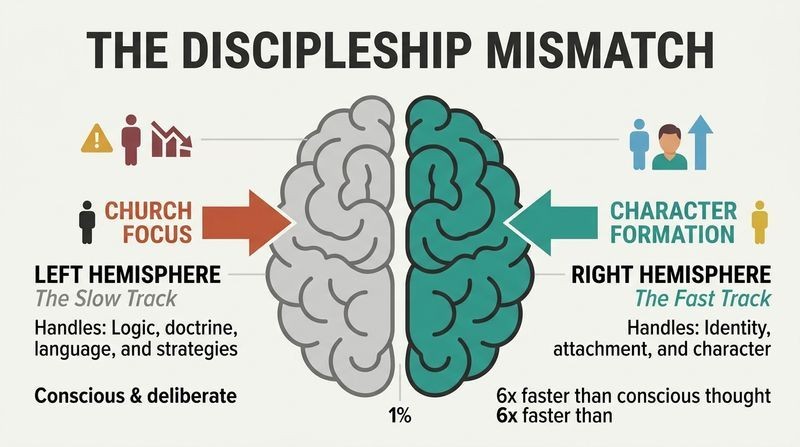
The left-brain/right-brain split is a simplification, and neuroscientists like Iain McGilchrist argue the hemispheres differ in how they attend to the world rather than what tasks they perform. Wilder acknowledges the control-versus-tendrils nuance in his footnotes. Still, the core claim aligns with dual-process theory (Kahneman's System 1 and System 2): fast, automatic processing shapes behavior more than slow deliberation. The pastoral insight is genuinely useful. Endless sermonizing about honesty rarely rewires the reflex to lie under pressure. The framing invites a productive question for any change-oriented institution: are you teaching information when you should be shaping automatic responses?
Your brain runs on joy, and joy means someone's glad to see you
Joy is relational, not circumstantial. Drawing on UCLA researcher Allan Schore, Wilder defines joy neurologically as the feeling of being the sparkle in someone's eye, the sense that another person is happy to be with you. It transmits through faces and eyes first, voice second. The Hebrew blessing about God's face shining on you describes this literally, though many translations soften it into a vague concept of God's presence, erasing the bodily sensation.
Wilder's trauma clinic proved the stakes. Patients once required hospitalization mid-treatment because emotionally taxing work drained empty tanks. When the clinic built patients' joy first, hospitalizations dropped to nearly zero. Joy is a supra-emotion: it layers atop sadness or fear, letting you stay connected while suffering rather than isolating.
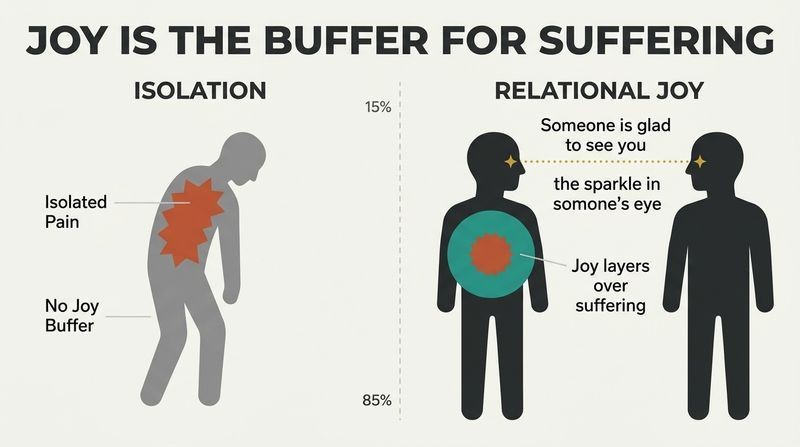
This reframing of joy as relational rather than as happiness is its most valuable move. It converges with attachment research and with polyvagal theory, where Stephen Porges shows the human nervous system co-regulates through facial cues and vocal tone. The claim that screens cannot substitute for live faces echoes findings that infants learn language poorly from video versus in-person interaction. One caution: defining joy strictly as another's delight risks making it contingent on being liked, which could distress the chronically lonely. Wilder partly addresses this by rooting ultimate joy in God's face, but the social dependency remains a real vulnerability worth naming.
Treat your community like garden soil, not like a seed catalog
Four nutrients determine what grows. Hendricks discovered his backyard tomatoes dwindled not from bad seeds or watering but from depleted soil. The metaphor organizes the whole book: spiritual disciplines are good seeds, but they yield little in exhausted relational soil. The four nutrients are joy, hesed (loving attachment), group identity, and healthy correction. When present, character transformation becomes commonplace. When absent, growth stalls no matter how solid the teaching.
This explained his inconsistent results as a pastor. Two men on identical Bible-reading plans thrived or froze depending on their relational starting point. Greg, joy-full and connected, devoured the New Testament. Chris, low on joy and carrying shame from past pressure, shut down. Same seed, different soil.
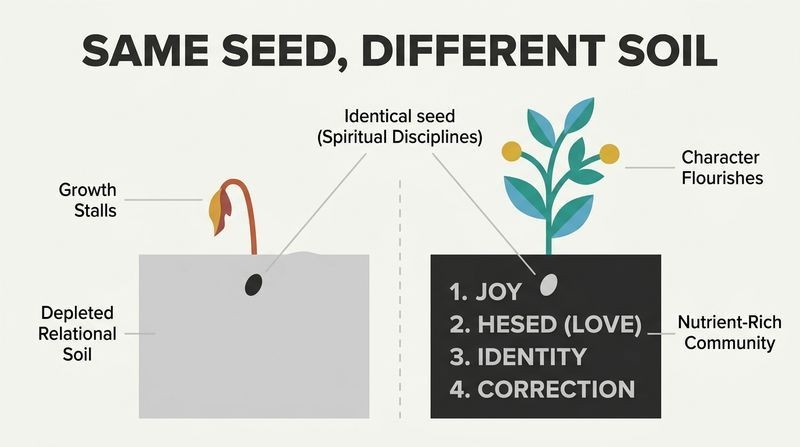
The soil framework is the book's organizing genius, and it echoes systems thinking across disciplines: outcomes depend on the environment, not just the intervention. Educational research on psychological safety (Amy Edmondson) shows teams learn only when the relational ground is secure enough to risk failure. The framework's strength is diagnostic humility. Instead of blaming the person who won't change, examine the conditions. Its limitation is testability. With four interacting nutrients plus a narcissism variable, nearly any outcome can be retrofitted to the model. The appendix soil-assessment scales are an admirable attempt to operationalize something inherently fuzzy, but they remain self-report proxies.
Love is contact cement: hesed is the glue that reshapes character
We become like the people we're attached to. Hesed is a Hebrew word for enduring, loyal, covenant love that appears throughout the Old Testament, translated variously as steadfast love, lovingkindness, or mercy. Wilder equates it with what neuroscientists call attachment, the strongest force in the human brain, operating below willful control. He compares it to contact cement: once two surfaces bond, prying them apart destroys both.
Attachment is why character forms through community rather than solitary effort. The brain's identity center grows from joyful bonds, ideally an infant's triad with two delighted parents. Weak or fearful attachments build a fragile identity that fractures under stress. The Enlightenment formula (transformation equals truth plus good choices plus power) fails because it omits the prime mover: love.
Placing attachment at the center of moral formation is well supported. Bowlby and Ainsworth established that secure attachment predicts emotional regulation and social competence across the lifespan. The claim that we imitate those we love aligns with social learning theory (Bandura) and mirror-neuron research. Wilder's reading of the Ephesian church in Revelation, rebuked for abandoning its first love despite excellent doctrine, is a sharp application. One tension: attachment can also transmit dysfunction, as the book itself notes with narcissism spreading through communities. Strong bonds amplify whatever is being modeled, good or toxic. Hesed is powerful precisely because it is morally neutral machinery requiring Christlike content.
Remind people who they are instead of listing rules to obey
Group identity trains reactions willpower can't touch. Around age twelve the brain balances individual identity with group identity, and from then on the question driving character becomes: what do my people do here? The right brain answers six times a second, faster than thought. So the way to change a hot temper is not to try harder next time but to absorb a community's shared sense of what kind of people we are.
Hendricks experienced this at nineteen when his roommate Steve calmly reframed sex within a Christian worldview. His libraries of stored examples and values were being rewritten. The Sermon on the Mount, Wilder argues, is largely identity formation: we are people who reconcile quickly, love enemies, keep our word. Toxic identities also form, around fame, addiction labels, or, in the extreme, Nazi ideology.
The insight that identity precedes behavior inverts the standard moralistic sequence, and it has empirical backing. Behavioral studies show identity-based framing (be a voter) outperforms action-based framing (go vote). Aristotle argued virtue is habituated within a polis, not reasoned into individuals. Wilder's warning that group identity is morally double-edged is crucial and honest. The same mechanism that produces saints produces mobs. This raises a governance question the book gestures at but leaves open: who guards the guardians of identity? If community defines the self, a corrupted community corrupts selves at scale, which is precisely why the fourth nutrient, correction, becomes indispensable.
Stop being so nice: healthy shame is required for character to change
No pain, no change. Wilder distinguishes two kinds of shame. Toxic shame says you are bad and offers no way out (you'll always be a loser), leaving the person isolated. Healthy shame is a nonverbal signal that you've briefly stopped bringing joy, delivered inside a secure relationship with an immediate path back. The brain, like a smoke alarm, only corrects problems that cause discomfort. Remove all shame and character has zero motivation to change.
Healthy correction follows a shape: affirm the relationship first, name the specific lapse, then invite the person back into group identity (we don't do X; we are people who do Y). Jesus modeled this with Martha (saying her name twice before correcting) and with disciples thrilled by their power over demons. The barrier to receiving it is self-justification, the stiff-necked reflex of King Saul.
Reclaiming shame as developmentally necessary cuts against a therapeutic culture that treats all shame as toxic (Brene Brown, for instance, sharply separates guilt from shame and warns against the latter). Wilder's move is to redefine the term rather than abandon it, distinguishing relationship-preserving from relationship-severing correction. Developmentally he has a point: socialization research shows appropriate, repairable shame at around age two helps toddlers internalize norms. The risk is semantic. Because shame carries such heavy baggage, insisting on the word (rather than conviction or accountability) may retraumatize people whose shame was never healthy. The underlying mechanism, correction embedded in secure attachment, is sound regardless of the label.
Narcissism is a shame allergy, and it flourishes in depleted soil
Winning replaces metabolizing shame. Wilder defines a narcissist, in character terms rather than clinical diagnosis, as someone unable to metabolize shame relationally. Unable to feel special through love, they pursue it through performance, position, and winning. Correction becomes an argument they must win; they wield toxic shame skillfully while deflecting all of it through self-justification.
The crucial claim is systemic: narcissism is an infection that thrives in low-joy, weak-hesed, shallow-identity soil, especially in leadership. Wilder cites recurring headlines of pastors accused of abuse whose boards rubber-stamped denials until evidence became overwhelming. Firing the individual without enriching the soil just invites the next narcissist. Warning signs include an us-versus-them mentality, harsh unexplained firings, ministry elevated above relationships, and a submissive bubble of enablers who eject anyone who pushes back.
Framing narcissism as an environmental disease rather than merely an individual pathology is the book's most provocative and practically useful claim. It parallels organizational research showing toxic leadership is enabled by cultures lacking psychological safety and accountability. Wilder's brain framing (Predatory Enemy Mode, where attachment circuits switch off while manipulation circuits stay online) is evocative, though it outruns the peer-reviewed evidence and should be read as a heuristic. The book wisely notes the clinical category of narcissistic personality disorder is contested. The strongest contribution is prescriptive: communities that train members to reject condemnation and correct everyone remove the narcissist's primary weapons, toxic shame and self-justification.
Detect Enemy Mode, when people become problems to defeat
Relational circuits can trip like a breaker. When the brain is running well, we are in Relational Mode: curious about others, protective, treating relationships as more important than the problem. Under emotional overload, circuits can dim, flipping us into Enemy Mode. In Simple Enemy Mode all relational circuits shut off and we just want a person or problem to go away (snapping at a loved one). In Predatory Enemy Mode the attachment circuits go dark while the rest stay sharp, tracking others' weaknesses to exploit them.
The practical skill is noticing when you've flipped, then getting back. For Simple Enemy Mode: quiet yourself and talk to God about your emotions. For Predatory Enemy Mode: share the opponent's pain and pray for them. Hendricks caught himself yelling at a hesitant driver, recognized the shift, and imagined the driver's own frozen fear until compassion returned.
Enemy Mode maps neatly onto well-documented phenomena. The fight-flight-freeze response and amygdala hijack describe how stress suppresses prefrontal, socially attuned processing. The distinction between simply wanting escape and coldly hunting weakness is a genuinely useful refinement rarely made in popular psychology. The prescribed exit, sharing an adversary's pain, resonates with research on perspective-taking and empathy as de-escalators of conflict. The everyday application (giving a spouse permission to flag when you've flipped) is behaviorally smart because self-detection fails precisely when circuits are offline. The main limitation is that naming a state does not automatically confer the capacity to exit it, which is why the book stresses repeated practice over insight.
Build joy on demand through five minutes of daily gratitude
Gratitude is the on-ramp to joy. You cannot will yourself joyful any more than you can will lower blood pressure; both are regulated indirectly. Wilder's exercise: recall a specific memory that stirs gratitude and connection with God, give it a short title (Hendricks used red-tailed hawk), relive it for ten seconds, and notice the bodily sensation. Build a list of at least ten such memories, then spend five minutes daily in nonverbal gratitude.
Two features keep it right-brained: you must feel something in your body, and you must sense connection with God. The thirty-day version escalates to five minutes three times daily, which resets the brain's default emotional state toward joy. Couples and families can add face-to-face joy practice: brief eye contact, a smile, then quiet, cycling joy-quiet-quiet, the same rhythm that wires an infant's brain.
This is the book's most concrete, testable practice, and it rests on solid ground. Gratitude interventions are among the most replicated findings in positive psychology (Emmons and McCullough showed gratitude journaling improves wellbeing and even sleep). The insistence on bodily sensation aligns with somatic and mindfulness research suggesting interoception strengthens emotional regulation. The joy-quiet cycle mirrors attachment research on rupture and repair, where attunement matters less than the rhythmic return to connection. One practical caveat: the required embodied sensation is difficult for those with alexithymia or trauma histories, who may feel numbness rather than warmth. Wilder's grace-giving instruction (this is a muscle you haven't used) is appropriate.
A healthy pastor stays small so Jesus stays large
Trainers, not celebrities. Wilder argues the emotionally mature leader deliberately shrinks. Just as we rarely know the drill sergeants who trained war heroes or the piano teacher who first taught Beethoven, the relational pastor is largely unknown outside the church, thankful people never talk about him, only about Jesus. This directly counters modern church culture, where stages, giant screens, and honorific titles magnify one personality, the very setup Jesus warned against when he told disciples the greatest must become the servant of all.
The alternative is a decentralized, family-like community. Wilder points to Paul's description of a gathering where each member contributes a song, teaching, or insight, effectively erasing the clergy-laity divide. Leaders openly share weakness, ask for correction, and distribute responsibility rather than running frantically on a hamster wheel of tasks.
The critique of platform-driven ministry is timely given the steady stream of celebrity-pastor collapses. Wilder connects this structurally to narcissism: the elevated stage lets leaders appear intimate while avoiding real attachment. This dovetails with organizational research on Level 5 Leadership (Jim Collins), where the most effective leaders blend fierce resolve with personal humility and deflect credit. The image-shrinkification idea also echoes Robert Greenleaf's servant leadership. The tension worth surfacing is scale. The participatory, everyone-contributes model Wilder draws from Corinth is hard to sustain beyond small groups, which may explain why megachurches drift toward broadcast models. Decentralization solves the narcissism problem but reintroduces the coordination problem it was designed to escape.
You are not to blame for your maturity gaps, but you must repair them
Maturity comes in stages with specific skills. Wilder maps five developmental levels: Infant, Child, Adult, Parent, and Elder, each with tasks and needs. Crucial infant-stage skills (quieting yourself, returning to joy from every emotion, staying the same person under distress) ideally form before age four. Because our parents carried their own holes, they passed holes to us. A person can be chronologically forty yet missing infant-level skills, which is why addictions and identity collapse under stress signal early gaps, not moral failure.
The liberating reframe: immaturity is not sin, though it makes sinning easier, and it says nothing about your value or God's love. You aren't culpable for skills your caregivers never gave you. You are, however, responsible for going back and filling them now, in community, since maturity cannot transfer through teaching alone.
Separating blame from responsibility is psychologically astute and therapeutically standard. Trauma-informed care rests on the same premise: what happened to you is not your fault, but healing is your work. The staged-maturity model resembles Erikson's psychosocial stages and Kegan's adult development theory, both of which describe capacities unfolding in sequence, each built on the last. The claim that key emotional regulation wires before age four is broadly consistent with developmental neuroscience on early attachment and the prefrontal cortex. The framework's practical risk is over-diagnosis: labeling every struggling adult as stuck at infant maturity can pathologize normal difficulty. Used gently, though, it replaces shame with a repairable to-do list.
Analysis
This is a thesis-driven Christian discipleship book that fuses interpersonal neurobiology with pastoral theology, told through Michel Hendricks's first-person conversion from frustrated megachurch pastor to full-brained disciple, with Jim Wilder supplying the science. Its structure is elegant: a diagnosis (Western Christianity is left-brained and therefore fails to form character), a governing metaphor (relational soil with four nutrients), and a payoff (that same soil resists the narcissism plaguing church leadership).
The book's central intellectual bet is that spiritual formation has been sabotaged by an Enlightenment anthropology reducing humans to what James K. A. Smith calls brains-on-a-stick. This is a defensible historical claim and resonates with a broader academic turn toward embodied cognition, affective neuroscience, and virtue ethics. The strongest material is not the neuroscience, which is popularized and occasionally outruns its evidence, but the pastoral phenomenology. Hendricks names something real: knowledge that fails to become character, communities rich in doctrine and poor in love, and the mystery of why identical practices transform one person and bounce off another.
The weaknesses are the flip side of the strengths. The left-brain/right-brain schema is a simplification that specialists would contest, and a four-nutrient model plus a narcissism variable is nearly unfalsifiable, able to explain any outcome after the fact. The insistence on the word shame, however carefully redefined, may confuse more than clarify given the term's cultural weight.
What makes the book durable is its integration. It refuses the body-soul dualism it critiques, treats love as machinery rather than sentiment, and offers concrete practices (gratitude drills, joy-quiet cycles, healthy-correction scripts) rather than mere exhortation. Its most transferable insight extends well beyond church: environments shape people more than instructions do, and any institution serious about transformation must tend its relational soil before demanding its fruit.
Review Summary
The Other Half of Church receives mostly positive reviews, with readers praising its insights on spiritual formation and brain science. Many find its emphasis on relational growth, joy, and community transformative. The book's practical applications and discussion of narcissism are appreciated. However, some criticize it for oversimplifying neuroscience, lacking practicality in places, and potentially incorporating New Age concepts. Despite mixed opinions on writing style and depth, many readers consider it a valuable resource for personal growth and church leadership.
People Also Read







FAQ
What's "The Other Half of Church" about?
- Integration of Brain Science and Faith: The book explores how brain science can be integrated with Christian discipleship to overcome spiritual stagnation.
- Focus on Right-Brain Development: It emphasizes the importance of right-brain functions like joy, attachment, and identity in spiritual growth.
- Transformational Community: The authors propose creating a community that nurtures these right-brain functions to foster personal and congregational transformation.
- Practical Guidance: It offers practical advice and exercises to help churches and individuals develop a full-brained approach to discipleship.
Why should I read "The Other Half of Church"?
- Address Spiritual Stagnation: If you're experiencing spiritual stagnation, this book provides insights into why it happens and how to overcome it.
- Innovative Approach: It combines neuroscience with biblical teachings, offering a fresh perspective on spiritual growth.
- Practical Tools: The book includes exercises and strategies that can be applied in personal and church settings to enhance spiritual development.
- Community Focus: It emphasizes the importance of community and relationships in spiritual formation, which can be transformative for church dynamics.
What are the key takeaways of "The Other Half of Church"?
- Right-Brain Importance: The right brain is crucial for character change and spiritual formation, focusing on joy, attachment, and identity.
- Joy and Attachment: Joy and strong relational attachments (hesed) are foundational for spiritual growth and should be nurtured in church communities.
- Group Identity: Developing a strong group identity based on the character of Jesus is essential for personal and communal transformation.
- Healthy Correction: Implementing healthy correction practices within a community can lead to significant character development.
How does "The Other Half of Church" integrate brain science with Christian discipleship?
- Dual Brain Processors: The book explains how the brain's right and left hemispheres process information differently, with the right brain being key to relational and emotional development.
- Joy and Attachment: It highlights how joy and attachment are processed in the right brain and are essential for spiritual growth.
- Practical Exercises: The authors provide exercises that engage the right brain, such as gratitude practices and relational skills training.
- Scientific Support: The book uses findings from neuroscience to support its claims about the importance of right-brain functions in discipleship.
What is the role of joy in "The Other Half of Church"?
- Joy as Fuel: Joy is described as the fuel for the brain, essential for emotional and relational health.
- Relational Joy: It is defined as the feeling when someone is glad to be with you, and it's crucial for building strong community bonds.
- Joy and Suffering: Joy helps individuals endure suffering by maintaining relational connections with God and others.
- Building Joy: The book offers practical steps to increase joy capacity, such as gratitude exercises and face-to-face interactions.
How does "The Other Half of Church" define hesed?
- Enduring Love: Hesed is described as an enduring, covenantal love that forms strong relational attachments.
- Biblical Foundation: The book connects hesed to biblical teachings, emphasizing its role in forming character and community.
- Attachment Theory: It aligns hesed with attachment theory, suggesting that strong attachments are crucial for spiritual growth.
- Community Glue: Hesed acts as the relational glue that holds communities together, fostering a family-like environment.
What is the significance of group identity in "The Other Half of Church"?
- Character Formation: Group identity helps shape individual character by providing a model of how "our people" act.
- Biblical Examples: The book uses biblical teachings to illustrate the importance of group identity in the early church.
- Identity Statements: It suggests creating identity statements that reflect the character of Jesus to guide community behavior.
- Cultural Impact: A strong group identity can counteract cultural fragmentation and provide a cohesive narrative for living as Christians.
How does "The Other Half of Church" address correction within a community?
- Healthy Shame: The book distinguishes between toxic and healthy shame, advocating for correction that affirms relationships.
- Character Development: Correction is seen as essential for character development, helping individuals return to their true identity.
- Community Practice: It encourages communities to practice healthy correction regularly, making it a part of their relational DNA.
- Avoiding Condemnation: The book emphasizes rejecting condemnation and focusing on relational solutions to character flaws.
What are the signs of narcissism according to "The Other Half of Church"?
- Shame Dysfunction: Narcissism is described as an inability to metabolize shame relationally, leading to self-justification and condemnation.
- Leadership Issues: Narcissistic leaders often prioritize winning and performance over relationships, causing harm to communities.
- Community Vulnerability: Churches with depleted relational soil are more susceptible to narcissistic influences.
- Healing Potential: The book suggests that a community with healthy soil can offer healing to narcissistic individuals through love and correction.
How can a church become resistant to narcissism according to "The Other Half of Church"?
- Rich Relational Soil: Building a community rich in joy, hesed, and group identity creates an environment resistant to narcissism.
- Culture of Correction: Implementing a culture of healthy correction helps prevent narcissistic behavior from taking root.
- Loving Enemies: Training to love difficult people, including narcissists, strengthens the community's relational bonds.
- Community Vigilance: A vigilant community that recognizes and addresses narcissistic behavior can maintain its health and integrity.
What are the best quotes from "The Other Half of Church" and what do they mean?
- "Joy is the fuel for the brain": This quote emphasizes the importance of joy in maintaining emotional and relational health.
- "Hesed is the glue that holds communities together": It highlights the role of enduring love in forming strong, transformative communities.
- "Group identity shapes individual character": This underscores the influence of community values on personal behavior and spiritual growth.
- "Healthy correction is an invitation to return to our true identity": It reflects the book's approach to correction as a loving, relational process.
What practical exercises does "The Other Half of Church" recommend for spiritual growth?
- Gratitude Practices: The book suggests daily gratitude exercises to increase joy capacity and strengthen relational bonds.
- Joy Building: It recommends face-to-face interactions and intentional joy-building activities within communities.
- Identity Statements: Creating and repeating group identity statements to reinforce community values and character.
- Correction Training: Practicing healthy correction techniques to foster a culture of growth and transformation.
Download PDF
Download EPUB
.epub digital book format is ideal for reading ebooks on phones, tablets, and e-readers.








































