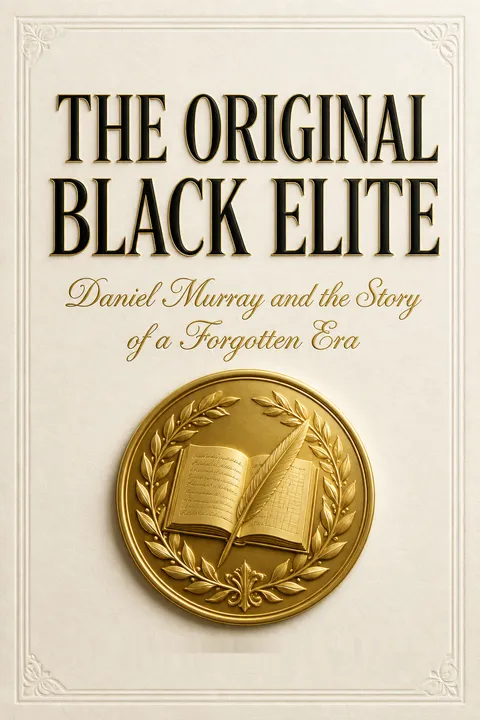

Key Takeaways
1. Daniel Murray's Ascent: A Self-Made Man in Washington's Early Black Elite
The recognition bestowed on Murray by Washington’s leading citizens with his inclusion on the “famous committee” was the kind for which he had worked assiduously, traveling far from a humble start in life.
Humble beginnings. Daniel Murray, born free in Baltimore in 1851 to a formerly enslaved father and an illiterate mother, rose through sheer ambition and intellect to become a prominent figure in Washington D.C.'s black elite. His early life was marked by a strong emphasis on education, with private tutors supplementing his grammar school studies, and a keen understanding of financial prudence instilled by his mother. This foundation set him apart, enabling him to navigate the complex social landscape of post-Civil War America.
Early career and mentorship. Murray's journey to influence began in the Capitol, working in his half-brother Samuel Proctor's Senate restaurant. There, he caught the attention of influential white figures like Senator Timothy Howe and Librarian of Congress Ainsworth Rand Spofford. Spofford, recognizing Murray's "amazing talent" and "untiring energy," took him under his wing, training him in all aspects of librarianship and encouraging his self-cultivation, leading to his appointment as an assistant librarian in 1871.
Financial acumen. Beyond his government work, Murray demonstrated remarkable business savvy, particularly in real estate. He leveraged his savings and Spofford's financial advice to invest wisely in Washington D.C.'s burgeoning property market, building and renting out houses. This dual income stream provided the economic security necessary to sustain an upper-class lifestyle and pursue his broader ambitions for racial uplift, distinguishing him as one of the city's wealthiest African Americans.
2. The Paradox of the Black Elite: Privilege Amidst Pervasive Prejudice
There is an aristocracy among the colored people of Washington as well as among the white, and it is quite as exclusive.
An exclusive society. Washington D.C.'s "colored aristocracy" was a small, tightly-knit group of well-educated, refined, and prosperous African American families, often lighter-skinned, who maintained their own social circles, balls, and dinner parties. They saw themselves as distinct from the broader black population, valuing "good breeding" and cultural attainment, and were protective of their hard-won status in a society that often denied them recognition.
Navigating white society. While socially exclusive among themselves, members of the black elite frequently interacted with influential whites in professional and civic capacities, and sometimes even socially. They believed their achievements served as living proof against white supremacist arguments of black inferiority, hoping to pave the way for broader assimilation. However, this interaction often came with unspoken boundaries:
- White patrons were willing to engage in business but drew the line at social equality.
- Networking opportunities, crucial for advancement, were often denied in informal white-only gatherings.
- Black elites faced the constant challenge of being judged as a collective, with the "errors and crimes of one" reflecting on the "whole body."
Internal critiques and aspirations. Despite their privileged position, the black elite faced criticism from within the black community for perceived snobbery and color prejudice. Yet, they maintained a strong sense of "noblesse oblige," believing their success and gentility would inspire the black masses and demonstrate the race's potential to whites. They were "primed to think of themselves as Americans first and foremost, with no apology for color," striving for a single, integrated society.
3. Reconstruction's Promise and the Crushing Weight of Betrayal
The slave went free; stood a brief moment in the sun; then moved back again toward slavery.
A fleeting dawn. Following Emancipation, the Reconstruction era brought a period of unprecedented progress and hope for African Americans, particularly in Washington D.C. Congressional actions like the 1866 Civil Rights Act, the Fourteenth and Fifteenth Amendments, and local suffrage for black men created a sense of burgeoning equality and opportunity. Black citizens actively participated in politics, held public office, and established thriving communities, believing the momentum was on their side.
The Wormley Agreement's shadow. This "glorious harvest of good things" was tragically cut short by the Compromise of 1877, often referred to as the Wormley Agreement. In exchange for the presidency, Republicans agreed to withdraw federal troops from the South, effectively abandoning black citizens to renewed oppression by white supremacists. This betrayal marked the beginning of a "backward slide" where the federal government not only failed to protect black rights but actively facilitated their erosion.
Systemic oppression. The post-Reconstruction period saw the rapid implementation of Jim Crow laws, legalizing segregation and discrimination across all aspects of life, from public accommodations to voting rights. This was compounded by extralegal violence, including lynchings, which the government largely ignored. For the black elite, who had risen furthest, the fall was particularly painful, as they realized their achievements and gentility offered no exemption from the pervasive racism that now defined American society.
4. Daniel Murray's Visionary Quest to Document Black Literary Achievement
The chief glory of every people arises from its authors.
A monumental undertaking. Daniel Murray embarked on a "task of herculean proportions" to compile a comprehensive bibliography and biographical encyclopedia of works by African Americans worldwide. This project, initially spurred by a request for the 1900 Paris Exposition, became his life's passion, driven by a profound belief that literature was the "real test of the standing of a people in the ranks of civilization" and a powerful tool to combat prejudice.
Challenging ignorance. Murray's research aimed to "show to the world that the colored race... is entitled to greater credit than is now accorded to it by the American people." He meticulously gathered thousands of titles and biographical sketches, often from obscure sources, to demonstrate the intellectual capacity and literary fecundity of black authors. His efforts were a direct response to the prevailing ignorance and dismissive attitudes, as exemplified by critics who claimed "there is no such thing as Negro literature."
A Sisyphian labor. Despite his "unflagging zeal" and the growing recognition of his expertise, Murray faced immense challenges in publishing his multi-volume encyclopedia. He self-funded a prospectus, sought subscriptions, and appealed to institutions like the Carnegie Institution, but the sheer scale of the project and the lack of financial backing proved insurmountable. Though his magnum opus remained unpublished in his lifetime, his "Daniel A. P. Murray Pamphlet Collection" at the Library of Congress and his influence on later scholars laid crucial groundwork for the black history movement.
5. Anna Murray's Pioneering Advocacy for Early Childhood Education and Women's Uplift
Education is a pearl of great price by which you will be able to set yourself free in your environment, wherever that may be.
A mother's mission. Anna Murray, deeply influenced by her own mother's emphasis on education and her experiences teaching in segregated schools, became a tireless advocate for early childhood education, particularly for black children. She believed that kindergartens were "that saving grace to the masses of our race," essential for molding character and instilling values in children who often lacked such influences at home.
Building a movement. As chairwoman of the Colored Woman's League's kindergarten committee, Anna launched her efforts "without the first penny to begin with." Her indefatigable fundraising and organizational skills led to:
- The establishment of University Park Kindergarten, the first for black children in Washington D.C.
- A series of "Mothers' Meetings" to educate working women on child care and home economy.
- The founding of a Kindergarten Training School for black teachers, supported by philanthropist Phoebe Hearst.
- Successful lobbying of Congress to secure federal funds for kindergarten education in D.C., a national first.
"Lifting as We Climb." Anna's activism extended beyond kindergartens to broader women's uplift, aligning with the National Association of Colored Women's motto. She championed day nurseries for working mothers and taught domestic economy to young girls in her home. A gifted orator, she traveled the country, delivering "scholarly and magnetic addresses" that stressed the importance of home-building and early education as "the solution to the race question," earning her national prominence as a "race speaker."
6. The Deepening Shadow of Jim Crow: A Relentless Erosion of Rights
The growth of color prejudice in Washington, the capital of the nation, is alarming. Things have grown decidedly worse during the last few years.
From promise to peril. The initial optimism of Reconstruction gave way to a stark reality as Jim Crow laws and practices intensified, even in the nation's capital. What began as "anomalies" of prejudice evolved into a pervasive system of segregation and discrimination, affecting every aspect of life for African Americans, regardless of their social standing or achievements.
Everyday indignities. The black elite, once afforded some flexibility in the color line, found themselves increasingly subjected to the same humiliating restrictions as all other black citizens. Examples included:
- Refusal of service at hotels and restaurants, often with flimsy excuses.
- Segregation on public transportation, with "Jim Crow cars" extending into D.C.
- Exclusion from public facilities like bathing beaches and even cemeteries.
- Housing discrimination, making it difficult for black families to purchase homes in desirable neighborhoods.
- Police profiling and biased judicial systems, where "the appearance of a Negro in a Washington police court is a fair presumption of guilt."
Government complicity. The federal government, particularly under the Wilson administration, not only failed to protect black citizens but actively implemented segregation in federal offices and public places. This official sanctioning of racism, coupled with Supreme Court decisions like Plessy v. Ferguson (1896) that upheld "separate but equal," solidified American apartheid and left African Americans feeling "abandoned to our fate."
7. Complexities of Identity: Colorism and Class Divisions Within the Black Community
The high-caste negroes who bring about all the ill feeling... The ordinary colored woman understands her position thoroughly.
Internal hierarchies. While united against white supremacy, the black community itself was not monolithic, exhibiting complex internal divisions based on class, education, and skin color. The black elite, often lighter-skinned, faced accusations of snobbery and "color prejudice" from darker-skinned African Americans, creating "war of the social cliques" and hindering unified action.
Murray's controversial theories. Daniel Murray, himself of mixed-race ancestry, delved into these complexities with his "Power of Blood Inheritance" essay, positing a theory of racial hierarchy that claimed mixed-race Americans were superior to both whites and "undiluted" blacks. He argued that:
- Mixed-bloods possessed "all the mentality of his white progenitor, sustained by the stamina and endurance of his African."
- They represented "the beginning of a new race, the true American standard."
- This theory, while intended to "establish the high character" of mixed-race individuals, inadvertently disparaged dark-skinned blacks and fueled internal divisions.
The "one-drop rule" inverted. Murray also strategically appropriated the "one-drop rule" to claim prominent figures like Robert Browning and Alexander Hamilton as having African ancestry, aiming to "show that a strain of African blood was not to be despised." However, this approach, while challenging white notions of racial purity, often led to conclusions that "straight blacks appear to have done almost nothing," further complicating the fight for universal black recognition and equality.
8. The Unyielding Fight for Civic Participation and Civil Service Integrity
The solving of the problem consists in bringing those diverse elements together.
Advocating for home rule. In Washington D.C., where residents lacked voting rights and local governance was controlled by Congress and presidential appointees, Daniel Murray was a tireless advocate for civic participation. He championed the restoration of home rule and greater black representation in city government, believing that "all the people must join in the solution of the race problem."
Civil service reform. Murray was a staunch proponent of civil service reform, advocating for a merit-based system of appointments and promotions in federal and municipal offices. He believed this would counter the "spoils system" of political patronage and ensure that "more bright and capable young colored men had gotten into the public service without political influence." However, his efforts were often met with resistance, and the Wilson administration later implemented policies that actively excluded blacks from federal jobs.
Confronting exclusion. Murray's commitment to civic engagement led him to challenge discriminatory practices in various forums:
- He drafted legislation for a "Freedmen's Inquiry Commission" to investigate the condition of black Americans.
- He worked to amend the Interstate Commerce Law to prohibit segregation on trains.
- He protested the exclusion of black civic associations from city-wide federations, walking out of a meeting when the word "white" was inserted into the constitution.
Despite numerous setbacks and the "hollow rhetoric of one President after another," Murray's "unwavering loyalty to the high ideals of the nation" fueled his persistent activism, even when the prize of full equality seemed "increasingly illusory."
9. Intergenerational Struggles: Children of the Elite Face Diminished Prospects
It now looks as though our children must go through in a large measure at least, the same fire of proscription that our fathers had to endure.
A dream deferred. The black elite, having achieved significant gains during Reconstruction, harbored hopes that their children would enjoy even greater opportunities. However, the rise of Jim Crow and systemic discrimination meant that the next generation often faced "diminished vistas relative to their parents' prospects," leading to profound disillusionment. The "American Dream" of upward mobility was increasingly denied to African Americans.
Educational and career barriers. Despite receiving excellent educations, often at prestigious institutions like Cornell and Harvard, children of the black elite encountered severe limitations in their career choices. Segregation in northern universities, coupled with widespread job discrimination, forced many into a narrow range of professions:
- Teaching in segregated public schools, where they were often overqualified.
- Entrepreneurship within the "city within a city" of black communities.
- Seeking opportunities abroad, as exemplified by Harold Murray's success in Mexico and Lillian Evanti's opera career in Europe.
Personal tragedies. The Murray family's own experiences reflected these broader struggles. Daniel and Anna lost two young children to infectious diseases, and their eldest son, Dannie, a talented violinist, succumbed to tuberculosis at 36. Their son Paul battled epilepsy and mental illness, eventually spending years in a segregated hospital. These personal heartbreaks underscored the harsh realities faced by black families, regardless of their social standing.
10. An Enduring Legacy: Activism and Hope Amidst Profound Disillusionment
The Nation has not yet found peace from its sins; the freedman has not yet found in freedom his promised land.
The nadir of race relations. The early 20th century marked a "nadir" for African Americans, characterized by pervasive discrimination, violence, and the systematic dismantling of rights. The Washington D.C. race riot of 1919, where black citizens fought back against white mobs, symbolized a new era of resistance, but also the depth of racial antagonism. The dedication of the Lincoln Memorial in 1922, with black attendees segregated, was a stark reminder of the nation's hypocrisy.
Unwavering commitment. Despite these profound setbacks, Daniel and Anna Murray, along with their peers, never abandoned their commitment to racial justice. Daniel continued his work on black history, believing in the power of truth to dispel prejudice, while Anna remained a tireless advocate for education and social welfare. Their efforts, though often met with frustration, laid crucial groundwork for future civil rights movements.
A foundation for the future. The "Old Citz" like Murray, though sometimes at odds with the "New Negro" generation of the Harlem Renaissance, shared the ultimate goal of full citizenship and racial pride. Organizations like the NAACP, building on the strategies of earlier groups like the National Afro-American Council, would eventually achieve significant legal victories, such as striking down the grandfather clause and residential segregation. Daniel Murray's life, a testament to "unremitting labor" and "unwavering loyalty," serves as a powerful reminder that the fight for equality is a continuous, intergenerational struggle, and that "rights won must be rights guarded and, if necessary, rewon."
Review Summary
People Also Read







Download PDF
Download EPUB
.epub digital book format is ideal for reading ebooks on phones, tablets, and e-readers.








































