


Key Takeaways
Some children arrive defiant: temperament is inborn, not manufactured by you
Kids come pre-wired. Dobson opens with his dachshund Siggie, a twelve-pound revolutionary who once fought him for over an hour rather than go to bed. The point is not about dogs but human nature: some children are born compliant (easy to feed, quick to obey) while others emerge, in his phrase, ready to argue with the delivery-room staff. He rejects the old blank-slate theory of Locke and Rousseau, citing the Minnesota twin studies (identical twins raised apart showing uncanny similarities) suggesting roughly 70% of personality is inherited.
The strong-willed child craves control from toddlerhood and tests every boundary. Dobson estimates from surveying 35,000 parents that these tough kids outnumber compliant ones nearly three to one, and two-thirds of parents know by the first birthday.
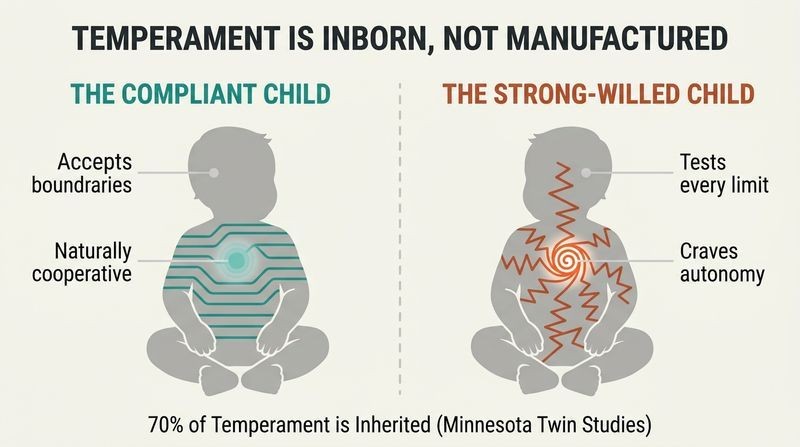
What's striking is how this reframes parental guilt as misplaced. Modern behavioral genetics broadly supports Dobson's heritability estimates, though most researchers place personality heritability closer to 40-50% than 70%, with gene-environment interaction muddying clean numbers. The temperament research of Chess and Thomas, which he cites, remains foundational in developmental psychology. One caution: labeling a toddler permanently strong-willed risks the Pygmalion effect, where expectations shape outcomes. Temperament is a starting tendency, not a life sentence, and the same trait he calls defiance others call persistence, a quality that predicts entrepreneurial success and resistance to peer pressure later.
Pilot between love and control; drifting to either extreme crashes the plane
Two runway lights guide parenting. Dobson uses the image of a pilot landing at night: love and control are the lighted boundaries, and disaster lies on either side. Too much control without love produces an icy, fearful, dependent child prone to explosive adolescent rebellion. Too much love without control breeds contempt, chaos, and a child who secretly wonders why nobody cares enough to stop him.
The strong-willed child pushes parents toward both cliffs. Constant battles tempt exhausted parents to become either screaming tyrants or pathetic pushovers. Dobson's cover diagram from his first book placed healthy parenting in the balanced middle. He argues most cultures swing like a pendulum between these extremes rather than holding the center where children genuinely thrive.
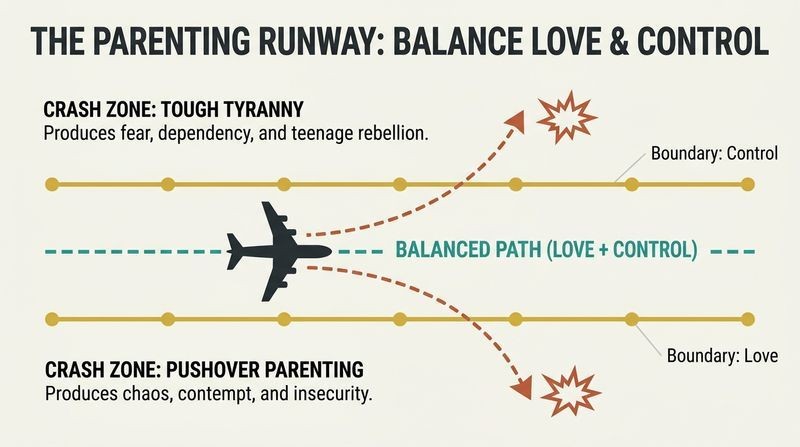
This maps almost perfectly onto Diana Baumrind's parenting typology, which Dobson cites directly. Her Berkeley research identified the authoritative style (high warmth plus high demands) as producing the best outcomes, distinct from authoritarian (control without warmth) and permissive (warmth without control). Decades of subsequent research have largely validated this. The pilot metaphor is memorable because it captures a truth self-help often misses: the goal is not maximizing any single virtue but calibrating tension between competing ones. Where Dobson leans harder than secular developmentalists is in tilting the balance toward control for the tough child.
Win the deliberate showdowns decisively; ignore the accidental spills
Distinguish defiance from immaturity. Dobson's most practical framework separates two behaviors parents constantly confuse. Childish irresponsibility is the spilled milk, the lost jacket, the broken lamp during horseplay. It is developmental, not malicious, and deserves patience, not punishment. Willful defiance is the clenched fist, the shouted no, the toe deliberately crossing the line you drew, a direct challenge to your authority.
Respond to each differently. He borrows from Susanna Wesley, mother of nineteen, who advised overlooking childish follies but never forgiving willful transgressions without correction. When a child stages a nose-to-nose confrontation asking who is boss, Dobson insists the parent answer conclusively. One mother, Joy, described a ninety-minute battle with her five-year-old over a spanking; losing it, she believed, would have forfeited control forever.
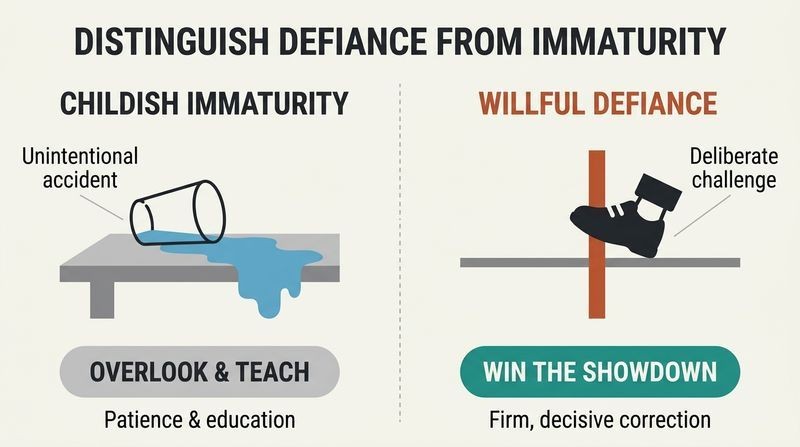
The distinction is genuinely useful and echoes a principle in behavioral therapy: consequences should match intent and function, not just surface behavior. Punishing a child for an accident teaches that the world is arbitrary and erodes trust, while ignoring genuine defiance teaches that rules are optional. Where contemporary developmental science diverges is on the toddler's capacity for premeditated defiance. Executive function and impulse control are neurologically immature before age four, so what looks like calculated rebellion is often dysregulation. The diagnostic frame is sound; the attribution of adult-like intent to very young children is where many child psychologists would push back.
Anger doesn't produce obedience; the credible threat of action does
The screaming trap. Dobson calls trying to control children through anger the single most common parenting mistake. He illustrates with Henry, whose mother repeats bedtime commands with escalating fury until she finally explodes, at which point Henry moves. She concludes her anger worked. She is wrong: Henry moved because her explosion signaled that real consequences were finally imminent, not because of the emotion itself.
Action replaces rage. Compare a police officer with no car, badge, or authority, screaming at speeders (ignored) to a calm officer who quietly writes a ticket (obeyed). The lesson: consequences change behavior, anger does not. Dobson advises acting early and calmly, linking misbehavior to a real, unpleasant outcome, so parents can stop living perpetually half-irritated and children stop tuning out empty words.
This is behaviorism at its cleanest, and University of Washington research he cites confirms that yelling and insulting actually increase defiance. The insight generalizes far beyond parenting: managers, teachers, and spouses all confuse emotional intensity with influence. Anger signals loss of control, which observant subordinates read as weakness. The deeper mechanism is credibility. A consequence delivered consistently and calmly becomes predictable, and predictability is what shapes behavior. One nuance worth adding: suppressing all emotion can read as cold or phony. The goal is not robotic detachment but decoupling the consequence from the tantrum, letting calm action carry the message.
Shape the will without ever breaking the fragile spirit
Two targets, opposite materials. Dobson's central distinction: the will is made of titanium and can be bent, molded, and brought under authority without harm. The spirit, a child's sense of worth, is a million times more delicate and shatters under ridicule, rejection, and cutting words. The whole art of discipline is subduing one while protecting the other.
Words leave permanent scars. He recounts how a straight-A report card earned one public figure only her father's dismissive remark that she must attend an easy school, a wound she still felt decades later. Because the fight-or-flight adrenaline surge makes us say what we do not mean, Dobson urges parents to pause, count to ten, and repair damage fast, quoting the biblical counsel not to let the sun set on anger.
The will/spirit distinction is Dobson's most valuable contribution and anticipates modern research on the difference between guilt and shame. Correcting behavior (you did a bad thing) preserves the spirit; attacking identity (you are bad) damages it, a line Brene Brown's shame research later made central. Neuroscience supports his point about the amygdala hijack: under acute stress, the prefrontal cortex goes offline and we speak from raw reactivity. The practical genius is recognizing that firmness and affirmation are not opposites. A child can be corrected hard and loved visibly in the same hour, which is precisely what secure attachment requires.
Establish your authority in the preschool years, then loosen the reins yearly
Front-load the leadership. Dobson's most urgent advice: establish yourself as a loving but confident leader while the child is very young, ideally before age four. The strong-willed toddler is actively probing whether anyone is strong enough to lead him, and a parent who wins early confrontations calmly earns respect that pays off for two decades.
Then progressively let go. Authority is not meant to be permanent domination. Every passing year should bring fewer rules, less direct discipline, and more independence, so that by late adolescence the child is nearly emancipated. Dobson notes corporal punishment loses effectiveness after age ten and should stop. The Harvard Preschool Project he cites found the best parents were simultaneously firm disciplinarians and deeply affectionate, organizing rich environments while setting clear limits.
The developmental logic is sound and matches attachment theory: children who internalize secure limits early become more autonomous, not less. The counterintuitive part for permissive-leaning parents is that early structure enables later freedom rather than restricting it. There is an economic parallel in the concept of scaffolding from Vygotsky: support is heaviest when competence is lowest and withdrawn as mastery grows. One tension: Dobson's emphasis on winning early confrontations can slide into power struggles that some research links to later defiance. The healthiest version emphasizes consistency and predictability of limits more than the parent's need to dominate any given battle.
Never compare siblings; it lights the fuse of lifelong rivalry
Comparison is gasoline. Dobson argues sibling rivalry is old-fashioned jealousy, and the fastest way to inflame it is comparing children on the traits they care most about: beauty, intelligence, and athletic ability. He tells of throwing a tennis ball toward a passive Scottie, triggering a savage attack from a nearby bulldog. Careless praise of one child within earshot of another works the same way, tossing a ball that provokes a brawl.
Build a system of justice at home. A family is a mini-society needing enforced rules: no destructive mockery, respect for each child's private territory, no requiring the compliant child to always yield. Dobson warns the quiet, agreeable sibling often gets exploited because parents are too drained to fight the tougher one, accumulating resentment that surfaces as adult psychosomatic illness.
The comparison insight is well-supported: research on parental differential treatment consistently links perceived favoritism to worse sibling relationships and lower self-esteem in the less-favored child. Dobson's rereading of the Prodigal Son through the resentful older brother is a genuinely fresh literary touch, spotlighting the overlooked cost borne by the dutiful child. His warning about the compliant child being shortchanged deserves emphasis; these children rarely squeak, so they rarely get the grease. The psychosomatic claims are dated and overstated, but the core relational dynamic, that unfairness breeds buried resentment, is durable across family systems research.
Blame the hormones and unfinished brain, not your parenting, at fourteen
Adolescent irrationality has biology behind it. Dobson describes the thirteenth and fourteenth years as often the hardest twenty-four months of life, driven by a hormonal assault that arrives right on schedule with physical maturation. Teens temporarily misjudge danger, responsibility, and social reality. He compares the emotional volatility to severe PMS and advises tracking a daughter's menstrual cycle to predict monthly storms.
The brain is literally under construction. He cites findings that the prefrontal cortex, responsible for judgment and calming emotions, is among the last regions to mature, while emotional centers are already revved up by sex hormones. The brain also undergoes pruning, discarding unused neurons formed around ages nine and ten. So the intelligent sixteen-year-old who climbs into a drunk friend's car is not simply badly raised.
The neuroscience Dobson invokes has only strengthened since publication. Work by Laurence Steinberg (whom he quotes) and others established that the socioemotional system matures years ahead of the cognitive-control system, creating a developmental mismatch that peaks in mid-adolescence. This explains why teens are not miniature adults with bad attitudes but people running sophisticated emotional hardware on incomplete regulatory software. The practical payoff is enormous: it converts parental fury into patience. One caveat: biology explains tendencies, not destiny, and framing everything as hormones can inadvertently excuse behavior that still needs limits. The reassurance that the river calms in the early twenties is empirically accurate.
Use action over anger with teens; you can only manipulate consequences
Teens require a different toolkit. Since spanking is off the table and reasoning often fails against hormonal irrationality, Dobson says parents of teenagers can mainly manipulate environmental consequences: car keys, money, privileges, curfews, and access to devices. He admits candidly these levers are relatively weak, and a determined sixteen-year-old can win a worst-case showdown because the law and culture now favor the teen.
Open the door with respect, not nagging. He scripts a Saturday-morning breakfast conversation with a defiant son, acknowledging the boy's growing hunger for freedom, promising to grant every privilege that causes no harm, but standing like the Rock of Gibraltar on the few nonnegotiables. Endless finger-wagging makes teens go deaf; incentive contracts (points toward a coveted item) motivate far better than perpetual threats.
The honest admission that parental power collapses in adolescence is refreshingly non-utopian. It reframes the task from control to influence, which relationship research strongly endorses: connection, not coercion, predicts teen cooperation. His breakfast script models a technique family therapists call joining, aligning with the teen's legitimate desire for autonomy before setting limits, which lowers defensiveness. The point-contract system is straight token-economy behaviorism, effective for concrete goals though weaker for internalizing values. The deeper truth surfacing here is that the foundation of teen discipline was poured years earlier; without prior respect for authority, the balance of power has already shifted to the younger, more motivated combatant.
Hold them close, then set them free; love demands the exit option
Overprotection cripples. Dobson warns that American parents are bad at releasing grown children, and cites the Palisades High class of 1965, once profiled as a golden generation, whose parents kept bailing them out of jail, paying their bills, and offering unwanted advice, contributing to a decade of drug abuse, breakdowns, and one suicide. Refusing appropriate independence produces either dependent emotional cripples or guilt-ridden rebels.
Freedom is the price of real love. He recounts trapping a wild coyote pup, realizing that even leashed it would never truly be his; friendship meant nothing unless he could release it and let it choose to stay. His three guidelines: hold on with an open hand, hold them close and let them go, and if you love something set it free. He notes God himself grants humans the choice to reject him.
The launching failure Dobson diagnoses has intensified since he wrote, with terms like failed launch and helicopter parenting now mainstream, and research linking overparenting to anxiety, entitlement, and diminished coping in young adults. The coyote parable elegantly captures a paradox at the heart of both parenting and love: control forfeits the very thing it seeks to secure. This connects to self-determination theory, which finds autonomy is a basic psychological need; thwart it and you get either compliance without commitment or reactive rebellion. His theological framing, that God permits rejection because coerced love is meaningless, gives the principle unusual philosophical weight regardless of the reader's beliefs.
ADHD is a real brain difference and often defiant kids' hidden partner
Not a fad, and not just bad discipline. Dobson insists attention deficit hyperactivity disorder is a genuine physical and emotional condition, marked by extreme distractibility, impulsiveness, and often hyperactivity, not something invented by drug-pushing doctors. He notes that between 40 and 60% of ADHD kids also have Oppositional Defiant Disorder, a volatile combination, and that the condition is largely inherited: identical-twin studies show up to 80% heritability.
Reframe it as a possible asset. Citing colleagues, he argues the ADHD brain may be a superior structure simply mismatched to a one-size-fits-all school system. He recommends unconditional love, structured routines, one task at a time, discovering the child's giftedness, and considering medication, which helps 70 to 95% of patients short-term, while guarding against classmates seeking to abuse the stimulants.
Dobson threads a needle well here, validating the diagnosis while resisting both denialism and overmedication. The heritability figures align with current consensus that ADHD is among the most genetically influenced psychiatric conditions. His framing of ADHD as a mismatch rather than a defect anticipates the neurodiversity movement, which reframes such conditions as variations suited to different environments (hunter versus farmer hypotheses). The structured-environment advice matches evidence-based behavioral interventions. Where readers should update: the DeGrandpre screen-time causation theory he cites remains speculative and unproven, and medication's long-term outcomes are more debated than the rosy short-term numbers suggest. Still, the compassionate, practical posture holds up remarkably well.
Analysis
Dobson's book, first published in 1978 and revised in 2004, is a thesis-driven parenting manual wrapped in warm anecdote and Christian conviction. Its animating claim is that some children are born with an unusually strong will, and that raising them well requires balancing love with firm control while protecting their fragile sense of self-worth. The book blends folksy storytelling (the dachshund Siggie, the grocery cart with crooked wheels), transcribed interviews with exhausted mothers, and appeals to both behavioral research and Scripture.
The genuine and durable contributions are three. First, the will/spirit distinction, which anticipates later work separating behavior-correction from identity-attack and maps onto guilt-versus-shame research. Second, the childish-irresponsibility versus willful-defiance framework, a practical diagnostic that prevents parents from punishing accidents. Third, the action-not-anger principle, clean behaviorism showing that consequences, not emotional intensity, shape behavior. His love-and-control balance is essentially Baumrind's authoritative parenting, which remains the best-supported model in developmental psychology.
The book's limitations are equally clear. Dobson's advocacy of corporal punishment, extensively defended, runs against the current weight of research; the American Academy of Pediatrics now advises against spanking, citing associations with aggression and worse mental-health outcomes, and the sources he leans on are dated and contested. His attribution of premeditated, adult-like defiance to toddlers underestimates the neurological immaturity of impulse control before age four. His hostility toward permissive experts occasionally strawmans a more nuanced field. And the strong religious framing, while offering coherent philosophical grounding (love requiring freedom, divine accountability), will limit resonance for secular readers.
What endures is the pastoral tone and the liberating message to guilt-ridden parents: your difficult child was born difficult, that difficulty is an asset in disguise, and most rebels return to their values by the mid-twenties. The neuroscience he cites on the adolescent brain has only grown stronger. Read critically, especially on physical discipline, the book still offers a memorable, humane framework.
Review Summary
The New Strong-Willed Child receives mixed reviews. Some readers find it helpful for disciplining difficult children, praising its practical advice and biblical approach. However, many criticize its advocacy for corporal punishment, viewing it as outdated and potentially abusive. Critics argue that Dobson's methods are harsh and lack empathy. Some appreciate the book's acknowledgment of individual differences in children, while others find it condescending and unhelpful. The book's religious content is welcomed by some but off-putting to others. Overall, opinions are sharply divided on its effectiveness and appropriateness.
People Also Read




FAQ
What's The New Strong-Willed Child about?
- Focus on Challenges: The book addresses the unique challenges of raising strong-willed children, offering insights into their behavior and practical strategies for parents.
- Revised Edition: It is a revised edition of The Strong-Willed Child, incorporating new research and insights into child development.
- Parenting Strategies: James C. Dobson provides methods for discipline and parenting, emphasizing a balance between love and control to foster cooperation and respect.
Why should I read The New Strong-Willed Child?
- Expert Guidance: Written by child psychologist James C. Dobson, the book offers expert advice based on years of experience and research.
- Support for Parents: It reassures parents feeling overwhelmed by their strong-willed children, validating their experiences and providing hope for positive outcomes.
- Effective Techniques: Readers will learn effective discipline techniques tailored for strong-willed children, leading to improved behavior and family harmony.
What are the key takeaways of The New Strong-Willed Child?
- Understanding Temperament: Recognizing different temperaments is crucial, helping parents identify their child's nature and tailor their approach.
- Authority and Security: Establishing authority early is essential for shaping a child's will and providing a sense of security.
- Balance of Love and Control: The book stresses balancing love and control, fostering a nurturing environment with clear behavioral boundaries.
What specific methods does James C. Dobson recommend for disciplining strong-willed children?
- Firmness and Consistency: A firm yet loving approach is advocated, with consistent enforcement of rules to help children understand boundaries.
- Immediate Consequences: Immediate consequences for disobedience help children connect their actions with resulting discipline.
- Mild Punishment: Dobson supports mild punishment, like a swat on the hand, done calmly to avoid damaging the child's spirit.
How does The New Strong-Willed Child address the issue of parental authority?
- Establishing Authority Early: Parents must establish authority early, setting a foundation for respect and obedience.
- Consequences of Weak Authority: Weak authority can lead to ongoing battles and disrespect, making children feel insecure.
- Role of Consistency: Consistent rule enforcement is key to maintaining authority and avoiding confusion in children.
What are some common mistakes parents make with strong-willed children according to James C. Dobson?
- Losing Control: Resorting to anger is ineffective and can damage the parent-child relationship.
- Inconsistent Discipline: Inconsistency leads to confusion and defiance; clear expectations and follow-through are crucial.
- Ignoring Emotional Needs: Overlooking emotional needs and focusing solely on behavior can hinder effective discipline.
How does The New Strong-Willed Child address sibling rivalry?
- Understanding Differences: Recognizing differences between strong-willed and compliant siblings helps manage conflicts.
- Encouraging Cooperation: Strategies for promoting teamwork and shared responsibilities reduce competition and conflict.
- Addressing Individual Needs: Recognizing and addressing each child's needs creates a harmonious family dynamic.
What are the long-term outcomes for strong-willed children according to James C. Dobson?
- Potential for Success: With proper guidance, strong-willed children can grow into successful adults, using their assertiveness positively.
- Decrease in Rebellion: Rebellion tends to decrease in young adulthood as children mature and take on responsibilities.
- Value of Resilience: Strong-willed children often develop resilience and determination, leading to positive personal and professional outcomes.
What role does faith play in parenting according to The New Strong-Willed Child?
- Foundation of Faith: Introducing children to Jesus Christ and grounding them in faith provides moral guidance and accountability.
- Prayer as a Tool: Regular prayer for children is essential for their spiritual and emotional well-being.
- Modeling Faith: Parents should model faith through actions and discussions, helping children internalize these values.
How can I effectively discipline a strong-willed child according to The New Strong-Willed Child?
- Establish Clear Rules: Setting clear and consistent rules helps children understand expectations and consequences.
- Use Positive Reinforcement: Recognizing and rewarding positive behavior motivates children to behave well.
- Stay Calm and Collected: Maintaining calm during conflicts prevents escalation and further defiance.
What should I do if my child is lying, as discussed in The New Strong-Willed Child?
- Understand Developmental Stages: Assess the child's understanding of truth and lies before reacting harshly.
- Teach the Value of Honesty: Use teachable moments to emphasize honesty, possibly through relevant scriptures.
- Implement Consequences for Lying: Once understood, impose mild consequences for dishonesty to reinforce truthfulness.
What are the best quotes from The New Strong-Willed Child and what do they mean?
- Consequences of Actions: "The overall objective...is to teach the child that his actions have inevitable consequences." This highlights the importance of understanding behavior-outcome relationships.
- Understanding Autonomy: "If you fail to understand his lust for power and independence, you can exhaust your resources and bog down in guilt." Recognizing a child's need for autonomy is crucial for effective parenting.
- Love's Risks: "The only place outside heaven where you can be perfectly safe from all the dangers of love is hell!" This C.S. Lewis quote underscores the inherent risks and rewards of deep love in parenting.
About the Author
Other books by James C. Dobson



Download PDF
Download EPUB
.epub digital book format is ideal for reading ebooks on phones, tablets, and e-readers.








































