
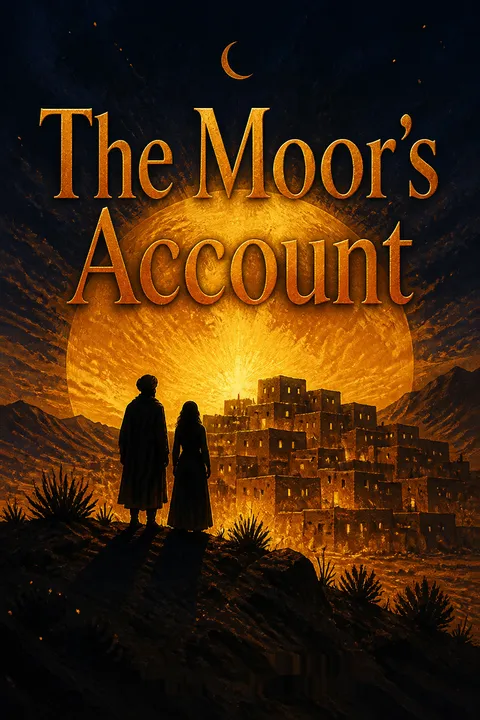


Plot Summary
Prologue
Mustafa ibn Muhammad,1 a Moroccan from Azemmur, declares that this book is his true account of traveling from his homeland to the Land of the Indians, where he arrived as a slave and was lost for many years.
He names his three Castilian companions — Dorantes,2 his legal master; Castillo,4 his fellow captive; and Cabeza de Vaca,3 his rival storyteller — and states that their official testimony to the Spanish authorities was distorted by pressure from powerful men. Unlike them, Mustafa1 was never asked to testify.
He writes freely, unbeholden to Castilian power, because every person — black or white, master or slave — wants to be remembered after death. He asks only that his account be copied faithfully, so his countrymen may hear the truth in the guise of entertainment.
Born on a River
Mustafa's1 father Muhammad,10 a young notary, was stabbed by a Portuguese soldier on a ferry crossing the Umm er-Rbi' River while defending a chained prisoner. Heniya,11 his pregnant mother, went into labor during the chaos and pushed Mustafa1 into the world on the barge itself.
The wound cost Muhammad10 his left arm. In Azemmur, Mustafa1 grew up restless — his father10 dreamed of him becoming a notary, but the boy preferred the marketplace, its storytellers and healers.
When the Portuguese conquered the city, Muhammad10 clung to hope of liberation that never came. The occupation hollowed his spirit. After graduating, Mustafa1 defied his father10 and became a merchant, growing wealthy — and eventually trading in slaves himself, a sin that would haunt him across continents.
Fifteen Reais for a Son
Two years of drought broke the province. Mustafa1 lost his position with the merchant house of al-Dib. His father,10 weakened by disease, stopped working and died. The family shattered — his sister divorced, his uncles departed. Five hungry souls remained under Mustafa's1 charge.
He sold every rug and chest he had once bought with pride. When nothing remained, he walked his twelve-year-old twin brothers Yahya and Yusuf to the Portuguese dock and negotiated his own sale for fifteen reais.
Yusuf tried to return the money; Yahya's eyes went wide with terror. Mustafa1 pulled both boys into his arms, promised he would return, and walked up the ship's plank into bondage. His mother11 stood in their doorway, calling his name as he closed the blue door behind him.
Ramatullai's Kitchen
Baptized as Esteban in a Sevillian cathedral, Mustafa1 was sold at auction to a fabric merchant named Rodriguez.12 The closet behind the kitchen became his room. Rodriguez12 beat him for praying toward Mecca. When Rodriguez12 purchased a second slave — Ramatullai,8 a woman from southern Morocco — Mustafa1 found his only companion.
They shared meals, stories, and the quiet solidarity of exile. She searched for her daughter Amna, sold to another master; Mustafa1 wrote letters for her. Rodriguez12 violated Ramatullai8 at night.
When his gambling debts mounted, he sold Mustafa1 to a nobleman named Dorantes,2 who was preparing to sail for La Florida. Mustafa1 never said goodbye. At the registry office, a hunchbacked clerk — the very man who owned Ramatullai's8 daughter — recorded his new name: Estebanico.
The Pebble That Moved an Army
In the spring of 1528, the Narváez5 expedition landed on the coast of La Florida. While examining fishing nets in a deserted village, Mustafa1 found a rough yellow pebble. His master Dorantes2 snatched it and brought it to the governor.
Narváez5 — one-eyed, helmeted, vain — declared it gold and tortured captive Indians until they confirmed a wealthy kingdom called Apalache. He then split the armada: ships would sail to the port of Pánuco while three hundred men marched inland.
The young captain Castillo4 objected — they had no maps, no supply line — but Narváez5 insulted him into silence. Cabeza de Vaca,3 the expedition's treasurer, supported the march. The ships sailed away. Three hundred souls entered the wilderness, chasing a kingdom built from a tortured man's confession.
Fifty Huts, No Kingdom
Weeks of marching brought them through alligator-infested swamps, across rivers where a horseman drowned, and past Indians who shot arrows from invisible positions. When scouts reported sighting Apalache, the company surged with hope.
Cabeza de Vaca3 led a raiding party that took the town without resistance. They entered triumphantly — and found fifty thatched huts, fields of corn, and no gold whatsoever. The commissary observed gently that people in straw houses do not possess gold. An Indian cacique led warriors in relentless attacks.
Mustafa1 took an arrow in the thigh. That night, soldiers dragged women from the temple. The women who remained began to drum and mourn, their keening reaching every corner of the stolen town, forcing every man who tried to sleep to reckon with what had been done.
Sails of Stolen Shirts
After the burned village of Aute offered no refuge, the company retreated to a coastal bay. Fever consumed dozens. Deserters tried to flee with their horses. In the silence of a condemned camp, Mustafa1 proposed what no one else had dared: build rafts and sail to Pánuco.
The idea was adopted. A blacksmith built a forge from stones and horse-skin bellows; soldiers surrendered their armor to be melted into crude tools. Horses were slaughtered for food and braided-hair rope — including Abejorro, Dorantes's2 beloved mount.
Mustafa1 sewed patchwork sails from flags, vestments, shirts, and handkerchiefs, fabric that caught the wind like prayers stitched from rags. Over five weeks, the carpenter Fernándes directed construction of five rafts. They sailed in early fall — two hundred and fifty skeletal men on boats held together with horsehair.
The Governor Lets Go
The rafts crept along the coast under tattered sails, plagued by rancid water and dwindling corn. On one island, Narváez5 destroyed Indian canoes for gunwale wood, provoking an attack at the next village — generous hosts turned violent after hearing of the destruction.
Then the rafts reached a mighty river whose current threatened to capsize them. Dorantes2 called out for Narváez5 to throw lines between the vessels. The governor refused. The time for orders was past, he declared; each raft should save itself.
A storm struck that night, driving the vessels apart in the darkness. Narváez5 and his page were swept out to sea and never seen again. The rest drifted alone across the gulf, their quarrels drowned by thunder, each man wrestling with the weight of his own approaching death.
Misfortune's Winter
Mustafa's1 raft wrecked on a barrier island. Of thirty-nine survivors, many were too sick to walk. When the soldier Ruíz13 refused to approach the island's Indians, Mustafa1 walked to the Capoque village with Diego,7 the carpenter Fernándes, and Father Anselmo9 — the young, stuttering friar beloved for his fiddle-playing and gentle graveside prayers.
The Capoques gave them food and shelter. Cabeza de Vaca's3 raft had also wrecked nearby. That winter, a bowel disease devastated both groups, killing over a hundred and twenty Capoques and nearly all the Castilians.
Ruíz13 reappeared from the island's far side to confess he had eaten his dead companions. The Indians recoiled in horror. By spring, only twelve men from Mustafa's1 group survived. They bartered their last possessions for passage to the mainland.
Killed Over a Dream
On the mainland, rivers claimed two of their party. A cobbler named León, found alive near a lagoon, later boasted about raping Indian women in Apalache; Mustafa1 attacked him and was pulled off. They fell in with the Carancahuas, who demanded menial labor for food.
When León stole provisions and blamed Mustafa,1 the Indians beat him. Later Mustafa1 caught León stealing again; the Carancahuas killed him. Then came the cruelest blow. A pregnant woman dreamed that Diego,7 Dorantes's2 gentle younger brother, had harmed her unborn child.
Without trial, her husband slit Diego's7 throat. Dorantes2 caught his brother's7 body as he fell, cradling Diego's7 head while blood pooled between them. Three more Castilians were killed for taboo violations. Only Dorantes,2 Castillo,4 and Mustafa1 remained.
The Cupping Cure
Dorantes2 fled the Carancahuas without warning, leaving Mustafa1 and Castillo4 to escape alone. They found him living with the Yguaces. Among this tribe, Mustafa1 befriended Chaubekwan,15 a healer who dressed as a woman and taught him indigenous medicine — how to grind roots, prepare poultices, and weave ceremony into treatment.
When the Susola cacique fell ill with crippling back pain, Mustafa1 recalled the traveling healer who had treated his own father10 with hijama in the Azemmur marketplace years ago. He heated a cup, placed it on the cacique's back, and told a long, distracting story while the cure took hold.
The cacique recovered in days. Word spread among neighboring tribes. At the River of Prickly Pears, the four survivors finally reunited — Cabeza de Vaca3 had lost his Indian wife and child to fever — and began healing together.
Oyomasot Unbowed
They found shelter with the Avavares, led by the generous cacique Tahacha.16 The shaman Behewibri watched Mustafa1 warily but grew curious about his remedies. Behewibri's daughter Oyomasot6 was another matter — fierce, independent, contemptuous of every rule imposed on Avavare women.
She made weapons in secret and wandered the woods alone. Mustafa1 first spoke to her while she struggled with a rope in a mulberry tree; when he tried to help, she scolded him for breaking it. He fell in love watching her stand in the rain after her mother berated her — feet sinking in mud, spine unbowed.
Tahacha16 decreed the four survivors should marry Avavare women. Dorantes2 married Tekotsen, Castillo4 married Kewaan, and Mustafa1 married Oyomasot.6 On their wedding night, she traced the scar on his neck and asked how he got it. He told her everything.
Children of the Sun
Oyomasot6 urged Mustafa1 to accept invitations from distant tribes. She composed rhyming cures patients could remember; Dorantes's2 brother-in-law Satosol14 served as flamboyant translator. Each tribe they healed sent guides to escort them to the next, and the custom became unstoppable.
Their following swelled from dozens to hundreds to twelve hundred. They crossed mountain ranges into the Land of Corn, where tribes lived in permanent mud-brick towns with cultivated fields of corn, beans, and squash. One cacique gifted Dorantes2 five hundred carved deer hearts.
The four were called the Children of the Sun — strangers from the east with miraculous powers. Mustafa1 sensed danger in their growing fame, a tower of trust that could topple at any moment. He told Oyomasot6 this would end badly. She told him he worried too much.
Glass Under the Cactus
While gathering herbs, Mustafa1 spotted a shard of glass beneath a cactus and spoke the word before he could stop himself. Cabeza de Vaca3 followed bootprints to five Spanish horsemen. It was January 1536 — eight years since La Florida.
The soldiers' officer, Alcaraz, listened to their story and announced his intention to enslave their Indian followers. The four survivors argued — they had promised these people safety — but Alcaraz held firm. In Culiacán, the alcalde Díaz offered smooth assurances while corralling hundreds of Indians in a horse run.
Oyomasot6 warned the women to flee at night, but those who tried were caught and returned. Despite months of argument, the survivors could not free the people who had followed them. The empire's appetite swallowed every promise they had made.
The Papers Never Come
In the capital, Bishop Zumárraga dressed the survivors in loincloths and presented them at mass as living saints of peaceful conversion. The viceroy17 collected their Joint Report over two months — Mustafa1 was never asked to testify. Cabeza de Vaca3 departed for Spain.
Dorantes2 courted a wealthy widow; Castillo4 did the same. Repeatedly, Mustafa1 asked Dorantes2 for the freedom papers he had promised. Dorantes2 refused five hundred pesos from the viceroy17 and rejected an offer from the famous Cortés — not to free Mustafa,1 but to keep him.
Each refusal posed as generosity. Oyomasot6 told Mustafa1 to stop asking: freedom could not be requested, only seized. In the quiet of their room, Mustafa1 began writing his own account — the story the empire would never record, the truth the officials would never hear.
Smaller and Smaller Crosses
When the viceroy17 proposed a mission to find the legendary Seven Cities of Gold, Mustafa1 saw his opening. He persuaded Dorantes2 that sending his slave north would yield a claim to undiscovered riches. Dorantes2 agreed. Mustafa1 departed with two friars, a hundred Aztec porters, his pregnant wife, and his greyhounds.
He arranged to travel ahead of the friar Marco, promising to send back crosses of varying sizes — large for wealth, small for poverty. He frightened the younger friar with embellished tales of cannibals until the man refused to continue.
At each town, Mustafa1 dispatched his remaining escorts bearing a cross slightly smaller than the last. By the time he reached Hawikuh, a Zuni town whose mud walls glowed orange in the sunset, his final ten porters carried a cross the size of one hand.
Estebanico's Useful Death
Free of every Castilian companion and imperial escort, Mustafa1 sat with the Zuni cacique Ahku and told him the truth: armed white men were approaching. He proposed an audacious counter-fiction — send messengers to the friar claiming the Zunis had killed Estebanico.
The news would deter the empire. The slave name would die; the man would live. While Ahku deliberated with his elders, Mustafa1 lay in the tall grass outside the town walls with Oyomasot,6 his ear against the mound of her belly, listening to their unborn child's heartbeat.
He would return to Avavare country, following the rhythms of the land his wife's6 people had known for centuries. The story of their journey would be their child's inheritance — not gold, not empire, but truth in the form of a tale well told.
Analysis
The Moor's Account interrogates who controls the narrative of empire. Mustafa's1 chronicle exists because the official record — the Castilians' Joint Report — erased him. His account does not merely supplement; it reframes. Where the Spanish testimony portrays the expedition's suffering as a test of Christian faith, Mustafa1 reveals a more uncomfortable architecture: conquistadors' misery as self-inflicted, born from greed dressed as destiny.
Lalami constructs identity at the intersection of multiple erasures: Mustafa's1 Arabic name replaced by a Spanish diminutive, his faith suppressed by enforced conversion, his testimony excluded from history. Yet the novel insists that erasure is never total. Mustafa1 carries his mother's11 stories, his father's10 discipline, the cupping cure witnessed in an Azemmur marketplace — all resurface when needed most. Identity, Lalami argues, cannot be destroyed by renaming; it can only be driven underground, where it waits.
The novel's deepest insight concerns complicity. Mustafa1 is not merely a victim. He sold slaves before being enslaved. He found the gold pebble that justified Narváez's5 atrocities. He spotted the glass shard that led to his followers' enslavement. Each discovery was innocent in intention but catastrophic in consequence — mirroring how empires operate through the accumulated actions of individuals who believe themselves powerless. Mustafa's1 journey is not from innocence to experience, but from complicity to accountability.
The resolution at Hawikuh reclaims storytelling as counter-weapon. By fabricating his own death, Mustafa1 demonstrates that the fictions of empire — the Requerimiento, the kingdom of gold, the Seven Cities — can be fought with counter-fictions. The lie he tells is more honest than any truth the empire recorded. Lalami proposes that the most trustworthy history is not the one sealed with a notary's stamp, but the one told freely, without obligation to any master — truth wearing the only disguise that has ever protected it: a story worth remembering.
Review Summary
The Moor's Account is highly praised for its unique perspective on Spanish colonization through the eyes of a Moroccan slave. Reviewers commend Lalami's vivid storytelling, historical research, and exploration of themes like slavery, colonialism, and cultural clashes. The novel's lyrical prose and complex characters are widely appreciated. Some critics note occasional pacing issues and anachronistic character traits. Overall, the book is considered a thought-provoking and engaging work of historical fiction that sheds light on an overlooked figure in history.
People Also Read


Characters
Mustafa ibn Muhammad (Estebanico)
Narrator, slave turned healerA Moroccan from Azemmur who sells himself into slavery during a famine to save his family. Renamed Estebanico by his Castilian masters, he carries the dual burden of bondsman and witness across an entire continent. His psychology is shaped by guilt—for trading slaves before becoming one, for finding the gold pebble that launched an expedition of suffering, for bringing disease to Indians who sheltered him. He possesses an exceptional ear for languages, a gift for storytelling inherited from his mother11, and an instinct for survival that evolves from passive endurance into active self-determination. His arc traces the long journey from a man who places his fate in others' hands to one who writes his own story and orchestrates his own liberation.
Andrés Dorantes
Mustafa's master, noblemanA nobleman from Béjar del Castañar who joins the Narváez5 expedition seeking fortune. Dorantes is ambitious, vain, and emotionally volatile—quick to form alliances when convenient, quick to abandon them when they cease to serve. He nicknames everyone but never gives Mustafa1 one, a telling absence. His relationship with his younger brother Diego7 reveals both protectiveness and condescension. His psychology revolves around status: he needs an audience, someone to witness his importance. His bond with Mustafa1 deepens through shared hardship in the wilderness—they depend on each other completely—yet upon returning to civilization, Dorantes reverts to the power dynamics of ownership. His repeated promise to free Mustafa1 becomes the novel's cruelest refrain.
Álvar Núñez Cabeza de Vaca
Treasurer and rival storytellerThe expedition's treasurer, a nobleman close to the governor, and Mustafa's1 rival narrator. Cabeza de Vaca carries himself with earnest idealism that both attracts and alienates others. He supports Narváez's5 dangerous decisions early on, yet proves resourceful in crisis—surviving shipwreck, adapting to Indian life, learning to trade among coastal tribes. His greatest talent and deepest flaw are identical: he knows how to shape a narrative. When the survivors reach civilization, he casts himself as their leader and moral center, omitting inconvenient truths from the official record. His rivalry with Mustafa1 is structural rather than personal—only one account can be deemed authoritative, and the empire will always choose the Castilian's version.
Alonso del Castillo
Youngest captain, expedition's conscienceThe youngest captain, who joins the expedition on a whim after a banquet in Seville. Castillo is the company's conscience—he questions Narváez's5 decision to leave the ships, challenges the governor's lies about Indian testimony, and protests the treatment of captives. His nasal voice and slight build undermine his authority, and his candor often earns ridicule rather than respect. His friendship with Dorantes2 sustains him through the early disasters. Castillo's arc is one of quiet maturation: the sheltered nobleman who once carried a treasured chessboard into the wilderness becomes a man who picks roots beside Indian women and falls deeply for a world he was sent to conquer. He is the first Castilian to say thank you to Mustafa1.
Pánfilo de Narváez
One-eyed governor of the expeditionThe expedition's commander, a vain man who wears a plumed helmet and a blue sash over his breastplate. He claims to understand Indian languages he cannot speak and tortures captives for information he invents. His decisions—splitting the armada, marching to Apalache on fabricated intelligence, refusing to bind the rafts together—define the expedition's catastrophe. He handles soldiers with familiar charm while treating officers with contempt. His single eye, lost in a prior defeat by Cortés, becomes an emblem of his fundamental blindness to everything beyond his ambition.
Oyomasot
Shaman's daughter, Mustafa's wifeDaughter of the Avavare shaman Behewibri, Oyomasot is fierce, independent, and contemptuous of the gender roles imposed on her. She makes weapons in secret, wanders alone, and refuses to defer. Her relationship with Mustafa1 is built on mutual recognition—two outsiders who chafe under rules they did not choose. She encourages his healing career, composes rhyming cures for patients, and becomes his most trusted advisor. Her directness cuts through Mustafa's1 tendency toward accommodation. She understands before he does that freedom is not something one requests.
Diego Dorantes
Andrés's gentle younger brotherAndrés Dorantes's2 younger brother, quiet and kind where his sibling is brash and self-serving. Diego carves wooden sparrows, walks with Father Anselmo9 collecting plant specimens, and volunteers for missions his brother avoids. He has a beautiful singing voice and a disposition so gentle it seems incompatible with the violence surrounding him. His bond with Mustafa1 is one of genuine warmth—he tells Mustafa1 he will see his brothers again, a promise that carries the weight of sincere belief. He patterns himself after Andrés2 but consistently demonstrates a generosity his brother lacks.
Ramatullai
Fellow slave in SevilleA slave woman from southern Morocco purchased by Rodriguez12 as a domestic. Ramatullai becomes Mustafa's1 closest companion in Seville—they share meals on a sisal mat, the pain of exile, and a private language of grief. She searches ceaselessly for her daughter Amna, sold to another master. Her resilience and devotion to family mirror Mustafa's1 own motivations, making their forced separation one of the novel's most wrenching losses. Her name means 'a blessing from God,' and for Mustafa1, she is exactly that.
Father Anselmo
Stuttering friar, beloved musicianA young Franciscan friar with red hair and a terrible stutter that makes him the target of jokes. Despite this impediment, Father Anselmo becomes the expedition's most popular clergyman—he delivers moving graveside prayers, plays the fiddle for weary soldiers, and protests the governor's torture of Indian captives when no other officer dares. He walks with Diego7, collects plant specimens, and treats the sick. His gentleness and moral clarity offer a counterpoint to the expedition's cruelty.
Muhammad
Mustafa's one-armed fatherA notary in Azemmur who lost his left arm defending a prisoner from Portuguese soldiers. Principled and melancholic, he dreamed of Mustafa1 becoming a scholar. His cupping treatment by a healer in the marketplace plants a seed that saves lives decades later.
Heniya
Mustafa's storytelling motherMustafa's1 mother, whose fairy tales and proverbs shape his understanding of the world. She tells him he was destined for travel—a prophecy he can never escape. Her silhouette in the doorway becomes the image he carries across oceans.
Bernardo Rodriguez
Sevillian merchant, first masterA fabric merchant who buys Mustafa1 at auction in Seville. Ambitious and impulsive, his gambling debts force him to sell Mustafa1 to Dorantes2. He beats his slaves and violates Ramatullai8.
Gonzalo Ruíz
Impulsive soldierA rough soldier whose bravado masks fragile discipline. His impulsive decision to break from the company and attack Indians alone costs him an eye. His later actions on the Island of Misfortune become the expedition's darkest confession.
Satosol
Brother-in-law, showman guideTekotsen's brother who serves as the four healers' self-appointed usher and translator. Ambitious and pragmatic, he amplifies their fame but ultimately cooperates with Spanish authorities for personal gain.
Chaubekwan
Yguace healer and teacherA healer among the Yguaces who dresses as a woman and lives openly with a male partner. He teaches Mustafa1 indigenous medicine, showing him how ceremony and practical cures work in tandem.
Tahacha
Generous Avavare caciqueThe kind-hearted leader of the Avavares who offers shelter, food, and eventually brides to the four survivors. His wisdom and generosity mark a turning point in Mustafa's1 journey from servitude to belonging.
Viceroy Mendoza
Power broker in TenochtitlánThe viceroy of New Spain who collects the survivors' testimony, attempts to buy Mustafa1, and ultimately commissions the northern expedition that becomes Mustafa's1 vehicle for escape.
Plot Devices
The Gold Pebble
Launches the entire catastropheMustafa1 finds a rough yellow pebble in an Indian fishing village. Dorantes2 snatches it; Narváez5 declares it gold from the kingdom of Apalache. This single object becomes the justification for splitting the armada, marching three hundred men inland, and torturing Indians for information. It represents the collision of accident and ambition—Mustafa's1 idle curiosity meets the governor's insatiable greed. The pebble also embodies Mustafa's1 unwitting complicity: he did not seek gold, yet his find precipitated the expedition's suffering. When Apalache yields no treasure, the pebble becomes a monument to imperial delusion. Mustafa1 reflects that he once sold his own life for gold, and now the pebble teaches him that life should not be traded for metal—a lesson he must learn twice.
The Patchwork Sails
Embody desperate improvisationWhen the expedition is stranded with no ships, Mustafa1 proposes building rafts. He sews the sails from an absurd collection of fabrics: military flags, priestly vestments, officers' shirts, handkerchiefs. The sails are a physical metaphor for the expedition—an improvised patchwork of ranks, nations, and ambitions, held together by desperate need. They also mark Mustafa's1 transformation: a slave who conceives the escape plan that saves his masters. The moment he unfurls the first sail and it catches the wind, he stands back with pride—no sailcloth he has seen before looks quite like it. The sails function narratively as the mechanism of departure from La Florida and as the fragile membrane between the company and annihilation during their ocean voyage.
The Cupping Cure
Bridges Azemmur and the new worldWhen the Susola cacique falls ill, Mustafa1 performs hijama, a traditional cupping treatment he witnessed as a boy when a traveling healer treated his father10 in the Azemmur marketplace. The cure connects his Moroccan childhood to his adult life among Indians, bridging two continents through shared healing practice. It launches his career as a medicine man and transforms his status from servant to honored guest. Crucially, Mustafa1 tells a story while performing the treatment—narrative as anesthesia—a technique he refines over years of practice. The cupping cure embodies the novel's central argument: that stories themselves are curative, that the act of being listened to and believed is as therapeutic as any physical remedy.
The Name Estebanico
Instrument of identity erasureWhen Mustafa1 is enslaved, his Arabic name is stripped away: first replaced with Esteban at baptism, then diminished to Estebanico when Dorantes2 registers him. Each renaming peels away language, history, faith, and family. The name functions as a chain more binding than iron—it rewrites him as a Castilian invention, someone quite different from who he really is. Throughout the novel, Mustafa1 chafes at the foreignness of these syllables. In the story's resolution, he orchestrates the death of Estebanico by asking the Zunis to tell the Spanish friar they killed him. By destroying the slave name, Mustafa1 reclaims the identity his parents chose. The name's death becomes the condition for the man's rebirth.
The System of Crosses
Communication tool turned escape mechanismOn the final expedition north, Mustafa1 arranges with the friar Marco to send back wooden crosses as signals: large for wealth, small for poverty. Each cross he dispatches is smaller than the last, communicating that the territory holds nothing worth pursuing. But the crosses also serve a hidden agenda—with each dispatch, Mustafa1 sends away more of his imperial escorts, gradually stripping himself of surveillance. The device inverts the expedition's purpose: Coronado sent Mustafa1 north to find gold, but he uses the mission's own communication system to dismantle it from within. The final cross, barely the size of a hand, is his signature on a document no notary would ever draft—his own freedom.
FAQ
Synopsis & Basic Details
What is The Moor's Account about?
- A Slave's Perspective: The novel tells the story of the Narváez expedition to La Florida from the perspective of Mustafa ibn Muhammad, a Moroccan slave known as Estebanico.
- Challenging Historical Narratives: It re-examines the traditional accounts of the expedition, offering a counter-narrative that highlights the experiences of those often marginalized in history.
- Journey of Survival: The narrative follows Mustafa's journey from his capture in Morocco to his enslavement and his struggle for survival in the New World, marked by hardship, loss, and a persistent hope for freedom.
Why should I read The Moor's Account?
- Unique Historical Perspective: The novel provides a fresh and compelling perspective on the early exploration of the Americas, challenging traditional narratives by focusing on a non-European voice.
- Complex Character Study: It offers a deep exploration of Mustafa's character, his internal conflicts, and his resilience in the face of extreme adversity, making him a memorable and relatable protagonist.
- Exploration of Themes: The book delves into profound themes of freedom, identity, power, and the human capacity for both cruelty and compassion, prompting readers to reflect on these issues.
What is the background of The Moor's Account?
- Historical Basis: The novel is based on the real-life Narváez expedition of 1527-1528, which aimed to explore and colonize La Florida (present-day southeastern United States).
- Cultural Context: It draws on the cultural and historical context of 16th-century Morocco, Spain, and the early encounters between Europeans and indigenous peoples in the Americas.
- Exploration Era: The story is set during the Age of Exploration, a period marked by European expansion, conquest, and the transatlantic slave trade, all of which are central to the narrative.
What are the most memorable quotes in The Moor's Account?
- "What each of us wants, in the end, whether he is black or white, master or slave, rich or poor, man or woman, is to be remembered after his death.": This quote encapsulates the universal human desire for legacy and recognition, a driving force behind Mustafa's narrative.
- "I know now that these conquerors, like many others before them, and no doubt like others after, gave speeches not to voice the truth, but to create it.": This quote highlights the manipulative nature of power and the way narratives are constructed to serve specific agendas.
- "The elders teach us: a living dog is better than a dead lion.": This proverb, repeated throughout the book, reflects Mustafa's pragmatic approach to survival and his understanding of the need to adapt to circumstances.
What writing style, narrative choices, and literary techniques does Laila Lalami use?
- First-Person Perspective: Lalami employs a first-person narrative, allowing readers to intimately experience the events through Mustafa's eyes, creating a sense of immediacy and emotional depth.
- Historical Fiction: The novel blends historical facts with fictional elements, creating a compelling and believable account of the Narváez expedition while also exploring the inner life of a marginalized character.
- Subtle Irony and Social Commentary: Lalami uses subtle irony and social commentary to critique the power dynamics of the time, exposing the hypocrisy and brutality of colonialism and slavery.
Hidden Details & Subtle Connections
What are some minor details that add significant meaning?
- The Yellow Pebble: The seemingly insignificant yellow pebble that Mustafa finds becomes a catalyst for the entire expedition, symbolizing the allure of gold and the destructive power of greed.
- The Ostrich Feather: The detail of the ostrich feather on Narváez's helmet, often askew, subtly reveals his vanity and the fragility of his authority.
- The Chessboard: Señor Castillo's treasured chessboard, a gift from his deceased brother, represents his longing for a more civilized world and his inability to fully adapt to the harsh realities of the expedition.
What are some subtle foreshadowing and callbacks?
- The Water Animal: The description of the "water animal with scaly skin" foreshadows the dangers that await the expedition in the swamps and rivers of La Florida, and the lack of understanding of the new world.
- The Story of My Birth: Mustafa's mother's story about his birth on the river foreshadows his life of travel and the constant movement that defines his journey.
- The Whipping of the Indians: The governor's whipping of the captured Indians foreshadows the violence and brutality that will become commonplace throughout the expedition, and the way that power is used to extract information.
What are some unexpected character connections?
- Mustafa and Abejorro: The bond between Mustafa and Señor Dorantes's horse, Abejorro, reveals Mustafa's capacity for empathy and his longing for connection, even with an animal.
- Mustafa and Father Anselmo: The shared experience of being outsiders in the expedition creates a subtle connection between Mustafa and the young friar, highlighting their shared vulnerability.
- Dorantes and Castillo: The close friendship between Dorantes and Castillo, often overshadowing Dorantes's relationship with his brother, reveals the complex dynamics of loyalty and ambition within the expedition.
Who are the most significant supporting characters?
- Oyomasot: Mustafa's wife, Oyomasot, represents the resilience and strength of indigenous women, and her presence challenges the traditional power dynamics of the narrative.
- Father Anselmo: The young friar, Father Anselmo, serves as a counterpoint to the brutality of the expedition, highlighting the conflict between faith and violence.
- The Indian Guides: The various Indian guides, though often unnamed, play a crucial role in the narrative, representing the knowledge and resilience of the indigenous peoples of the Americas.
Psychological, Emotional, & Relational Analysis
What are some unspoken motivations of the characters?
- Narváez's Need for Glory: Beyond the quest for gold, Narváez is driven by a deep-seated need for recognition and historical significance, which fuels his reckless decisions.
- Dorantes's Ambition and Insecurity: Dorantes's ambition is intertwined with a deep insecurity, leading him to constantly seek validation and recognition from others, especially from Narváez.
- Mustafa's Yearning for Home: Beneath his pragmatic approach to survival, Mustafa is driven by a profound yearning for his family and his homeland, which shapes his actions and decisions.
What psychological complexities do the characters exhibit?
- Mustafa's Internal Conflict: Mustafa grapples with the conflict between his desire for freedom and his pragmatic need to survive, leading to a complex and nuanced portrayal of his inner life.
- Dorantes's Fickle Nature: Dorantes's shifting loyalties and his tendency to form intense but fleeting friendships reveal a deep-seated insecurity and a need for validation.
- Cabeza de Vaca's Moral Struggle: Cabeza de Vaca's internal struggle between his loyalty to the Crown and his growing empathy for the indigenous peoples highlights the moral complexities of the colonial era.
What are the major emotional turning points?
- The Discovery of Gold: The initial discovery of the yellow pebble ignites a sense of hope and ambition, setting the stage for the expedition's journey and Mustafa's dreams of freedom.
- The Battle of the Río Oscuro: The violent encounter with the Indians at the Río Oscuro shatters the illusion of easy conquest and forces the characters to confront the harsh realities of the New World.
- The Abandonment at Sea: Narváez's decision to abandon his men on the rafts marks a turning point in the narrative, highlighting the depths of human betrayal and the fragility of hope.
How do relationship dynamics evolve?
- Mustafa and Dorantes: The relationship between Mustafa and Dorantes evolves from a master-slave dynamic to a complex mix of dependence, resentment, and occasional camaraderie.
- Dorantes and Castillo: The friendship between Dorantes and Castillo is tested by the hardships of the expedition, revealing the limits of loyalty and the corrosive effects of ambition.
- Mustafa and Oyomasot: The relationship between Mustafa and Oyomasot evolves from a shared experience of bondage to a deep and meaningful connection, offering a glimpse of hope and love amidst the harsh realities of their lives.
Interpretation & Debate
Which parts of the story remain ambiguous or open-ended?
- The Nature of the Seven Cities: The novel leaves the existence of the Seven Cities of Gold ambiguous, suggesting that they may be nothing more than a myth or a symbol of unattainable desires.
- The True Nature of the Indians: The novel does not offer a simplistic portrayal of the indigenous peoples, leaving their motivations and beliefs open to interpretation and challenging the reader's assumptions.
- Mustafa's Ultimate Fate: The ending of the novel leaves Mustafa's ultimate fate open-ended, suggesting that his journey is ongoing and that the search for freedom is a continuous process.
What are some debatable, controversial scenes or moments in The Moor's Account?
- The Cannibalism Scene: The scene depicting Ruíz's cannibalism is a controversial moment that forces readers to confront the extreme measures people take to survive and the moral implications of such choices.
- The Treatment of the Indians: The novel's portrayal of the treatment of the Indians by the Spanish explorers raises questions about the ethics of colonialism and the responsibility of individuals within a system of oppression.
- Mustafa's Role in Slavery: Mustafa's past as a slave trader, though he later becomes a slave himself, raises questions about his moral culpability and the complexities of his character.
The Moor's Account Ending Explained: How It Ends & What It Means
- Mustafa's Choice: The ending sees Mustafa choosing to write his own account, reclaiming his voice and challenging the dominant narratives of the time, but his future remains uncertain.
- Rejection of Empire: Mustafa's decision to leave the Spanish expedition and live among the Indians represents a rejection of the imperial project and a search for a more authentic way of life.
- The Power of Storytelling: The novel's ending emphasizes the power of storytelling as a means of resistance, survival, and the preservation of memory, suggesting that the true legacy of the expedition lies not in conquest but in the stories that are told about it.
Download PDF
Download EPUB
.epub digital book format is ideal for reading ebooks on phones, tablets, and e-readers.








































